
Communication Skills The purpose of this module is
- Slides: 26
Communication Skills The purpose of this module is to present basic principles of communication and an opportunity for participants to practice effective communication techniques. QUALITY ASSURANCE PROJECT 1
At the end of this module participants will be able to: · Identify characteristics of effective communication · Demonstrate active listening techniques · Demonstrate giving and receiving supportive and corrective feedback QUALITY ASSURANCE PROJECT 2
At the end of this module participants will be able to: · Recognize blocks to effective communication · Identify a three-step technique to help in communicating feelings QUALITY ASSURANCE PROJECT 3
Content • • • The Communication Model Communication Channels Communication Skills Blocks to Effective Communication Communicating Feelings QUALITY ASSURANCE PROJECT 4
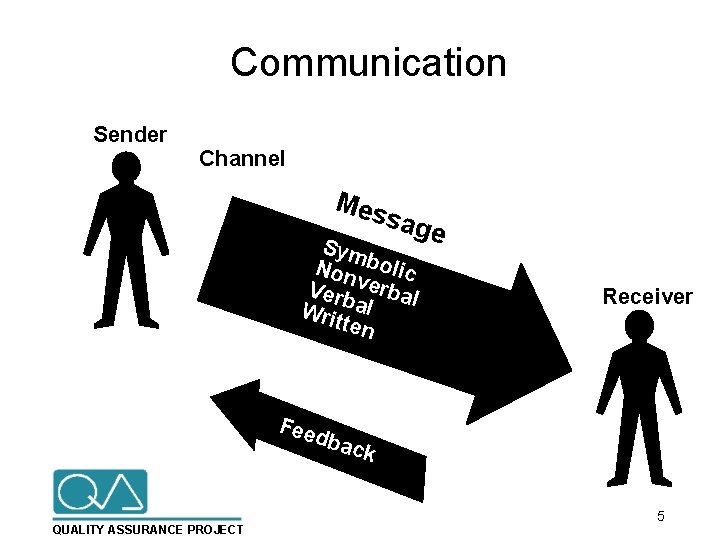
Communication Sender Channel Mes sag e Sym Non bolic Verb verbal Writ al ten Receiver Fee dba c k QUALITY ASSURANCE PROJECT 5
Understanding Depends On • • Communication skills Attitudes Experience Knowledge QUALITY ASSURANCE PROJECT 6
Understanding Depends On • • • Self-concept Rights Responsibilities Feelings Assessment of what is valuable or worthwhile QUALITY ASSURANCE PROJECT 7
Communication will be effective when the sender and receiver feel positive and respectful of each other QUALITY ASSURANCE PROJECT 8
Communication Channels · Symbolically · Nonverbally · Verbally · Written · Electronically QUALITY ASSURANCE PROJECT 9
Effective Sending • Self-awareness of thoughts and feelings • Freedom of expression • Awareness of the listener QUALITY ASSURANCE PROJECT 10
Active Listening Behaviors • • No interruptions Body language conveys interest Eye contact Restating sender’s words QUALITY ASSURANCE PROJECT 11
Active Listening Behaviors • • • Encouragement Open-ended questions Clarification Summarizing Being non-judgmental QUALITY ASSURANCE PROJECT 12
Active Listening Suggestions • Be fully accessible • Be aware of own feelings • Maintain self-esteem of others QUALITY ASSURANCE PROJECT 13
Active Listening Suggestions • Acknowledge feelings with empathy • Check for understanding • Make suggestions about the process QUALITY ASSURANCE PROJECT 14
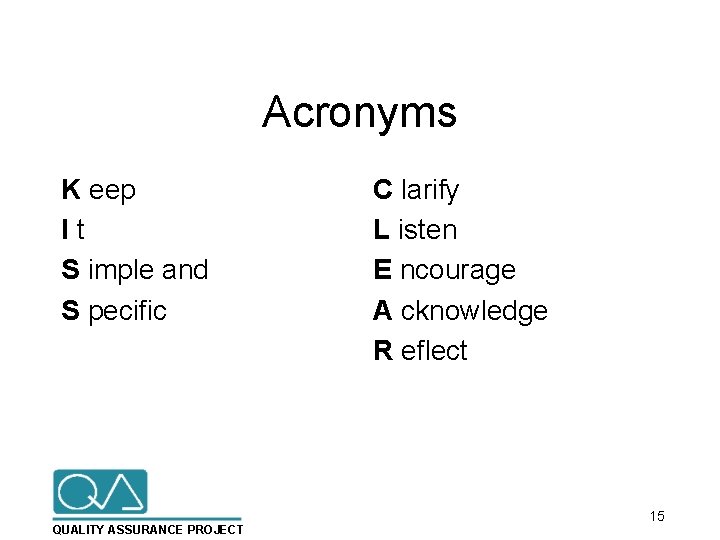
Acronyms K eep It S imple and S pecific QUALITY ASSURANCE PROJECT C larify L isten E ncourage A cknowledge R eflect 15
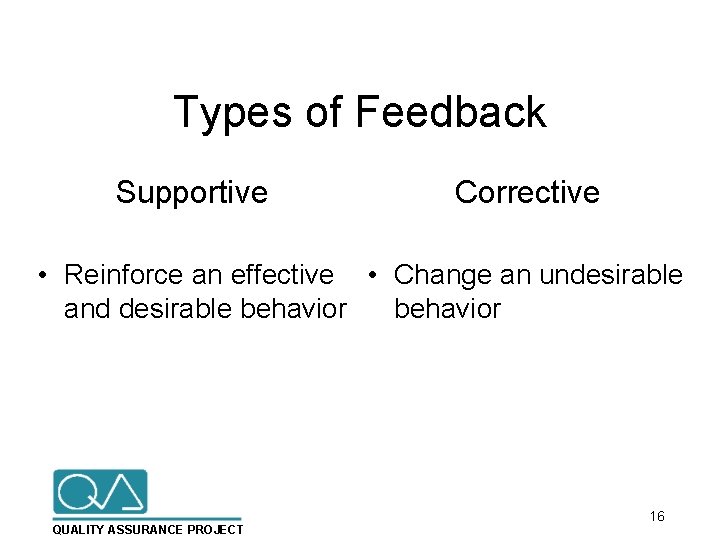
Types of Feedback Supportive Corrective • Reinforce an effective • Change an undesirable and desirable behavior QUALITY ASSURANCE PROJECT 16
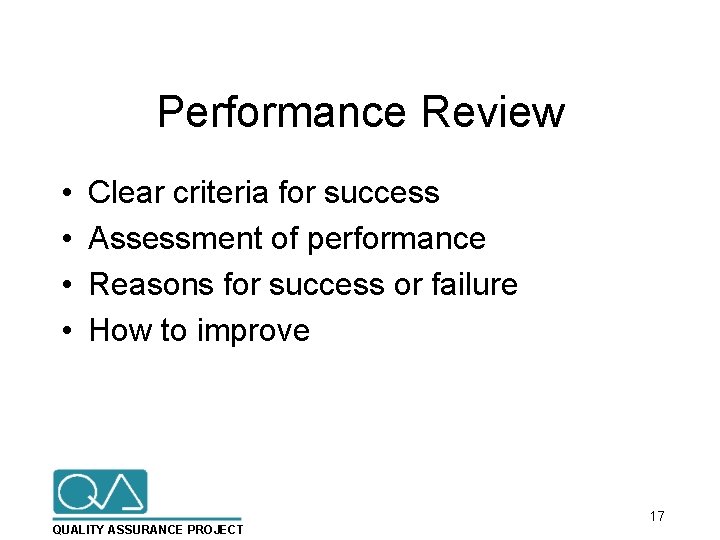
Performance Review • • Clear criteria for success Assessment of performance Reasons for success or failure How to improve QUALITY ASSURANCE PROJECT 17
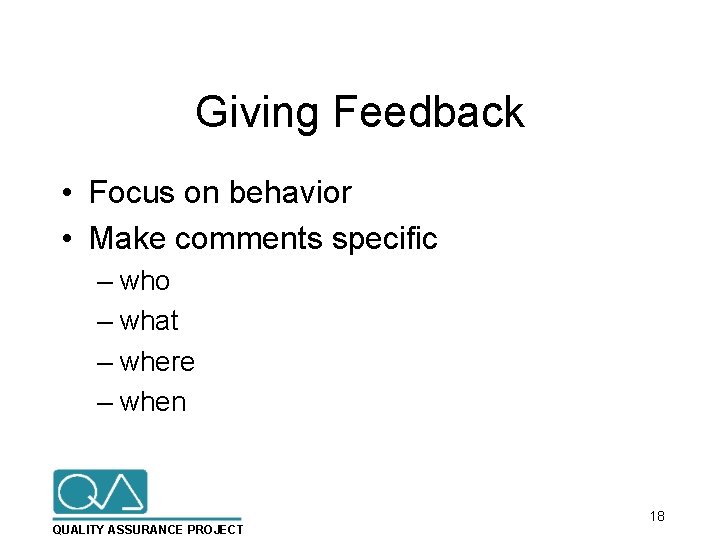
Giving Feedback • Focus on behavior • Make comments specific – who – what – where – when QUALITY ASSURANCE PROJECT 18
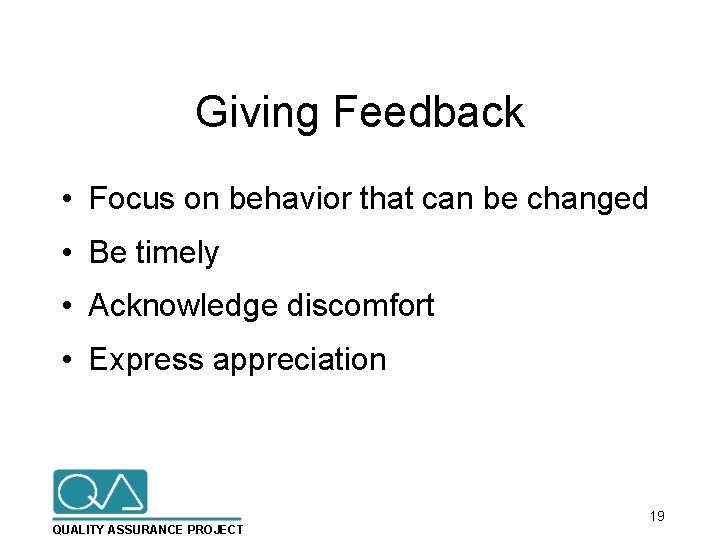
Giving Feedback • Focus on behavior that can be changed • Be timely • Acknowledge discomfort • Express appreciation QUALITY ASSURANCE PROJECT 19
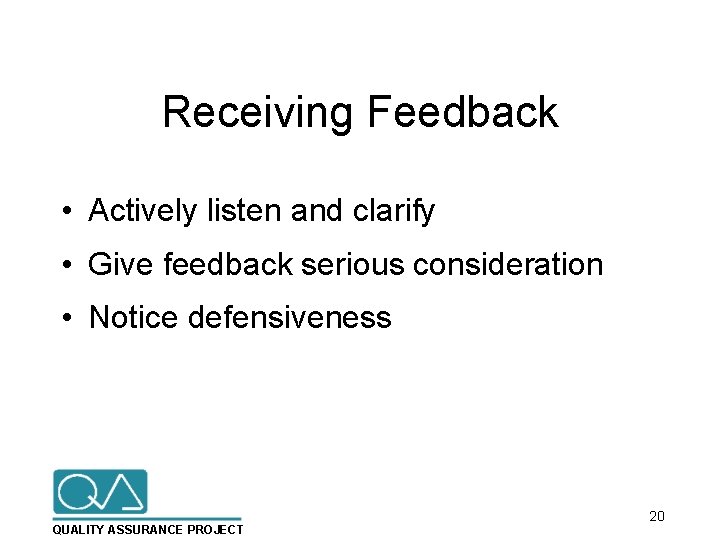
Receiving Feedback • Actively listen and clarify • Give feedback serious consideration • Notice defensiveness QUALITY ASSURANCE PROJECT 20
Receiving Feedback • Summarize feedback • Communicate need for help • Express appreciation QUALITY ASSURANCE PROJECT 21
Blocks to Communication • • Evaluating Advice-giving Discounting Diagnosing or being psychoanalytical QUALITY ASSURANCE PROJECT 22
Blocks to Communication • • Prying Warning, admonishing, commanding Lecturing Devaluing QUALITY ASSURANCE PROJECT 23
Communicating Feelings Step One: Focus on Feelings Ask, “What am I feeling? ” QUALITY ASSURANCE PROJECT 24
Communicating Feelings Step Two: Focus on behaviors that generate the feelings Ask, “what behaviors are causing this feeling? ” QUALITY ASSURANCE PROJECT 25
Communicating Feelings Step Three: Focus on possible responses and choose one QUALITY ASSURANCE PROJECT 26