
COMMUNICATION SKILLS THE NATURE OF COMMUNICATION Dr Abdullah
COMMUNICATION SKILLS THE NATURE OF COMMUNICATION Dr. Abdullah AL-Zahrani
THE NATURE OF COMMUNICATION Definitions. u Constituents. u Aims. u Inappropriate Assumptions. u Objectives. u Barriers. u Levels. u Styles. u
THE NATURE OF COMMUNICATION Definitions: u Communication = to make it common. = to make it shared. u Communication deals (sending and receiving) with information, feelings, thoughts, messages, ideas, attitude, and understanding, . . etc. u Effective communication can be measured in terms of whether or not the sender’s message has had the intended impact on it’s receiver.
THE NATURE OF COMMUNICATION Definitions (cont. ): u Effective communication versus Miscommunication. u Real communication versus Feedback loop.
THE NATURE OF COMMUNICATION Communication is a continuous process that composed of : 1. Sender ( thought and encoding ). 2. Medium (means, channels). 3. Receiver( reception, decoding, and understanding ). 4. Message. (Transmission ) 5. Feedback. 6. Noise.
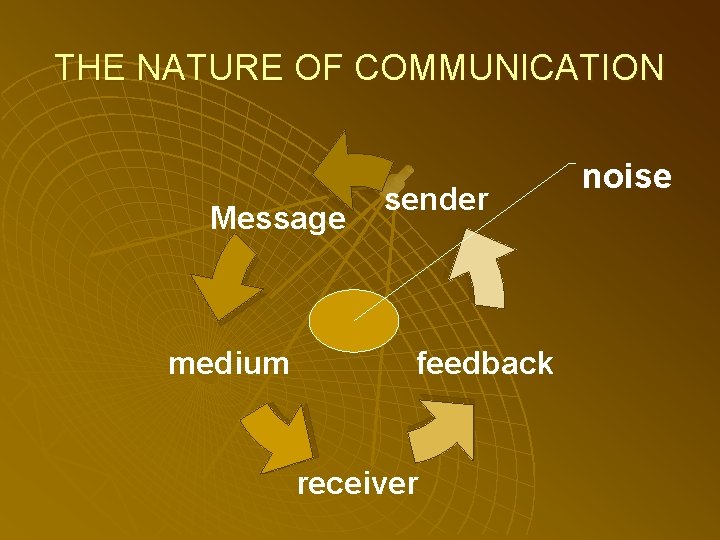
THE NATURE OF COMMUNICATION Message medium sender feedback receiver noise
THE NATURE OF COMMUNICATION Sender can be writer, speaker, and encoder. u Medium can be memo, report, letter, interview, speech, telephone conversation, gesture, tone of voice, physical movement, picture, and chart. u Receiver can be reader, listener, perceiver, and decoder. u
THE NATURE OF COMMUNICATION The most common inappropriate assumptions about communication includes : u Communication is a simple, one-way act. u Effective communication is easy. u The message sent ( intended ) is the same as the message received ( interpreted ). u Communication is a human skill cannot be improved.
THE NATURE OF COMMUNICATION Aims of the communication in the individuals level includes : u Requesting information “ To inquire”. u Informing information “To inform”. u Initiate people to understand the information and implement it “ To persuade”. u Enjoyment “To entertain”
THE NATURE OF COMMUNICATION The objectives of the communication within the organization are: u Meeting organizational goals. u Satisfying professional responsibilities. u Fulfilling personal roles.
THE NATURE OF COMMUNICATION u u Barriers are mainly the noise which exist in and effect each part within the communication process. Barriers includes the following: 1. Distractions; A. B. C. Senses, e. g. Poor lighting, Overheated room, smoke filed. Appearance, e. g. Poor appearance of a speaker, coffee spots on a written report. Lack of interest in the subject matter.
THE NATURE OF COMMUNICATION 2. Inadequate Knowledge. ( sufficient background). 3. Poor Planning and listening. u 60% of our time is spent in listening. u Good listening is not easy. 4. Differences in perception: u Mental Filter which no two are identical. u Influenced by peoples skills, attitude, knowledge levels and sociocultural factors.
THE NATURE OF COMMUNICATION 5. Emotions and Personalities; • Both can play positive or negative role. 6. Frozen Evaluation; • e. g. Typical head nurse. 7. Language; • • In One language there are problems. In Different languages there are many problems.
THE NATURE OF COMMUNICATION The levels of the communication can be classified into deferent types ; 1. Communication levels according to the number of participants ; A. Intrapersonal. B. Interpersonal. C. Small group. D. Public. E. Mass.
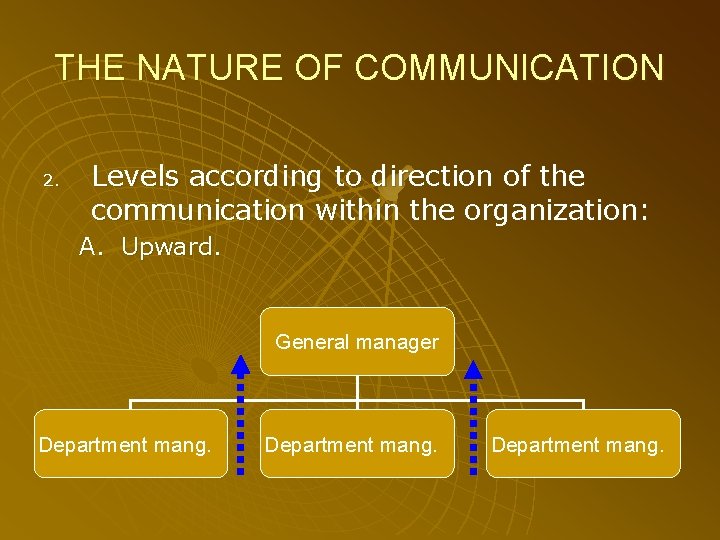
THE NATURE OF COMMUNICATION 2. Levels according to direction of the communication within the organization: A. Upward. General manager Department mang.
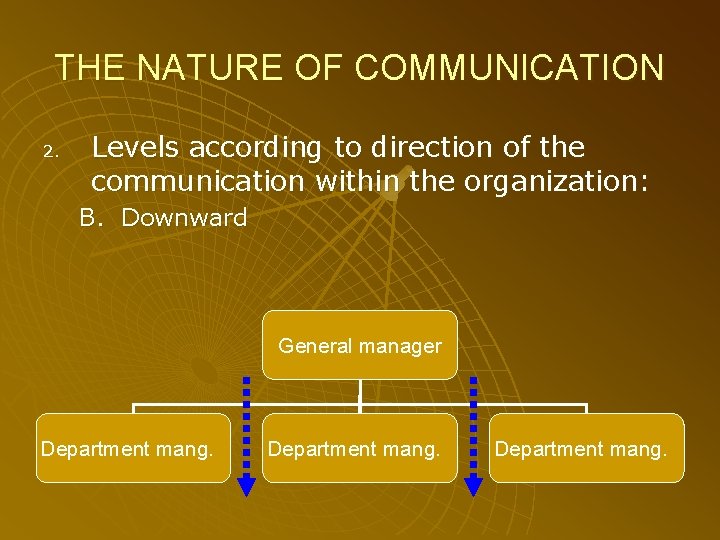
THE NATURE OF COMMUNICATION 2. Levels according to direction of the communication within the organization: B. Downward General manager Department mang.
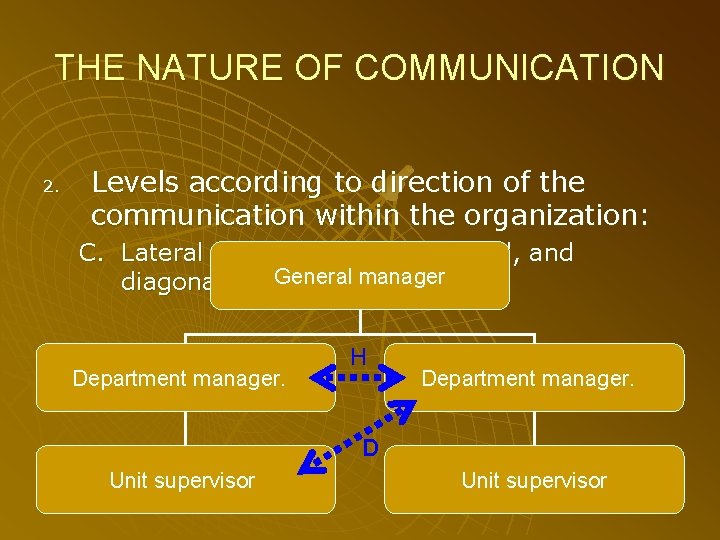
THE NATURE OF COMMUNICATION 2. Levels according to direction of the communication within the organization: C. Lateral or Crosswise, ( horizontal, and General manager diagonal) Department manager. H Department manager. D Unit supervisor
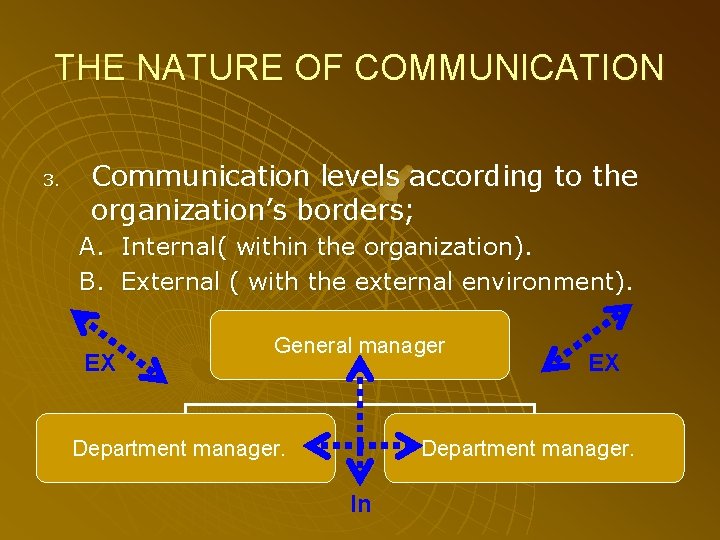
THE NATURE OF COMMUNICATION 3. Communication levels according to the organization’s borders; A. Internal( within the organization). B. External ( with the external environment). EX General manager Department manager. EX Department manager. In
THE NATURE OF COMMUNICATION The styles of the communication can be : u Authoritarian or autocratic. u Paternalistic. u Permissive. u Democratic or participative.
THE NATURE OF COMMUNICATION u Written communication: • the advantages of written communication are; The documentation. u Provides legal defenses. u Uniformity of procedure. u May decrease the cost. u • The disadvantages are; Increase paper. u Not immediate feedback. u Take long time. u
THE NATURE OF COMMUNICATION u Oral communication ( formal or informal): • The advantages of oral communication are; The feedback is immediate. u Possible clarification. u The effect can be noted. u Give feeling of importance. u • The disadvantages are; May take time. u May be costly. u
THE NATURE OF COMMUNICATION u Guides toward effective communication: • Clarify the messages. • Use familiar symbols. • Plan your communication. • Consider receiver’s needs and interests. • Good selection of means. • Give required feedback. • Insure good environment. • Good listening. ( 10 guides ).
THE NATURE OF COMMUNICATION u 1. 2. 3. 4. 5. 10 guides of good listening; Stop talking. Put the talker at ease. Show the talker that you want to listen. Remove distractions. Empathize with the talker.
THE NATURE OF COMMUNICATION u 10 guides of good listening; Be patient. 7. Hold your temper. 8. Go easy on argument and criticism. 9. Ask questions. 10. Stop talking. 6.
THE NATURE OF COMMUNICATION u Guides toward effective written communication: • Words should be; u Simple. u Familiar. u Necessary. • Sentence should be; u Short. u With examples. u Using active verbs. u With personal pronouns “you”.
THE NATURE OF COMMITTEE The committee is one of complex example of the communication which used due to a growing emphasis on group management. u Authority; (decisions, recommendations, and insights). u Size ; 5 – 16. u
THE NATURE OF COMMITTEE Membership; • Represents the interests intended to serve and the required authority. • Member should have the capacity to communicate. u Subject matter; • Limitations should be considered by an agenda and relevant information circulated well in advance. u

THE NATURE OF COMMITTEE Chairperson; act to avoid the wastes of the committee. u Minutes; used to avoid the varying interpretations. u Cost effectiveness where the committee most worth it’s cost. u
- Slides: 28