
Communication Skills Dr Faris Alsaraireh Communication in mental
- Slides: 25
Communication Skills Dr. Faris Al-saraireh
Communication in mental health is an n essential component of all therapeutic interventions. The knowledge and interpersonal skills that a doctor uses to communicate are essential aspects of helping the person who is experiencing mental health problems or distress. As well as facilitating the development of a positive doctor-client relationship.
Definition of Communication The act of transmitting information communicated, a verbal , nonverbal or written message. A process by which information is exchanged between individuals through a common system of symbols, signs, or behavior. A system for communicating by using. a) Technology of the transmission of information b) Technique for expressing ideas effectively
Communication Process n n n A two way process involving the sending and receiving of message The exchange of ideas or thoughts Transmission of feelings, personal and social interaction between people It is basic components of human relationship Exchanging information's or feelings between two or more people
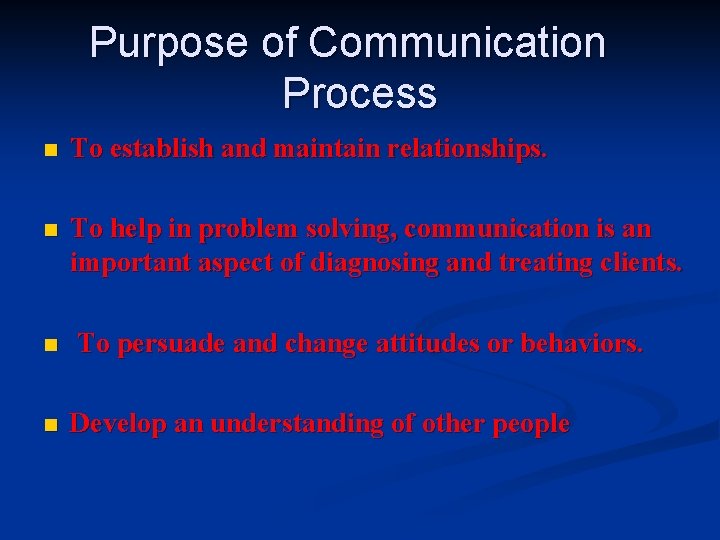
Purpose of Communication Process n To establish and maintain relationships. n To help in problem solving, communication is an important aspect of diagnosing and treating clients. n n To persuade and change attitudes or behaviors. Develop an understanding of other people
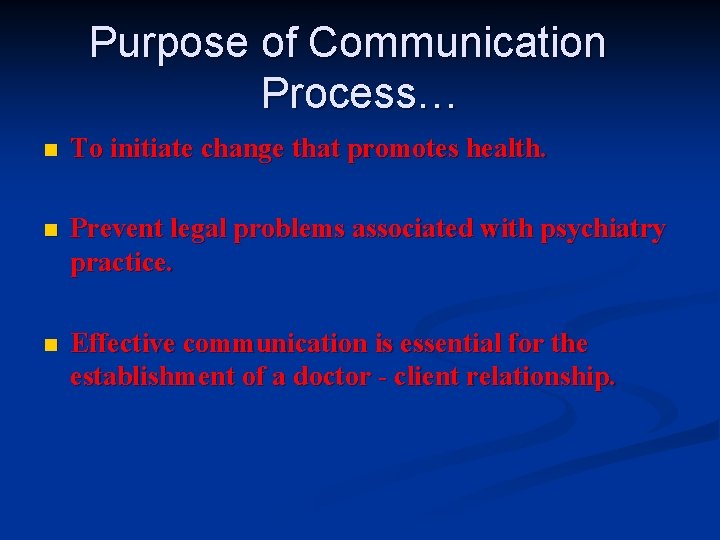
Purpose of Communication Process… n To initiate change that promotes health. n Prevent legal problems associated with psychiatry practice. n Effective communication is essential for the establishment of a doctor - client relationship.
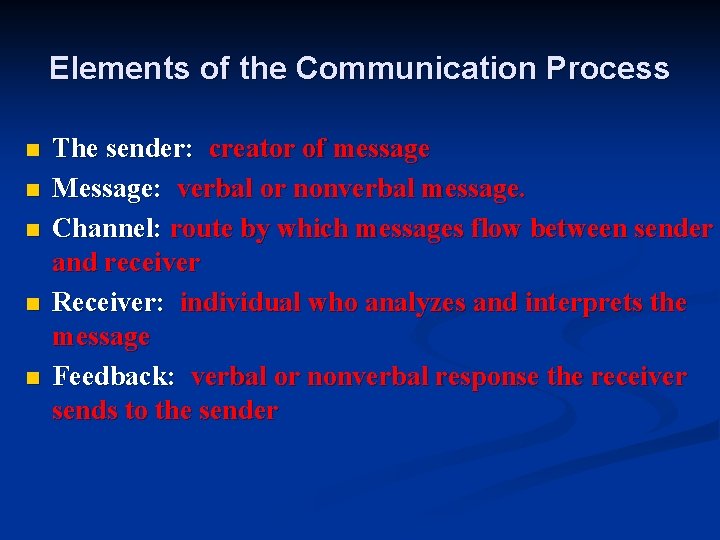
Elements of the Communication Process n n n The sender: creator of message Message: verbal or nonverbal message. Channel: route by which messages flow between sender and receiver Receiver: individual who analyzes and interprets the message Feedback: verbal or nonverbal response the receiver sends to the sender
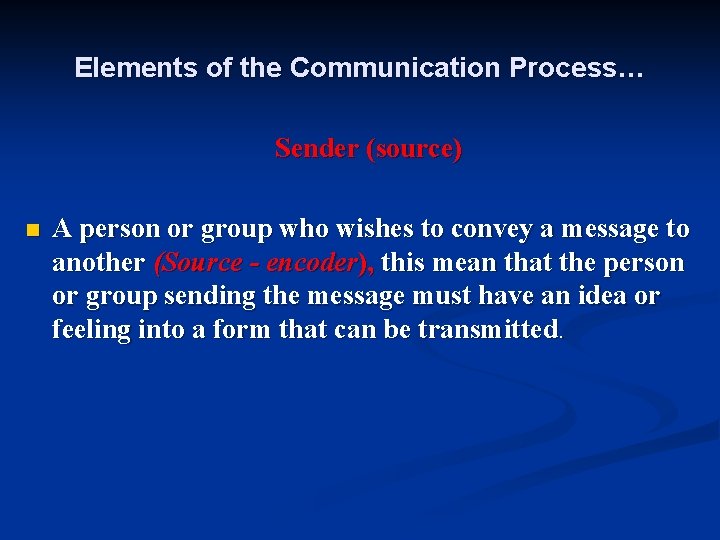
Elements of the Communication Process… Sender (source) n A person or group who wishes to convey a message to another (Source - encoder), this mean that the person or group sending the message must have an idea or feeling into a form that can be transmitted.
Elements of the Communication Process… n Encoding Selection of specific signs or symbols (codes) to transmit the message, such as: Language and words to use n How to arrange the words n What tone of voice and gesture to use. n
Elements of the Communication Process… Message n n n What is actually said or written The body language that accompanies the words , and how the message transmitted Talking face to face with a person may be more effective than telephoning or writing a message Written communication is often appropriate for longer explanations or for communication that needs to be preserved Recording a message on a tape or communicating by radio or television may be more appropriate for larger audience.
Elements of the Communication Process… Channel n It is the medium used to convey the message and it target any of the receiver’s sense. n Channel should be appropriate for the message and it should help make the message more clear.
Elements of the Communication Process… Receiver n The listener who must listen, observe, and attend (Decoder), who must perceive what the sender intended (Interpretation). n Perception uses all the senses to receive verbal and nonverbal message. If the meaning of the decoding message matches the intent of the sender , then the communication has been effective n
Elements of the Communication Process… n n n Receiver Ineffective communication occurs when the message sent is misinterpreted by the receiver. According to the sender intent , depends largely on their similarities in knowledge and experience and sociocultural background Decode means: to relate the message perceived to receiver, storehouse of knowledge and experience and to sort out the meaning of the message
Elements of the Communication Process… Feedback The information or the reaction given by the receptor.
Levels of communication n Intrapersonal level : Is the communication that you have with yourself ( Self - talk ). n Interpersonal level: All the verbal and nonverbal activities people use when communicating with each other. n Public communication: Is the communication that you have with public require greater degree of formality
Communications Barriers (obstacles) n - At the sender level: Does not know the subject. Cannot communicate the message. Does not formulate clearly the objectives. Does not formulate well the message. Does not choose the language of the receptor. Does not adapt the tone
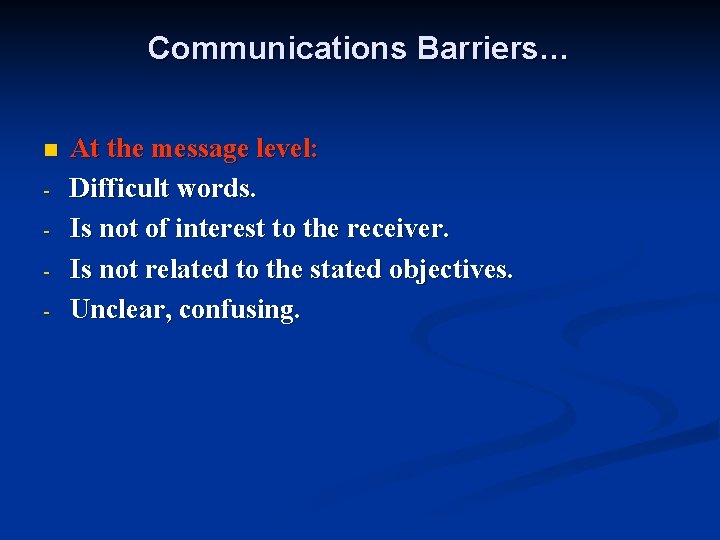
Communications Barriers… n - At the message level: Difficult words. Is not of interest to the receiver. Is not related to the stated objectives. Unclear, confusing.
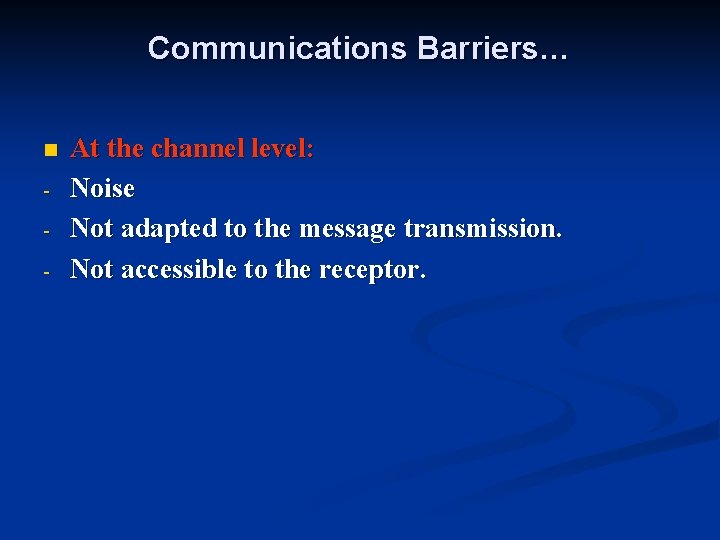
Communications Barriers… n - At the channel level: Noise Not adapted to the message transmission. Not accessible to the receptor.
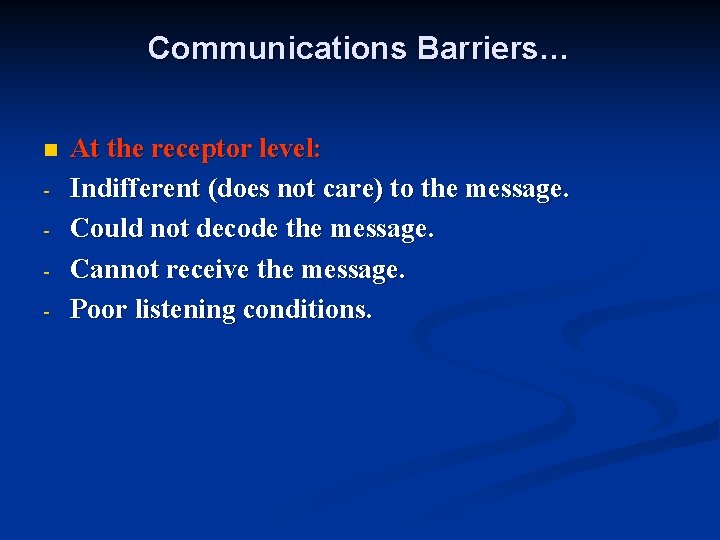
Communications Barriers… n - At the receptor level: Indifferent (does not care) to the message. Could not decode the message. Cannot receive the message. Poor listening conditions.
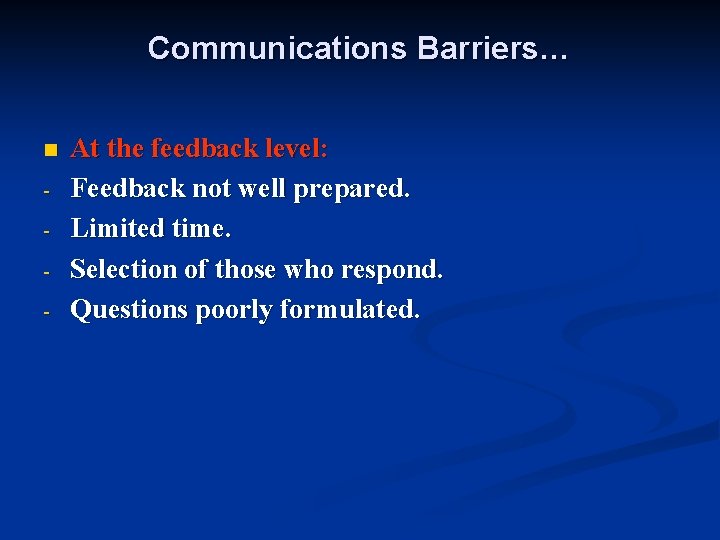
Communications Barriers… n - At the feedback level: Feedback not well prepared. Limited time. Selection of those who respond. Questions poorly formulated.
Active listening and non-verbal communication Listening is the most important skill and often the most challenging. One of the common mistakes made by novice psychiatrist as well as experienced psychiatrist is to talk too much (When we are talking, we are not listening!).
- The best and the most therapeutic thing to do are to say less and listen more. - Listening to a client does not mean that you are doing nothing; instead, you are allowing a space for the person to talk.
Non-verbal behaviors include: - Facial expression: Showing it in your face, for example facial expression, looking interested and concerned; maintaining good eye contact - Body movements: Showing it in your body movements, for example nodding of head, leaning forward
- Much of the communication that takes place between people is non-verbal. Our faces and bodies are extremely communicative. Being able to read nonverbal messages or body language is an important factor in establishing and maintaining relationships.
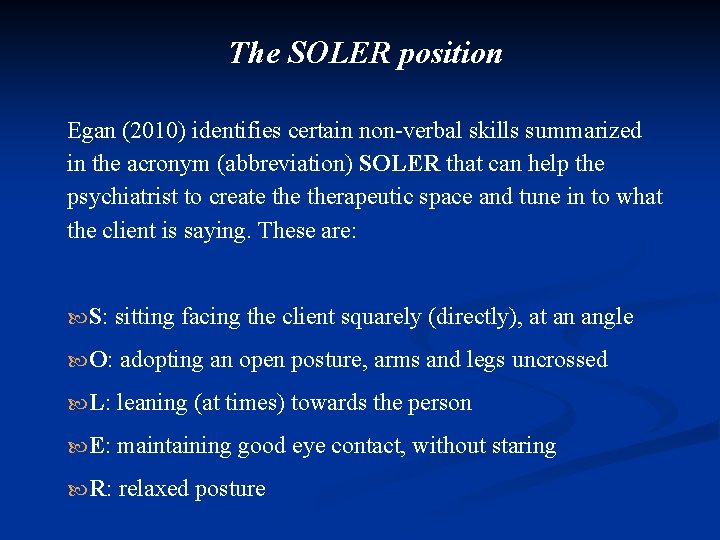
The SOLER position Egan (2010) identifies certain non-verbal skills summarized in the acronym (abbreviation) SOLER that can help the psychiatrist to create therapeutic space and tune in to what the client is saying. These are: S: sitting facing the client squarely (directly), at an angle O: adopting an open posture, arms and legs uncrossed L: leaning (at times) towards the person E: maintaining good eye contact, without staring R: relaxed posture