
Communication protocols and network security Multicast Multicast Ways
- Slides: 41
Communication protocols and network security Multicast
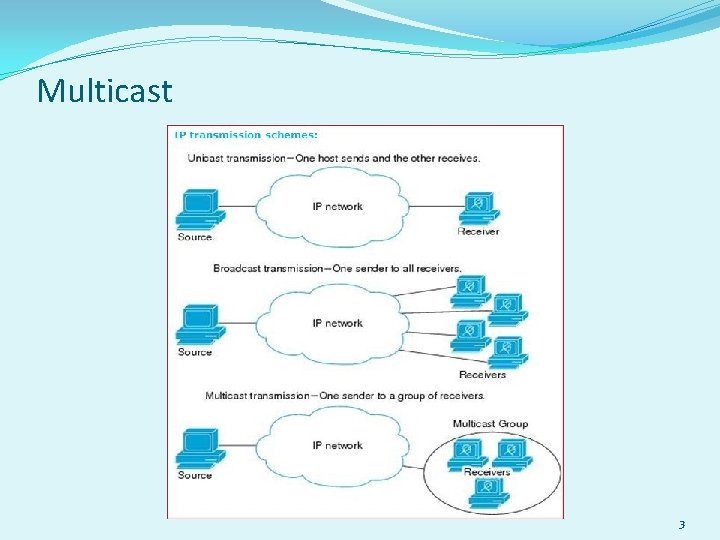
Multicast �Ways of addressing: � unicast (traditional): transmission to a single destination IP address (unique on the Internet / local network) � broadcast: addressing "all receivers" in a subnetwork (e. g. looking for a router or server, urgent message); doesn't deliver packets outside the network �How to transmit only to a selected group of addresses, even outside the local network? � multicast addressing allows delivery to groups of receivers regardless of the borders of the subnetworks � IGMP (Internet Group Management Protocol) is used for managing those groups 2
Multicast 3
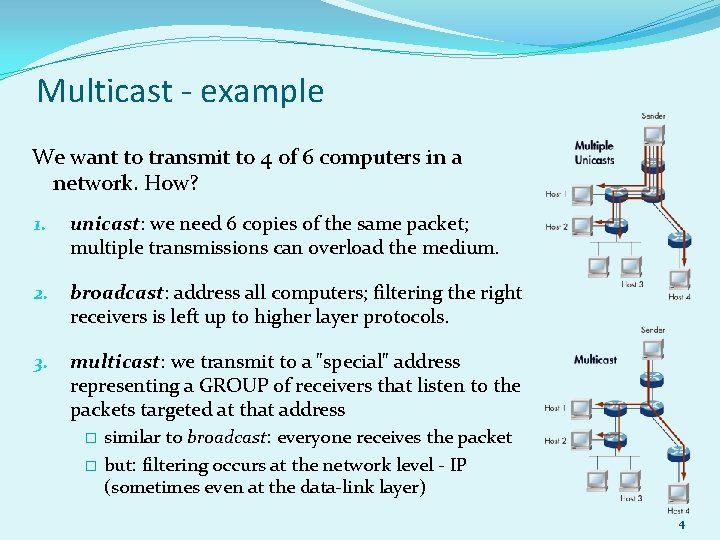
Multicast - example We want to transmit to 4 of 6 computers in a network. How? 1. unicast: we need 6 copies of the same packet; multiple transmissions can overload the medium. 2. broadcast: address all computers; filtering the right receivers is left up to higher layer protocols. 3. multicast: we transmit to a "special" address representing a GROUP of receivers that listen to the packets targeted at that address similar to broadcast: everyone receives the packet � but: filtering occurs at the network level - IP (sometimes even at the data-link layer) � 4
Multicast: packet routing � broadcast packets are not forwarded by routers (everyone would receive them!), meaning they stay inside the local network � multicast routing is practical: a single packet is replicated by the router and forwarded only through those interfaces where there are listeners to that packet. Group names are 32 bit numbers (almost). � Challenges for the protocol: � finding out where the packet receivers are, � multicast requires additional work: routing protocols, forwarding information about the listeners, � multicast addresses don't form a (sub)network -> the mask has 32 bits. Therefore they require special input in routing tables � challenge: they can also have more special inputs. Why? � security: an eavesdropper (illicit listener) can subscribe to listening the packets and thus become a legitimate receiver � what to do when only one receiver signalizes it didn't receive the packet 5
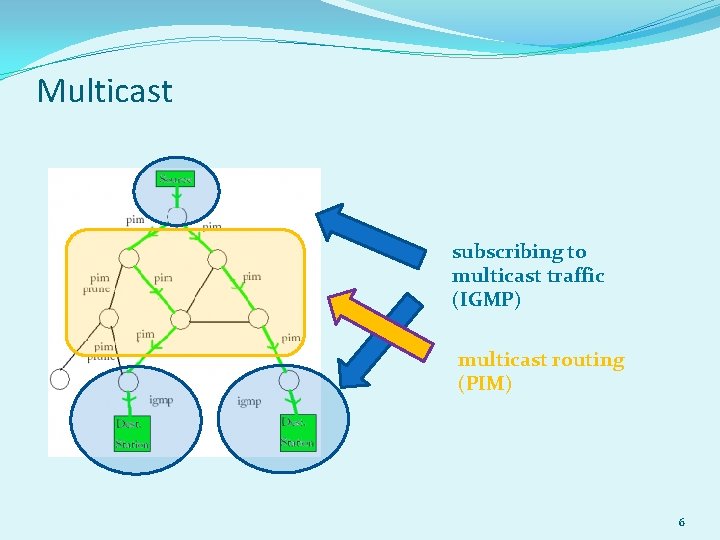
Multicast subscribing to multicast traffic (IGMP) multicast routing (PIM) 6
Multicast applications � sending large files over a network (central office to affiliates) - reliable transmission � software updates in a large network � data streaming (e. g. sending information about shares to all financial companies � audio/video streaming � video on demand (watching a TV program) � conference holding (consideration: better use of a conference center that decides who can speak and whose packets are to be forwarded to others) � challenge: think about how a conference is held using a multicast approach � real-time applications with RTP, which is used for ensuring continuous and quality deliveries within environments that use multicast 7
IPv 4 and IPv 6 addressing 8
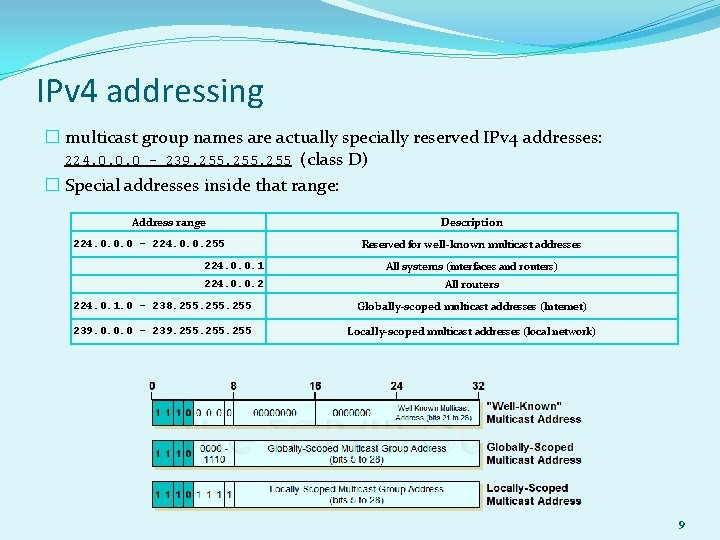
IPv 4 addressing � multicast group names are actually specially reserved IPv 4 addresses: 224. 0. 0. 0 - 239. 255 (class D) � Special addresses inside that range: Address range 224. 0. 0. 0 - 224. 0. 0. 255 Description Reserved for well-known multicast addresses 224. 0. 0. 1 All systems (interfaces and routers) 224. 0. 0. 2 All routers 224. 0. 1. 0 - 238. 255 Globally-scoped multicast addresses (Internet) 239. 0. 0. 0 - 239. 255 Locally-scoped multicast addresses (local network) 9
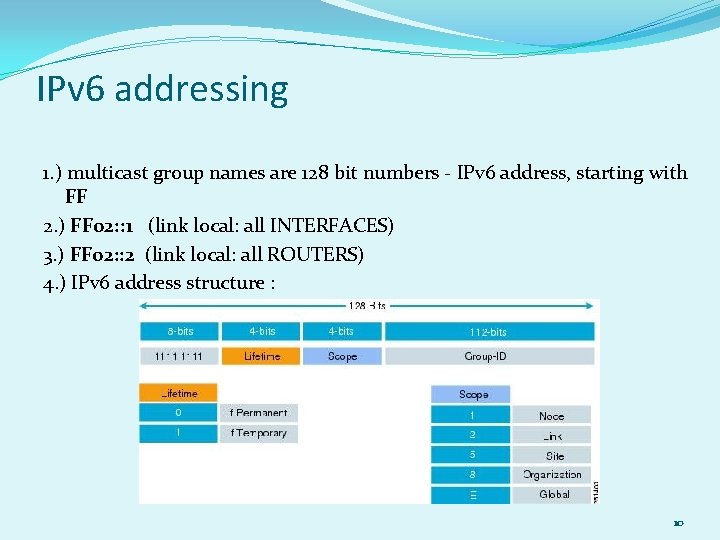
IPv 6 addressing 1. ) multicast group names are 128 bit numbers - IPv 6 address, starting with FF 2. ) FF 02: : 1 (link local: all INTERFACES) 3. ) FF 02: : 2 (link local: all ROUTERS) 4. ) IPv 6 address structure : 10
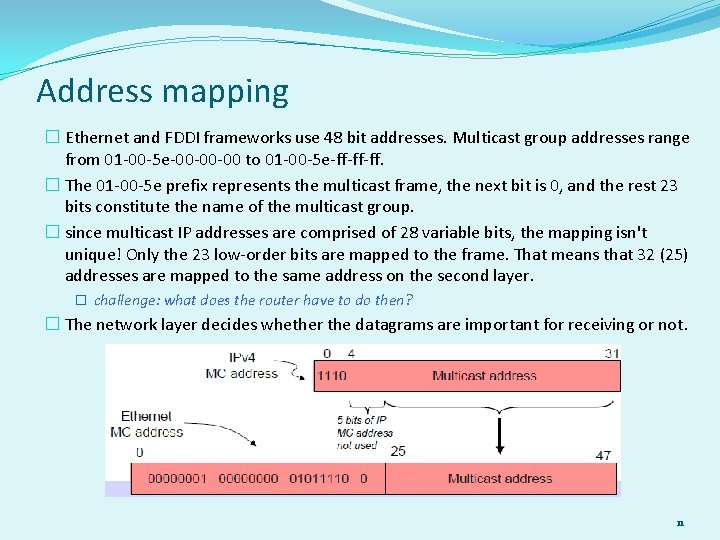
Address mapping � Ethernet and FDDI frameworks use 48 bit addresses. Multicast group addresses range from 01 -00 -5 e-00 -00 -00 to 01 -00 -5 e-ff-ff-ff. � The 01 -00 -5 e prefix represents the multicast frame, the next bit is 0, and the rest 23 bits constitute the name of the multicast group. � since multicast IP addresses are comprised of 28 variable bits, the mapping isn't unique! Only the 23 low-order bits are mapped to the frame. That means that 32 (25) addresses are mapped to the same address on the second layer. � challenge: what does the router have to do then? � The network layer decides whether the datagrams are important for receiving or not. 11
Subscription to multicast traffic: IGMP and MLD protocols 12
IGMP protocol � network layer protocol IPv 4, protocol number 2 � RFC 2236, Internet Group Management Protocol, Version 2, RFC 3376, Internet Group Management Protocol, Version 3 � required: find it on the Internet and read it - further reading! � challenge: find the other RFC documents related to IGMP � IGMP takes care of managing who the multicast receivers are. It allows: � establishing group memberships � leaving a group � detecting other interfaces in the group 13
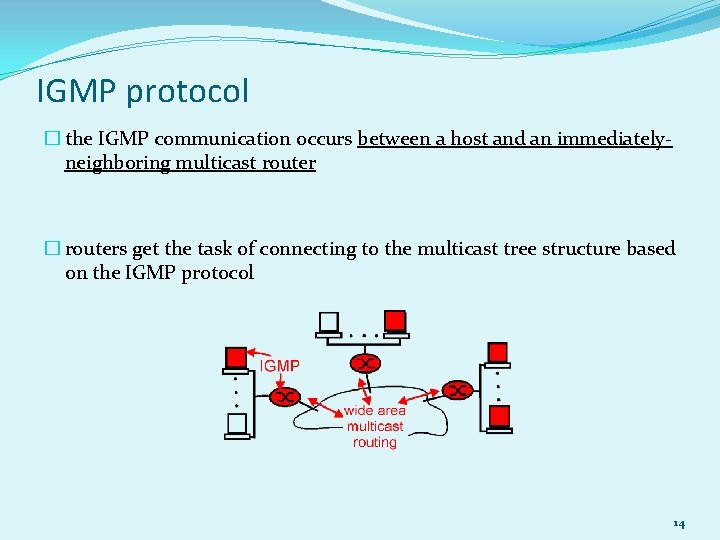
IGMP protocol � the IGMP communication occurs between a host and an immediatelyneighboring multicast router � routers get the task of connecting to the multicast tree structure based on the IGMP protocol 14
IGMP versions There are 3 versions: IGMP v 1, v 2 and v 3. � IGMPv 1: Interfaces can connect to groups. There are no messages for leaving a group. Routers use timeouts to detect groups of no concern for the interface. � IGMPv 2: Messages for leaving a group are added. That allows for faster notification about unnecessary traffic termination. � IGMPv 3: Bigger changes in the protocol. Interfaces can determine a LIST of other interfaces from which they wish to receive traffic. The network blocks all traffic from other interfaces. 15
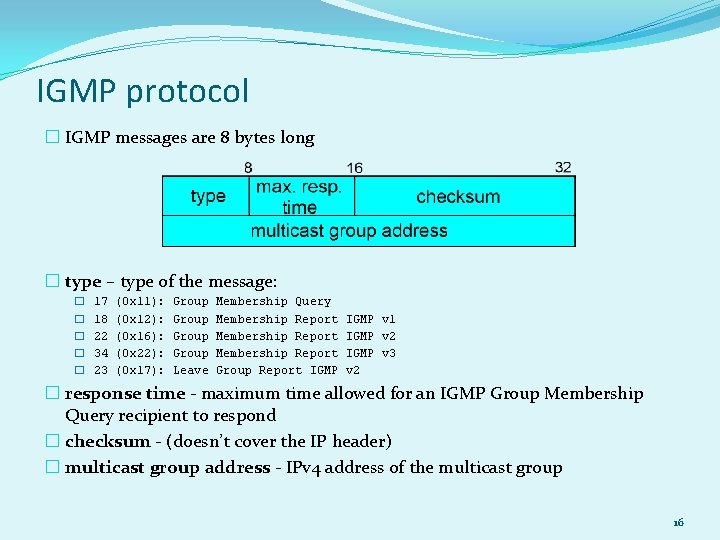
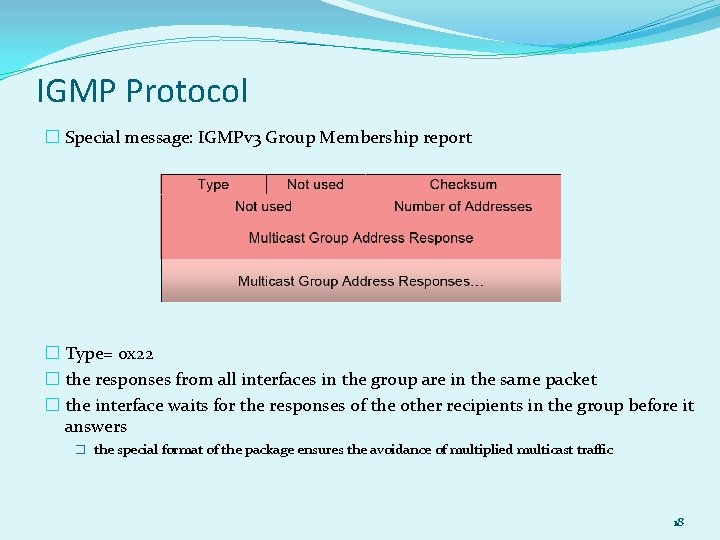
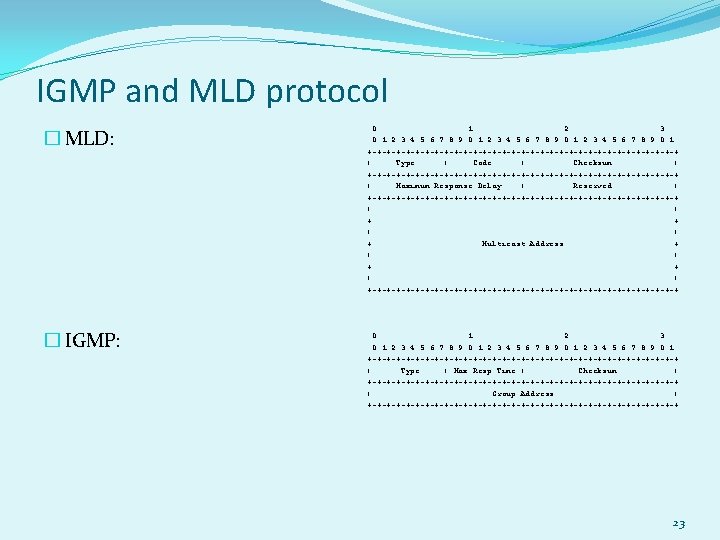
IGMP protocol � IGMP messages are 8 bytes long � type – type of the message: � 17 (0 x 11): Group Membership Query � 18 (0 x 12): Group Membership Report IGMP v 1 � 22 (0 x 16): Group Membership Report IGMP v 2 � 34 (0 x 22): Group Membership Report IGMP v 3 � 23 (0 x 17): Leave Group Report IGMP v 2 � response time - maximum time allowed for an IGMP Group Membership Query recipient to respond � checksum - (doesn’t cover the IP header) � multicast group address - IPv 4 address of the multicast group 16
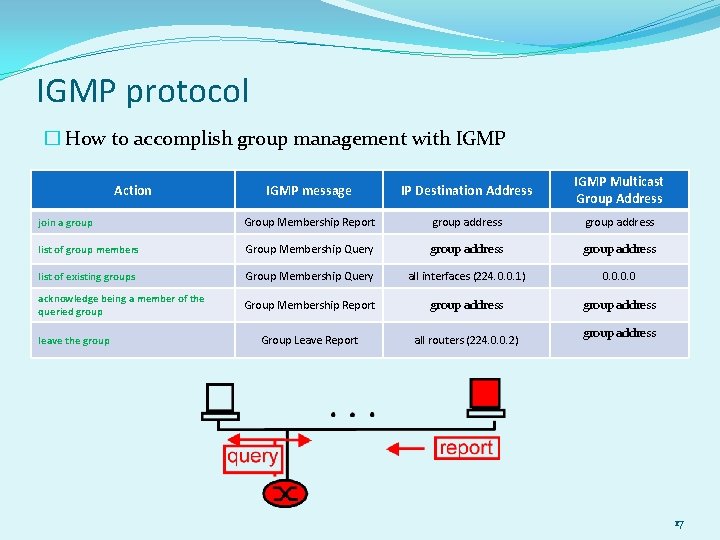
IGMP protocol � How to accomplish group management with IGMP message IP Destination Address IGMP Multicast Group Address join a group Group Membership Report group address list of group members Group Membership Query group address list of existing groups Group Membership Query all interfaces (224. 0. 0. 1) 0. 0 acknowledge being a member of the queried group Group Membership Report group address Group Leave Report all routers (224. 0. 0. 2) Action leave the group address 17
IGMP Protocol � Special message: IGMPv 3 Group Membership report � Type= 0 x 22 � the responses from all interfaces in the group are in the same packet � the interface waits for the responses of the other recipients in the group before it answers � the special format of the package ensures the avoidance of multiplied multicast traffic 18
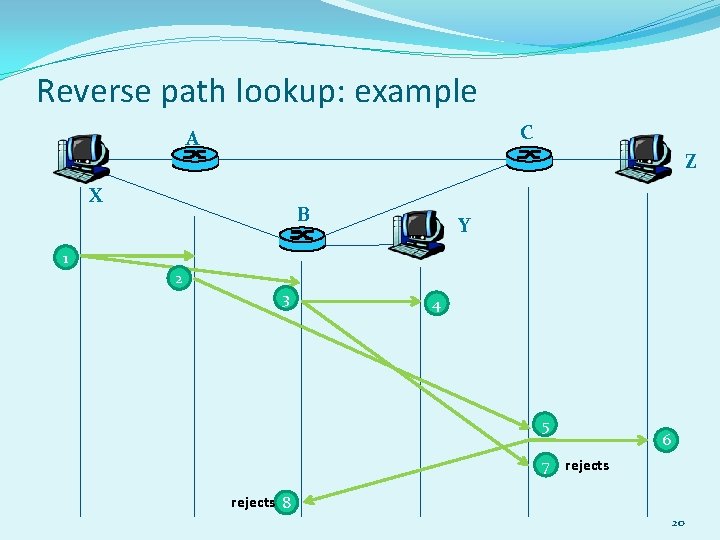
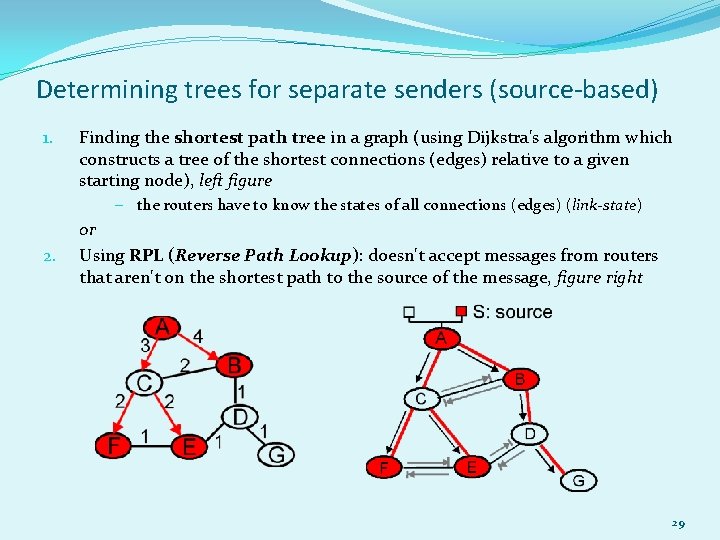
IGMP protocol: subscription to a source � for joining a group, a GMR message is sent with value TTL=1 (delivered only to the nearest router) � the router recognizes that it must forward the group packets to the new subscriber (how? mapped multicast address / datagram copies to the IP address) � the router informs the neighboring routers that it has a new subscriber. If every router were to pass the same message onwards, there would be a problem - the packets would be cross-forwarded across all connections in the network. Solutions: � use of the RPL algorithm (Reverse Path Lookup): we reject all multicast packets coming from routers that don't connect to the source of the packet through the shortest path � routers have special routing protocols for multicast traffic: e. g. the PIMSM protocol (Protocol Independent Multicast - Sparse Mode) 19
Reverse path lookup: example C A Z X B Y 1 2 3 4 5 6 7 rejects 8 20
MLD protocol � Multicast Listener Discovery, RFC 2710, Multicast Listener Discovery (MLD) for IPv 6 � required: find it on the Internet and read it - further reading! � challenge: look for the differences between MLD and IGMP � challenge: what about the coexistence of IGMP (IPv 4) and MLD (IPv 6)? 21
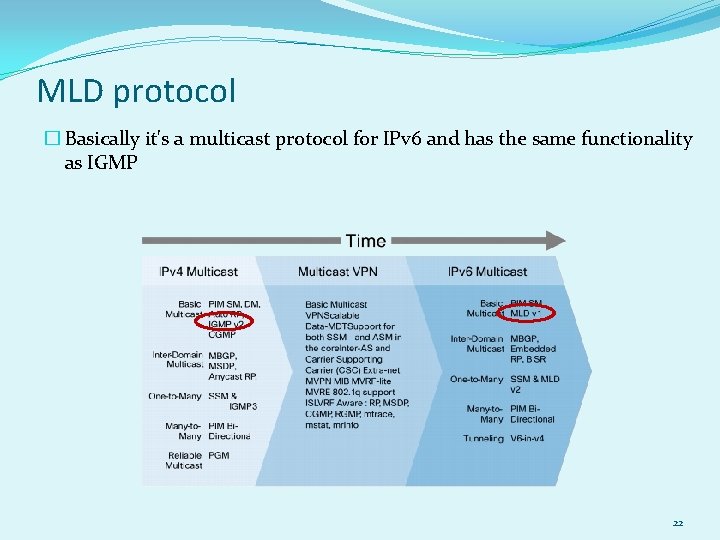
MLD protocol � Basically it's a multicast protocol for IPv 6 and has the same functionality as IGMP 22
Multicast trees 24
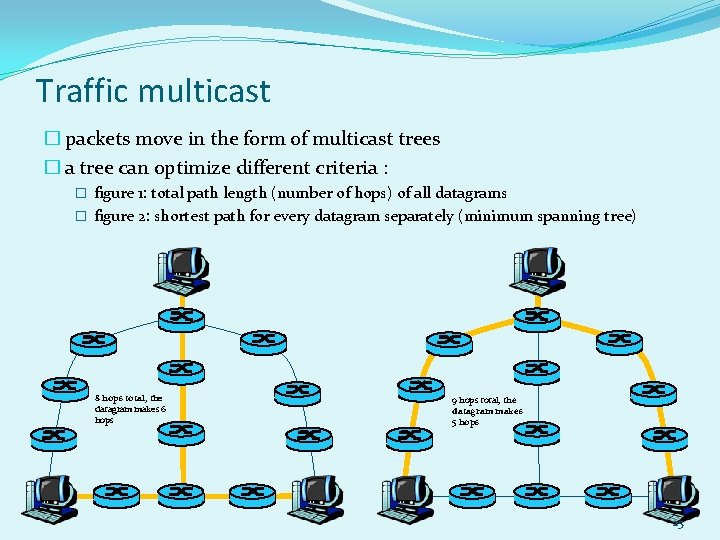
Traffic multicast � packets move in the form of multicast trees � a tree can optimize different criteria : � figure 1: total path length (number of hops) of all datagrams � figure 2: shortest path for every datagram separately (minimum spanning tree) 8 hops total, the datagram makes 6 hops 9 hops total, the datagram makes 5 hops 25
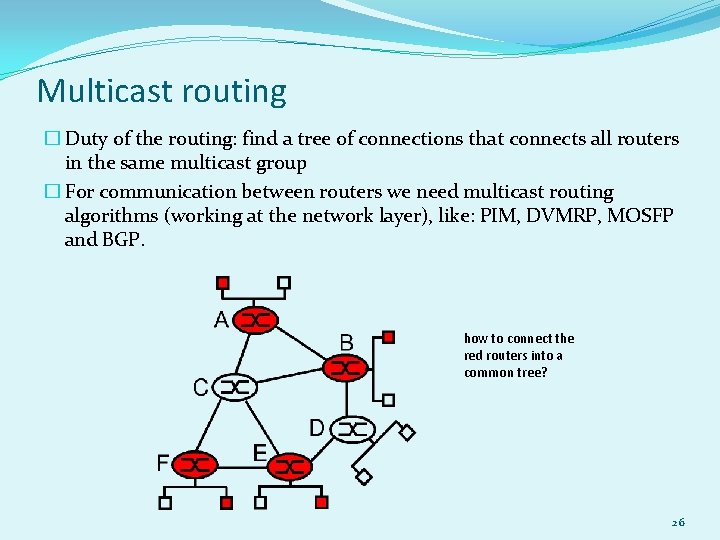
Multicast routing � Duty of the routing: find a tree of connections that connects all routers in the same multicast group � For communication between routers we need multicast routing algorithms (working at the network layer), like: PIM, DVMRP, MOSFP and BGP. how to connect the red routers into a common tree? 26
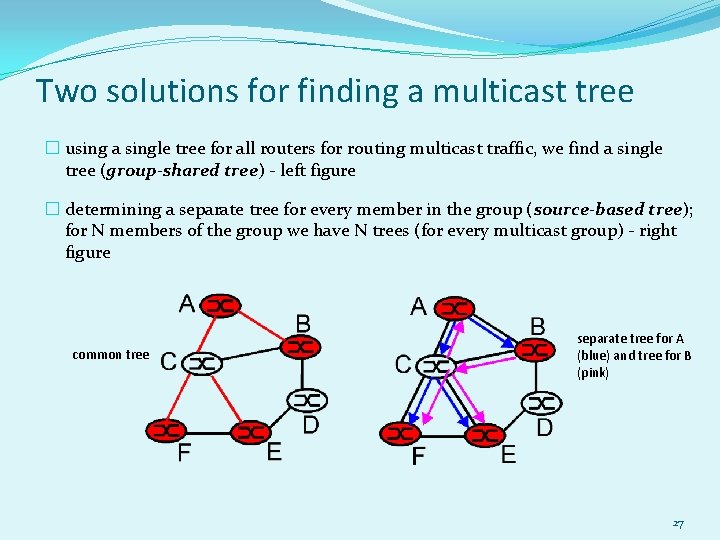
Two solutions for finding a multicast tree � using a single tree for all routers for routing multicast traffic, we find a single tree (group-shared tree) - left figure � determining a separate tree for every member in the group (source-based tree); for N members of the group we have N trees (for every multicast group) - right figure common tree separate tree for A (blue) and tree for B (pink) 27
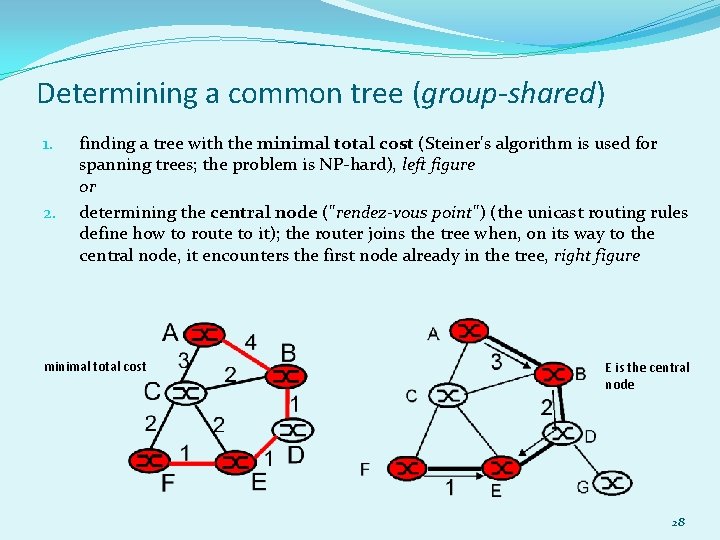
Determining a common tree (group-shared) 1. 2. finding a tree with the minimal total cost (Steiner's algorithm is used for spanning trees; the problem is NP-hard), left figure or determining the central node ("rendez-vous point") (the unicast routing rules define how to route to it); the router joins the tree when, on its way to the central node, it encounters the first node already in the tree, right figure minimal total cost E is the central node 28
Determining trees for separate senders (source-based) 1. Finding the shortest path tree in a graph (using Dijkstra's algorithm which constructs a tree of the shortest connections (edges) relative to a given starting node), left figure the routers have to know the states of all connections (edges) (link-state) 2. or Using RPL (Reverse Path Lookup): doesn't accept messages from routers that aren't on the shortest path to the source of the message, figure right 29
Multicast routing 30
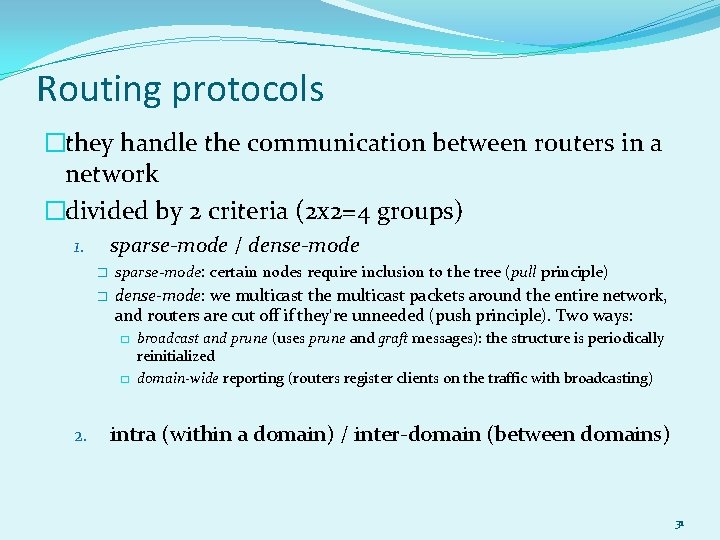
Routing protocols �they handle the communication between routers in a network �divided by 2 criteria (2 x 2=4 groups) sparse-mode / dense-mode 1. � sparse-mode: certain nodes require inclusion to the tree (pull principle) � dense-mode: we multicast the multicast packets around the entire network, and routers are cut off if they're unneeded (push principle). Two ways: � � 2. broadcast and prune (uses prune and graft messages): the structure is periodically reinitialized domain-wide reporting (routers register clients on the traffic with broadcasting) intra (within a domain) / inter-domain (between domains) 31
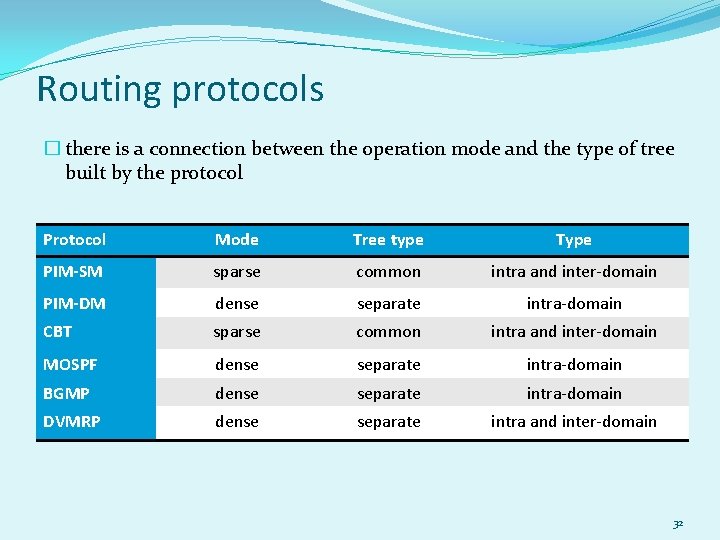
Routing protocols � there is a connection between the operation mode and the type of tree built by the protocol Protocol Mode Tree type Type PIM-SM sparse common intra and inter-domain PIM-DM dense separate intra-domain CBT sparse common intra and inter-domain MOSPF dense separate intra-domain BGMP dense separate intra-domain DVMRP dense separate intra and inter-domain 32
PIM-SM (Protocol Independent Multicast - Sparse Mode) �PIM-DM: dense-mode, separate tree �PIM-SM: sparse-mode, common tree, occasionally separate � challenge: read RFC 4601 and study it �protocols PIM-SM and PIM-DM are suitable for routers that are already running unicast routing. They are independent from the unicast protocol �messages use the IP network protocol with protocol number 103 �messages between routers are unicast or multicast to the address 224. 0. 0. 13 (all PIM routers) 33
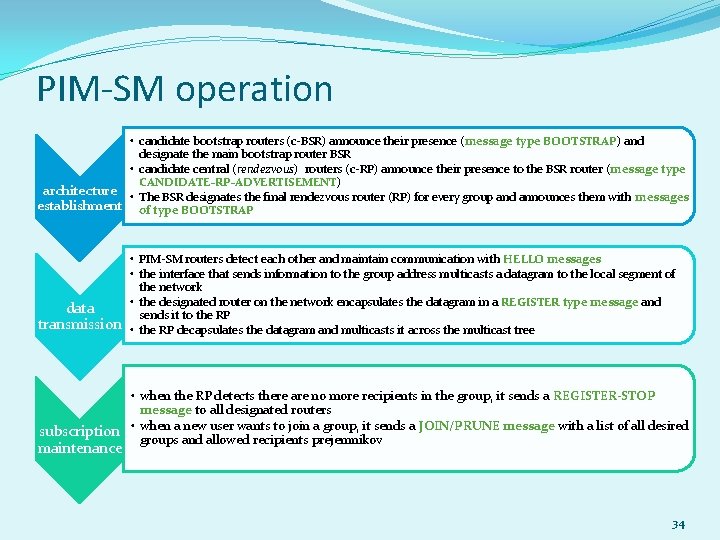
PIM-SM operation • candidate bootstrap routers (c-BSR) announce their presence (message type BOOTSTRAP) and designate the main bootstrap router BSR • candidate central (rendezvous) routers (c-RP) announce their presence to the BSR router (message type CANDIDATE-RP-ADVERTISEMENT) architecture • The BSR designates the final rendezvous router (RP) for every group and announces them with messages establishment of type BOOTSTRAP data transmission • PIM-SM routers detect each other and maintain communication with HELLO messages • the interface that sends information to the group address multicasts a datagram to the local segment of the network • the designated router on the network encapsulates the datagram in a REGISTER type message and sends it to the RP • the RP decapsulates the datagram and multicasts it across the multicast tree • when the RP detects there are no more recipients in the group, it sends a REGISTER-STOP message to all designated routers subscription • when a new user wants to join a group, it sends a JOIN/PRUNE message with a list of all desired groups and allowed recipients prejemnikov maintenance 34
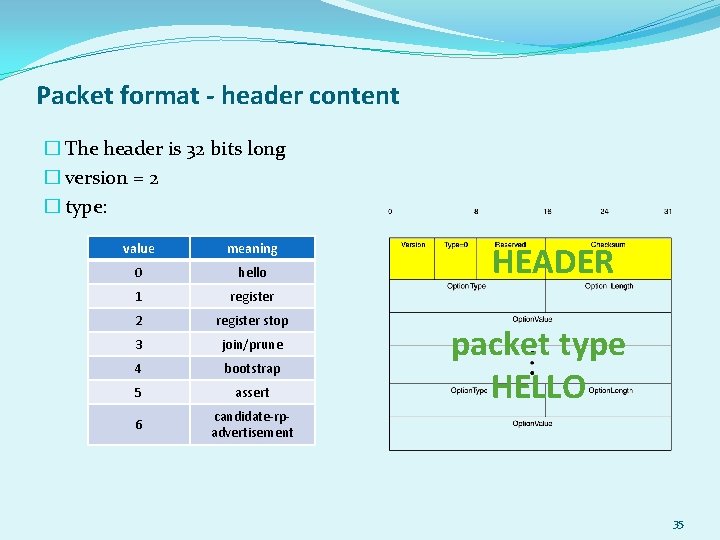
Packet format - header content � The header is 32 bits long � version = 2 � type: value meaning 0 hello 1 register 2 register stop 3 join/prune 4 bootstrap 5 assert 6 candidate-rpadvertisement HEADER packet type HELLO 35
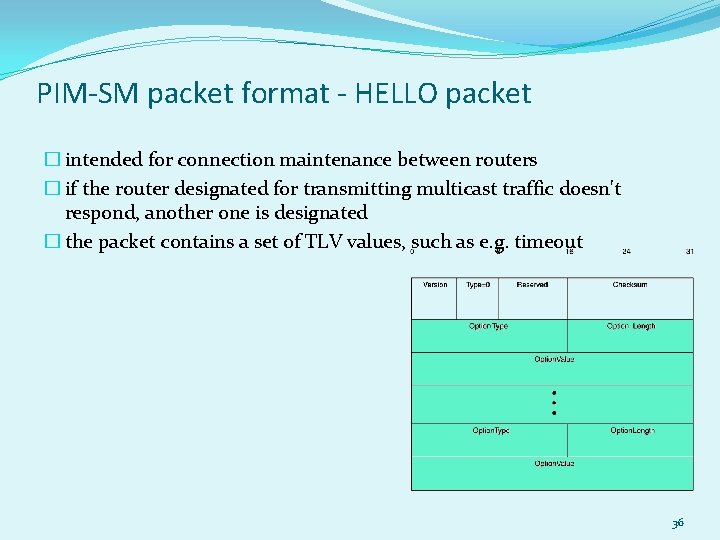
PIM-SM packet format - HELLO packet � intended for connection maintenance between routers � if the router designated for transmitting multicast traffic doesn't respond, another one is designated � the packet contains a set of TLV values, such as e. g. timeout 36
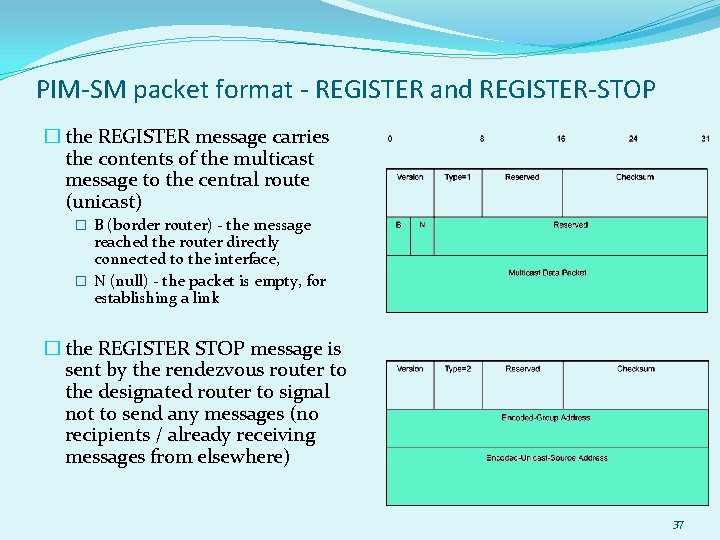
PIM-SM packet format - REGISTER and REGISTER-STOP � the REGISTER message carries the contents of the multicast message to the central route (unicast) � B (border router) - the message reached the router directly connected to the interface, � N (null) - the packet is empty, for establishing a link � the REGISTER STOP message is sent by the rendezvous router to the designated router to signal not to send any messages (no recipients / already receiving messages from elsewhere) 37
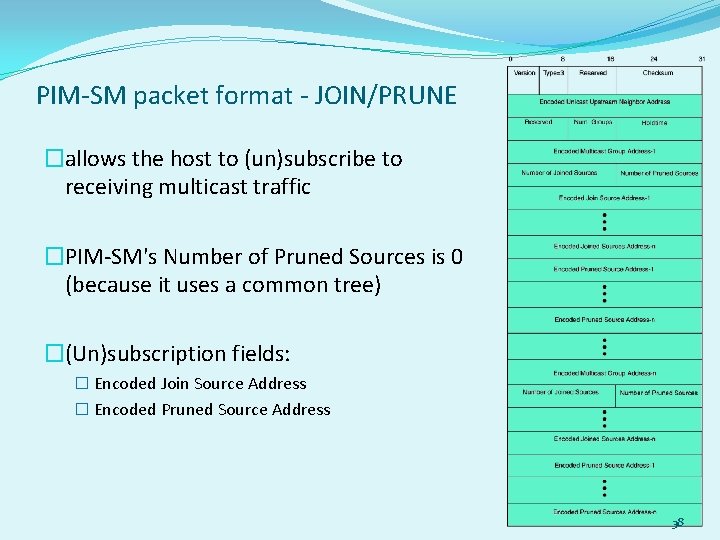
PIM-SM packet format - JOIN/PRUNE �allows the host to (un)subscribe to receiving multicast traffic �PIM-SM's Number of Pruned Sources is 0 (because it uses a common tree) �(Un)subscription fields: � Encoded Join Source Address � Encoded Pruned Source Address 38
Other routing protocols �MOSPF � Multicast OSPF � added: a special packet format that shares information about multicast traffic � challenge: find the RFC documents that describe MOSPF and read them! �DVMRP � Distance Vector Multicast Routing Protocol � transmitted through IGMP packets (type 13) � challenge: read RFC 1075 and study how the protocol works 39
MBONE �connections between networks capable of multicast traffic � at first inside the Internet, used by workstations with virtual connections � challenge: read RFC 2715 � 1995: MBONE contains 901 routers (DVMRP is used) and it's present in 20 countries � 1999: 4178 routers, increased use of RTP, service providers become overloaded � IETF sets up the MBONE task force with the task of establishing multicast routing across the entire Internet (development of the MSDP protocol: Multicast Source Discovery Protocol) � challenge: read RFC 1112, what is Any Source Multicast architecture (ASM)? 40
We continue next time! �authentication, authorization and accounting - AAA! 41