
Communication practices of project managers to enhance development
- Slides: 1
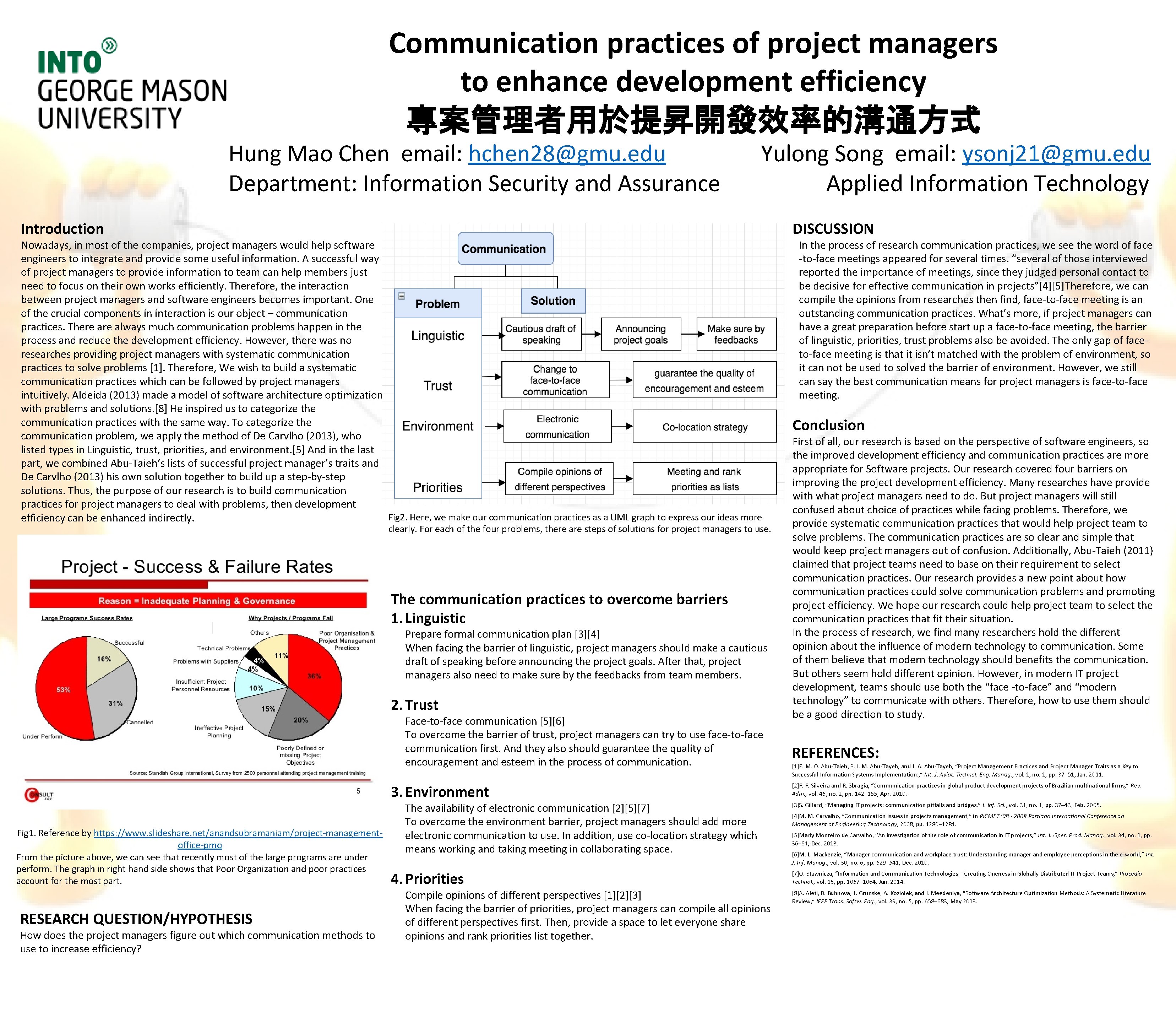
Communication practices of project managers to enhance development efficiency 專案管理者用於提昇開發效率的溝通方式 Hung Mao Chen email: hchen 28@gmu. edu Department: Information Security and Assurance Yulong Song email: ysonj 21@gmu. edu Applied Information Technology Introduction Nowadays, in most of the companies, project managers would help software engineers to integrate and provide some useful information. A successful way of project managers to provide information to team can help members just need to focus on their own works efficiently. Therefore, the interaction between project managers and software engineers becomes important. One of the crucial components in interaction is our object – communication practices. There always much communication problems happen in the process and reduce the development efficiency. However, there was no researches providing project managers with systematic communication practices to solve problems [1]. Therefore, We wish to build a systematic communication practices which can be followed by project managers intuitively. Aldeida (2013) made a model of software architecture optimization with problems and solutions. [8] He inspired us to categorize the communication practices with the same way. To categorize the communication problem, we apply the method of De Carvlho (2013), who listed types in Linguistic, trust, priorities, and environment. [5] And in the last part, we combined Abu-Taieh’s lists of successful project manager’s traits and De Carvlho (2013) his own solution together to build up a step-by-step solutions. Thus, the purpose of our research is to build communication practices for project managers to deal with problems, then development Fig 2. Here, we make our communication practices as a UML graph to express our ideas more efficiency can be enhanced indirectly. clearly. For each of the four problems, there are steps of solutions for project managers to use. The communication practices to overcome barriers 1. Linguistic Prepare formal communication plan [3][4] When facing the barrier of linguistic, project managers should make a cautious draft of speaking before announcing the project goals. After that, project managers also need to make sure by the feedbacks from team members. 2. Trust Face-to-face communication [5][6] To overcome the barrier of trust, project managers can try to use face-to-face communication first. And they also should guarantee the quality of encouragement and esteem in the process of communication. 3. Environment Fig 1. Reference by https: //www. slideshare. net/anandsubramaniam/project-managementoffice-pmo From the picture above, we can see that recently most of the large programs are under perform. The graph in right hand side shows that Poor Organization and poor practices account for the most part. RESEARCH QUESTION/HYPOTHESIS How does the project managers figure out which communication methods to use to increase efficiency? The availability of electronic communication [2][5][7] To overcome the environment barrier, project managers should add more electronic communication to use. In addition, use co-location strategy which means working and taking meeting in collaborating space. 4. Priorities Compile opinions of different perspectives [1][2][3] When facing the barrier of priorities, project managers can compile all opinions of different perspectives first. Then, provide a space to let everyone share opinions and rank priorities list together. DISCUSSION In the process of research communication practices, we see the word of face -to-face meetings appeared for several times. “several of those interviewed reported the importance of meetings, since they judged personal contact to be decisive for effective communication in projects”[4][5]Therefore, we can compile the opinions from researches then find, face-to-face meeting is an outstanding communication practices. What’s more, if project managers can have a great preparation before start up a face-to-face meeting, the barrier of linguistic, priorities, trust problems also be avoided. The only gap of faceto-face meeting is that it isn’t matched with the problem of environment, so it can not be used to solved the barrier of environment. However, we still can say the best communication means for project managers is face-to-face meeting. Conclusion First of all, our research is based on the perspective of software engineers, so the improved development efficiency and communication practices are more appropriate for Software projects. Our research covered four barriers on improving the project development efficiency. Many researches have provide with what project managers need to do. But project managers will still confused about choice of practices while facing problems. Therefore, we provide systematic communication practices that would help project team to solve problems. The communication practices are so clear and simple that would keep project managers out of confusion. Additionally, Abu-Taieh (2011) claimed that project teams need to base on their requirement to select communication practices. Our research provides a new point about how communication practices could solve communication problems and promoting project efficiency. We hope our research could help project team to select the communication practices that fit their situation. In the process of research, we find many researchers hold the different opinion about the influence of modern technology to communication. Some of them believe that modern technology should benefits the communication. But others seem hold different opinion. However, in modern IT project development, teams should use both the “face -to-face” and “modern technology” to communicate with others. Therefore, how to use them should be a good direction to study. REFERENCES: [1]E. M. O. Abu-Taieh, S. J. M. Abu-Tayeh, and J. A. Abu-Tayeh, “Project Management Practices and Project Manager Traits as a Key to Successful Information Systems Implementation: , ” Int. J. Aviat. Technol. Eng. Manag. , vol. 1, no. 1, pp. 37– 51, Jan. 2011. [2]F. F. Silveira and R. Sbragia, “Communication practices in global product development projects of Brazilian multinational firms, ” Rev. Adm. , vol. 45, no. 2, pp. 142– 155, Apr. 2010. [3]S. Gillard, “Managing IT projects: communication pitfalls and bridges, ” J. Inf. Sci. , vol. 31, no. 1, pp. 37– 43, Feb. 2005. [4]M. M. Carvalho, “Communication issues in projects management, ” in PICMET ’ 08 - 2008 Portland International Conference on Management of Engineering Technology, 2008, pp. 1280– 1284. [5]Marly Monteiro de Carvalho, “An investigation of the role of communication in IT projects, ” Int. J. Oper. Prod. Manag. , vol. 34, no. 1, pp. 36– 64, Dec. 2013. [6]M. L. Mackenzie, “Manager communication and workplace trust: Understanding manager and employee perceptions in the e-world, ” Int. J. Inf. Manag. , vol. 30, no. 6, pp. 529– 541, Dec. 2010. [7]O. Stawnicza, “Information and Communication Technologies – Creating Oneness in Globally Distributed IT Project Teams, ” Procedia Technol. , vol. 16, pp. 1057– 1064, Jan. 2014. [8]A. Aleti, B. Buhnova, L. Grunske, A. Koziolek, and I. Meedeniya, “Software Architecture Optimization Methods: A Systematic Literature Review, ” IEEE Trans. Softw. Eng. , vol. 39, no. 5, pp. 658– 683, May 2013.