
Communication Model The Communication Plan Specifying agentagent transactions

- Slides: 39
Communication Model The Communication Plan Specifying agent-agent transactions Transaction patterns Communication Model
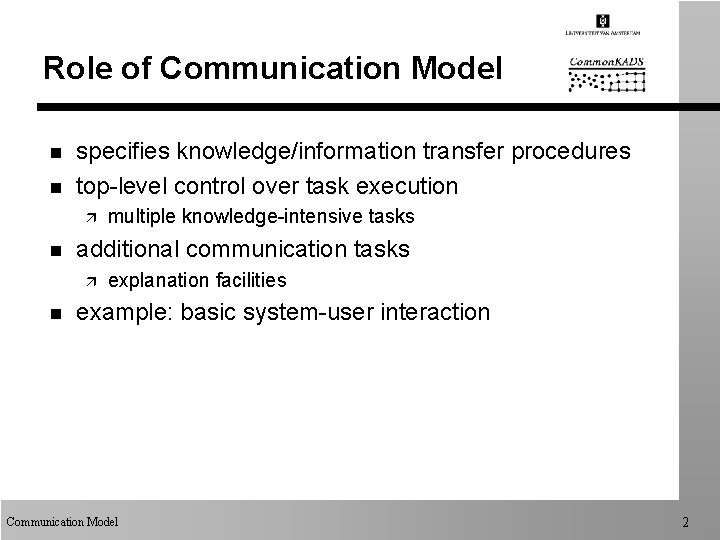
Role of Communication Model n n specifies knowledge/information transfer procedures top-level control over task execution ä n additional communication tasks ä n multiple knowledge-intensive tasks explanation facilities example: basic system-user interaction Communication Model 2
Relation to other models Communication Model 3
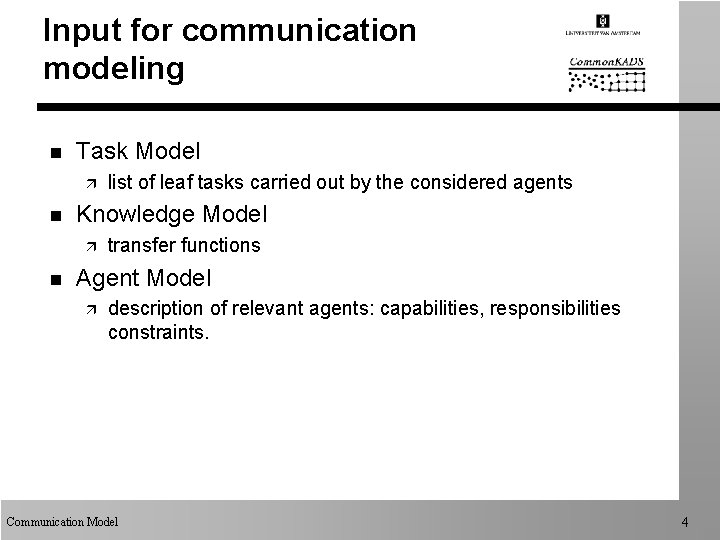
Input for communication modeling n Task Model ä n Knowledge Model ä n list of leaf tasks carried out by the considered agents transfer functions Agent Model ä description of relevant agents: capabilities, responsibilities constraints. Communication Model 4
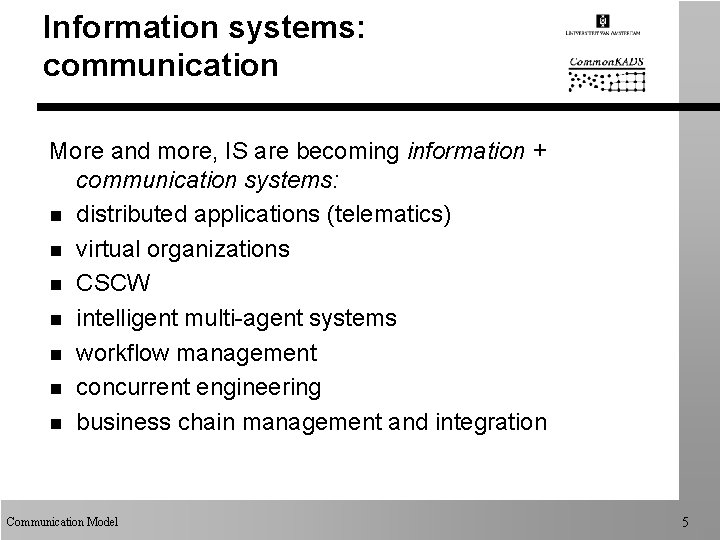
Information systems: communication More and more, IS are becoming information + communication systems: n distributed applications (telematics) n virtual organizations n CSCW n intelligent multi-agent systems n workflow management n concurrent engineering n business chain management and integration Communication Model 5
Communication between actors n Information modeling must cover: – Organizational/Business analysis – Task/Workplace analysis – Actor/Agent analysis (both human and system) n Usually, several actors cooperate in a business process or task, so – Communication model intends to capture agent interactions within a joint task n Communication Model = conceptual specification of: what kind of information objects are exchanged between agents in cooperating in and carrying out a task, and how? Communication Model 6
Communication model: overview Focuses on modeling the dialogue between agents Structured, semiformal approach Communication Model 7
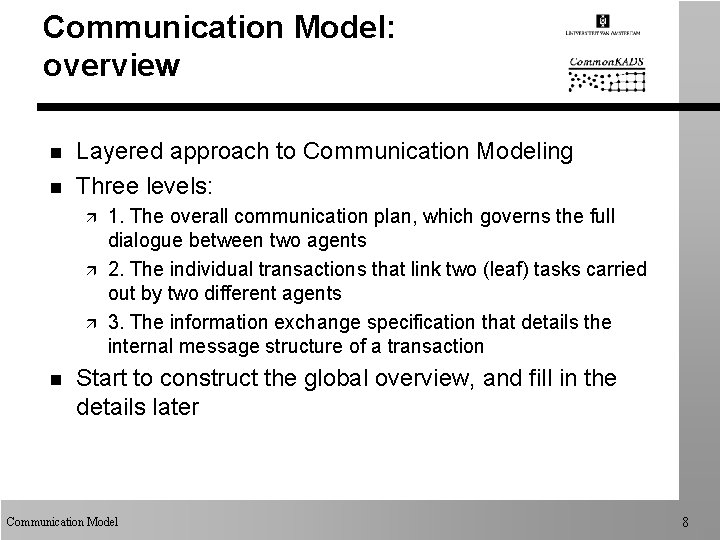
Communication Model: overview n n Layered approach to Communication Modeling Three levels: ä ä ä n 1. The overall communication plan, which governs the full dialogue between two agents 2. The individual transactions that link two (leaf) tasks carried out by two different agents 3. The information exchange specification that details the internal message structure of a transaction Start to construct the global overview, and fill in the details later Communication Model 8
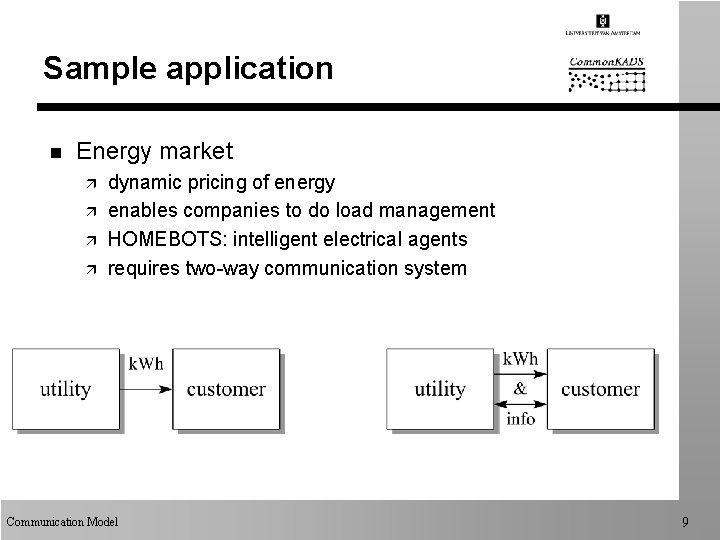
Sample application n Energy market ä ä dynamic pricing of energy enables companies to do load management HOMEBOTS: intelligent electrical agents requires two-way communication system Communication Model 9
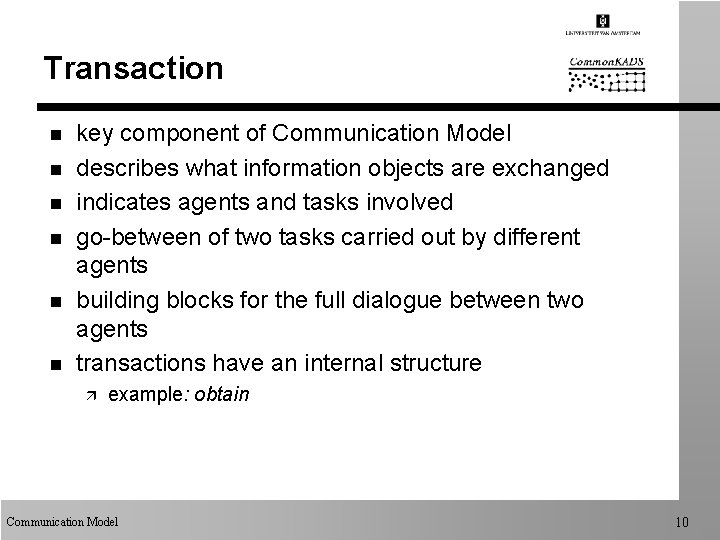
Transaction n n n key component of Communication Model describes what information objects are exchanged indicates agents and tasks involved go-between of two tasks carried out by different agents building blocks for the full dialogue between two agents transactions have an internal structure ä example: obtain Communication Model 10
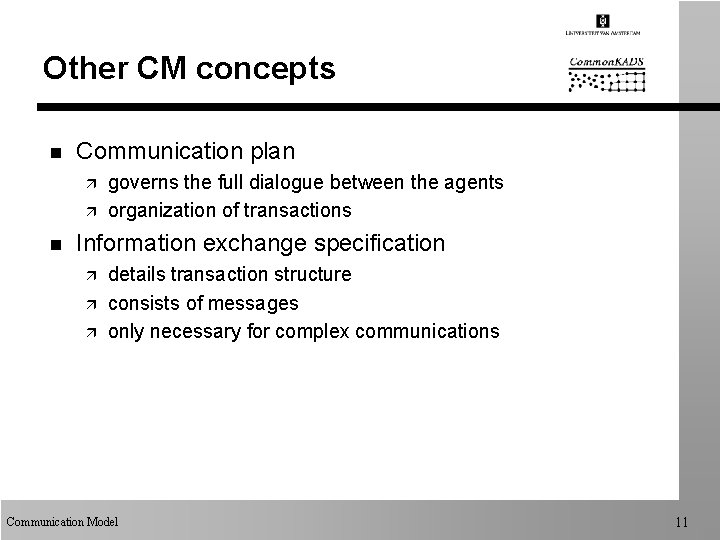
Other CM concepts n Communication plan ä ä n governs the full dialogue between the agents organization of transactions Information exchange specification ä ä ä details transaction structure consists of messages only necessary for complex communications Communication Model 11
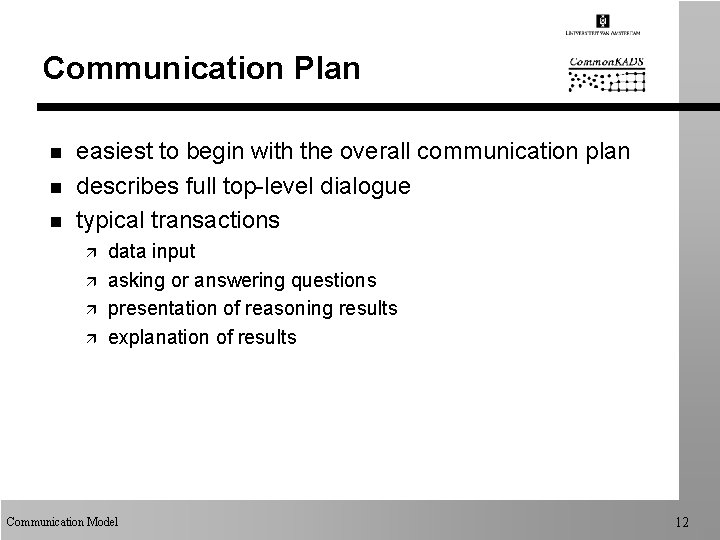
Communication Plan n easiest to begin with the overall communication plan describes full top-level dialogue typical transactions ä ä data input asking or answering questions presentation of reasoning results explanation of results Communication Model 12
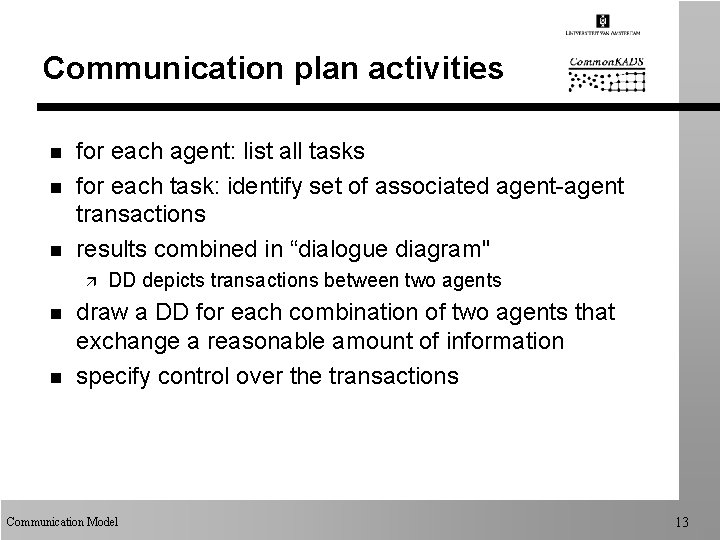
Communication plan activities n n n for each agent: list all tasks for each task: identify set of associated agent-agent transactions results combined in “dialogue diagram" ä n n DD depicts transactions between two agents draw a DD for each combination of two agents that exchange a reasonable amount of information specify control over the transactions Communication Model 13
Dialogue Diagram: general structure Note: agent's (leaf) tasks are key entry to dialogue diagram construction Communication Model 14
New Customer Services: ICT Technology n Through networked microprocessors, devices can 'talk to', 'negotiate', 'make decisions', and 'cooperate' with one another. – Smart equipment agents we call homebots (inspired by Star Trek and Asimow's Robot Stories) n n We use this, e. g. , for distributed power load management (Further info: see separate case) Benefits: – handles much larger scale – higher degree of automation & decentralized flexible approach – proactive for the customer Communication Model 15
DD for energy market Task and transaction links in power auction are graphically sketched in the dialogue diagram: Gives overview of the system's communication plan Communication Model 16
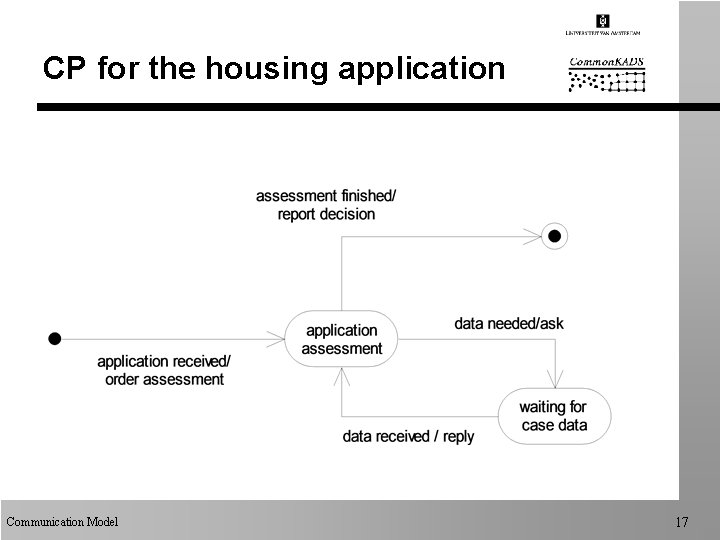
CP for the housing application Communication Model 17
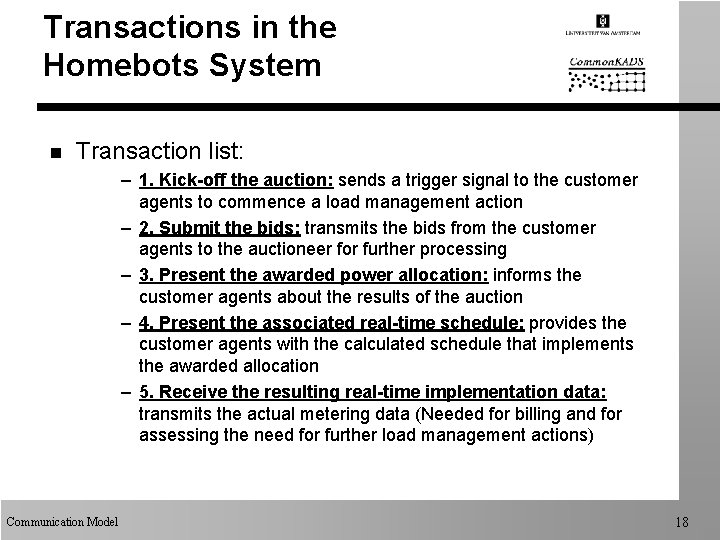
Transactions in the Homebots System n Transaction list: – 1. Kick-off the auction: sends a trigger signal to the customer agents to commence a load management action – 2. Submit the bids: transmits the bids from the customer agents to the auctioneer for further processing – 3. Present the awarded power allocation: informs the customer agents about the results of the auction – 4. Present the associated real-time schedule: provides the customer agents with the calculated schedule that implements the awarded allocation – 5. Receive the resulting real-time implementation data: transmits the actual metering data (Needed for billing and for assessing the need for further load management actions) Communication Model 18
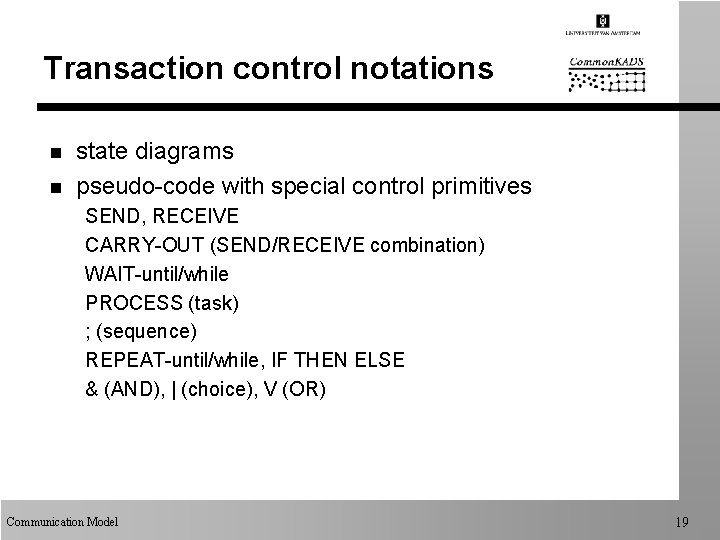
Transaction control notations n n state diagrams pseudo-code with special control primitives SEND, RECEIVE CARRY-OUT (SEND/RECEIVE combination) WAIT-until/while PROCESS (task) ; (sequence) REPEAT-until/while, IF THEN ELSE & (AND), | (choice), V (OR) Communication Model 19
Homebots Dialogue Control Communication Model 20
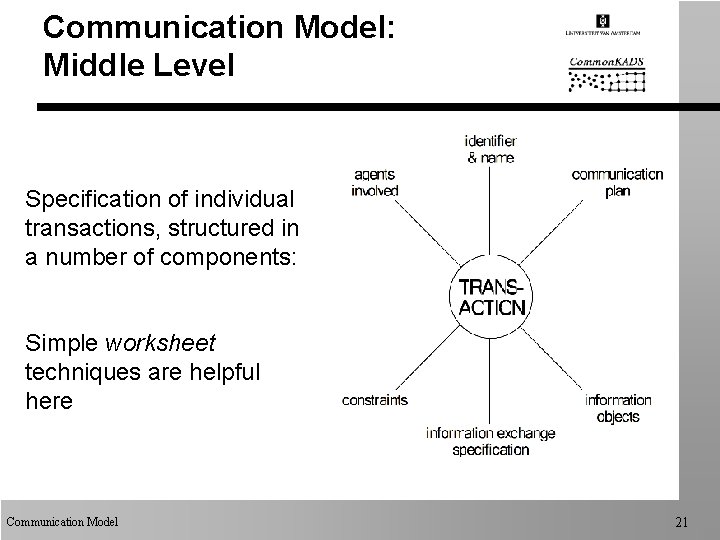
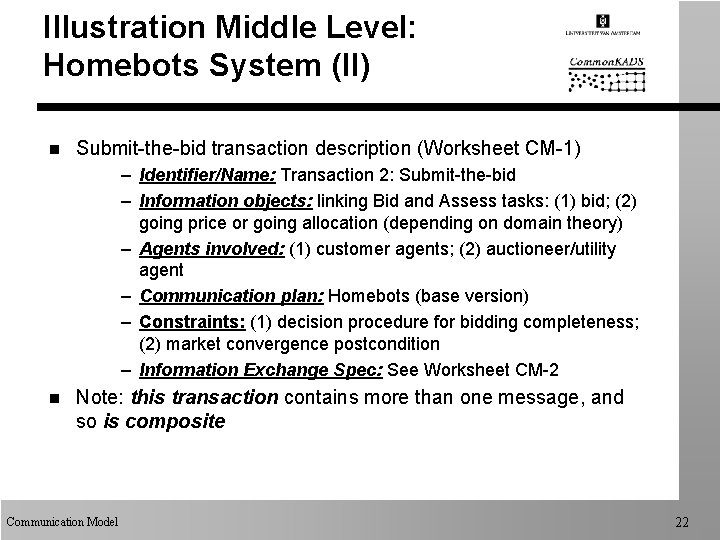
Communication Model: Middle Level Specification of individual transactions, structured in a number of components: Simple worksheet techniques are helpful here Communication Model 21
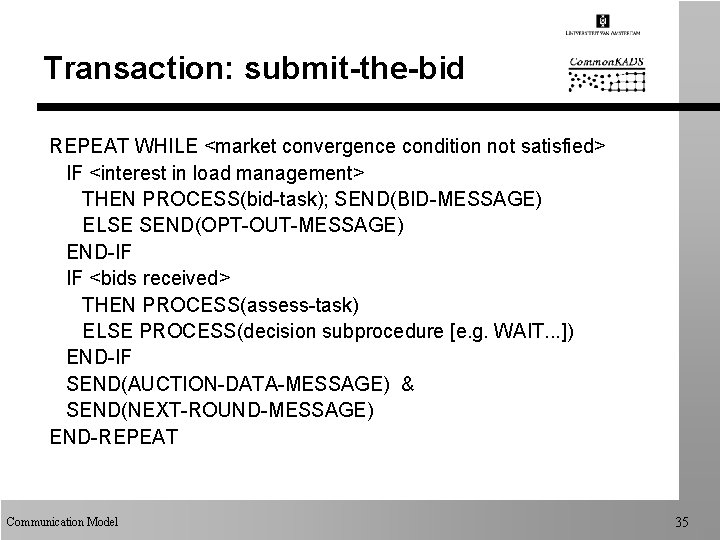
Illustration Middle Level: Homebots System (II) n Submit-the-bid transaction description (Worksheet CM-1) – Identifier/Name: Transaction 2: Submit-the-bid – Information objects: linking Bid and Assess tasks: (1) bid; (2) going price or going allocation (depending on domain theory) – Agents involved: (1) customer agents; (2) auctioneer/utility agent – Communication plan: Homebots (base version) – Constraints: (1) decision procedure for bidding completeness; (2) market convergence postcondition – Information Exchange Spec: See Worksheet CM-2 n Note: this transaction contains more than one message, and so is composite Communication Model 22
Transaction “Housing” (1) Communication Model 23
Transaction “Housing” (2) Communication Model 24
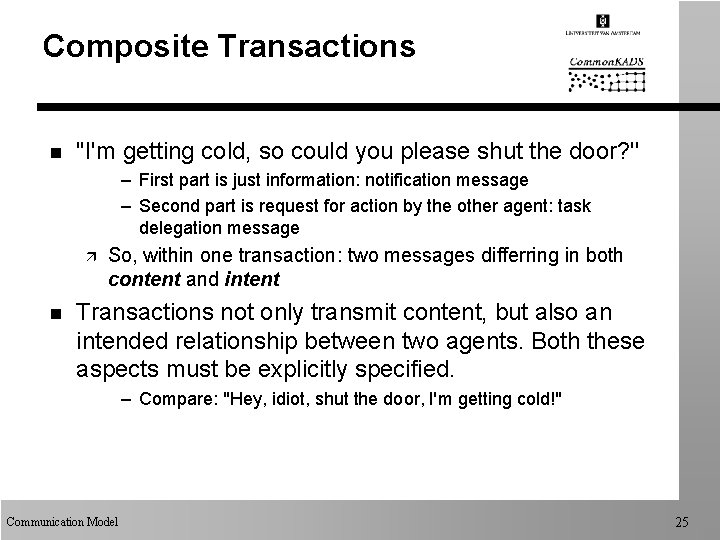
Composite Transactions n "I'm getting cold, so could you please shut the door? '' – First part is just information: notification message – Second part is request for action by the other agent: task delegation message ä n So, within one transaction: two messages differring in both content and intent Transactions not only transmit content, but also an intended relationship between two agents. Both these aspects must be explicitly specified. – Compare: "Hey, idiot, shut the door, I'm getting cold!" Communication Model 25
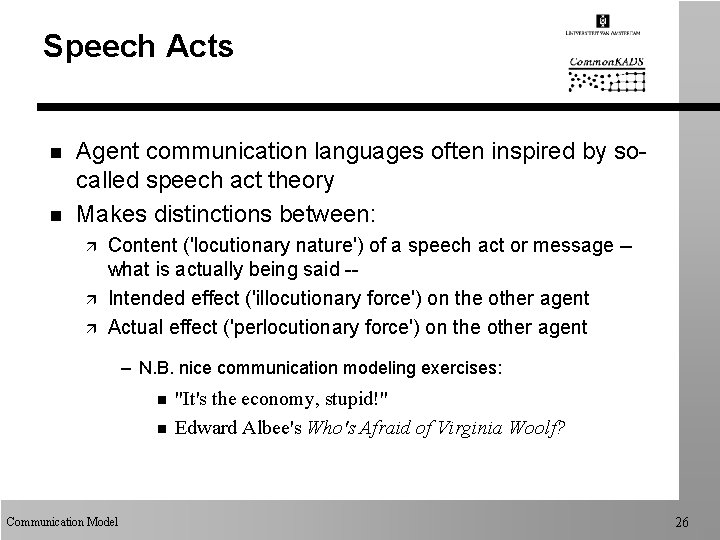
Speech Acts n n Agent communication languages often inspired by socalled speech act theory Makes distinctions between: ä ä ä Content ('locutionary nature') of a speech act or message -what is actually being said -Intended effect ('illocutionary force') on the other agent Actual effect ('perlocutionary force') on the other agent – N. B. nice communication modeling exercises: n n Communication Model "It's the economy, stupid!'' Edward Albee's Who's Afraid of Virginia Woolf? 26
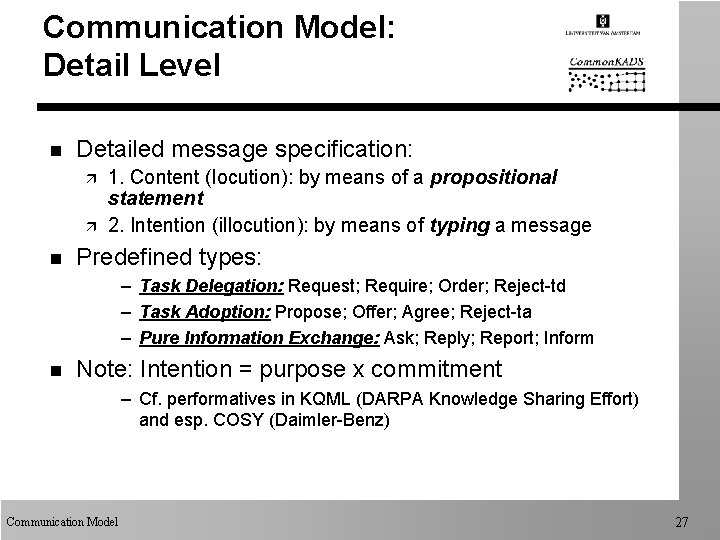
Communication Model: Detail Level n Detailed message specification: ä ä n 1. Content (locution): by means of a propositional statement 2. Intention (illocution): by means of typing a message Predefined types: – Task Delegation: Request; Require; Order; Reject-td – Task Adoption: Propose; Offer; Agree; Reject-ta – Pure Information Exchange: Ask; Reply; Report; Inform n Note: Intention = purpose x commitment – Cf. performatives in KQML (DARPA Knowledge Sharing Effort) and esp. COSY (Daimler-Benz) Communication Model 27
Communication types Communication Model 28
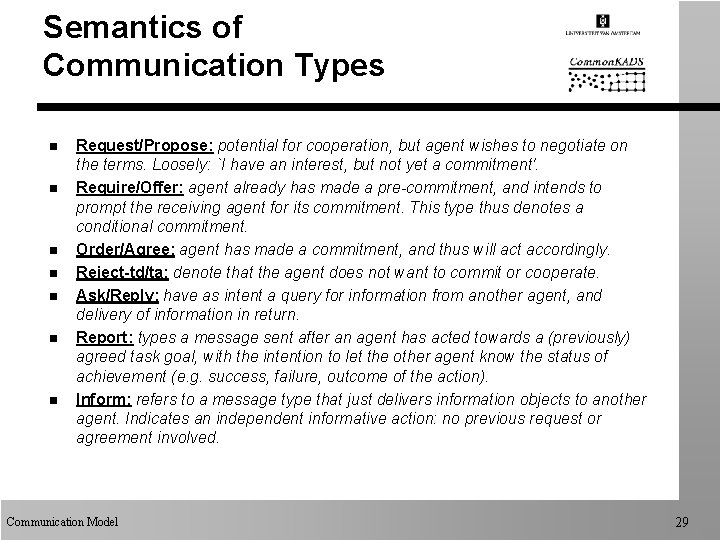
Semantics of Communication Types n n n n Request/Propose: potential for cooperation, but agent wishes to negotiate on the terms. Loosely: `I have an interest, but not yet a commitment'. Require/Offer: agent already has made a pre-commitment, and intends to prompt the receiving agent for its commitment. This type thus denotes a conditional commitment. Order/Agree: agent has made a commitment, and thus will act accordingly. Reject-td/ta: denote that the agent does not want to commit or cooperate. Ask/Reply: have as intent a query for information from another agent, and delivery of information in return. Report: types a message sent after an agent has acted towards a (previously) agreed task goal, with the intention to let the other agent know the status of achievement (e. g. success, failure, outcome of the action). Inform: refers to a message type that just delivers information objects to another agent. Indicates an independent informative action: no previous request or agreement involved. Communication Model 29
Typed Message Patterns Not only typing of single messages possible. Also, natural chains of message types can be formed (cf. COSY): Communication Patterns Communication Model 30
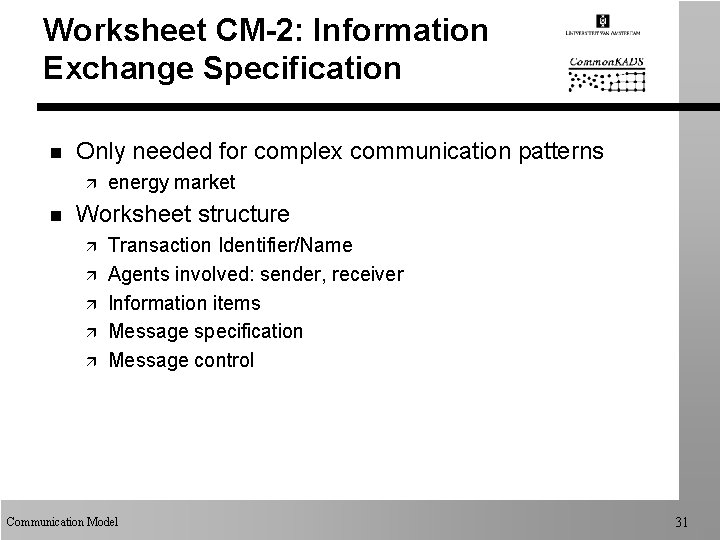
Worksheet CM-2: Information Exchange Specification n Only needed for complex communication patterns ä n energy market Worksheet structure ä ä ä Transaction Identifier/Name Agents involved: sender, receiver Information items Message specification Message control Communication Model 31
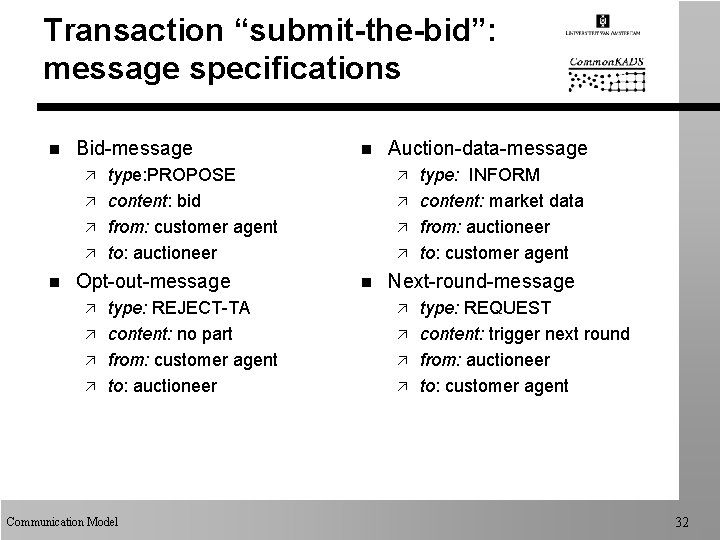
Transaction “submit-the-bid”: message specifications n Bid-message ä ä n type: PROPOSE content: bid from: customer agent to: auctioneer Opt-out-message ä ä n type: REJECT-TA content: no part from: customer agent to: auctioneer Communication Model Auction-data-message ä ä n type: INFORM content: market data from: auctioneer to: customer agent Next-round-message ä ä type: REQUEST content: trigger next round from: auctioneer to: customer agent 32
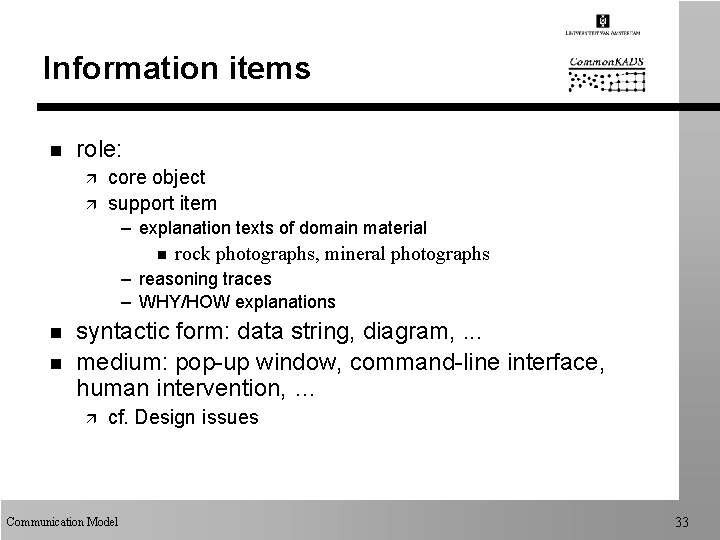
Information items n role: ä ä core object support item – explanation texts of domain material n rock photographs, mineral photographs – reasoning traces – WHY/HOW explanations n n syntactic form: data string, diagram, . . . medium: pop-up window, command-line interface, human intervention, … ä cf. Design issues Communication Model 33
Control over messages n n Refinement of control in communication plan Notations: the same ä ä State diagram Pseudo code Communication Model 34
Transaction: submit-the-bid REPEAT WHILE <market convergence condition not satisfied> IF <interest in load management> THEN PROCESS(bid-task); SEND(BID-MESSAGE) ELSE SEND(OPT-OUT-MESSAGE) END-IF IF <bids received> THEN PROCESS(assess-task) ELSE PROCESS(decision subprocedure [e. g. WAIT. . . ]) END-IF SEND(AUCTION-DATA-MESSAGE) & SEND(NEXT-ROUND-MESSAGE) END-REPEAT Communication Model 35
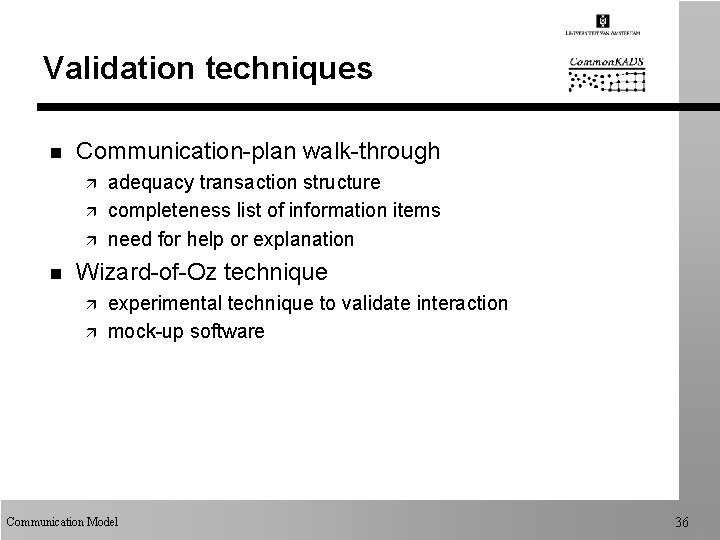
Validation techniques n Communication-plan walk-through ä ä ä n adequacy transaction structure completeness list of information items need for help or explanation Wizard-of-Oz technique ä ä experimental technique to validate interaction mock-up software Communication Model 36
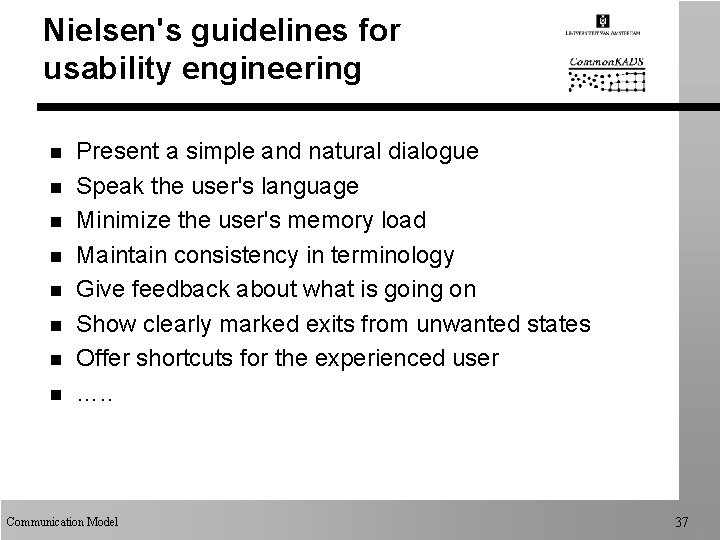
Nielsen's guidelines for usability engineering n n n n Present a simple and natural dialogue Speak the user's language Minimize the user's memory load Maintain consistency in terminology Give feedback about what is going on Show clearly marked exits from unwanted states Offer shortcuts for the experienced user …. . Communication Model 37
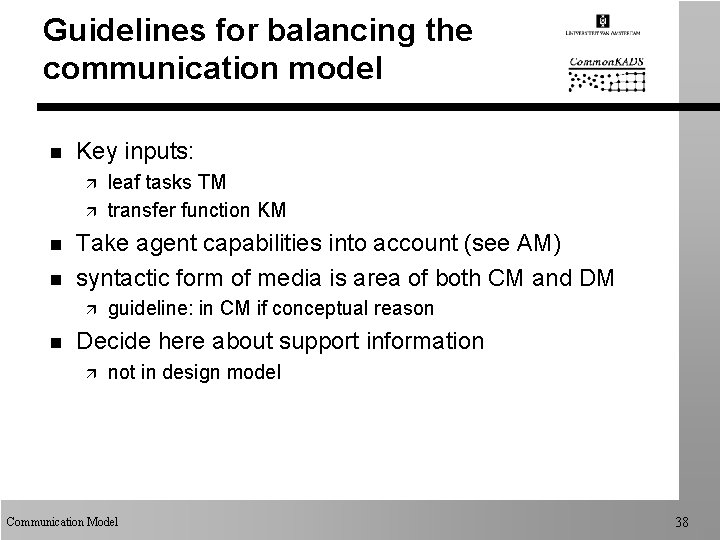
Guidelines for balancing the communication model n Key inputs: ä ä n n Take agent capabilities into account (see AM) syntactic form of media is area of both CM and DM ä n leaf tasks TM transfer function KM guideline: in CM if conceptual reason Decide here about support information ä not in design model Communication Model 38
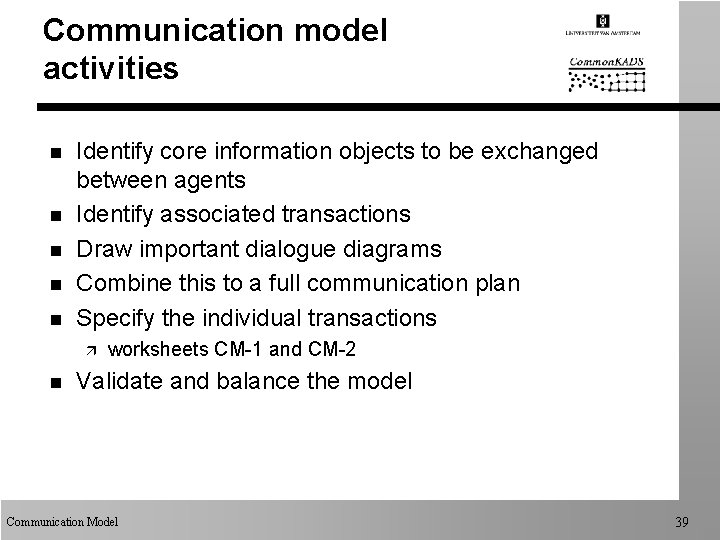
Communication model activities n n n Identify core information objects to be exchanged between agents Identify associated transactions Draw important dialogue diagrams Combine this to a full communication plan Specify the individual transactions ä n worksheets CM-1 and CM-2 Validate and balance the model Communication Model 39