
Communication Language Literacy What does this mean for
- Slides: 11
Communication, Language & Literacy What does this mean for the preschool child? The Ultimate Guide to Mark Making in the Early Years © Sue Cowley, 2019
Purpose of the Workshop ü To explore how the preschool child develops communication, language and literacy skills ü To give parents/carers information about why language delay happens ü To give parents/carers information about the activities provided at preschool ü To help parents/carers support their child’s language development at home The Ultimate Guide to Mark Making in the Early Years © Sue Cowley, 2019
The Importance of Communication • 50% of children are starting school with weak language skills • Language delay at this age can lead to problems later on in a child’s education • Early intervention can overcome any difficulties • The home environment is a key factor for success in developing language skills The Ultimate Guide to Mark Making in the Early Years © Sue Cowley, 2019
Typical Developmental Milestones • Children all develop at different rates, but … • 12 -15 months – babbling with a wide range of sounds (b, p, m, d, n), one or more words • 18 -24 months – 20 words by 18 months, 50 or more words by 24 months • 2 -3 years – too many words to count, can combine three or more words in sentences, produces words/phrases spontaneously, rather than imitating or using gestures The Ultimate Guide to Mark Making in the Early Years © Sue Cowley, 2019
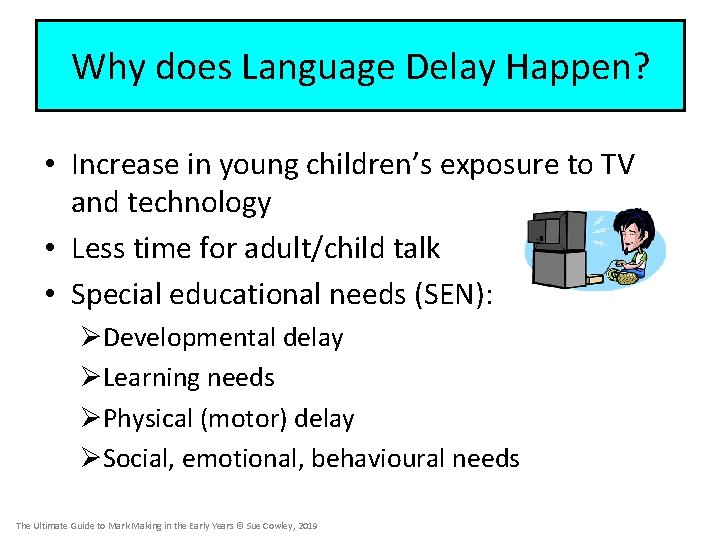
Why does Language Delay Happen? • Increase in young children’s exposure to TV and technology • Less time for adult/child talk • Special educational needs (SEN): ØDevelopmental delay ØLearning needs ØPhysical (motor) delay ØSocial, emotional, behavioural needs The Ultimate Guide to Mark Making in the Early Years © Sue Cowley, 2019
Language and SEN • SEN does not mean your child has something ‘wrong’ with them – it just means they would benefit from additional support in education • Young children’s brains develop quickly – early intervention is crucial for later success • Language delay can be caused by a variety of special educational needs – hearing issues, motor difficulties, social or emotional needs The Ultimate Guide to Mark Making in the Early Years © Sue Cowley, 2019
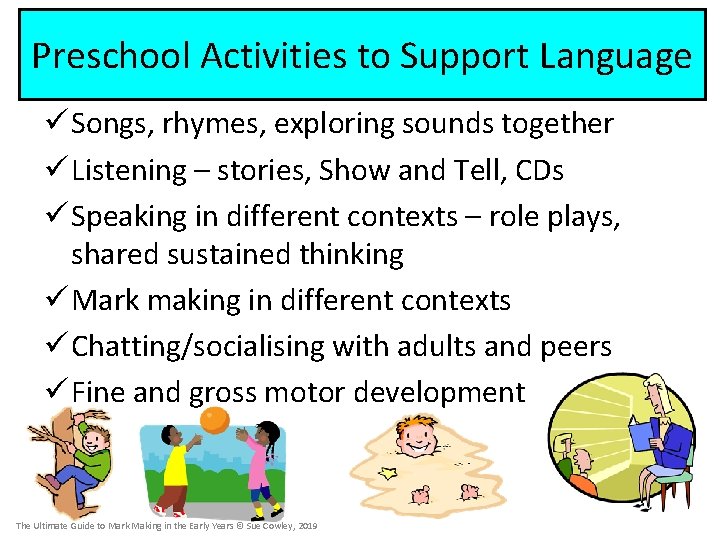
Preschool Activities to Support Language ü Songs, rhymes, exploring sounds together ü Listening – stories, Show and Tell, CDs ü Speaking in different contexts – role plays, shared sustained thinking ü Mark making in different contexts ü Chatting/socialising with adults and peers ü Fine and gross motor development The Ultimate Guide to Mark Making in the Early Years © Sue Cowley, 2019
Beginning to Write ü Children need to develop their motor skills, before they can learn to write ‘properly’ ü Gross motor – climbing, balancing, throwing – large whole body movements – lines, curves ü Fine motor – picking up, threading, holding a brush – small, finger and wrist movements ü Boys typically begin to write later than girls, but develop more quickly in other areas The Ultimate Guide to Mark Making in the Early Years © Sue Cowley, 2019
Learning to Read - Phonics ü Children need to learn to hear the individual sounds within words ü Phonemes = sounds (letter/group of letters) ü Blending sounds together to make words – CVC words ‘cat’ (consonant/vowel/consonant) ü Talk about the sound of letters, rather than the name ü So, not ‘See’ for ‘C’ but ‘Kuh’ for the sound it makes when it’s in a word The Ultimate Guide to Mark Making in the Early Years © Sue Cowley, 2019
Supporting Your Child at Home ü Read stories and talk together as much as possible ü Support them in making sounds correctly ü Use facial expression and vocal tone, e. g. put a pleased tone in your voice, widen your eyes ü ‘Model’ talk for your child, for instance talking through an activity as you do it together ü Use a rich and varied vocabulary – talk with your child about what words mean The Ultimate Guide to Mark Making in the Early Years © Sue Cowley, 2019
A Final Thought – Tricky Words! I take it you already know Of tough and bough and cough and dough? Others may stumble, but not you, On hiccough, thorough, plough and through? Well done! And now you wish, perhaps, To learn of less familiar traps? Beware of heard, a dreadful word That looks like beard and sounds like bird, And dead: it's said like bed, not bead – For goodness sake don't call it deed! Watch out for meat and great and threat (They rhyme with suite and straight and debt). The Ultimate Guide to Mark Making in the Early Years © Sue Cowley, 2019 A moth is not a moth in mother, Nor both in bother, broth in brother, And here is not a match for there Nor dear and fear for bear and pear, And then there's dose and rose and lose Just look them up - and goose and choose, And cork and work and card and ward, And font and front and word and sword, And do and go and thwart and cart – Come, come, I've hardly made a start! A dreadful language? Man alive! I'd mastered it when I was five!