
Communication in TQM Communication n n Is the

- Slides: 19
Communication in TQM
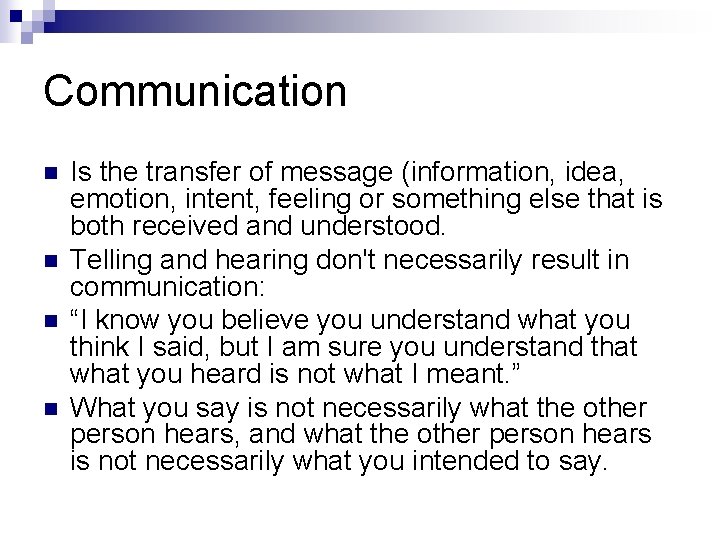
Communication n n Is the transfer of message (information, idea, emotion, intent, feeling or something else that is both received and understood. Telling and hearing don't necessarily result in communication: “I know you believe you understand what you think I said, but I am sure you understand that what you heard is not what I meant. ” What you say is not necessarily what the other person hears, and what the other person hears is not necessarily what you intended to say.
Levels of communication
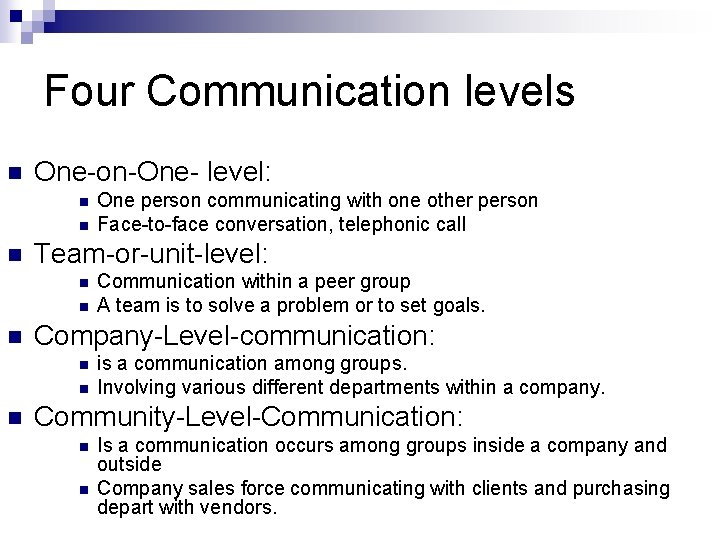
Four Communication levels n One-on-One- level: n n n Team-or-unit-level: n n n Communication within a peer group A team is to solve a problem or to set goals. Company-Level-communication: n n n One person communicating with one other person Face-to-face conversation, telephonic call is a communication among groups. Involving various different departments within a company. Community-Level-Communication: n n Is a communication occurs among groups inside a company and outside Company sales force communicating with clients and purchasing depart with vendors.
Role of communication in TQ n n n Communication works as a oil in the engine of TQ and keep it running. Total quality mostly depends on effective communication. Key elements of total quality regarding communication are ¨ ¨ ¨ ¨ Customer focus Employee involvement and empowerment Leadership Teamwork Decision making Problem solving Conflict resolution.
Problems of communication
Problem of communication n Difference in meaning: n n n External distraction through atmosphere, satellite communication Condescending tone: n n Trust b/w sender and receiver can cause problem Information overload: Interference: n n Due to different backgrounds Level of education and Culture Lack of Trust: n n Y Don't want to talk down to employees in the organization Premature judgments Inaccurate assumptions Kill-the-messenger condition: n It is the situation When an employee tells the hard truth the management kill the messenger.
Establishing a Unfavorable communication climate
Unfavorable communication occurs Communicating with peers and employees as little as possible n Speak in generalities n Communicating with only few selected individuals n Limiting employee access n Communicating only when it is personally advantageous n Ignoring the good ideas. n
Listening
Listening Hearing is natural process but listening is not n Sensitive hearing abilities may be a poor listeners n Hearing is the physiological decoding of sound waves n Listening involves perception n Good listening means receiving the message, correctly decoding it, and accurately perceiving what it means n
Problems of effective listening n Lack of concentration n n Interruption Preconceived ideas n Thinking ahead n Interference
Listening empathically n n Empathic Listening means listening with the intent to understand Steps for such listening R ¨ Remove all disturbance ¨ Put the speaker at ease ¨ Look directly at the speaker ¨ Concentrate on what is being said ¨ Watch nonverbal cues ¨ Be patient and wait ¨ Ask clarifying questions ¨ No matter what is said
Improving listening skills n Managers have to apply following strategies for improving their listening skills Upgrading the desire to listen n Ask the right question n Judge what is really being said n Eliminate listening errors. n
Communicating in writing
Strategies for improved written communication Following are the strategies n Plan before you write n Be Brief n Be direct n Be accurate n Practice self-editing n
Strategies for improving communication skills
Strategies for improving communication skills Keep up to date n Determine time constraints n Decide whom to inform n Determine how to communicate n Communicate and fallow up n Check understanding and obtain feedback n
End of the topic