
Communication in Small Groups Chapter 9 Overview Presentations

- Slides: 5
Communication in Small Groups Chapter 9
Overview • Presentations • Journal #8 analysis and discussion
Journal 8 Over time, how has your group grown and developed? Reference Table 9. 1 in GIS and explore how your group’s behavior relates to the different developmental stages.
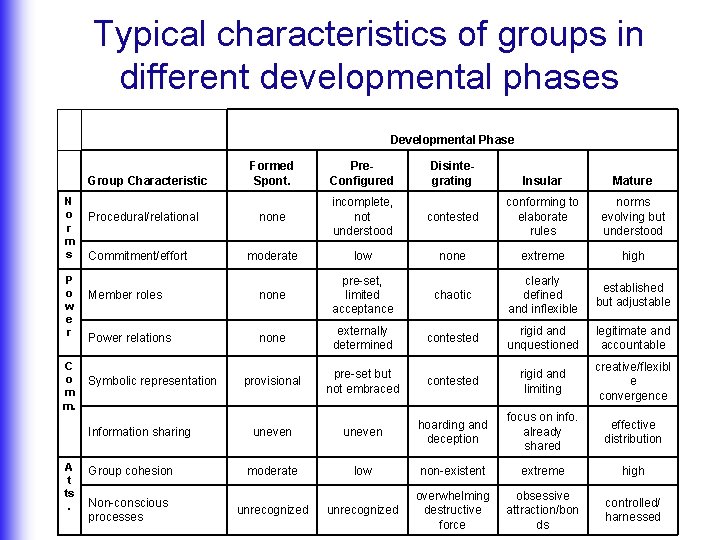
Typical characteristics of groups in different developmental phases Developmental Phase Formed Spont. Pre. Configured none incomplete, not understood moderate Member roles Power relations Group Characteristic N o r m s P o w e r C o m m. Procedural/relational Commitment/effort Symbolic representation Information sharing A t ts. Group cohesion Non-conscious processes Disintegrating Insular Mature contested conforming to elaborate rules norms evolving but understood low none extreme high none pre-set, limited acceptance chaotic clearly defined and inflexible established but adjustable none externally determined contested rigid and unquestioned legitimate and accountable provisional pre-set but not embraced contested rigid and limiting creative/flexibl e convergence uneven hoarding and deception focus on info. already shared effective distribution moderate low non-existent extreme high unrecognized overwhelming destructive force obsessive attraction/bon ds controlled/ harnessed unrecognized
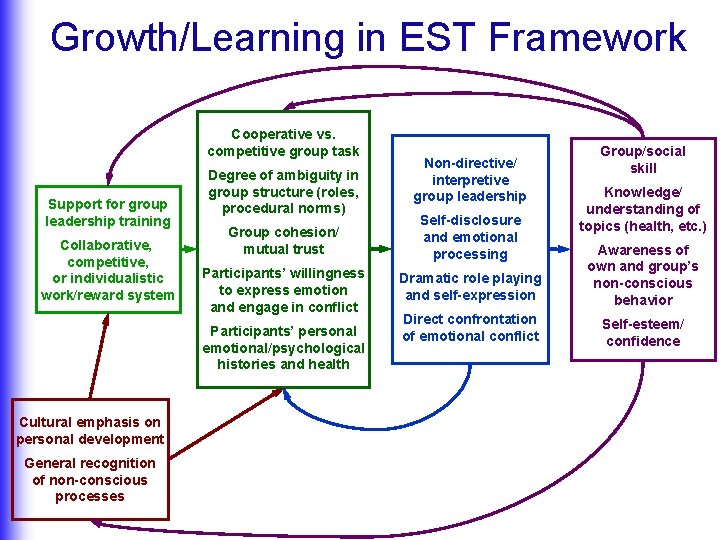
Growth/Learning in EST Framework Cooperative vs. competitive group task Support for group leadership training Collaborative, competitive, or individualistic work/reward system Degree of ambiguity in group structure (roles, procedural norms) General recognition of non-conscious processes Group/social skill Knowledge/ understanding of topics (health, etc. ) Group cohesion/ mutual trust Self-disclosure and emotional processing Participants’ willingness to express emotion and engage in conflict Dramatic role playing and self-expression Awareness of own and group’s non-conscious behavior Direct confrontation of emotional conflict Self-esteem/ confidence Participants’ personal emotional/psychological histories and health Cultural emphasis on personal development Non-directive/ interpretive group leadership