
Communication in Small Groups Chapter 2 Groups Fundamental








- Slides: 12
Communication in Small Groups Chapter 2
Groups Fundamental to Civilization • Evolutionary downsides – Parasites and disease – “Free riders” exploiting the group • Evolutionary upsides – Defense against enemies – Team hunting/foraging strategies – Labor specialization • Indirect results – Development of language, brain – Cultural development • Responsiveness to moral persuasion • Attunement to group identity
The Concept of a Group Archetype • Key features – Image or model of a particular group type – Idealized as following routine patterns, having regularized behavior – Has a common name in the vernacular • Socially situated – Product of a particular society – Exists in a well-suited institutional/cultural niche
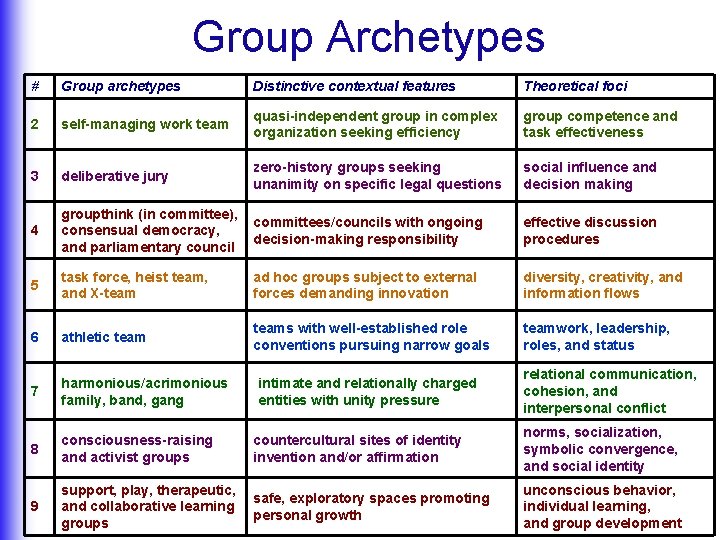
Group Archetypes # Group archetypes Distinctive contextual features Theoretical foci 2 self-managing work team quasi-independent group in complex organization seeking efficiency group competence and task effectiveness 3 deliberative jury zero-history groups seeking unanimity on specific legal questions social influence and decision making 4 groupthink (in committee), consensual democracy, and parliamentary council committees/councils with ongoing decision-making responsibility effective discussion procedures 5 task force, heist team, and X-team ad hoc groups subject to external forces demanding innovation diversity, creativity, and information flows 6 athletic teams with well-established role conventions pursuing narrow goals teamwork, leadership, roles, and status 7 harmonious/acrimonious family, band, gang 8 consciousness-raising and activist groups countercultural sites of identity invention and/or affirmation norms, socialization, symbolic convergence, and social identity 9 support, play, therapeutic, and collaborative learning groups safe, exploratory spaces promoting personal growth unconscious behavior, individual learning, and group development intimate and relationally charged entities with unity pressure relational communication, cohesion, and interpersonal conflict
Inventory of Journal Groups (Optional: Turning. Point Assessment of Journal Groups)
Empirical Theory vs. Framework • Empirical theory – Falsifiable hypotheses – Varying degrees of validity • Theoretical framework – Core claims closer to axioms – Provides solid foundation – Foregrounds key connections – Juxtaposes or integrates theories
Input-Process-Output Linear Model INPUT Tasks and/or purpose Group structure Member characteristics and beliefs PROCESS OUTPUT Group interaction Group decisions and records Cognitive/ emotional processing Subjective member assessments
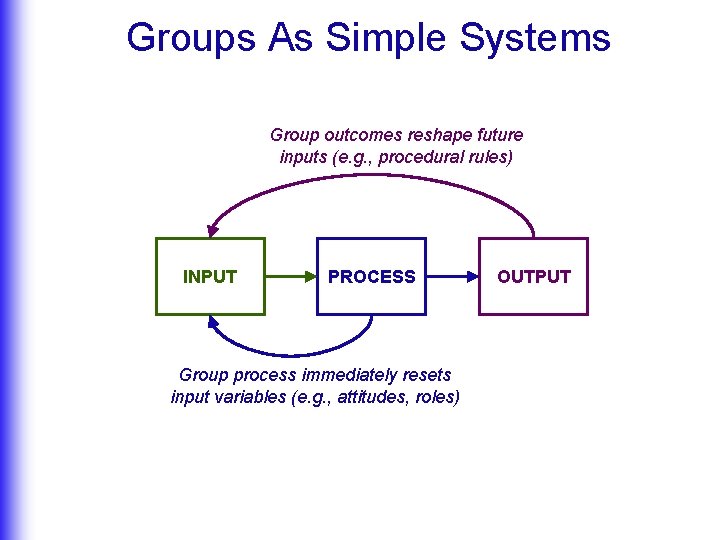
Groups As Simple Systems Group outcomes reshape future inputs (e. g. , procedural rules) INPUT PROCESS Group process immediately resets input variables (e. g. , attitudes, roles) OUTPUT
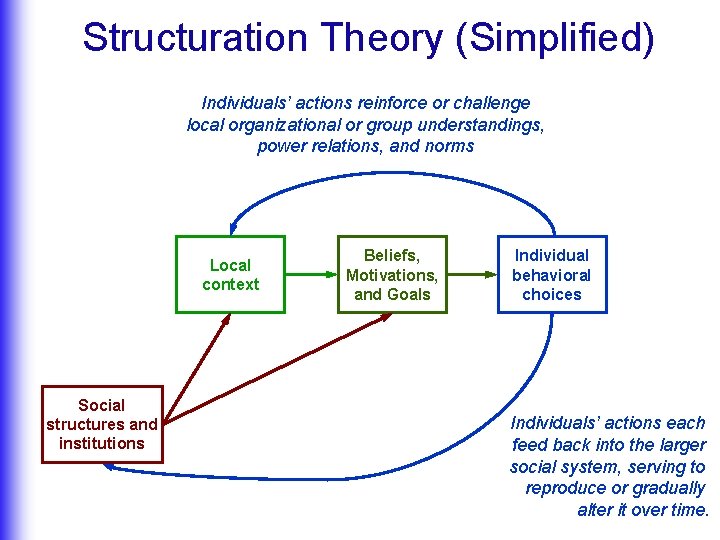
Structuration Theory (Simplified) Individuals’ actions reinforce or challenge local organizational or group understandings, power relations, and norms Local context Social structures and institutions Beliefs, Motivations, and Goals Individual behavioral choices Individuals’ actions each feed back into the larger social system, serving to reproduce or gradually alter it over time.
Embedded System Framework Tasks and/or purpose Local context Social system Group structure Member goals, beliefs, and characteristics Group interaction Cognitive and emotional processing Group decisions and records Subjective member assessments
Application of the Embedded System Framework to Self-Managed Work Teams 5 4 Administrative support 6 Clarity of group roles 1 Information transfer Discussion quality Knowledge, skills, and motivation Group effort 7 8 2 Consumer pressure Legal environment 9 3 Effective delivery of health care Respect/ cohesion