
COMMUNICATION IN MEDICAL SETTINGS PATIENTPRACTITIONER RELATIONSHIP DR AMINA
- Slides: 16
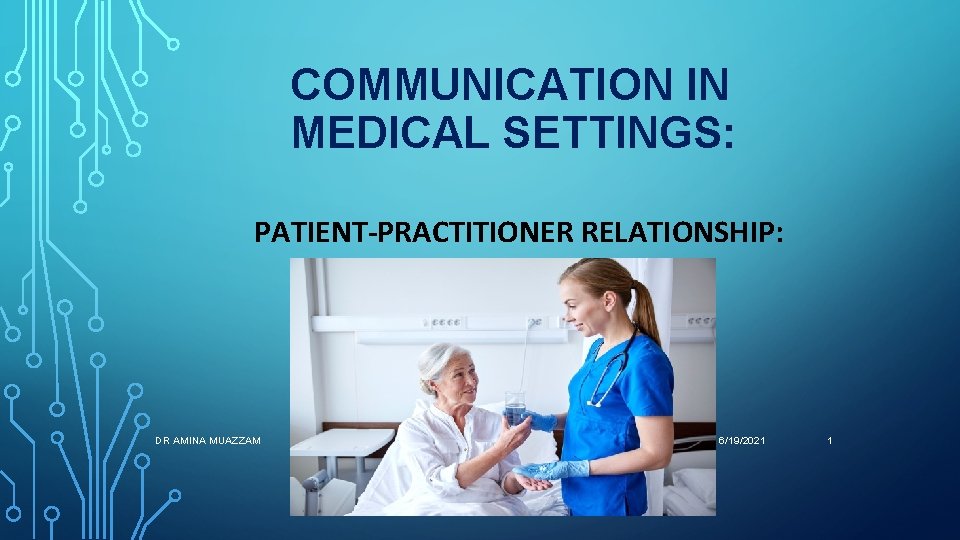
COMMUNICATION IN MEDICAL SETTINGS: PATIENT-PRACTITIONER RELATIONSHIP: DR AMINA MUAZZAM 6/19/2021 1
DEFINITION: All the interactions between a patient and a health care professional. These Interactions establish the basis for interpersonal trust, compliance, and satisfaction. (Medical Dictionary, 2009) William Osler said: “The good physician treats the disease the great physician treats the patient who has the disease” DR AMINA MUAZZAM 6/19/2021 2
HOW PATIENT DOCTOR RELATIONSHIP EVOLVED? • The relationship between patient and doctor has been analyzed since the early 1900's. • Parsons was the earliest sociologist to examine the doctor-patient relationship. He regarded illness as a form of social deviance (impairs normal role performance, affects smooth functioning of the society). • In the middle of the century when science and technology emerged, interpersonal aspects of health care were overshadowed. There is now a renewed interest in medicine as a social process. A doctor can do as much harm to a patient with the slip of a word as DR AMINA MUAZZAM 6/19/2021 3
WHAT IS DOCTOR- PATIENT RELATIONSHIP? • It is the ability to gather information in order to facilitate: • accurate diagnosis • counsel appropriately • give therapeutic instructions • establish caring relationships with patients DR AMINA MUAZZAM 6/19/2021 4
MAIN COMPONENTS OF DOCTOR-PATIENT RELATIONSHIP: • The doctor-patient relationship crosses two dimensions: • instrumental • Expressive DR AMINA MUAZZAM 6/19/2021 5
CONTINUE… • Instrumental: It is the competence of the doctor in performing the technical aspects of care such as: • performing diagnostic tests • physical examinations • prescribing treatments Expressive component: The expressive component reflects the art of medicine, including the affective portion of the interaction such as warmth and empathy, and how the doctor approaches the patient. DR AMINA MUAZZAM 6/19/2021 6
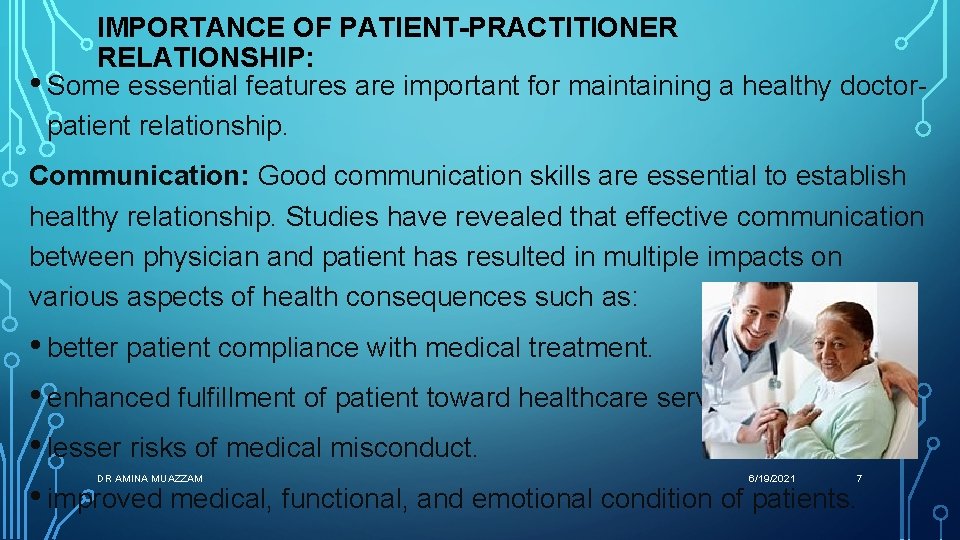
IMPORTANCE OF PATIENT-PRACTITIONER RELATIONSHIP: • Some essential features are important for maintaining a healthy doctorpatient relationship. Communication: Good communication skills are essential to establish healthy relationship. Studies have revealed that effective communication between physician and patient has resulted in multiple impacts on various aspects of health consequences such as: • better patient compliance with medical treatment. • enhanced fulfillment of patient toward healthcare services. • lesser risks of medical misconduct. • improved medical, functional, and emotional condition of patients. DR AMINA MUAZZAM 6/19/2021 7
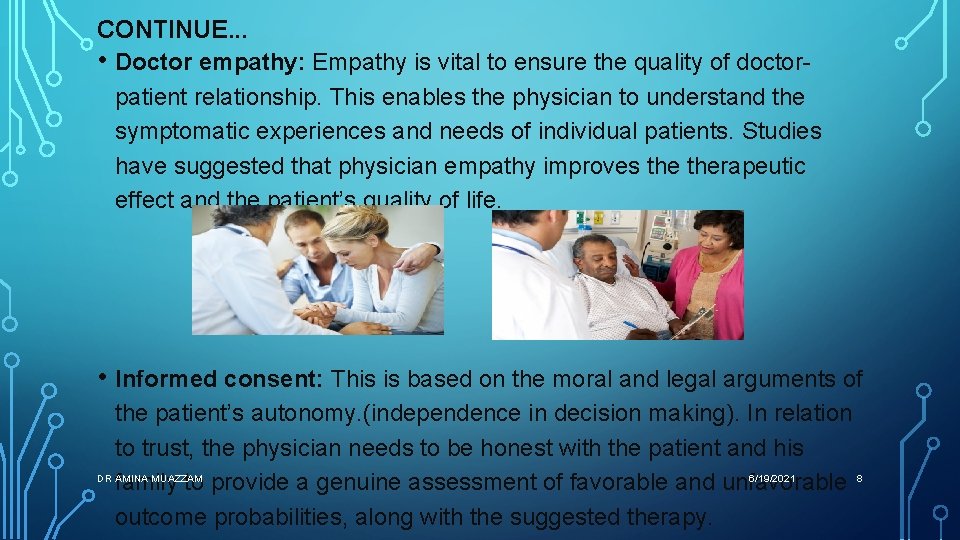
CONTINUE. . . • Doctor empathy: Empathy is vital to ensure the quality of doctorpatient relationship. This enables the physician to understand the symptomatic experiences and needs of individual patients. Studies have suggested that physician empathy improves therapeutic effect and the patient’s quality of life. • Informed consent: This is based on the moral and legal arguments of the patient’s autonomy. (independence in decision making). In relation to trust, the physician needs to be honest with the patient and his 8 DR AMINA MUAZZAM 6/19/2021 family to provide a genuine assessment of favorable and unfavorable outcome probabilities, along with the suggested therapy.
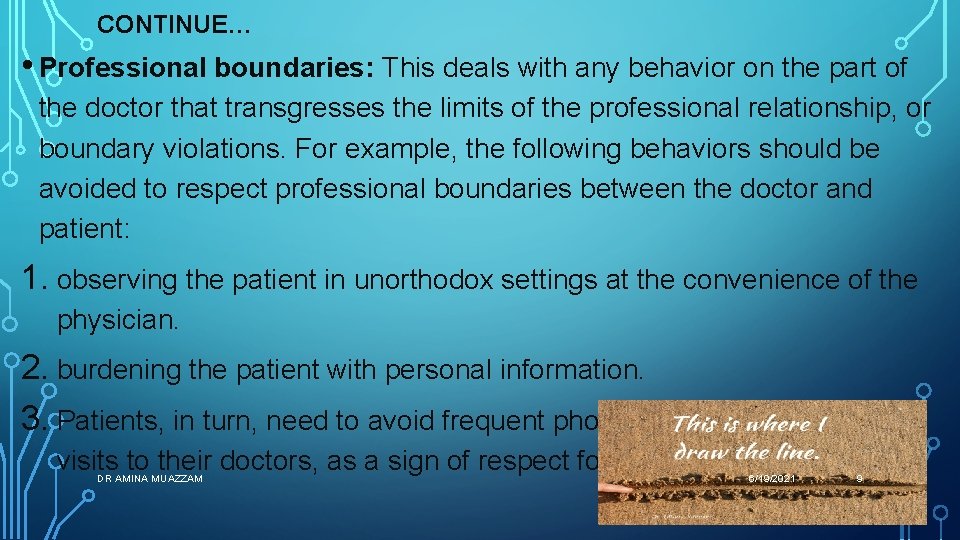
CONTINUE… • Professional boundaries: This deals with any behavior on the part of the doctor that transgresses the limits of the professional relationship, or boundary violations. For example, the following behaviors should be avoided to respect professional boundaries between the doctor and patient: 1. observing the patient in unorthodox settings at the convenience of the physician. 2. burdening the patient with personal information. 3. Patients, in turn, need to avoid frequent phone calls and unscheduled visits to their doctors, as a sign of respect for their time. DR AMINA MUAZZAM 6/19/2021 9
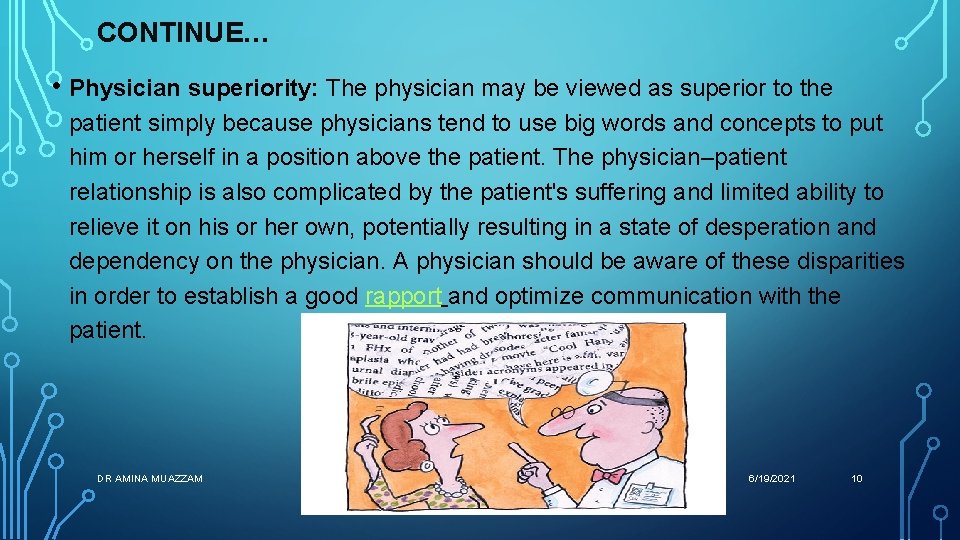
CONTINUE… • Physician superiority: The physician may be viewed as superior to the patient simply because physicians tend to use big words and concepts to put him or herself in a position above the patient. The physician–patient relationship is also complicated by the patient's suffering and limited ability to relieve it on his or her own, potentially resulting in a state of desperation and dependency on the physician. A physician should be aware of these disparities in order to establish a good rapport and optimize communication with the patient. DR AMINA MUAZZAM 6/19/2021 10
CONTINUE… • Chronic health: Physicians who communicate well and treat patients with chronic illnesses fairly improve the patient’s ability to manage their disease independently with adherence to the advice of doctors. For example, patients monitor their blood pressure and adhere to medical regimens as per the advice of the doctor to manage. • Psychiatry: Doctor patient relationship helps in good therapeutic outcomes in the field of psychiatry. The psychiatrist–patient relationship enables psychosomatic patients to overcome the mental symptoms through better rapport with them. Studies have revealed that the psychiatric symptoms in HIV patients are treated by retaining patient’s hope and giving adequate data DR AMINA MUAZZAM 6/19/2021 11
NATURE OF PATIENT-PRACTITIONER RELATIONSHIP: The Szasz-Hollender Model: The three basic models of doctorpatient relationship were proposed by Szasz and Hollender namely as: • Active-Passive model, • Guidance- Cooperation model • Mutual participation model. • The Activity-Passivity Model - Not the Best Model for Chronic Arthritis: It is the opinion of some people that the differential in power between the patient and doctor is necessary to the steady course of medical care. The patient seeks information and technical assistance, and the doctor formulates decisions which the patient DR AMINA MUAZZAM 6/19/2021 12
CONTINUE…. • Though this seems appropriate in medical emergencies, this model, known as the activity-passivity model, has lost popularity in the treatment of chronic conditions, such as rheumatoid arthritis and lupus. In this model, the doctor actively treats the patient, but the patient is passive and has no control. • The Guidance-Cooperation Model - The Most Prevalent Model: The guidance-cooperation model is the most prevalent in current medical practice. In this model, the doctor recommends a treatment and the patient cooperates. This coincides with the "doctor knows best" theory whereby the doctor is supportive and non-authoritarian, yet is responsible for choosing the appropriate treatment. The patient, having lesser power, is expected to follow the recommendations of the physician. DR AMINA MUAZZAM 6/19/2021 13
CONTINUE… • The Mutual Participation Model - Shared Responsibility: In the third model, the mutual participation model, the doctor and patient share responsibility for making decisions and planning the course of treatment. The patient and doctor are respectful of each other’s expectation, point of view, and values. Some have argued that this is the most appropriate model for chronic illnesses, such as rheumatoid arthritis and lupus, where patients are responsible for implementing their treatment and determining its efficacy • Informative/Consumer model: This is also called the consumer model. Here, the physician acts as a proficient technical expert by defining appropriate factual information about possible treatments provided for the patient and implementing the patient’s selected intervention. In this model, the patient is in charge of the decision making for his medical condition. This kind of model is 14 DR AMINA MUAZZAM 6/19/2021 justified in a patient-centered medical location.
CONTINUE… • How to improve doctor-patient communication? : There are following tips to improve the doctor patient relationship: • Be patient. • Be respectful. • Be involved. • Offer Empathy. • Validate the Patient's Feelings • Negotiate. • Cultivate Confidence. • Take Time to Prepare. • Put It in Writing. DR AMINA MUAZZAM Put Technology to Work. 6/19/2021 15
THANK YOU !! • Any questions? DR AMINA MUAZZAM 6/19/2021 16