
Communication in a Changing World 2006 Edition 5
- Slides: 21
Communication in a Changing World, 2006 Edition 5 -1 5 C H A P T E R Understanding and Shaping the World through Verbal Communication Bethami A. Dobkin Roger C. Pace Mc. Graw-Hill © 2006 The Mc. Graw-Hill Companies, Inc. All rights reserved.
5 -2 Understanding and Shaping the World through Verbal Communication • • Verbal Communication and Meaning Understanding the Meaning of Words Communicating Culture through Language Ethical Challenges in Verbal Communication • Communicating Responsibly: Managing Nonverbal Cues Effectively Mc. Graw-Hill © 2006 The Mc. Graw-Hill Companies, Inc. All rights reserved.
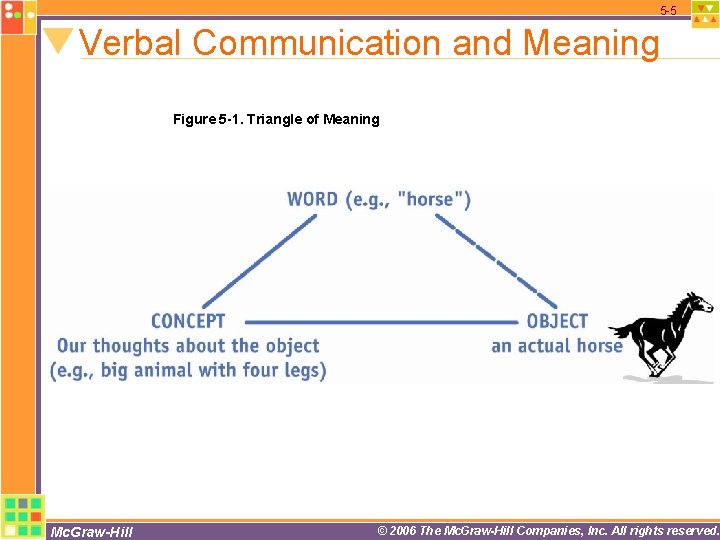
5 -3 Verbal Communication and Meaning • Words are symbolic, arbitrary, ambiguous, and changeable – Words are symbolic that allow us to talk about things without being the things themselves • Represent ides or objects and allow us to talk about them • Allows us to talk about things that do not exist Mc. Graw-Hill © 2006 The Mc. Graw-Hill Companies, Inc. All rights reserved.
5 -4 Verbal Communication and Meaning • Words are Symbolic, Arbitrary, ambiguous, and Changeable (continued) – Words are ambiguous when they do not have clear meaning • Ex: “Good” has different meanings to different people – Words are changeable if they are based on social, political, and cultural contexts, and the historical time in which they are located • Ex: “Lift” means a ride, to pick up, or an elevator Mc. Graw-Hill © 2006 The Mc. Graw-Hill Companies, Inc. All rights reserved.
5 -5 Verbal Communication and Meaning Figure 5 -1. Triangle of Meaning Mc. Graw-Hill © 2006 The Mc. Graw-Hill Companies, Inc. All rights reserved.
5 -6 Verbal Communication and Meaning • Words Imply Actions and Attitudes – Words carry with them conventional meanings that are inescapable and conventions only change when groups with enough clout adopt new meaning so that shared understanding can occur – Words have a powerful capacity to influence our thoughts and actions – Words tell us how to think and act in the world around us Mc. Graw-Hill © 2006 The Mc. Graw-Hill Companies, Inc. All rights reserved.
5 -7 Verbal Communication and Meaning • Words Influence the Way We Think – The community that agrees to use words in similar ways often shares beliefs, attitudes, and values – Linguistic relativity hypothesis states that our thoughts are influenced by the words we know and the patterns of language that dominate our culture • Suggests that language can expand the range of our thinking Mc. Graw-Hill © 2006 The Mc. Graw-Hill Companies, Inc. All rights reserved.
5 -8 Verbal Communication and Meaning “The choice of what words we may use determines what dreams we are able to express” —Gloria Steinem, author and activist Mc. Graw-Hill © 2006 The Mc. Graw-Hill Companies, Inc. All rights reserved.
5 -9 Understanding the Meaning of Words • Denotation is the most concrete, specific, and objective meaning of a word – Often called concrete words because they come as close as possible to an objective description of reality Mc. Graw-Hill © 2006 The Mc. Graw-Hill Companies, Inc. All rights reserved.
5 -10 Understanding the Meaning of Words • Connotation refers to the meaning of words based on individual or cultural experiences or values – Connotative meanings for words vary based on the relationship of participants and the cultural context in which they are communication – Analyzing the common understanding of such words is also the first step in changing their meaning and gaining access to the potential power of language Mc. Graw-Hill © 2006 The Mc. Graw-Hill Companies, Inc. All rights reserved.
5 -11 Understanding the Meaning of Words • Codes are a set of conventions or rules that is shared by members of a culture and which governs the use of words and symbols – Ex: it takes more than an understanding of the English language to understand what a “diamond ring” represents. – Help us make sense of words and the context in which they are uttered • Ex: codes for phone conversations, lectures, first dates, etc. – Once we understand the codes that govern our use of language, we can decide whether violating them is necessary or ethical – Special codes based on our membership in groups help to define our identity Mc. Graw-Hill © 2006 The Mc. Graw-Hill Companies, Inc. All rights reserved.
5 -12 Understanding the Meaning of Words • Exploring Communication Concepts – Communication Codes and Talk Shows • Do you think that television viewers are interested in seeing talk show guests as social outcasts? As individuals responsible for their own circumstances? • Does the talk show format, or code, promote connections or divisiveness among the people? Mc. Graw-Hill © 2006 The Mc. Graw-Hill Companies, Inc. All rights reserved.
5 -13 Communicating Culture through Language • Communication and Co-Cultures – The language we use to describe our personal identities necessarily includes names and labels for the groups to which we belong • The groups with which we most strongly identify function as reference groups. Such as groups based on gender, ethniciity, soicoeconomic status, age. For example, a heterosexual, female, nonwhite, upper class… – The language used by members of co-cultures when talking with one another can also help to create and maintain boundaries, provide a means of identification, and ensure privacy • The specialized language of a co-culture is called argot Mc. Graw-Hill © 2006 The Mc. Graw-Hill Companies, Inc. All rights reserved.
5 -14 Communicating Culture through Language • Communication and Co-Cultures (continued) – Because of this discrepancy [between cocultures’ codes], members of co-cultures often learn code-switching, or the ability to adopt a preferred code based on the group with which one is interacting • Groups with lower social status must become more adept at code-switching • Recognizing the codes of co-cultures promotes learning about the expression and identity of others Mc. Graw-Hill © 2006 The Mc. Graw-Hill Companies, Inc. All rights reserved.
5 -15 Ethical Challenges in Verbal Communication • Deception – Effective verbal communication requires trust among participants, but deception has the potential to destroy trust • Euphemisms is a socially accepted word or phrase substituted for an uncomfortable or unacceptable one – We use euphemisms to make others comfortable • Doublespeak occurs when we use language to intentionally obscure, confuse, equivocate, or deceive – Doublespeak goes beyond politeness to mislead and confuse Mc. Graw-Hill © 2006 The Mc. Graw-Hill Companies, Inc. All rights reserved.
5 -16 Communicating Responsibly: Managing Nonverbal Cues Effectively • Qualifying Inferences – Indexing and dating help to counter the potential confusion and damage caused by some inferences • Indexing ties evaluations to a specific circumstance to make them unique • Dating places observations in a specific time frame to suggest that change is possible Mc. Graw-Hill © 2006 The Mc. Graw-Hill Companies, Inc. All rights reserved.
5 -17 Communicating Responsibly: Managing Nonverbal Cues Effectively • Including Others – Verbal communication often establishes boundaries of identity and acceptance, implying who is acceptable and who is not – Inclusive language addresses this imbalance and enhances the quality of communication by demonstrating respect for others by using language that values them as individuals • Jargon is technical language often associated with a particular profession Mc. Graw-Hill © 2006 The Mc. Graw-Hill Companies, Inc. All rights reserved.
5 -18 Communicating Responsibly: Managing Nonverbal Cues Effectively • Practicing Civility – Speaking appropriately and effectively requires thought and effort – Practicing civility also means keeping teases and taunts in check Mc. Graw-Hill © 2006 The Mc. Graw-Hill Companies, Inc. All rights reserved.
5 -19 Communicating Responsibly: Managing Nonverbal Cues Effectively • Speaking with Cultural Sensitivity – Cultural sensitivity requires the knowledge, awareness, and skills to communicate effectively and appropriately with diverse people Mc. Graw-Hill © 2006 The Mc. Graw-Hill Companies, Inc. All rights reserved.
5 -20 Summary • Words are symbolic because they allow us to talk about thins without being the tings themselves • Language is never neutral; words have the ability to influence our thoughts and actions • According to the linguistic relativity hypothesis, our thoughts are influenced by the words that we know and the patters of language that are dominant in our culture Mc. Graw-Hill © 2006 The Mc. Graw-Hill Companies, Inc. All rights reserved.
5 -21 Summary • Words have both denotative and connotative levels of meaning • Codes establish rules or norms that guide our use of language, depending on the context in which verbal communication takes place and the culture of the communicators • Effective communication depends on trust Mc. Graw-Hill © 2006 The Mc. Graw-Hill Companies, Inc. All rights reserved.