
Communication How can I get others to understand

- Slides: 29
Communication How can I get others to understand me?
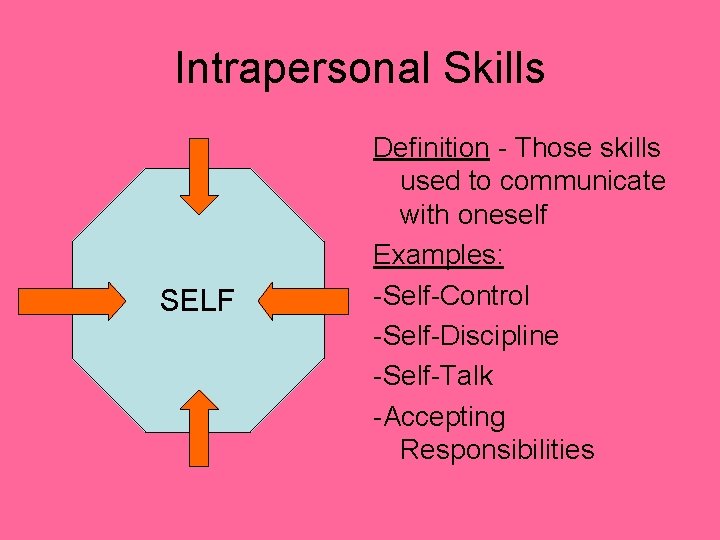
Intrapersonal Skills SELF Definition - Those skills used to communicate with oneself Examples: -Self-Control -Self-Discipline -Self-Talk -Accepting Responsibilities
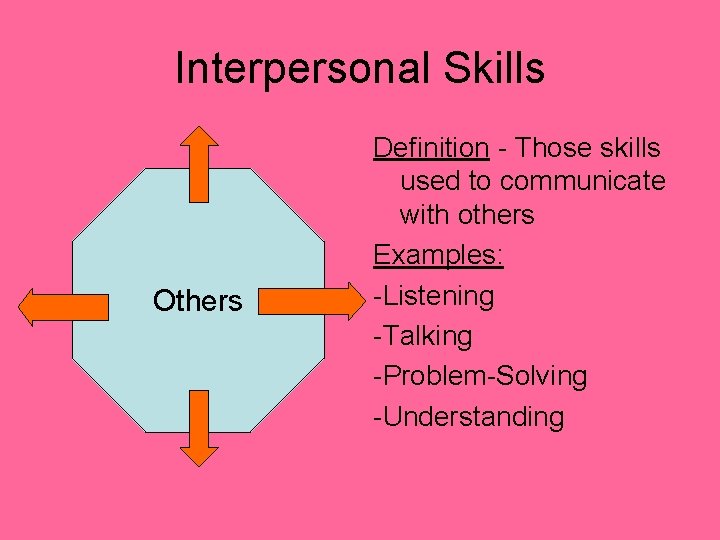
Interpersonal Skills Others Definition - Those skills used to communicate with others Examples: -Listening -Talking -Problem-Solving -Understanding
Reasons Why We Need These Skills • They Help us to UNDERSTAND our own behavior • They Help us COPE with circumstances of life • They Help us CONTROL situations we find ourselves in
Communication Styles Transactional Analysis
Child-like Communication • • Easiest to recognize Most natural to use Immature Least effective when you are an adult • Self-centered • Many teens and adults revert to this style when they are frustrated or upset
Child-like Communication • • • Giving orders Whining Name calling Yelling Verbal abuse Not listening Interrupting Topping Throwing tantrums Acting out of control
Parent-like Communication • Has nothing to do with age or being a parent • Directing other’s behaviors • Effective in getting others to comply • One-way or dictatorial • Gets the point across • Affects the behavior of others • Commonly used with those using child-like communication
Parent-like Communication • • Giving Instructions Directing Punishing Demanding Ordering Talking down to “Mom, get me a cookie. ” “Go get my book out of my locker. ” • “Lend me a dollar”
Adult-like Communication • Highest level • Most desirable • Most Effective
Adult-like Communication • Desire for open- two way communication • Taking responsibility for comments and actions • Remaining calm • Showing respect for others’ feelings and opinions • Wanting to resolve problems with a win-win attitude • Having trust in others • Controlling emotions while discussing
Which is the most effective style of communication? Adult
Communication Hammer Shank Is like Non-Verbal Communication It is strong and can be used to support construction or destruction
Communication Hammer Claw Is like Destructive Communication It is sharp and dangerous and is used to destroy and tear down relationships
Communication Hammer Head Is like Constructive Communication It is smooth and rounded and is used to build and help put things together
Communication Hammer Handle Is like Us, the driving force We are in control of our communication. We choose to use it in a constructive or destructive manner.
Destructive Communication • • • Threatening Sarcasm Interrupting Swearing Insulting Harassing Teasing Gossip Lies Sexual Harassment • Blaming • Endless Fighting • Character Assassination • Calling in Reinforcements • Withdrawal • Need to be Right • Playing the Martyr • “You” Messages
Constructive Communication • • Timing Asking Questions Clarifying Reflective Listening Respect Consideration Listening • Avoiding Intense Emotions • Honesty/Openness • Positive & Encouraging • Keeping Confidences • “I” Messages
“I” Messages • Help to decrease tension and defensiveness • Simple structure: – I feel _____ when ________. – Use feeling words for the first blank – Use what is happening or causing the problem in the second blank – I feel angry when you ignore what I am saying.
Behavior Characteristics Passive • Always Agrees • Buys from Everyone • Takes the blame • Lets others walk over them • Apologizes a lot • Refers to Other’s Opinions
Behavior Characteristics Aggressive • Tells others what to do • Gets angry easily • Forces their opinions on others • Demands explanations • Critical • Interrupts • Sarcastic • Runs over people
Behavior Characteristics Assertive • States Opinion Calmly • Negotiates and makes compromises • Smiles • Takes credit when due • Doesn’t have to win • Can admit mistakes • Cooperates with others • Listens to others
Conflict Resolution Step 1 - Define the Problem -Begin with the Positive -Describe the specifics -Express your Feelings -Admit your part in the situation *Avoid changing the subject!
Conflict Resolution Step 2 - Summarize your feelings for clarification “So you feel angry because took your clothes without asking. ”
Conflict Resolution Step 3 - Look for solutions There are many solutions to one problem. Look for consequences. Make compromises. Each person should be involved.
Conflict Resolution Step 4 - End with an expression of Love (kindness) for each other.
Conflict Resolution If a resolution has not been achieved within a short period (30 mins or less), put things on hold for a set period of time. Then readdress the problem later. Sessions that go too long have very little chance of a mutual resolution.
Verbal Drawing Exercise 1. 2. 3. 4. 5. 6. 7. 8. 9. 10. Down 2 inches Right 3 inches Up 2 inches Diagonal Up and Left 2 inches Diagonal Down and Left 2 inches Right 3 inches Down 2 inches Left 2 inches Up 1 and 1/2 inches Right 1 inch 11. 12. 13. 14. 15. 16. 17. 18. 19. Down 1 and 1/2 inches Left 4 inches Up 2 inches Make a squiggly circle 2 inches around over the top of the line Down 2 inches Left 2 inches Up 4 inches Make a smooth circle 1 inch around at the top of the line Draw triangles around the circle
How Much Do We Really Listen? This Line represents 1 Hour of what we hear • • • 30 mins - we don’t hear what is said 15 mins - we don’t understand 7. 5 mins - we don’t believe 3. 5 mins - we forget 3. 5 mins - We Remember!