
COMMUNICATION HEDGES LANGUAGE HEDGES In communication a verbal

COMMUNICATION HEDGES
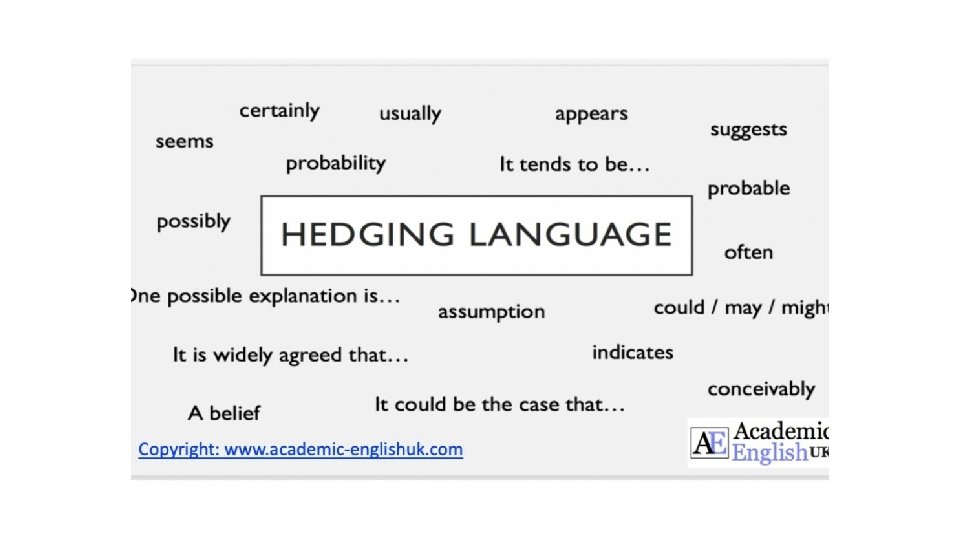
LANGUAGE HEDGES In communication, a verbal hedge is a word or phrase that makes a statement less forceful or assertive. It's also called hedging. Contrast to them are adverbs to boost other words which are called intensifiers (absolutely, completely etc. ) and amplify a term. Hedging language is also known as cautious language or vague language. In this context, a hedge (noun) is a cautious, vague, or evasive statement. And to hedge is to avoid answering a question, making a clear, direct statement, or committing yourself to a particular action or decision. Hedging words and phrases are things we write and say in order to soften our words, to make them less direct, and to limit or qualify claims and statements we make. You're probably already familiar with hedging in news reports where journalists make frequent use of the word 'allegedly' - partly because the statements they make are not necessarily proven, and also to create a defense for themselves if confronted about the content of the report (protecting themselves from criticism and potential legal action in the process).
Examples of hedge words and phrases Modal verbs could, may, might, should, would For example: Hedged: It could be that human expansion of the greenhouse effect is the cause of global warming. Not hedged: Human expansion of the greenhouse effect is the cause of global warming) Modal adjectives possible, probable, likely, unlikely For example: Hedged: The study’s results are likely due to chance. Not hedged: The study's results are due to chance. Adverbs conceivably, perhaps, possibly, probably, usually For example: We could conceivably finish the design outline by Friday.
Nouns assumption, likelihood, possibility, probability For example: There is a strong possibility, therefore, that we will have another economic recession within the next five years. Lexical verbs assume, believe, indicate, interpret, seem, suggest For example: I suggest that we wait another week. Scientists believe there will soon be a cure for this disease.
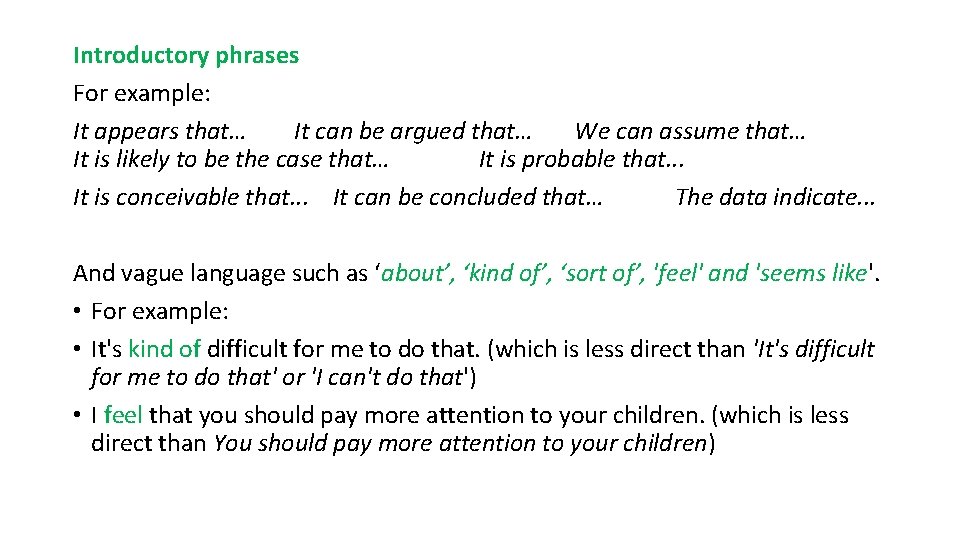
Introductory phrases For example: It appears that… It can be argued that… We can assume that… It is likely to be the case that… It is probable that. . . It is conceivable that. . . It can be concluded that… The data indicate. . . And vague language such as ‘about’, ‘kind of’, ‘sort of’, 'feel' and 'seems like'. • For example: • It's kind of difficult for me to do that. (which is less direct than 'It's difficult for me to do that' or 'I can't do that') • I feel that you should pay more attention to your children. (which is less direct than You should pay more attention to your children)
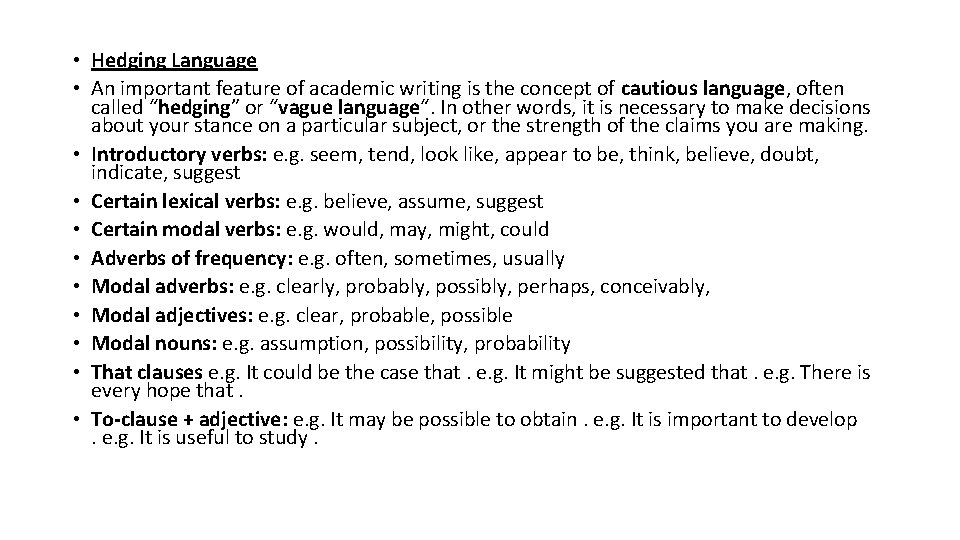
• Hedging Language • An important feature of academic writing is the concept of cautious language, often called “hedging” or “vague language“. In other words, it is necessary to make decisions about your stance on a particular subject, or the strength of the claims you are making. • Introductory verbs: e. g. seem, tend, look like, appear to be, think, believe, doubt, indicate, suggest • Certain lexical verbs: e. g. believe, assume, suggest • Certain modal verbs: e. g. would, may, might, could • Adverbs of frequency: e. g. often, sometimes, usually • Modal adverbs: e. g. clearly, probably, possibly, perhaps, conceivably, • Modal adjectives: e. g. clear, probable, possible • Modal nouns: e. g. assumption, possibility, probability • That clauses e. g. It could be the case that. e. g. It might be suggested that. e. g. There is every hope that. • To-clause + adjective: e. g. It may be possible to obtain. e. g. It is important to develop. e. g. It is useful to study.
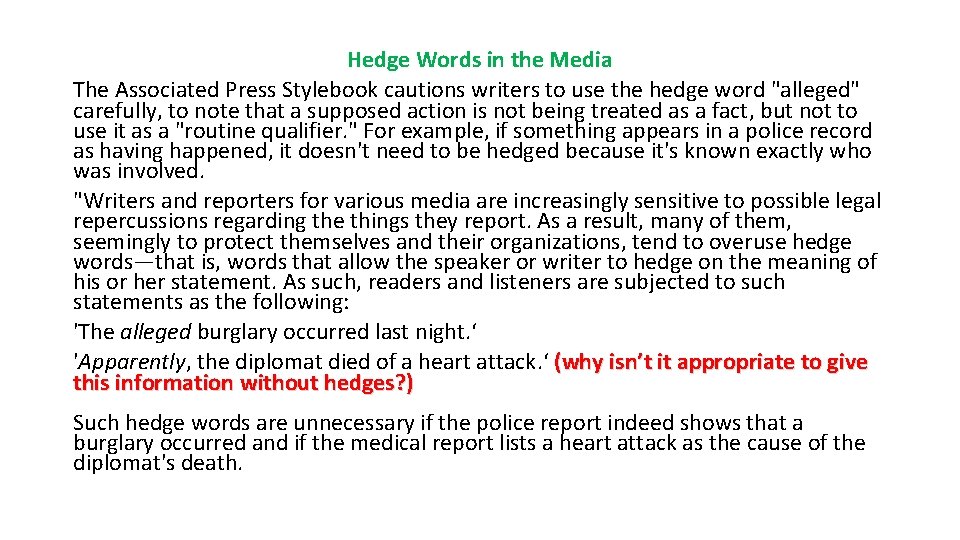
Hedge Words in the Media The Associated Press Stylebook cautions writers to use the hedge word "alleged" carefully, to note that a supposed action is not being treated as a fact, but not to use it as a "routine qualifier. " For example, if something appears in a police record as having happened, it doesn't need to be hedged because it's known exactly who was involved. "Writers and reporters for various media are increasingly sensitive to possible legal repercussions regarding the things they report. As a result, many of them, seemingly to protect themselves and their organizations, tend to overuse hedge words—that is, words that allow the speaker or writer to hedge on the meaning of his or her statement. As such, readers and listeners are subjected to such statements as the following: 'The alleged burglary occurred last night. ‘ 'Apparently, the diplomat died of a heart attack. ‘ (why isn’t it appropriate to give this information without hedges? ) Such hedge words are unnecessary if the police report indeed shows that a burglary occurred and if the medical report lists a heart attack as the cause of the diplomat's death.
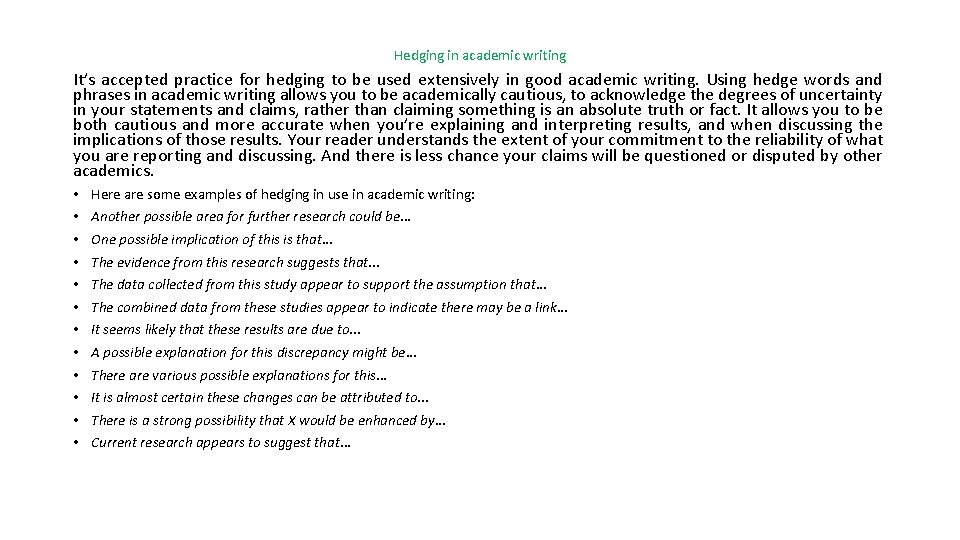
Hedging in academic writing It’s accepted practice for hedging to be used extensively in good academic writing. Using hedge words and phrases in academic writing allows you to be academically cautious, to acknowledge the degrees of uncertainty in your statements and claims, rather than claiming something is an absolute truth or fact. It allows you to be both cautious and more accurate when you’re explaining and interpreting results, and when discussing the implications of those results. Your reader understands the extent of your commitment to the reliability of what you are reporting and discussing. And there is less chance your claims will be questioned or disputed by other academics. • • • Here are some examples of hedging in use in academic writing: Another possible area for further research could be. . . One possible implication of this is that. . . The evidence from this research suggests that. . . The data collected from this study appear to support the assumption that. . . The combined data from these studies appear to indicate there may be a link. . . It seems likely that these results are due to. . . A possible explanation for this discrepancy might be. . . There are various possible explanations for this. . . It is almost certain these changes can be attributed to. . . There is a strong possibility that X would be enhanced by. . . Current research appears to suggest that. . .
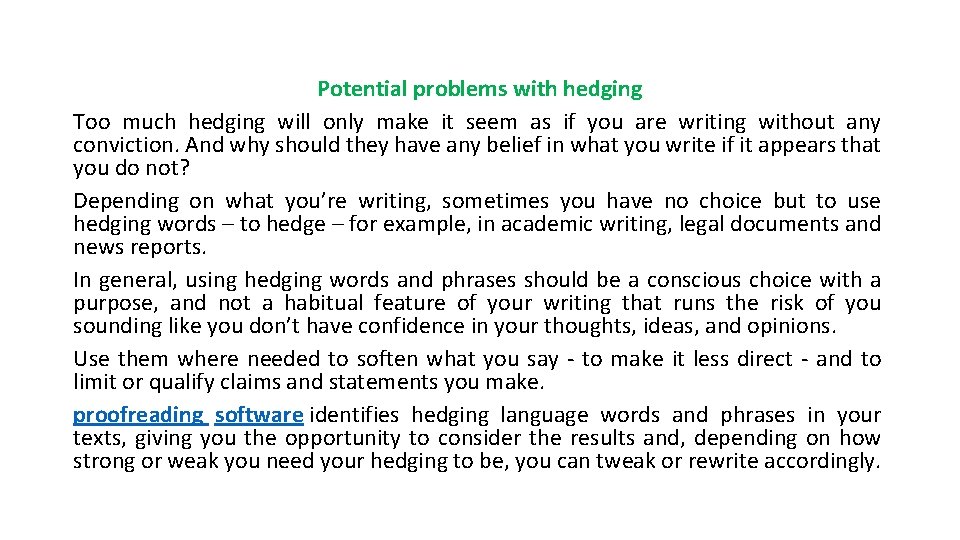
Potential problems with hedging Too much hedging will only make it seem as if you are writing without any conviction. And why should they have any belief in what you write if it appears that you do not? Depending on what you’re writing, sometimes you have no choice but to use hedging words – to hedge – for example, in academic writing, legal documents and news reports. In general, using hedging words and phrases should be a conscious choice with a purpose, and not a habitual feature of your writing that runs the risk of you sounding like you don’t have confidence in your thoughts, ideas, and opinions. Use them where needed to soften what you say - to make it less direct - and to limit or qualify claims and statements you make. proofreading software identifies hedging language words and phrases in your texts, giving you the opportunity to consider the results and, depending on how strong or weak you need your hedging to be, you can tweak or rewrite accordingly.
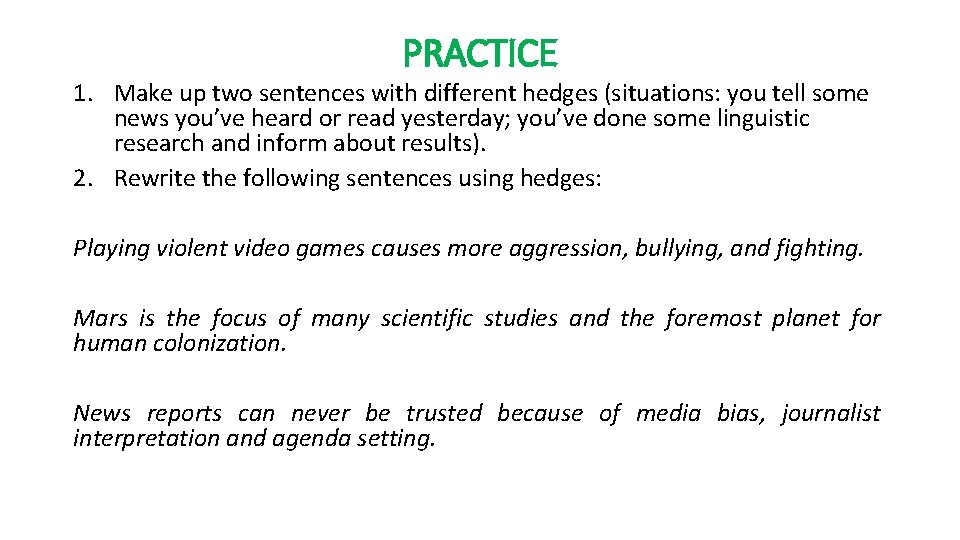
PRACTICE 1. Make up two sentences with different hedges (situations: you tell some news you’ve heard or read yesterday; you’ve done some linguistic research and inform about results). 2. Rewrite the following sentences using hedges: Playing violent video games causes more aggression, bullying, and fighting. Mars is the focus of many scientific studies and the foremost planet for human colonization. News reports can never be trusted because of media bias, journalist interpretation and agenda setting.
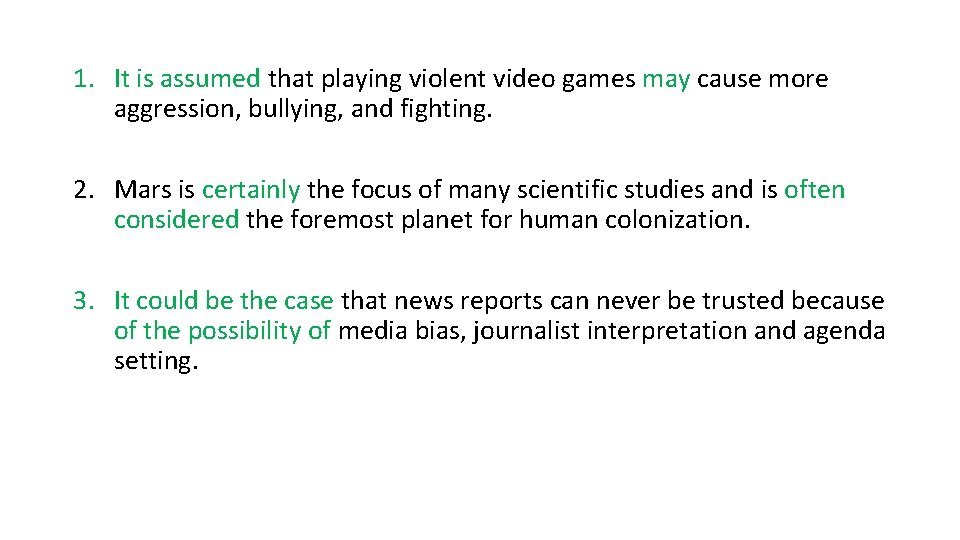
1. It is assumed that playing violent video games may cause more aggression, bullying, and fighting. 2. Mars is certainly the focus of many scientific studies and is often considered the foremost planet for human colonization. 3. It could be the case that news reports can never be trusted because of the possibility of media bias, journalist interpretation and agenda setting.
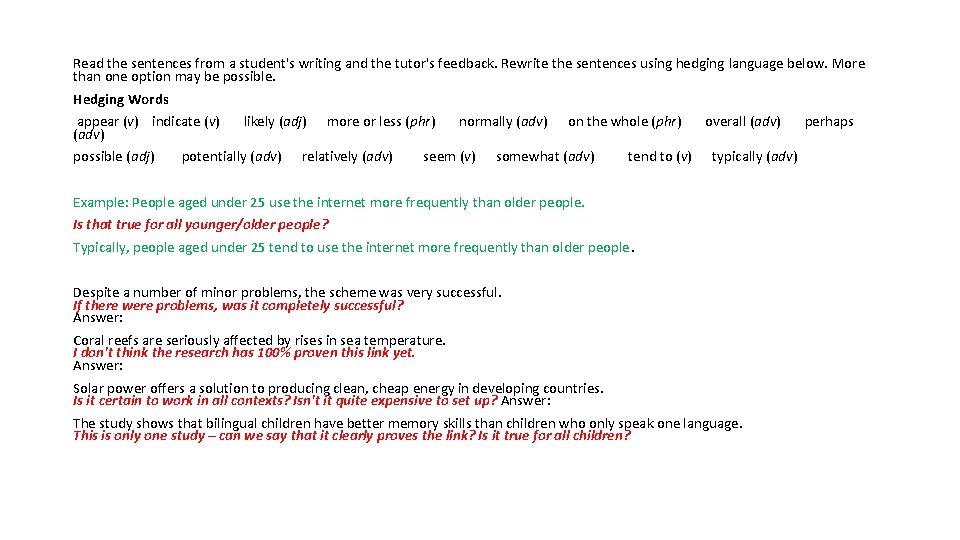
Read the sentences from a student's writing and the tutor's feedback. Rewrite the sentences using hedging language below. More than one option may be possible. Hedging Words appear (v) indicate (v) (adv) possible (adj) likely (adj) potentially (adv) more or less (phr) relatively (adv) normally (adv) seem (v) on the whole (phr) somewhat (adv) tend to (v) overall (adv) typically (adv) Example: People aged under 25 use the internet more frequently than older people. Is that true for all younger/older people? Typically, people aged under 25 tend to use the internet more frequently than older people. Despite a number of minor problems, the scheme was very successful. If there were problems, was it completely successful? Answer: Coral reefs are seriously affected by rises in sea temperature. I don't think the research has 100% proven this link yet. Answer: Solar power offers a solution to producing clean, cheap energy in developing countries. Is it certain to work in all contexts? Isn't it quite expensive to set up? Answer: The study shows that bilingual children have better memory skills than children who only speak one language. This is only one study – can we say that it clearly proves the link? Is it true for all children? perhaps
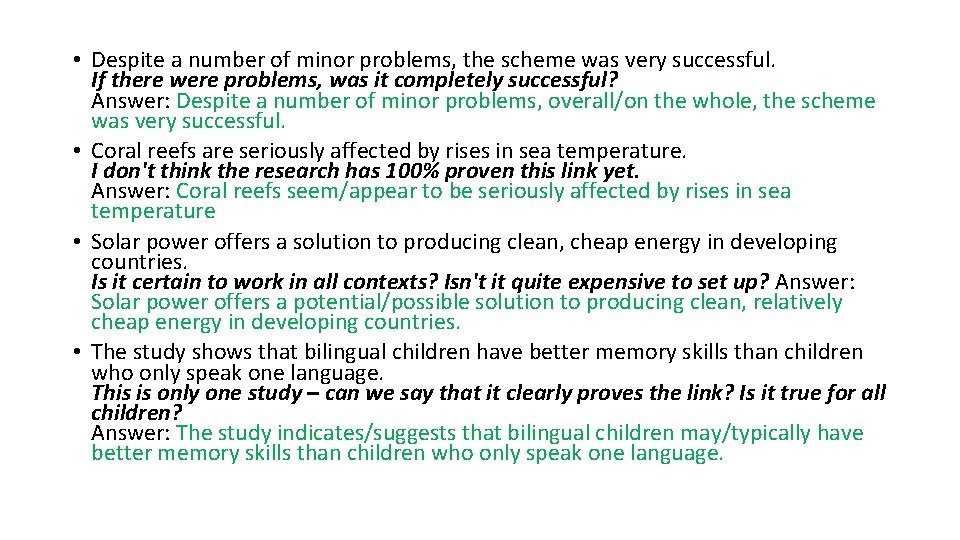
• Despite a number of minor problems, the scheme was very successful. If there were problems, was it completely successful? Answer: Despite a number of minor problems, overall/on the whole, the scheme was very successful. • Coral reefs are seriously affected by rises in sea temperature. I don't think the research has 100% proven this link yet. Answer: Coral reefs seem/appear to be seriously affected by rises in sea temperature • Solar power offers a solution to producing clean, cheap energy in developing countries. Is it certain to work in all contexts? Isn't it quite expensive to set up? Answer: Solar power offers a potential/possible solution to producing clean, relatively cheap energy in developing countries. • The study shows that bilingual children have better memory skills than children who only speak one language. This is only one study – can we say that it clearly proves the link? Is it true for all children? Answer: The study indicates/suggests that bilingual children may/typically have better memory skills than children who only speak one language.
Practice more at: http: //elss. elc. cityu. edu. hk/ELSS/Resource/Practise%20 Hedging%20 in %20 your%20 Writing_Part%20 Three/ Home assignment: Find a passage of a text (or some separate sentences) with hedges. Copy the text and extract hedges from one of the texts so that you have two texts – one is with hedges, and the other one is without.
- Slides: 15