
Communication Delays in Wide Area Measurement Systems WAMS
- Slides: 17
Communication Delays in Wide Area Measurement Systems (WAMS) Biju Naduvathuparambil, Matthew C. Valenti, and Ali Feliachi Lane Department of Comp. Sci. & Elect. Eng. West Virginia University
Preview of Talk Idea: Communication delays in WAMS due to the usage of phasor measurement units (PMUs). Motivation: The use of innovative techniques like PMUs in wide area protection systems in a deregulated power industry. Technique: PMU processing time, PMU data format (IEEE 1344) length, and communication link involved.
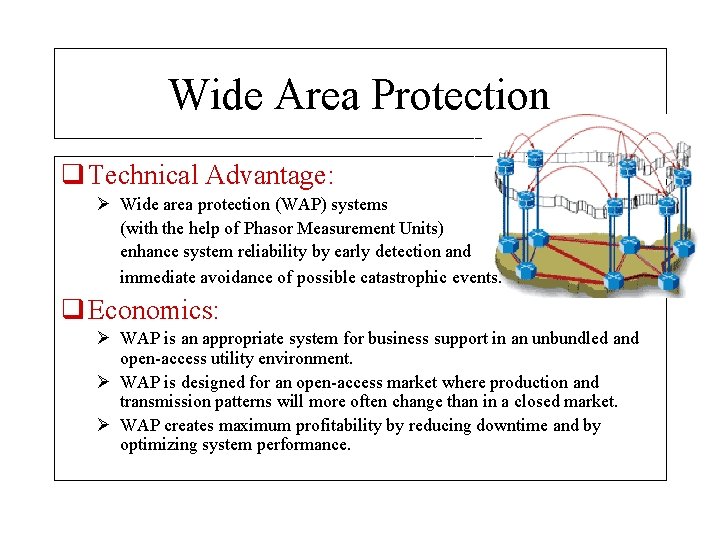
Wide Area Protection q Technical Advantage: Ø Wide area protection (WAP) systems (with the help of Phasor Measurement Units) enhance system reliability by early detection and immediate avoidance of possible catastrophic events. q Economics: Ø WAP is an appropriate system for business support in an unbundled and open-access utility environment. Ø WAP is designed for an open-access market where production and transmission patterns will more often change than in a closed market. Ø WAP creates maximum profitability by reducing downtime and by optimizing system performance.
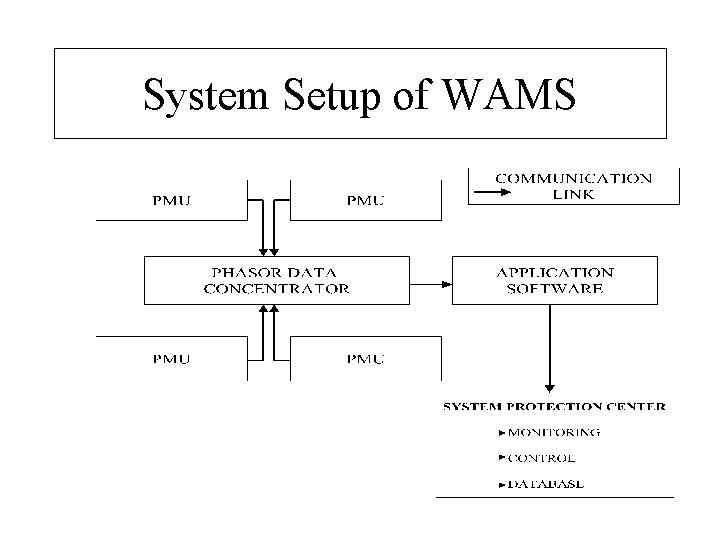
System Setup of WAMS
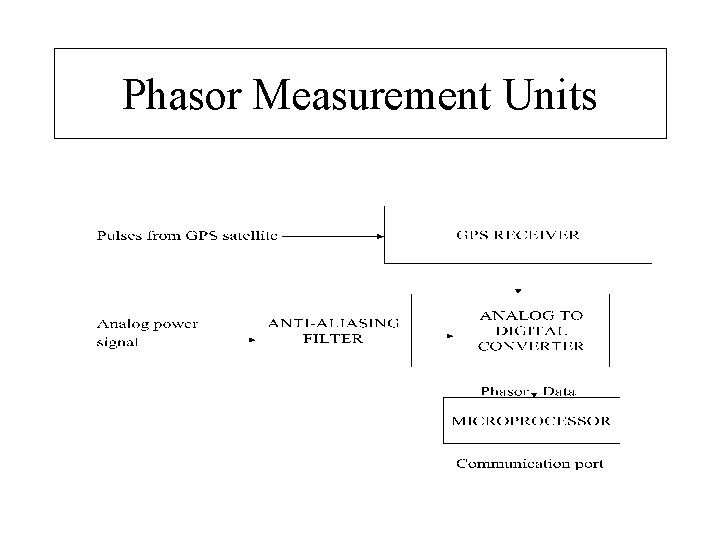
Phasor Measurement Units
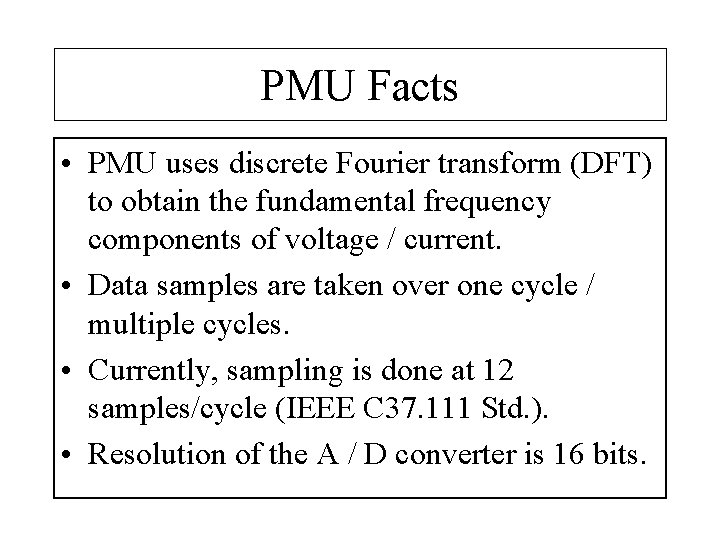
PMU Facts • PMU uses discrete Fourier transform (DFT) to obtain the fundamental frequency components of voltage / current. • Data samples are taken over one cycle / multiple cycles. • Currently, sampling is done at 12 samples/cycle (IEEE C 37. 111 Std. ). • Resolution of the A / D converter is 16 bits.
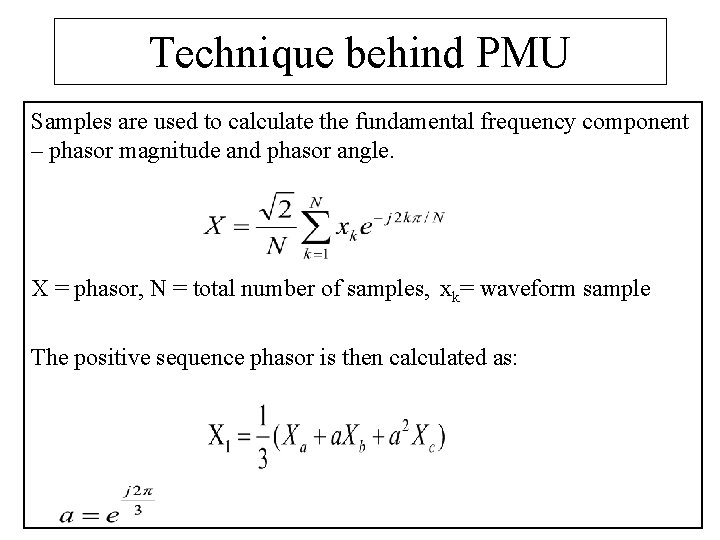
Technique behind PMU Samples are used to calculate the fundamental frequency component – phasor magnitude and phasor angle. X = phasor, N = total number of samples, xk= waveform sample The positive sequence phasor is then calculated as:
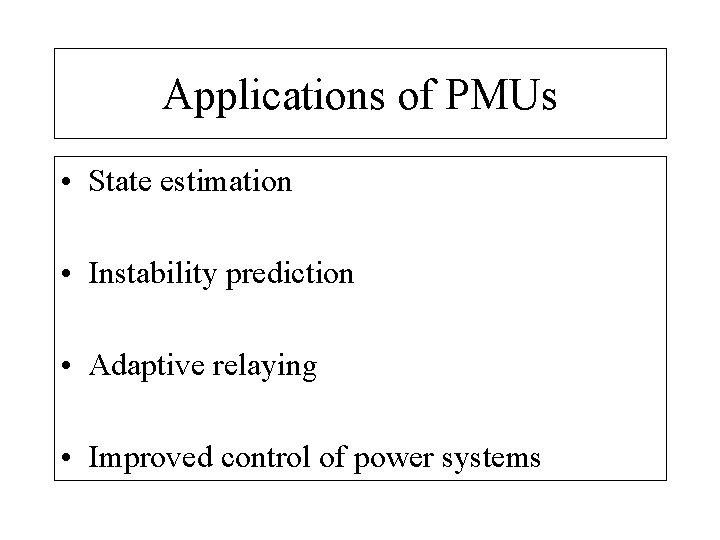
Applications of PMUs • State estimation • Instability prediction • Adaptive relaying • Improved control of power systems
PMU Data Communication • PMU communicates using the IEEE 1344 data format. • IEEE 1344 – Data frame • Information regarding phasor data – Header frame • Identification information about the PMU – Configuration frame • Number of phasors and digital channels
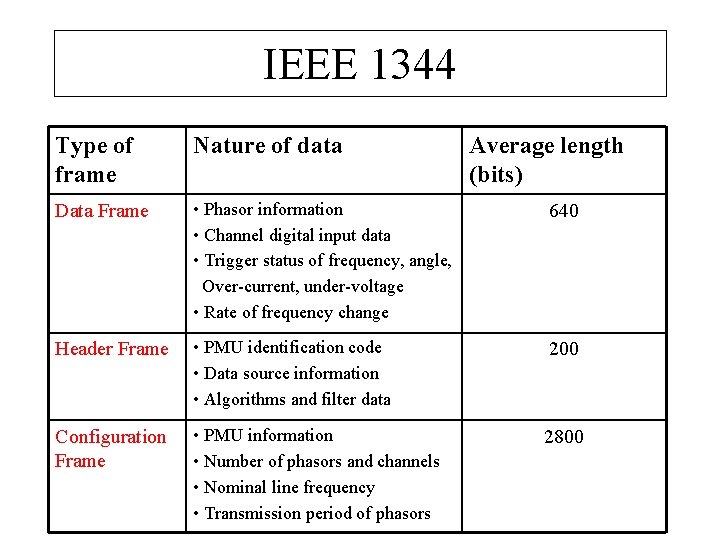
IEEE 1344 Type of frame Nature of data Average length (bits) Data Frame • Phasor information • Channel digital input data • Trigger status of frequency, angle, Over-current, under-voltage • Rate of frequency change 640 Header Frame • PMU identification code • Data source information • Algorithms and filter data 200 Configuration Frame • PMU information • Number of phasors and channels • Nominal line frequency • Transmission period of phasors 2800
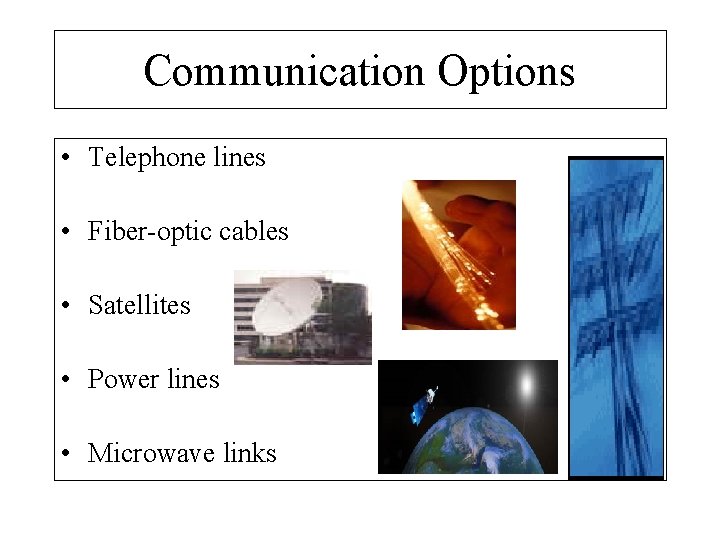
Communication Options • Telephone lines • Fiber-optic cables • Satellites • Power lines • Microwave links
Communication Delay Causes • Transducer delays • Window size of the DFT • Processing time • Data size of the PMU output • Multiplexing and transitions • Communication link involved • Data concentrators
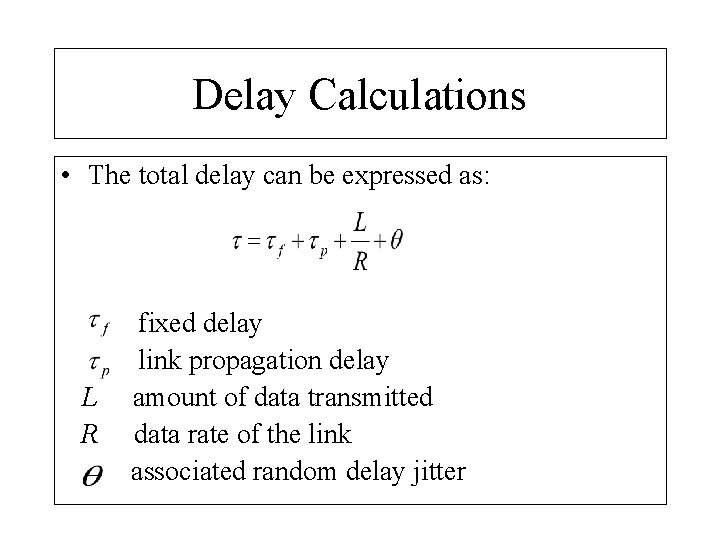
Delay Calculations • The total delay can be expressed as: L R fixed delay link propagation delay amount of data transmitted data rate of the link associated random delay jitter
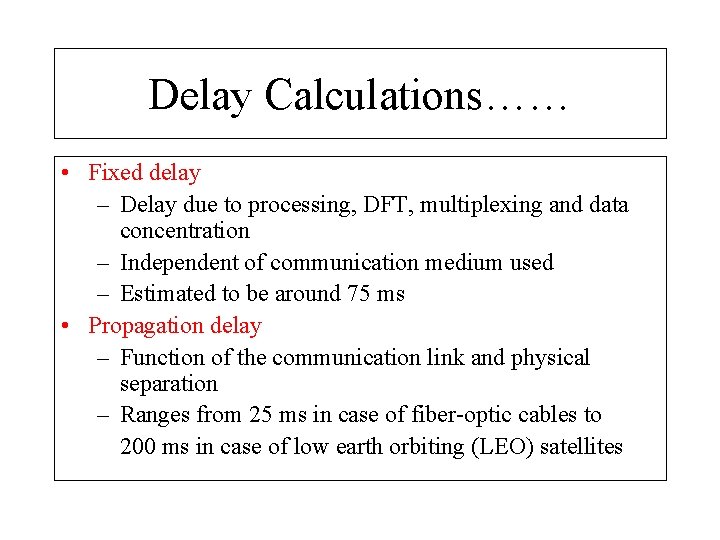
Delay Calculations…… • Fixed delay – Delay due to processing, DFT, multiplexing and data concentration – Independent of communication medium used – Estimated to be around 75 ms • Propagation delay – Function of the communication link and physical separation – Ranges from 25 ms in case of fiber-optic cables to 200 ms in case of low earth orbiting (LEO) satellites
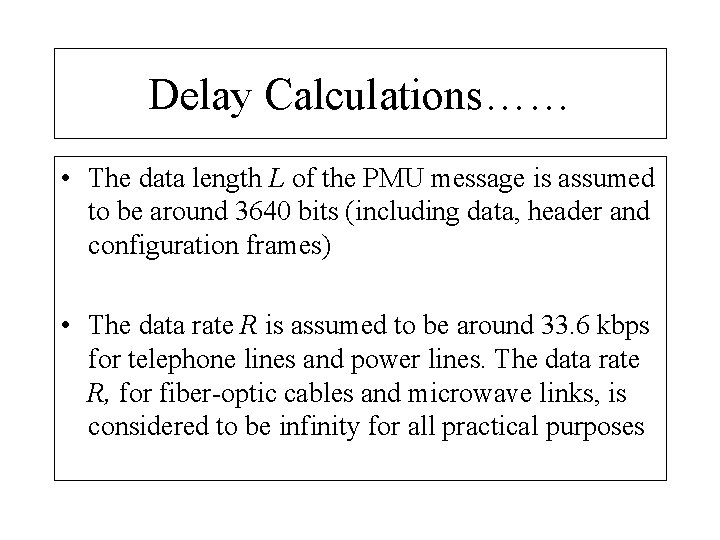
Delay Calculations…… • The data length L of the PMU message is assumed to be around 3640 bits (including data, header and configuration frames) • The data rate R is assumed to be around 33. 6 kbps for telephone lines and power lines. The data rate R, for fiber-optic cables and microwave links, is considered to be infinity for all practical purposes
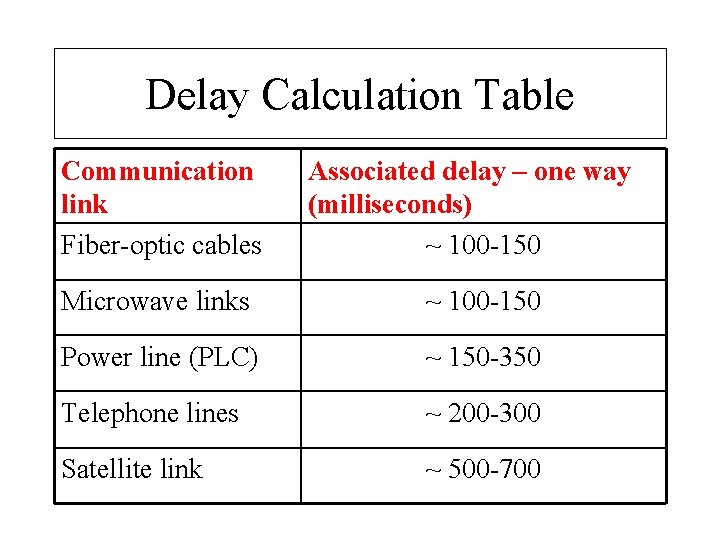
Delay Calculation Table Communication link Fiber-optic cables Associated delay – one way (milliseconds) ~ 100 -150 Microwave links ~ 100 -150 Power line (PLC) ~ 150 -350 Telephone lines ~ 200 -300 Satellite link ~ 500 -700
Conclusion • Communication delays play an important role in determining the effectiveness of control procedures • Delay parameters presented can be integrated with power systems design and analysis. – Distributed control with outdated measurements.