
Communication December 22 2021 Session Objectives The objectives
Communication December 22, 2021
Session Objectives • The objectives of this session are to: • Provide a basic overview of verbal and non-verbal interpersonal communication processes • Identify personal obstacles to effective interpersonal communication • Define some strategies for improving individual and group communications 2 www. centumlearning. com
Communication • Communication is defined as the interchange of thoughts or opinions through shared symbols; e. g. language, words, phrases 3 www. centumlearning. com

Process of Communication 4 www. centumlearning. com
Four facets of communication • • • 5 Three are four facets in all types of communication: Sender Receiver Information Behavior www. centumlearning. com
Four facets of communication • In any communication: • The Sender is the person trying to communicate a message • The Receiver is the person at whom the message is directed • A message is sent to convey information • Information is meant to change behavior 6 www. centumlearning. com
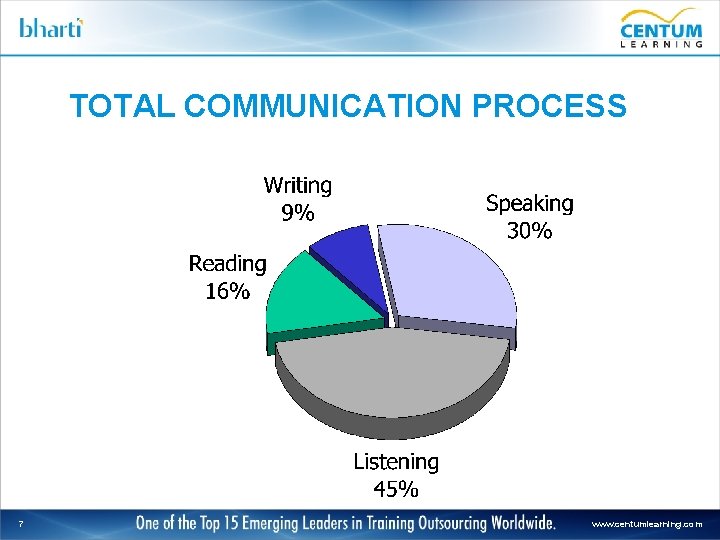
TOTAL COMMUNICATION PROCESS 7 www. centumlearning. com
LEVELS OF COMMUNICATION • VERBAL – Intra verbal: intonation of word and sound – Extra verbal: implication of words and phrases, semantics • NON-VERBAL – Gestures – Postures – Movements • SYMBOLIC 8 www. centumlearning. com
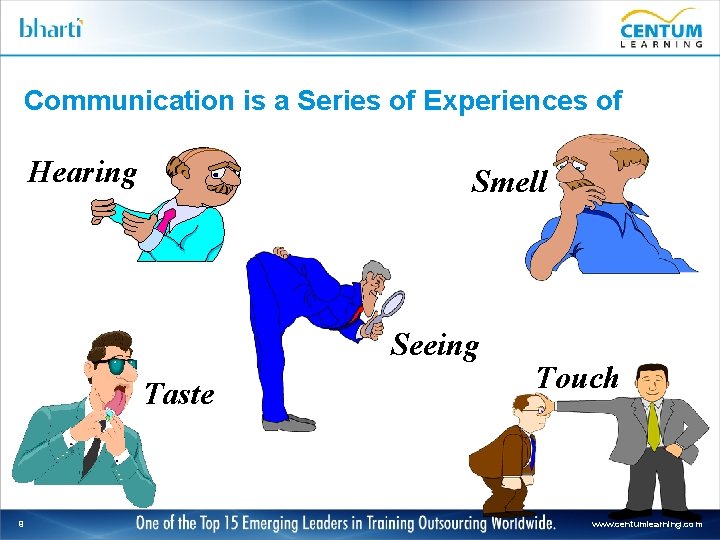
Communication is a Series of Experiences of Hearing Smell Seeing Taste 9 Touch www. centumlearning. com

Missed communication 10 www. centumlearning. com
Why we communicate • • 11 We communicate to: • Share our ideas and opinions • Provide feedback to others • Get information from others • Gain power and influence • Develop social relationships • Maintain self-expression and our culture www. centumlearning. com
How we communicate • We communicate and build interpersonal relationships through: – – – 12 Speech Writing Listening Non-verbal language Music, art, and crafts www. centumlearning. com
Choosing your medium • Depending upon the situation, one method of communication may be better than another. • In person: one-to-one • In person: meetings, small groups • In Person: présentations, large groups • Letter, Memo, Note, Email, Voice mail 13 www. centumlearning. com
Choosing your medium • • To determine the best medium for your message determine: What you as the sender need to achieve What the receiver needs to know How detailed, important, and or personal the information in the message is • Which behavior you want to influence and how 14 www. centumlearning. com
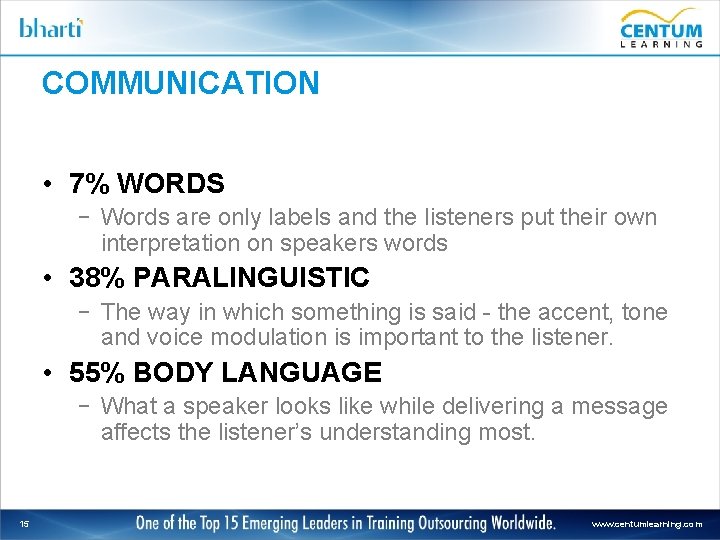
COMMUNICATION • 7% WORDS – Words are only labels and the listeners put their own interpretation on speakers words • 38% PARALINGUISTIC – The way in which something is said - the accent, tone and voice modulation is important to the listener. • 55% BODY LANGUAGE – What a speaker looks like while delivering a message affects the listener’s understanding most. 15 www. centumlearning. com
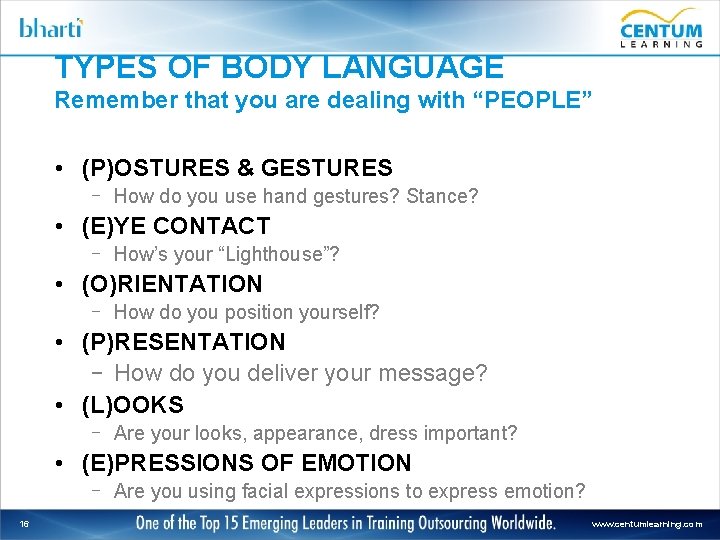
TYPES OF BODY LANGUAGE Remember that you are dealing with “PEOPLE” • (P)OSTURES & GESTURES – How do you use hand gestures? Stance? • (E)YE CONTACT – How’s your “Lighthouse”? • (O)RIENTATION – How do you position yourself? • (P)RESENTATION – How do you deliver your message? • (L)OOKS – Are your looks, appearance, dress important? • (E)PRESSIONS OF EMOTION – Are you using facial expressions to express emotion? 16 www. centumlearning. com
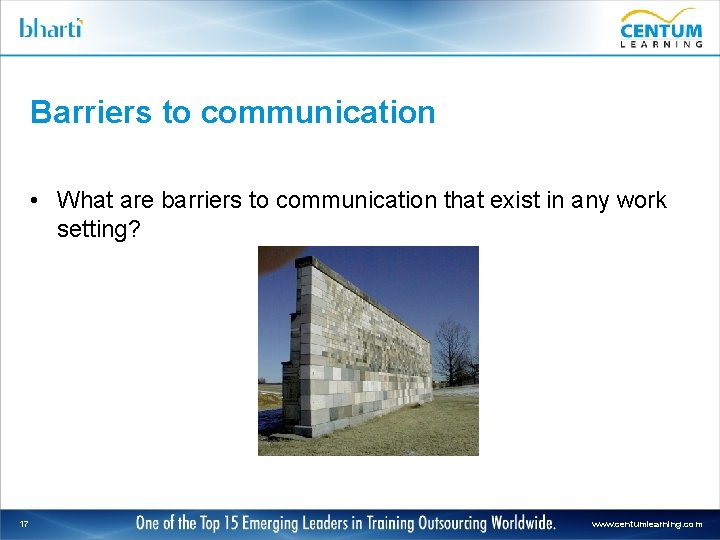
Barriers to communication • What are barriers to communication that exist in any work setting? 17 www. centumlearning. com
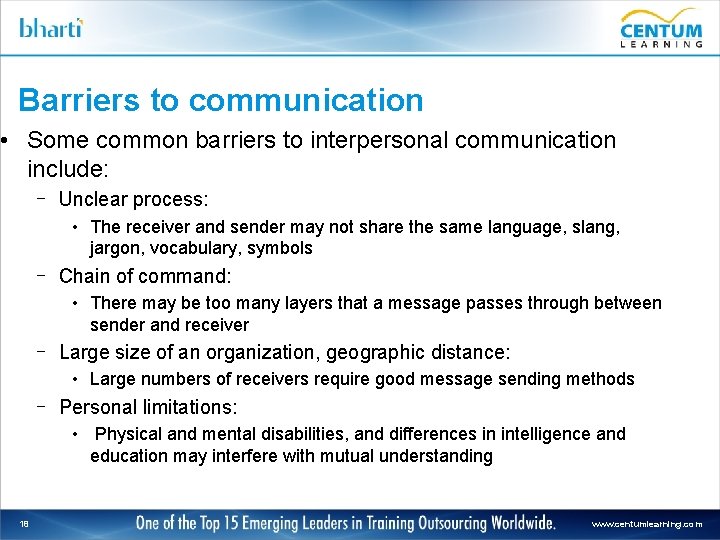
Barriers to communication • Some common barriers to interpersonal communication include: – Unclear process: • The receiver and sender may not share the same language, slang, jargon, vocabulary, symbols – Chain of command: • There may be too many layers that a message passes through between sender and receiver – Large size of an organization, geographic distance: • Large numbers of receivers require good message sending methods – Personal limitations: • Physical and mental disabilities, and differences in intelligence and education may interfere with mutual understanding 18 www. centumlearning. com
Barriers to communication • Additional common barriers to interpersonal communication include: • Human nature: Peoples’ egos, prejudices, and traditions can get in the way • Conflicting feelings, goals, opinions: If people feel on opposite sides of an issue they may not share • Power: The idea that knowledge is power can lead to information hoarding 19 www. centumlearning. com
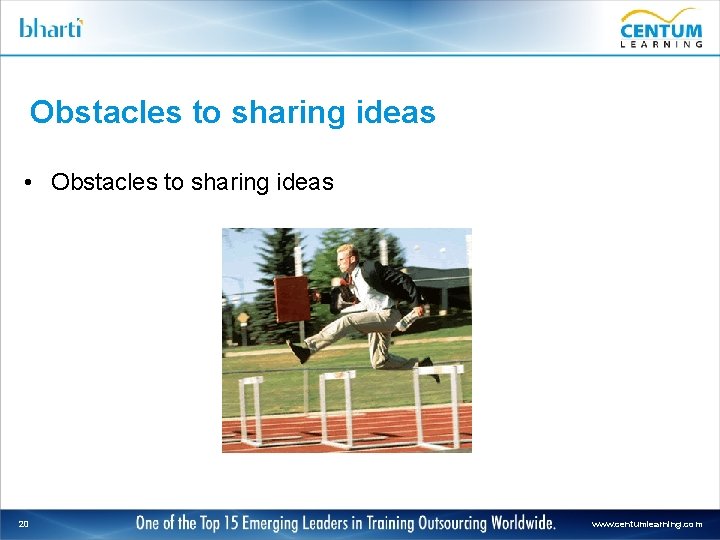
Obstacles to sharing ideas • Obstacles to sharing ideas 20 www. centumlearning. com
Obstacles to sharing ideas… • • 21 Your own shyness Fear of rejection Peer pressure Unorganized thinking Others possibly becoming defensive Physical disabilities (impaired sight, hearing, speech) Having to deal with aggressive people www. centumlearning. com
Counting the “F”s • FEATURE FILMS ARE THE RESULT OF YEARS OF SCIENTIFIC STUDY COMBINED WITH THE CONTINUOUS EFFORTS AND THE EXPERIENCE OF YEARS. • How many? Are you sure? See next slide… 22 www. centumlearning. com
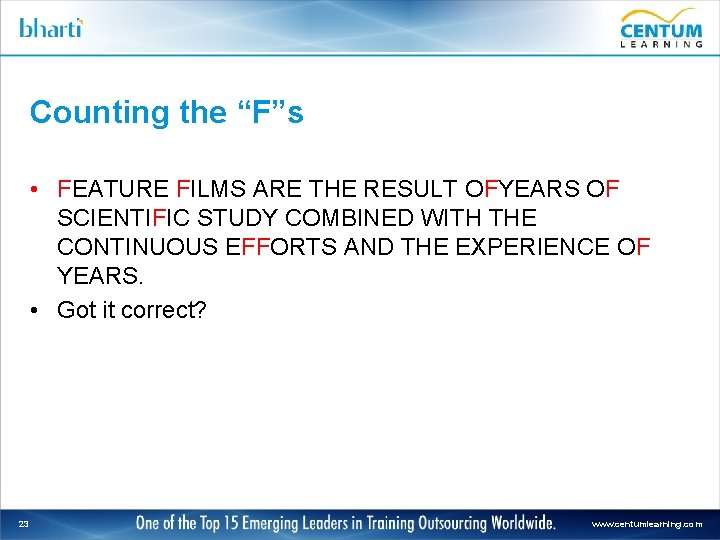
Counting the “F”s • FEATURE FILMS ARE THE RESULT OFYEARS OF SCIENTIFIC STUDY COMBINED WITH THE CONTINUOUS EFFORTS AND THE EXPERIENCE OF YEARS. • Got it correct? 23 www. centumlearning. com
Get good information to… • • • 24 Find out facts and details Get directions or instructions Try to understand another’s point of view Help someone solve a problem Resolve a team conflict Solve work problems www. centumlearning. com
Thank you Centum Learning Limited Neelagagan, Mandi Road, Sultanpur, Mehrauli, New Delhi-110030 Tel: 91 -11 -46001100 -01, Fax: 91 -11 -46001111 E-mail: contactus@bharti. in 25 www. centumlearning. com
- Slides: 25