
Communication Communication in one of the most important

- Slides: 10
Communication §Communication in one of the most important functions of management. Management can not succeed unless it has a properly development communication system. The word Communication has been derived from the Latin word ‘ Communis’. § Communication refers to the sharing of ideas, facts, opinions, information and understanding. It is defined as “ the process of passing information and understanding from one person to another. It is a process of transmitting ideas or thoughts from one person to another.
Elements of Communication • This includes generation of an idea. Putting into some logical sequence and transmitting it through some media and it means its reception by someone at the other end, his understanding of message sent and his acting upon the message or information received.
Upward Communication • It may be upward in regard to knowing the effectiveness of orders, ideas, comments, actions, reactions, attitudes, reports, complaints and grievances from the lowest level.
Downward Communication: • It may flow instructions, directions, clarifications, interpretations of rules, regulations, orders, policies and procedures. Horizontal Communication: • Information may be exchanged between two departmental heads or two or more persons who are of equal status.
Objectives • A management depends on communication to achieve organisational objectives. • To develop information and understanding which are necessary for group effort. • To develop an attitude which are necessary for motivation, cooperation and job satisfaction. • To discourage the spread of misinformation, rumours. • To prepare workers for a change by giving them the necessary information in advance. • To encourage ideas, suggestions from subordinates for an improvement in the product and work conditions and for the avoidance of the waste of raw materials. • To improve labour-management relations by keeping both in contact with each other. • To satisfy basic human needs.
Organisational Communication • The two important media of communication in the organisation are 1. Formal and 2. Informal Communication. • Formal Communication: are those that are ‘official’ that are a part of the recognised communication system which is involved in the operation of the organisation. This communication may oral or written. • Formal Communication: A formal communication can from a superior to a subordinate from subordinates.
§Downward Communication: Communication between the superiors and their subordinates. • Upward Communication: Communication between subordinates to their superiors. • Oral Communication: An oral Communication takes place when the audience is largely illiterate. • It is often known face to face communication. • It takes the form of talks, public address, telephonic talk, lectures, holidays of meetings and conferences and exhibitions etc.
Merits • 1. It is the least time consuming is more direct, simple and less expensive. • 2. It is more communication. • 3. It is generally friendly and cooperative sprit. • 4. It provides an immediate feed back. • Demerit: Lengthy and important information can not be effectively communicated. • Written Communication: A Written communication is always put into writing and generally used when audience is at a distance or where its preservation is essential. It is generally in the form instructions, orders, rules and regulations, policies, procedures, posters reports, newspapers etc or it may be put up on notice board.
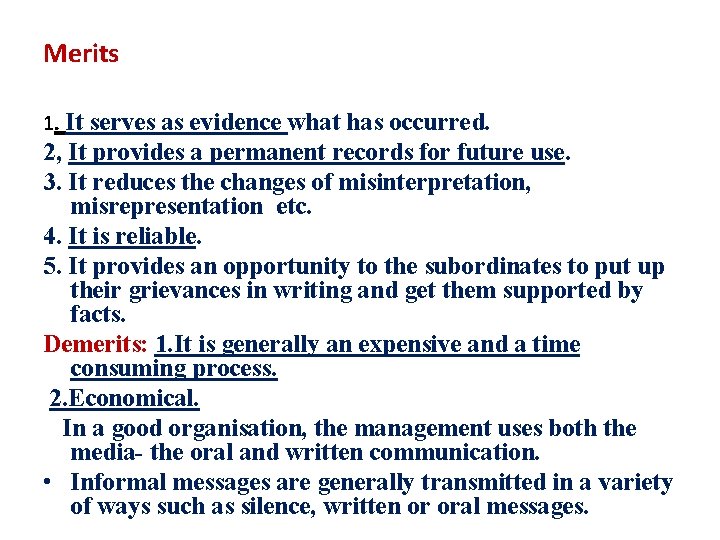
Merits 1. It serves as evidence what has occurred. 2, It provides a permanent records for future use. 3. It reduces the changes of misinterpretation, misrepresentation etc. 4. It is reliable. 5. It provides an opportunity to the subordinates to put up their grievances in writing and get them supported by facts. Demerits: 1. It is generally an expensive and a time consuming process. 2. Economical. In a good organisation, the management uses both the media- the oral and written communication. • Informal messages are generally transmitted in a variety of ways such as silence, written or oral messages.