
Communication campaign FCH JU control system Elena Climent


- Slides: 21
Communication campaign FCH JU control system Elena Climent Vañó FCH JU Audit Manager
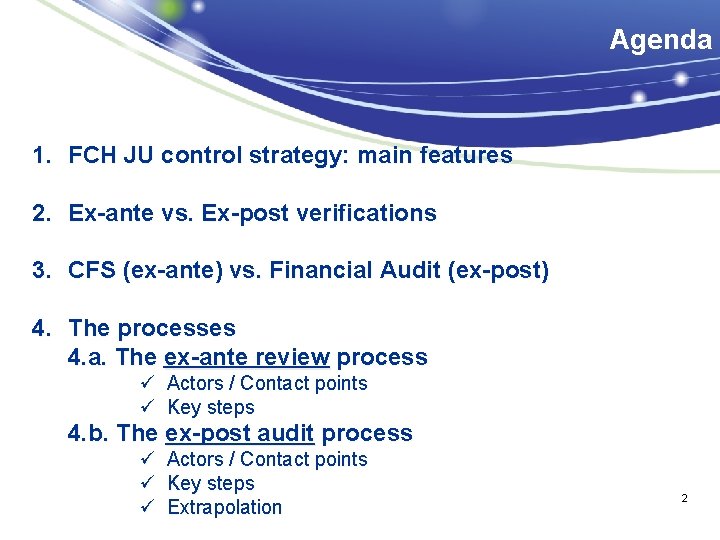
Agenda 1. FCH JU control strategy: main features 2. Ex-ante vs. Ex-post verifications 3. CFS (ex-ante) vs. Financial Audit (ex-post) 4. The processes 4. a. The ex-ante review process ü Actors / Contact points ü Key steps 4. b. The ex-post audit process ü Actors / Contact points ü Key steps ü Extrapolation 2
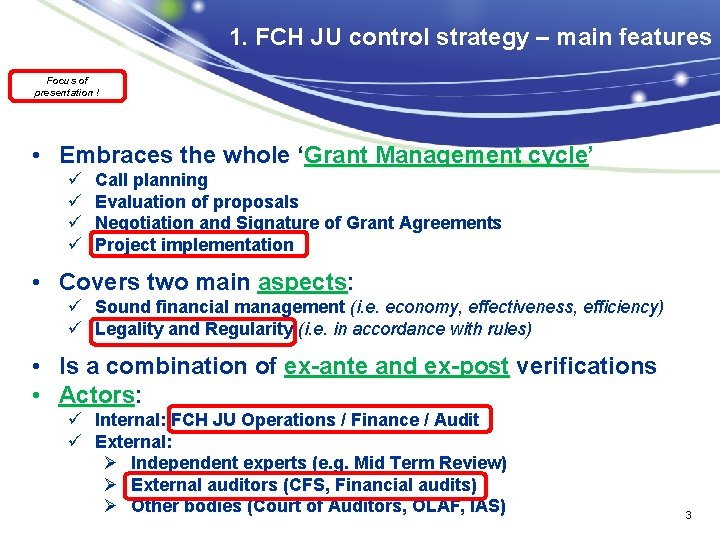
1. FCH JU control strategy – main features Focus of presentation ! • Embraces the whole ‘Grant Management cycle’ ü ü Call planning Evaluation of proposals Negotiation and Signature of Grant Agreements Project implementation • Covers two main aspects: ü Sound financial management (i. e. economy, effectiveness, efficiency) ü Legality and Regularity (i. e. in accordance with rules) • Is a combination of ex-ante and ex-post verifications • Actors: ü Internal: FCH JU Operations / Finance / Audit ü External: Ø Independent experts (e. g. Mid Term Review) Ø External auditors (CFS, Financial audits) Ø Other bodies (Court of Auditors, OLAF, IAS) 3
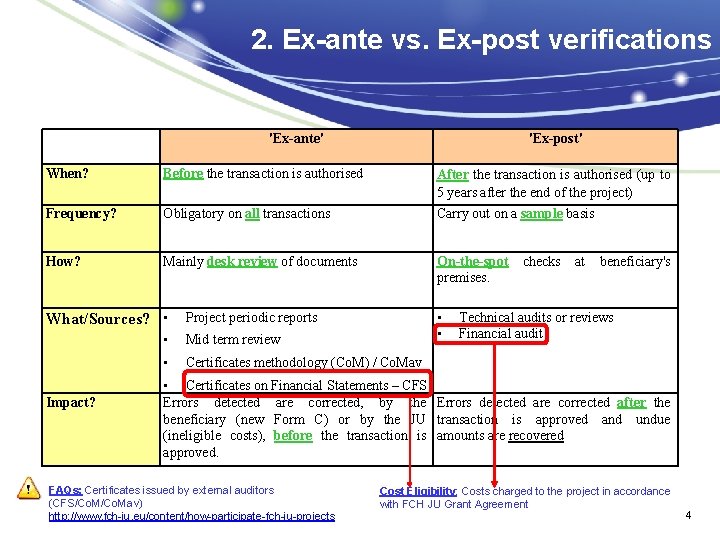
2. Ex-ante vs. Ex-post verifications 'Ex-ante' 'Ex-post' When? Before the transaction is authorised After the transaction is authorised (up to 5 years after the end of the project) Frequency? Obligatory on all transactions Carry out on a sample basis How? Mainly desk review of documents On-the-spot checks at beneficiary's premises. What/Sources? • Impact? • • Project periodic reports • Mid term review • Certificates methodology (Co. M) / Co. Mav Technical audits or reviews Financial audit • Certificates on Financial Statements – CFS Errors detected are corrected, by the Errors detected are corrected after the beneficiary (new Form C) or by the JU transaction is approved and undue (ineligible costs), before the transaction is amounts are recovered approved. FAQs: Certificates issued by external auditors (CFS/Co. Mav) http: //www. fch-ju. eu/content/how-participate-fch-ju-projects Cost Eligibility: Costs charged to the project in accordance with FCH JU Grant Agreement 4
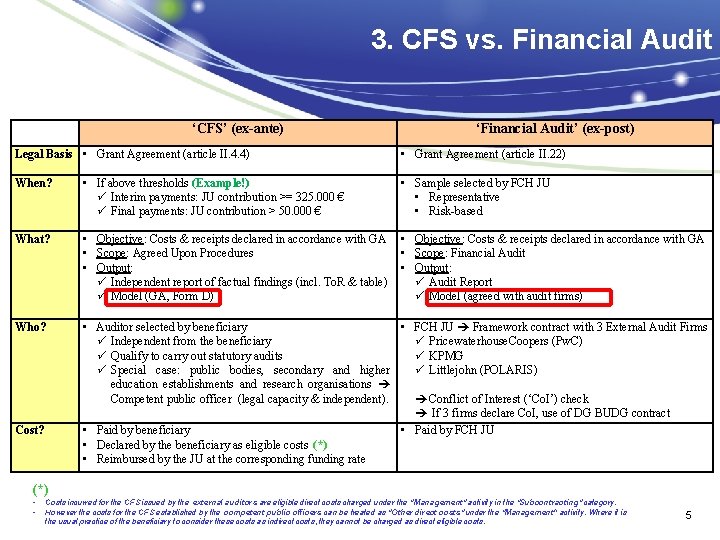
3. CFS vs. Financial Audit ‘CFS’ (ex-ante) Legal Basis • Grant Agreement (article II. 4. 4) ‘Financial Audit’ (ex-post) • Grant Agreement (article II. 22) When? • If above thresholds (Example!) ü Interim payments: JU contribution >= 325. 000 € ü Final payments: JU contribution > 50. 000 € • Sample selected by FCH JU • Representative • Risk-based What? • Objective: Costs & receipts declared in accordance with GA • Scope: Agreed Upon Procedures • Output: ü Independent report of factual findings (incl. To. R & table) ü Model (GA, Form D) • Objective: Costs & receipts declared in accordance with GA • Scope: Financial Audit • Output: ü Audit Report ü Model (agreed with audit firms) Who? • Auditor selected by beneficiary • FCH JU Framework contract with 3 External Audit Firms ü Independent from the beneficiary ü Pricewaterhouse. Coopers (Pw. C) ü Qualify to carry out statutory audits ü KPMG ü Special case: public bodies, secondary and higher ü Littlejohn (POLARIS) education establishments and research organisations Competent public officer (legal capacity & independent). Conflict of Interest (‘Co. I’) check If 3 firms declare Co. I, use of DG BUDG contract • Paid by beneficiary • Paid by FCH JU • Declared by the beneficiary as eligible costs (*) • Reimbursed by the JU at the corresponding funding rate Cost? (*) • • Costs incurred for the CFS issued by the external auditors are eligible direct costs charged under the " Management" activity in the "Subcontracting" category. However the costs for the CFS established by the competent public officers can be treated as "Other direct costs" under the "Management" activity. Where it is the usual practice of the beneficiary to consider these costs as indirect costs, they cannot be charged as direct eligible costs. 5
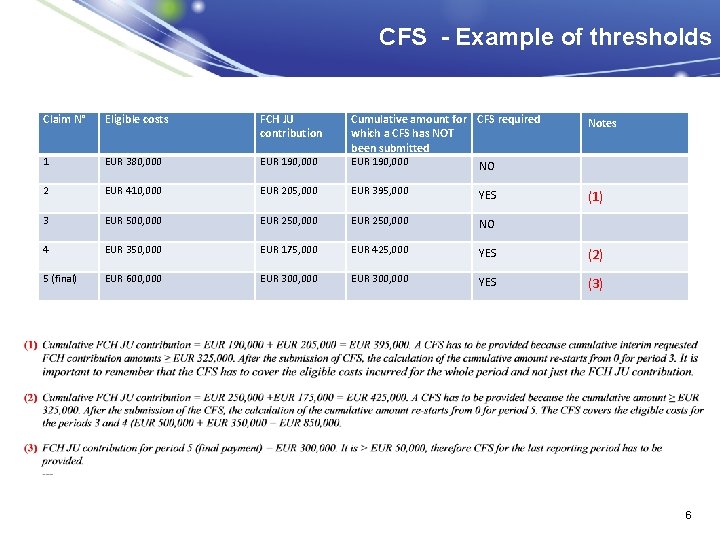
CFS - Example of thresholds Claim N° Eligible costs FCH JU contribution 1 EUR 380, 000 EUR 190, 000 2 EUR 410, 000 3 Cumulative amount for CFS required which a CFS has NOT been submitted Notes EUR 190, 000 NO EUR 205, 000 EUR 395, 000 YES EUR 500, 000 EUR 250, 000 NO 4 EUR 350, 000 EUR 175, 000 EUR 425, 000 YES (2) 5 (final) EUR 600, 000 EUR 300, 000 YES (3) (1) 6
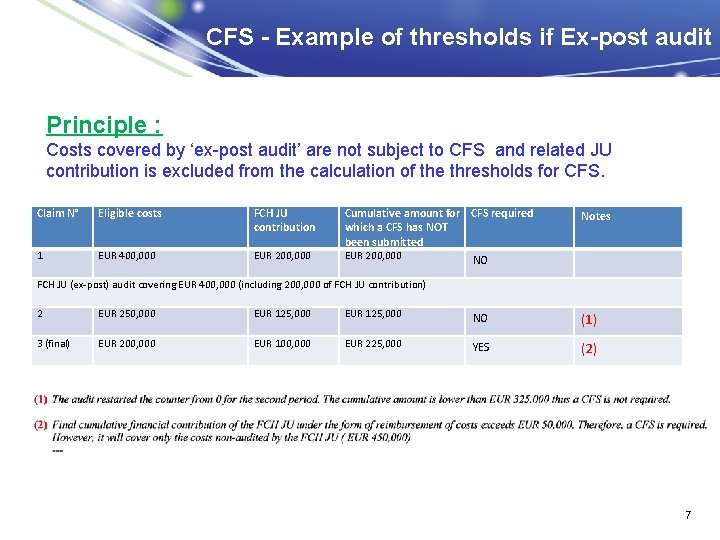
CFS - Example of thresholds if Ex-post audit Principle : Costs covered by ‘ex-post audit’ are not subject to CFS and related JU contribution is excluded from the calculation of the thresholds for CFS. Claim N° Eligible costs FCH JU contribution 1 EUR 400, 000 EUR 200, 000 Cumulative amount for CFS required which a CFS has NOT been submitted EUR 200, 000 NO Notes FCH JU (ex-post) audit covering EUR 400, 000 (including 200, 000 of FCH JU contribution) 2 EUR 250, 000 EUR 125, 000 NO (1) 3 (final) EUR 200, 000 EUR 100, 000 EUR 225, 000 YES (2) 7
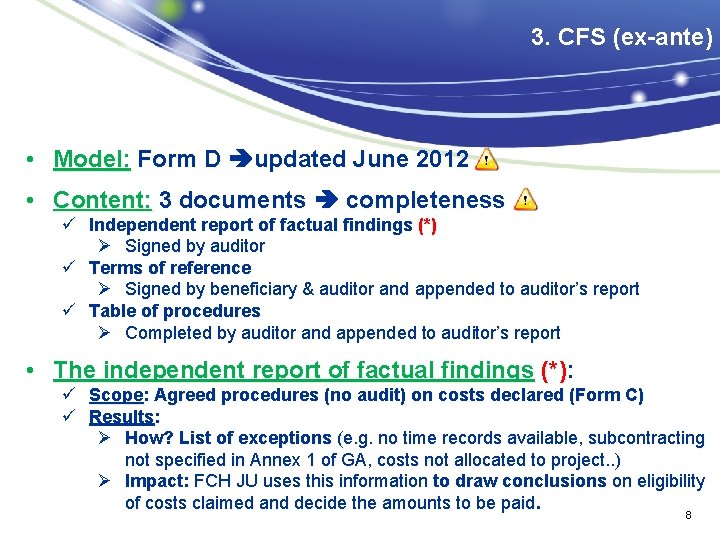
3. CFS (ex-ante) • Model: Form D updated June 2012 • Content: 3 documents completeness ü Independent report of factual findings (*) Ø Signed by auditor ü Terms of reference Ø Signed by beneficiary & auditor and appended to auditor’s report ü Table of procedures Ø Completed by auditor and appended to auditor’s report • The independent report of factual findings (*): ü Scope: Agreed procedures (no audit) on costs declared (Form C) ü Results: Ø How? List of exceptions (e. g. no time records available, subcontracting not specified in Annex 1 of GA, costs not allocated to project. . ) Ø Impact: FCH JU uses this information to draw conclusions on eligibility of costs claimed and decide the amounts to be paid. 8
3. CFS (Independent report) 9
3. CFS (table with procedures) 10
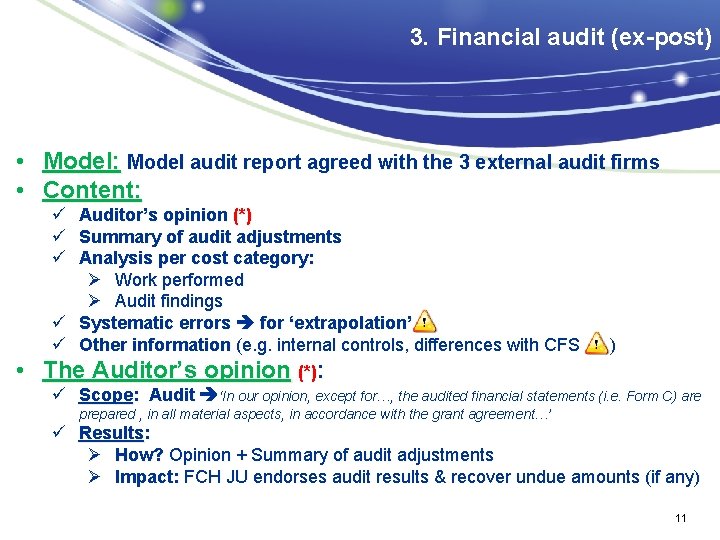
3. Financial audit (ex-post) • Model: Model audit report agreed with the 3 external audit firms • Content: • ü Auditor’s opinion (*) ü Summary of audit adjustments ü Analysis per cost category: Ø Work performed Ø Audit findings ü Systematic errors for ‘extrapolation’ ü Other information (e. g. internal controls, differences with CFS ) The Auditor’s opinion (*): ü Scope: Audit ‘In our opinion, except for…, the audited financial statements (i. e. Form C) are prepared , in all material aspects, in accordance with the grant agreement…’ ü Results: Ø How? Opinion + Summary of audit adjustments Ø Impact: FCH JU endorses audit results & recover undue amounts (if any) 11
3. Financial Audit (Independent report) 12
The Processes 4. a Ex-ante review process 4. b Ex-post audit process 13
4. a. The ex-ante review process • Actors ü Beneficiaries ü Coordinator ü FCH JU (Project Manager & Financial Officer) • Contact points ü Consortium: coordinator ü FCH JU: Project Manager 14
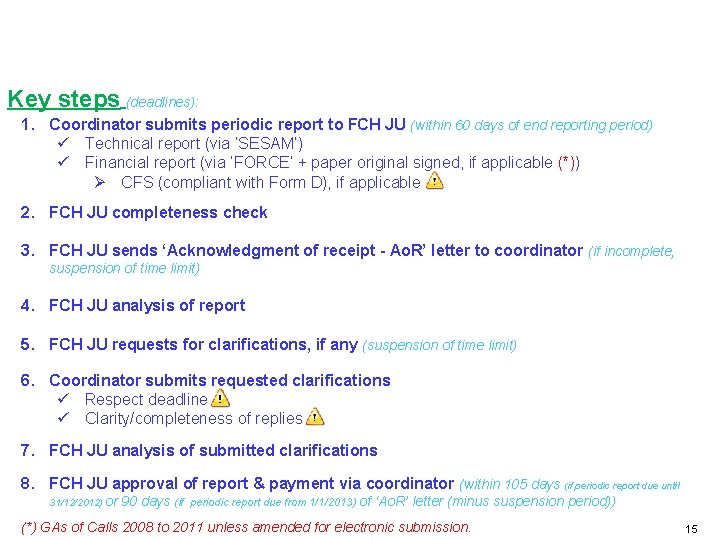
4. a. The ex-ante review process Key steps (deadlines): 1. Coordinator submits periodic report to FCH JU (within 60 days of end reporting period) ü Technical report (via ‘SESAM’) ü Financial report (via ‘FORCE’ + paper original signed, if applicable (*)) Ø CFS (compliant with Form D), if applicable 2. FCH JU completeness check 3. FCH JU sends ‘Acknowledgment of receipt - Ao. R’ letter to coordinator (if incomplete, suspension of time limit) 4. FCH JU analysis of report 5. FCH JU requests for clarifications, if any (suspension of time limit) 6. Coordinator submits requested clarifications ü Respect deadline ü Clarity/completeness of replies 7. FCH JU analysis of submitted clarifications 8. FCH JU approval of report & payment via coordinator (within 105 days (if periodic report due until 31/12/2012) or 90 days (if periodic report due from 1/1/2013) of ‘Ao. R’ letter (minus suspension period)) (*) GAs of Calls 2008 to 2011 unless amended for electronic submission. 15
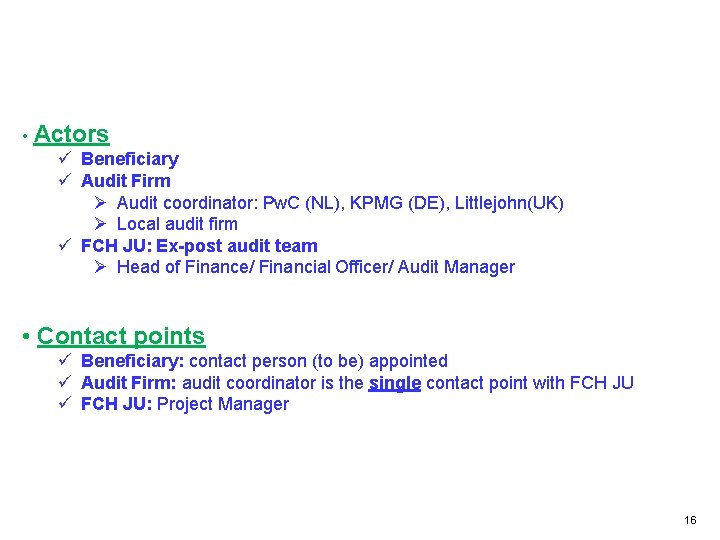
4. b. The ex-post audit process • Actors ü Beneficiary ü Audit Firm Ø Audit coordinator: Pw. C (NL), KPMG (DE), Littlejohn(UK) Ø Local audit firm ü FCH JU: Ex-post audit team Ø Head of Finance/ Financial Officer/ Audit Manager • Contact points ü Beneficiary: contact person (to be) appointed ü Audit Firm: audit coordinator is the single contact point with FCH JU ü FCH JU: Project Manager 16
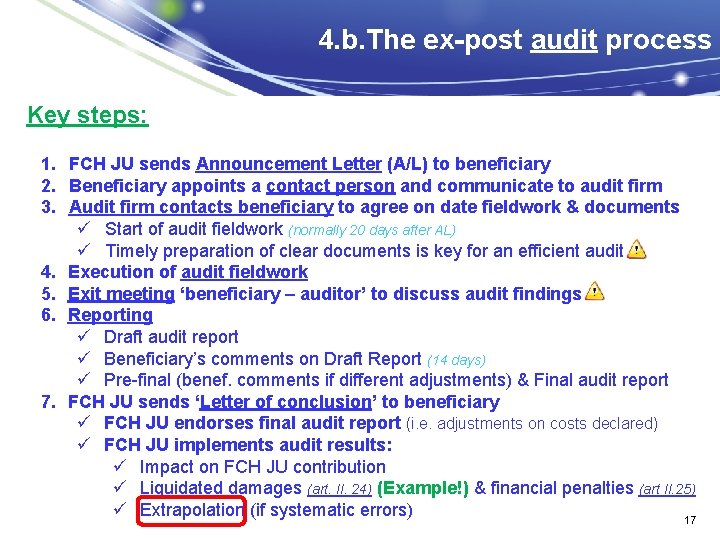
4. b. The ex-post audit process Key steps: 1. FCH JU sends Announcement Letter (A/L) to beneficiary 2. Beneficiary appoints a contact person and communicate to audit firm 3. Audit firm contacts beneficiary to agree on date fieldwork & documents ü Start of audit fieldwork (normally 20 days after AL) ü Timely preparation of clear documents is key for an efficient audit 4. Execution of audit fieldwork 5. Exit meeting ‘beneficiary – auditor’ to discuss audit findings 6. Reporting ü Draft audit report ü Beneficiary’s comments on Draft Report (14 days) ü Pre-final (benef. comments if different adjustments) & Final audit report 7. FCH JU sends ‘Letter of conclusion’ to beneficiary ü FCH JU endorses final audit report (i. e. adjustments on costs declared) ü FCH JU implements audit results: ü Impact on FCH JU contribution ü Liquidated damages (art. II. 24) (Example!) & financial penalties (art II. 25) ü Extrapolation (if systematic errors) 17
Example of Liquidated Damages (LD) 18
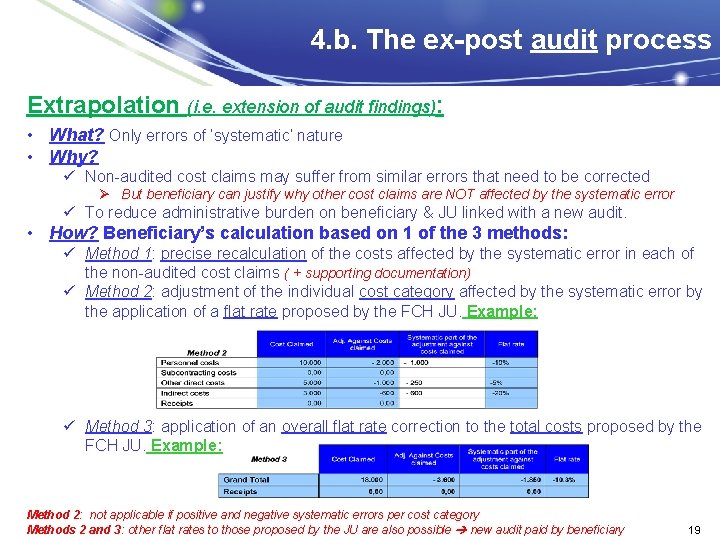
4. b. The ex-post audit process Extrapolation (i. e. extension of audit findings): • What? Only errors of ‘systematic’ nature • Why? ü Non-audited cost claims may suffer from similar errors that need to be corrected Ø But beneficiary can justify why other cost claims are NOT affected by the systematic error ü To reduce administrative burden on beneficiary & JU linked with a new audit. • How? Beneficiary’s calculation based on 1 of the 3 methods: ü Method 1: precise recalculation of the costs affected by the systematic error in each of the non-audited cost claims ( + supporting documentation) ü Method 2: adjustment of the individual cost category affected by the systematic error by the application of a flat rate proposed by the FCH JU. Example: ü Method 3: application of an overall flat rate correction to the total costs proposed by the FCH JU. Example: Method 2: not applicable if positive and negative systematic errors per cost category Methods 2 and 3: other flat rates to those proposed by the JU are also possible new audit paid by beneficiary 19
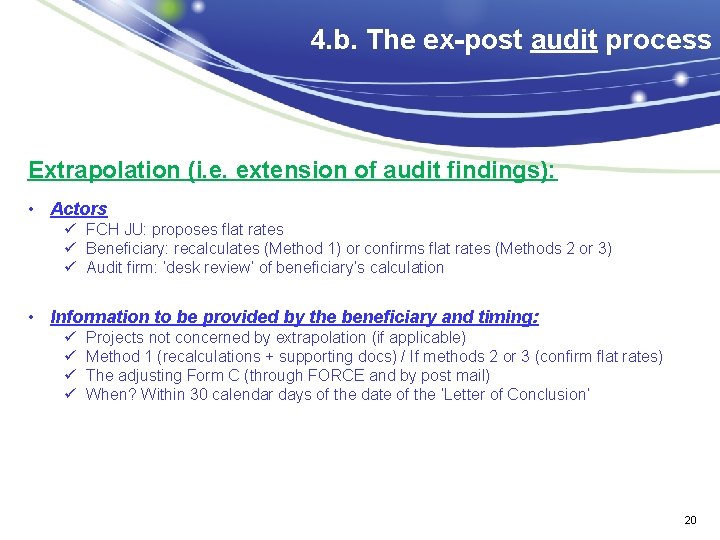
4. b. The ex-post audit process Extrapolation (i. e. extension of audit findings): • Actors ü FCH JU: proposes flat rates ü Beneficiary: recalculates (Method 1) or confirms flat rates (Methods 2 or 3) ü Audit firm: ‘desk review’ of beneficiary’s calculation • Information to be provided by the beneficiary and timing: ü ü Projects not concerned by extrapolation (if applicable) Method 1 (recalculations + supporting docs) / If methods 2 or 3 (confirm flat rates) The adjusting Form C (through FORCE and by post mail) When? Within 30 calendar days of the date of the ‘Letter of Conclusion’ 20
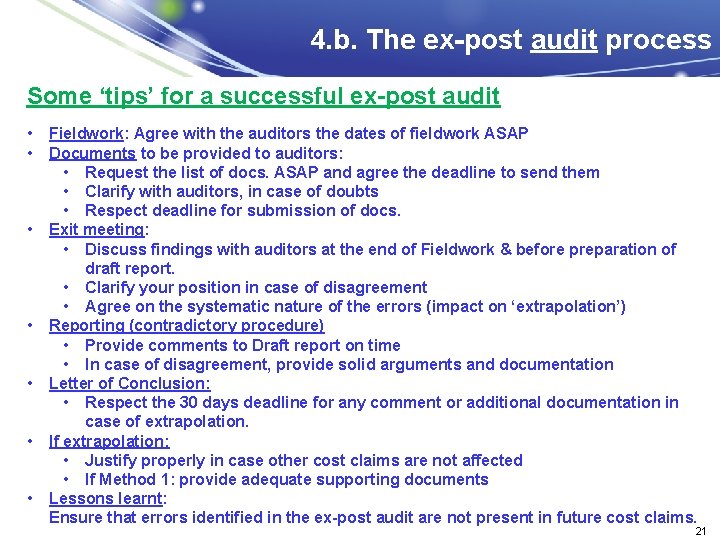
4. b. The ex-post audit process Some ‘tips’ for a successful ex-post audit • • Fieldwork: Agree with the auditors the dates of fieldwork ASAP Documents to be provided to auditors: • Request the list of docs. ASAP and agree the deadline to send them • Clarify with auditors, in case of doubts • Respect deadline for submission of docs. Exit meeting: • Discuss findings with auditors at the end of Fieldwork & before preparation of draft report. • Clarify your position in case of disagreement • Agree on the systematic nature of the errors (impact on ‘extrapolation’) Reporting (contradictory procedure) • Provide comments to Draft report on time • In case of disagreement, provide solid arguments and documentation Letter of Conclusion: • Respect the 30 days deadline for any comment or additional documentation in case of extrapolation. If extrapolation: • Justify properly in case other cost claims are not affected • If Method 1: provide adequate supporting documents Lessons learnt: Ensure that errors identified in the ex-post audit are not present in future cost claims. 21