
Communication Bottlenecks and Gradient Quantization Dimitris Papailiopoulos University
Communication Bottlenecks and Gradient Quantization Dimitris Papailiopoulos University of Wisconsin-Madison
Overview - Distributed ML - Communication Bottlenecks - Possible solutions: - Grad Quantization - Grad Sparsification QSGD, Terngrad, and beyond
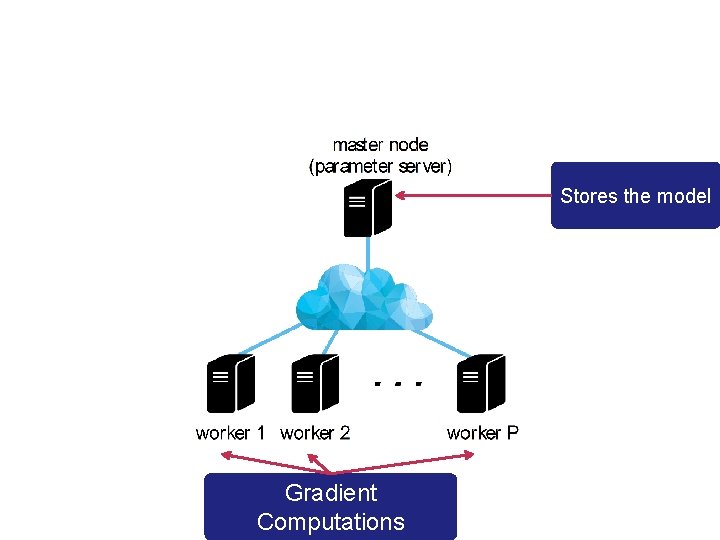
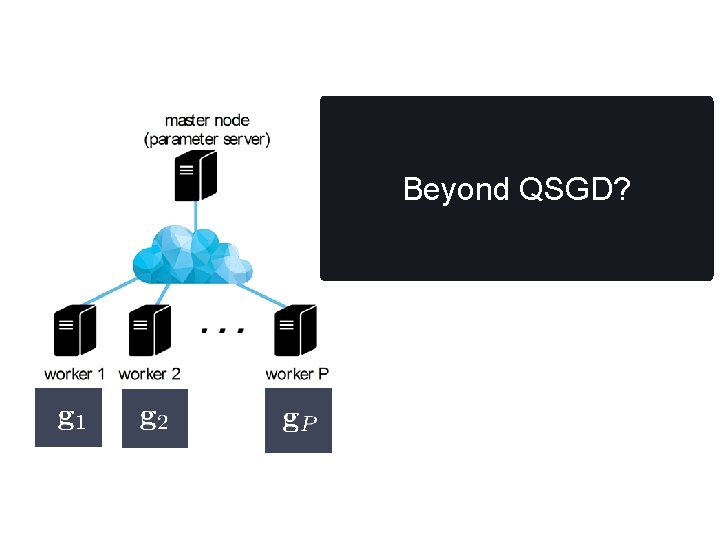
Stores the model Gradient Computations
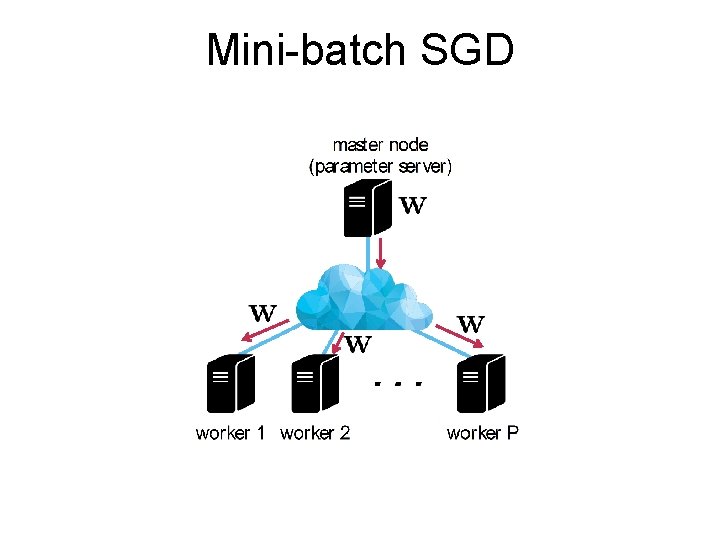
Mini-batch SGD
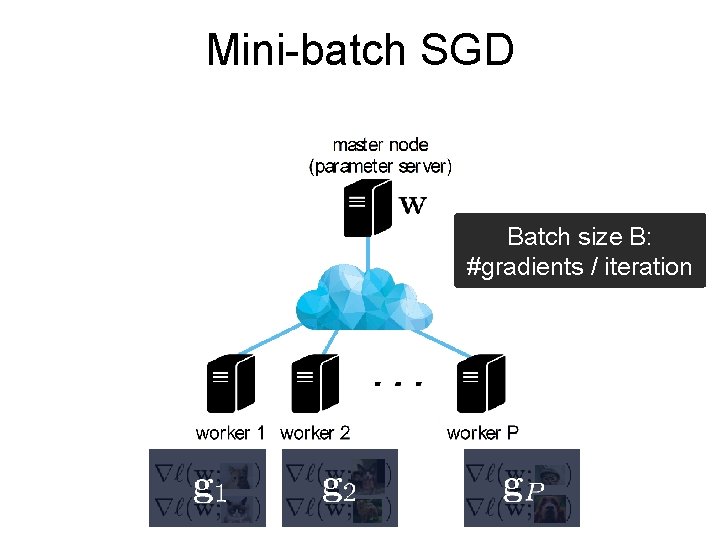
Mini-batch SGD Batch size B: #gradients / iteration + + +
![Mini-batch SGD [Zinkevich, Weimer, Smola, Li, NIPS 2010] [Taka c, Bijral, Richta rik, Srebro,](http://slidetodoc.com/presentation_image_h2/f5634d28253f7a39bac97547e69abc71/image-6.jpg "Mini-batch SGD [Zinkevich, Weimer, Smola, Li, NIPS 2010] [Taka c, Bijral, Richta rik, Srebro,")
Mini-batch SGD [Zinkevich, Weimer, Smola, Li, NIPS 2010] [Taka c, Bijral, Richta rik, Srebro, ICML 2013] [Cotter, Shamir, Srebro, Sridharan, NIPS 11] [Li, Zhang, Chen, Smola, KDD 2014] [Dekel, Gilad-Bachrach, Shamir, Xiao, JMLR[Jain, Kakade, Kidambi, Netrapalli, Sidford, 2012] arxiv’ 16]
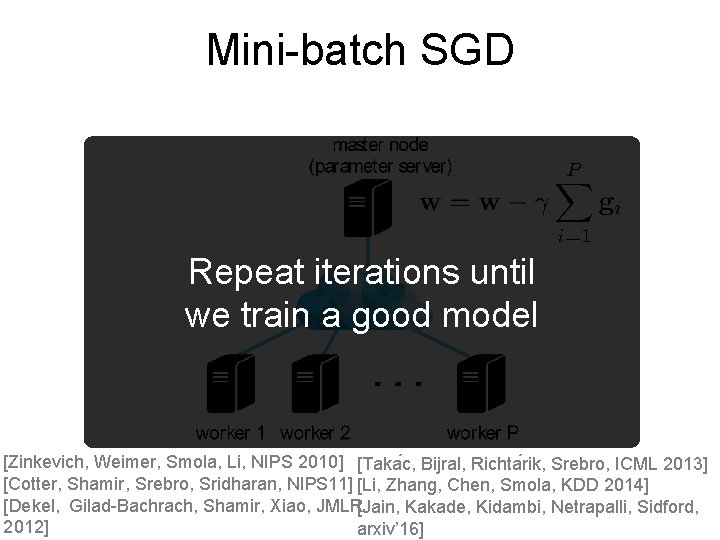
Mini-batch SGD Repeat iterations until we train a good model [Zinkevich, Weimer, Smola, Li, NIPS 2010] [Taka c, Bijral, Richta rik, Srebro, ICML 2013] [Cotter, Shamir, Srebro, Sridharan, NIPS 11] [Li, Zhang, Chen, Smola, KDD 2014] [Dekel, Gilad-Bachrach, Shamir, Xiao, JMLR[Jain, Kakade, Kidambi, Netrapalli, Sidford, 2012] arxiv’ 16]
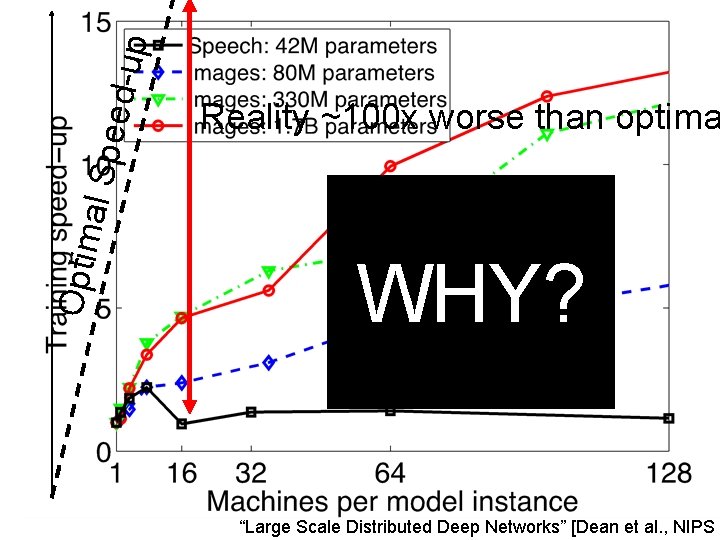
p eed-u Optim al Sp Reality ~100 x worse than optima WHY? “Large Scale Distributed Deep Networks” [Dean et al. , NIPS 2
![Two factors control run-time Time to accuracy ε = [time per data pass] X](http://slidetodoc.com/presentation_image_h2/f5634d28253f7a39bac97547e69abc71/image-9.jpg "Two factors control run-time Time to accuracy ε = [time per data pass] X")
Two factors control run-time Time to accuracy ε = [time per data pass] X [#passes to accuracy ε]
![Why so slow? “[…] on more than 8 machines […] network overhead starts to](http://slidetodoc.com/presentation_image_h2/f5634d28253f7a39bac97547e69abc71/image-10.jpg "Why so slow? “[…] on more than 8 machines […] network overhead starts to")
Why so slow? “[…] on more than 8 machines […] network overhead starts to dominate […]” - TL; DR: Communication is the Bottleneck Why? Time per pass: time for dataset_size/batch_size distributed iterations Bigger Batch Less Communication (smaller time per epoch)
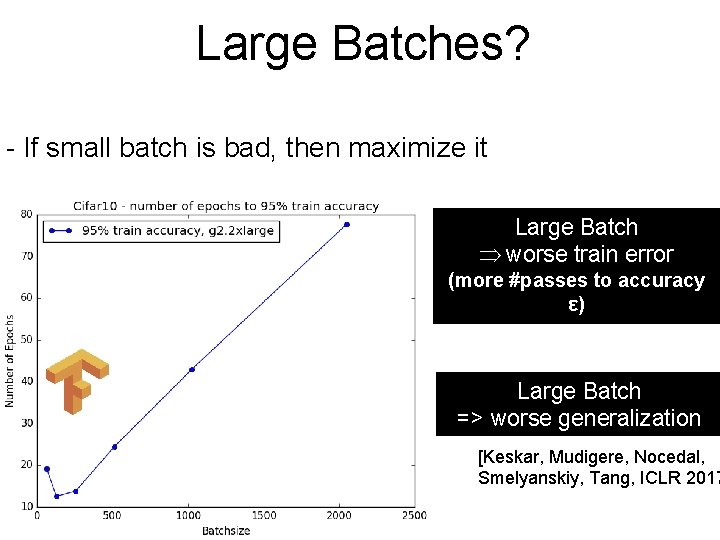
Large Batches? - If small batch is bad, then maximize it Large Batch worse train error (more #passes to accuracy ε) Large Batch => worse generalization [Keskar, Mudigere, Nocedal, Smelyanskiy, Tang, ICLR 2017
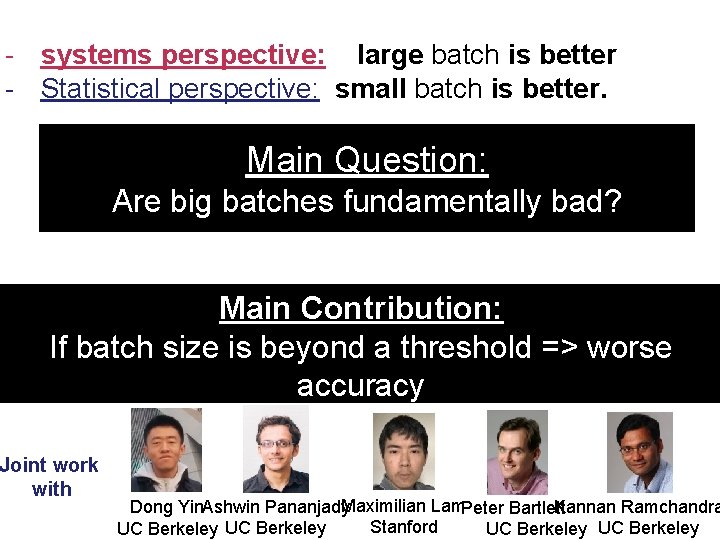
- systems perspective: large batch is better - Statistical perspective: small batch is better. Main Question: Are big batches fundamentally bad? Main Contribution: If batch size is beyond a threshold => worse accuracy Joint work with [ar. Xiv: 1706. 05699] Kannan Ramchandra Dong Yin. Ashwin Pananjady. Maximilian Lam. Peter Bartlett Stanford UC Berkeley
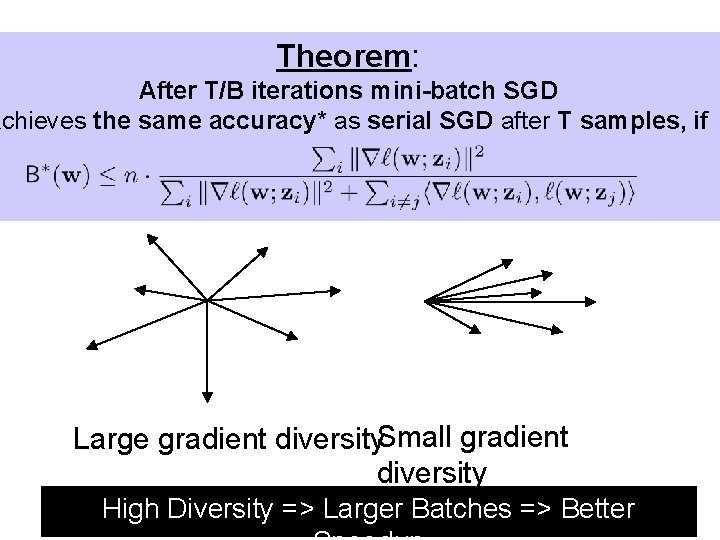
Theorem: After T/B iterations mini-batch SGD achieves the same accuracy* as serial SGD after T samples, if Large gradient diversity. Small gradient diversity High Diversity => Larger Batches => Better
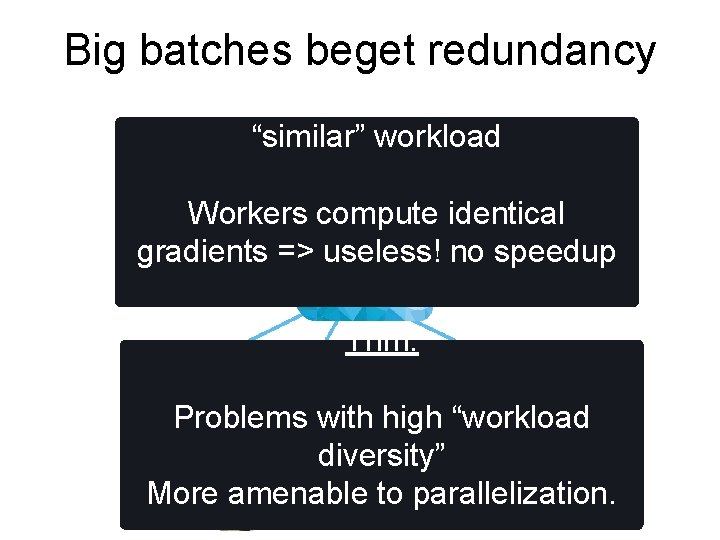
Big batches beget redundancy “similar” workload Workers compute identical gradients => useless! no speedup Thm: Problems with high “workload diversity” More amenable to parallelization.
Gradient Diversity Controls Distributed Performance

Conclusions - Novel analysis of minibatch SGD based on gradient interference - Batch size cannot increase beyond a fundamental point We need a better algorithm - Tight lower bound - Open Problems: - Lower bound for generalization - Fundamental trade-off between parallelizability and statistical accuracy - Stragglers
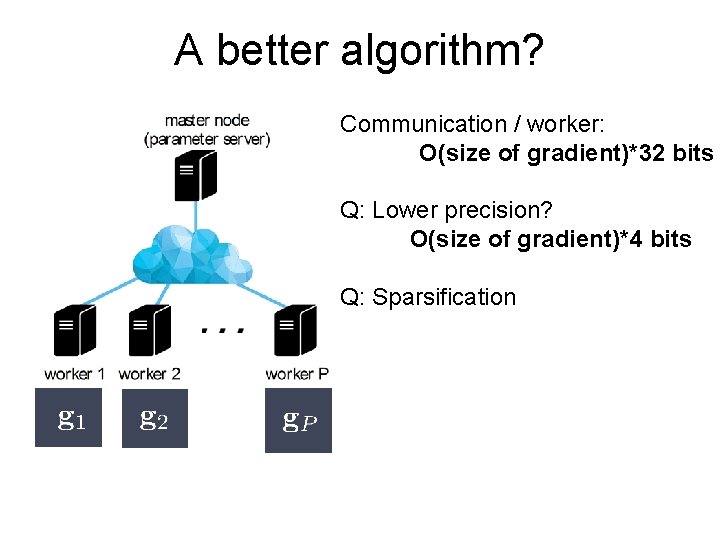
A better algorithm? Communication / worker: O(size of gradient)*32 bits Q: Lower precision? O(size of gradient)*4 bits Q: Sparsification
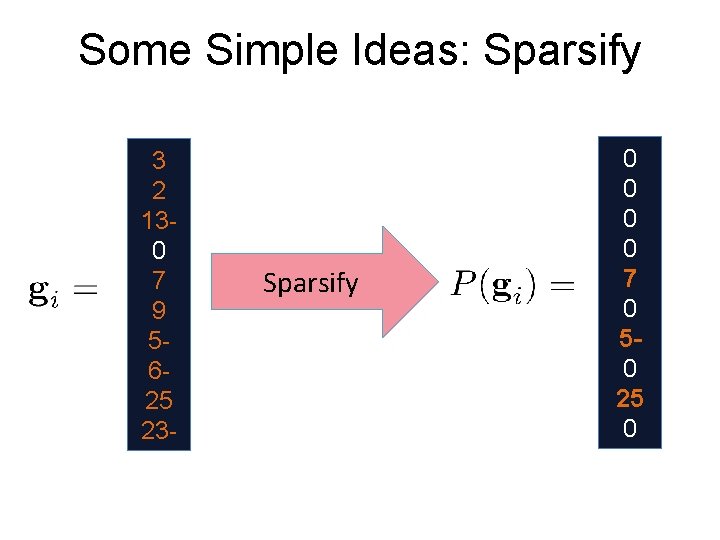
Some Simple Ideas: Sparsify 3 2 130 7 9 5625 23 - Sparsify 0 0 7 0 50 25 0
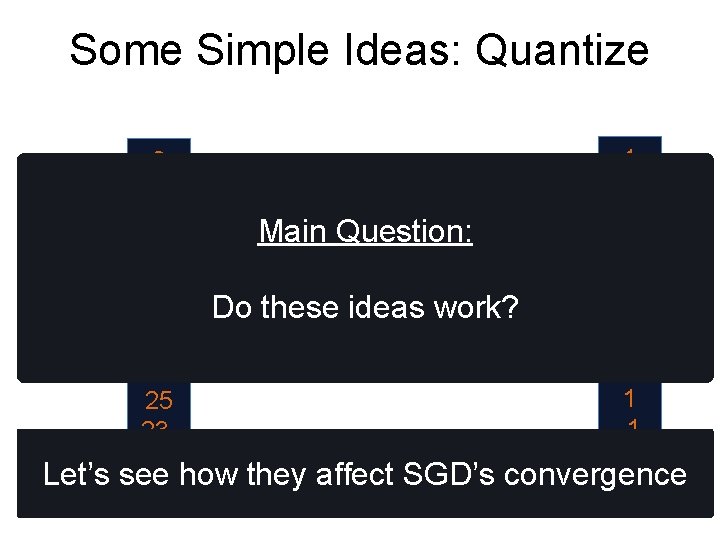
Some Simple Ideas: Quantize 3 2 130 7 9 5625 23 - Main Question: Sparsify Do these ideas work? 1 1 -1 -1 Let’s see how they affect SGD’s convergence
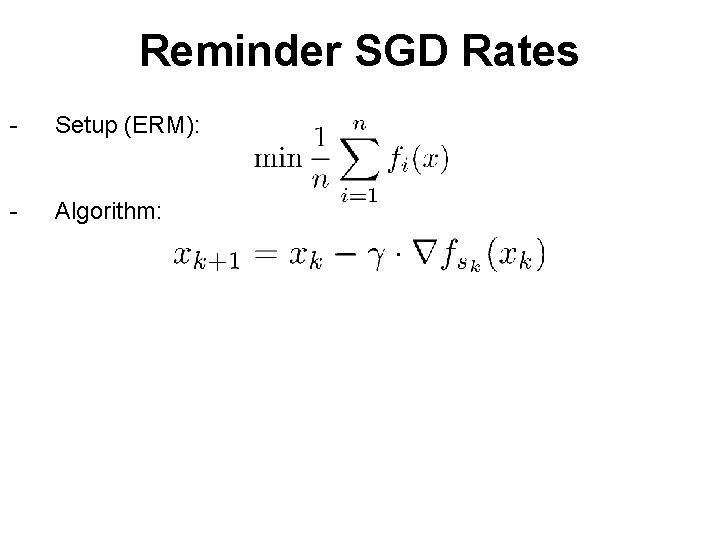
Reminder SGD Rates - Setup (ERM): - Algorithm:
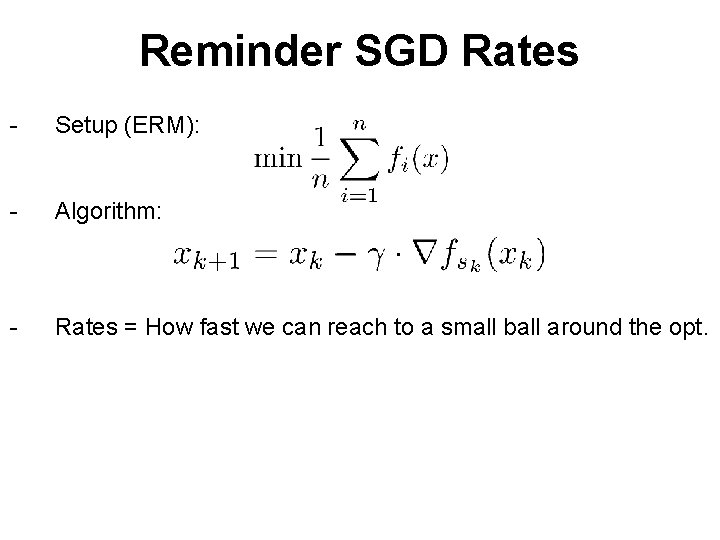
Reminder SGD Rates - Setup (ERM): - Algorithm: - Rates = How fast we can reach to a small ball around the opt.
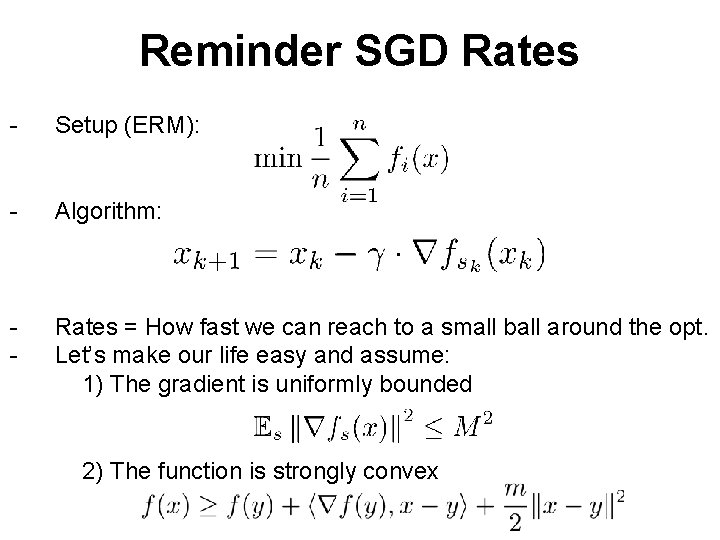
Reminder SGD Rates - Setup (ERM): - Algorithm: - Rates = How fast we can reach to a small ball around the opt. Let’s make our life easy and assume: 1) The gradient is uniformly bounded 2) The function is strongly convex
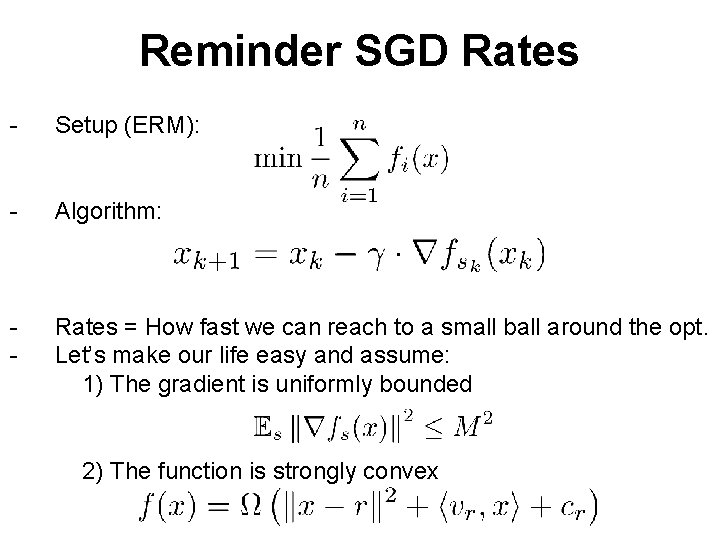
Reminder SGD Rates - Setup (ERM): - Algorithm: - Rates = How fast we can reach to a small ball around the opt. Let’s make our life easy and assume: 1) The gradient is uniformly bounded 2) The function is strongly convex
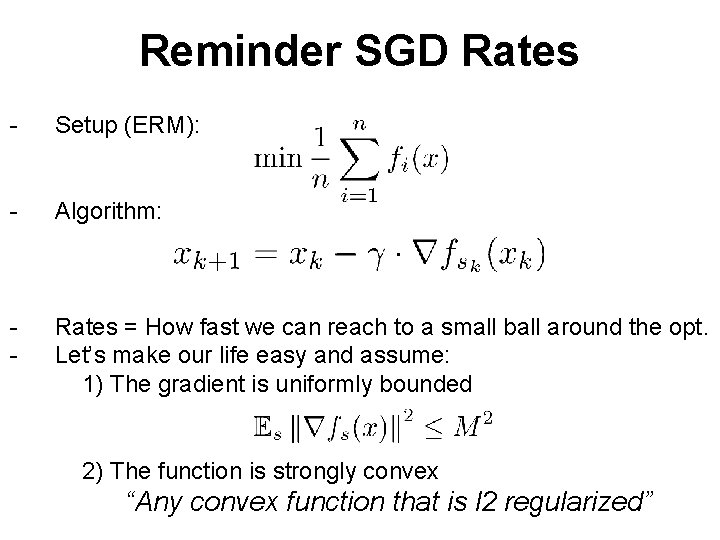
Reminder SGD Rates - Setup (ERM): - Algorithm: - Rates = How fast we can reach to a small ball around the opt. Let’s make our life easy and assume: 1) The gradient is uniformly bounded 2) The function is strongly convex “Any convex function that is l 2 regularized”
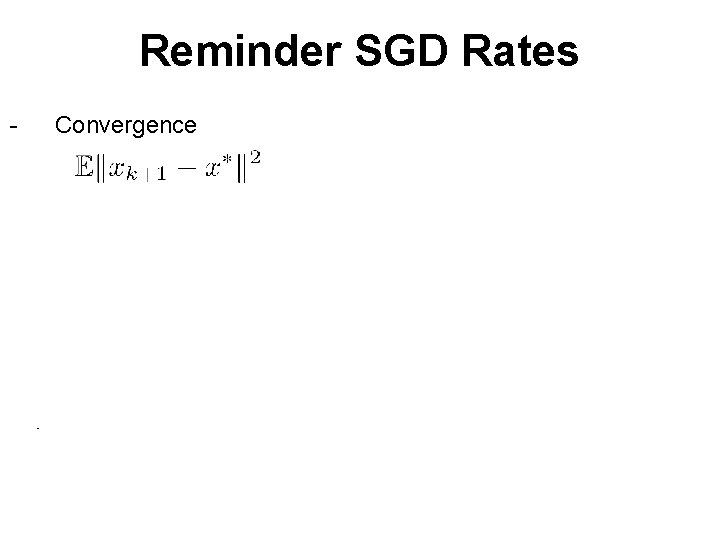
Reminder SGD Rates - Convergence Asm. 1 Asm. 2 - Let’s rename things
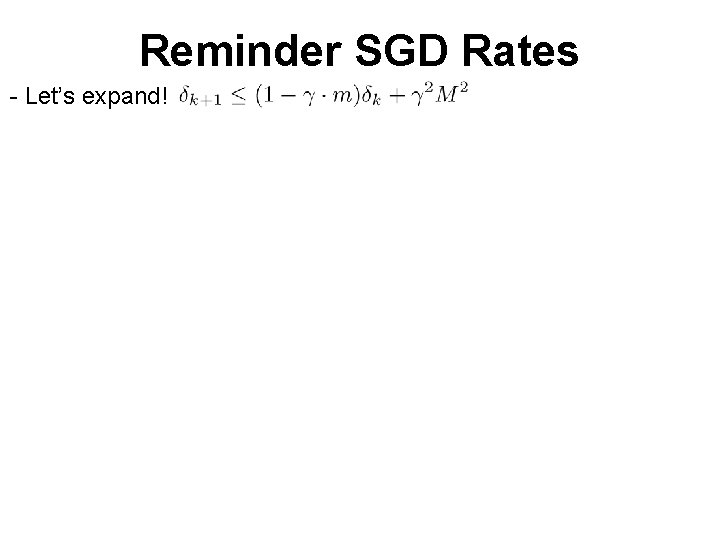
Reminder SGD Rates - Let’s expand! = ε/2 Q: Stepsize and iterations to reach accuracy ε? A:
![High-level requirements - E[Stochastic gradient] = true gradient - Variance M is small, so](http://slidetodoc.com/presentation_image_h2/f5634d28253f7a39bac97547e69abc71/image-27.jpg "High-level requirements - E[Stochastic gradient] = true gradient - Variance M is small, so")
High-level requirements - E[Stochastic gradient] = true gradient - Variance M is small, so that SGD doesn’t take too many iterations - Does simple sparsification and quantization satisfy the above?
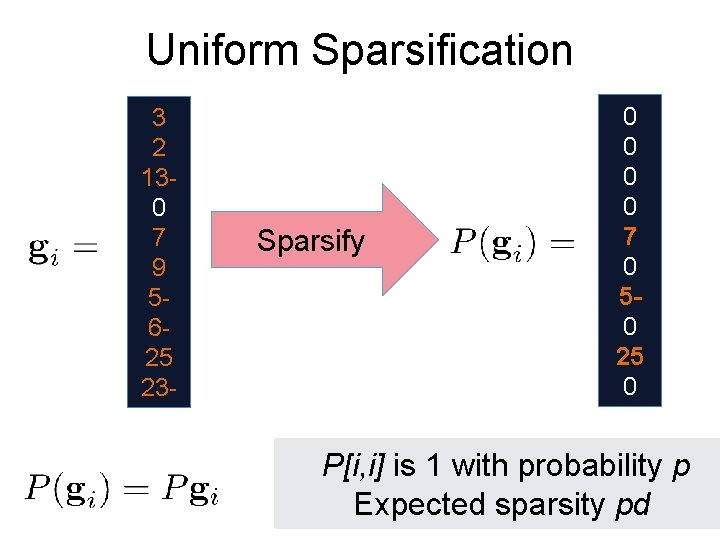
Uniform Sparsification 3 2 130 7 9 5625 23 - Sparsify 0 0 7 0 50 25 0 P[i, i] is 1 with probability p Expected sparsity pd
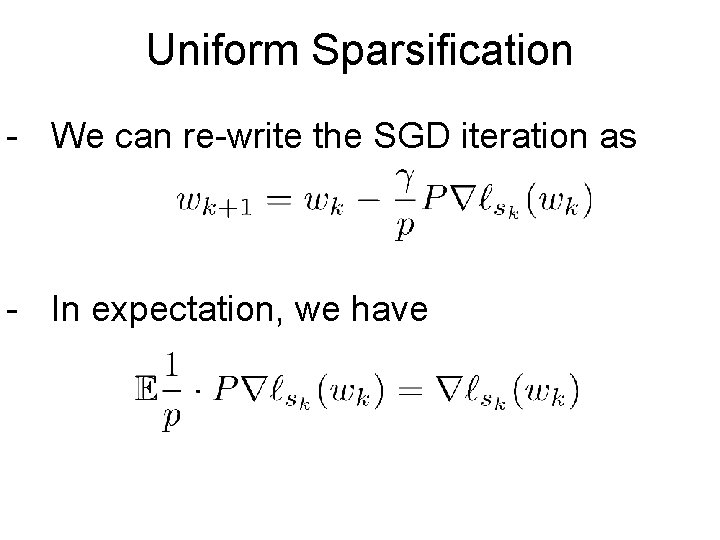
Uniform Sparsification - We can re-write the SGD iteration as - In expectation, we have
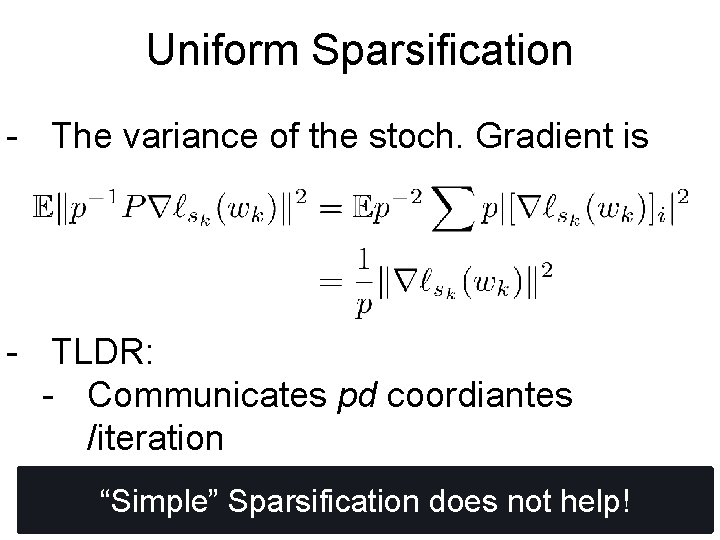
Uniform Sparsification - The variance of the stoch. Gradient is - TLDR: - Communicates pd coordiantes /iteration - Requires 1/p more iterations. “Simple” Sparsification does not help!
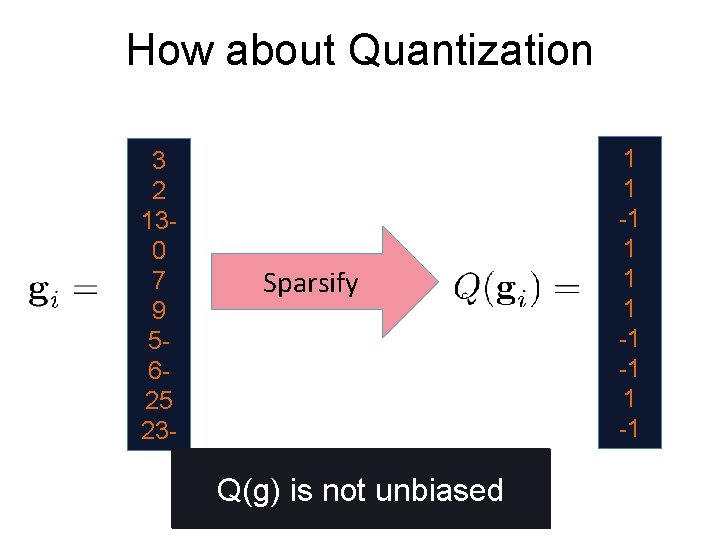
How about Quantization 3 2 130 7 9 5625 23 - Sparsify Q(g) is not unbiased 1 1 -1 -1
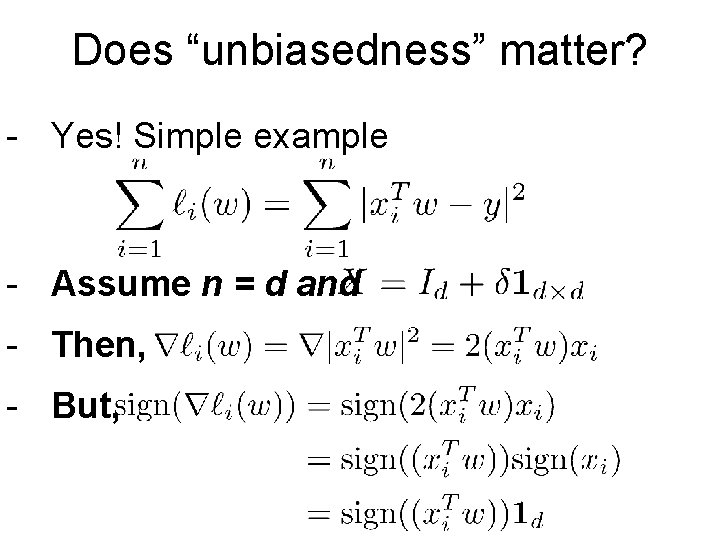
Does “unbiasedness” matter? - Yes! Simple example - Assume n = d and - Then, - But,
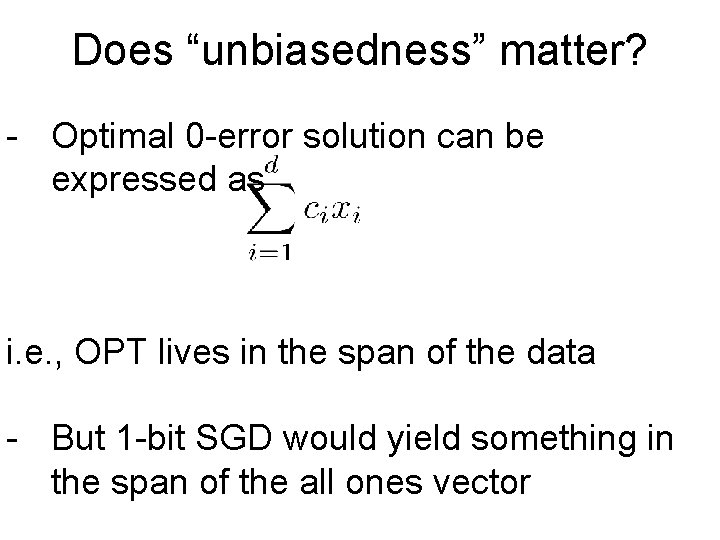
Does “unbiasedness” matter? - Optimal 0 -error solution can be expressed as i. e. , OPT lives in the span of the data - But 1 -bit SGD would yield something in the span of the all ones vector
Simple Quantization and Sparsification Simple ideas don’t work Hint: let’s create quantized stochastic gradients, such that: - They are unbiased - They have smaller variance
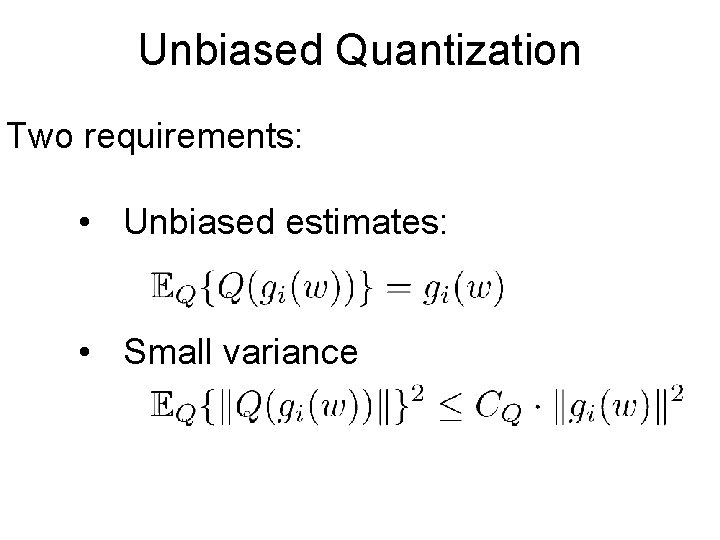
Unbiased Quantization Two requirements: • Unbiased estimates: • Small variance
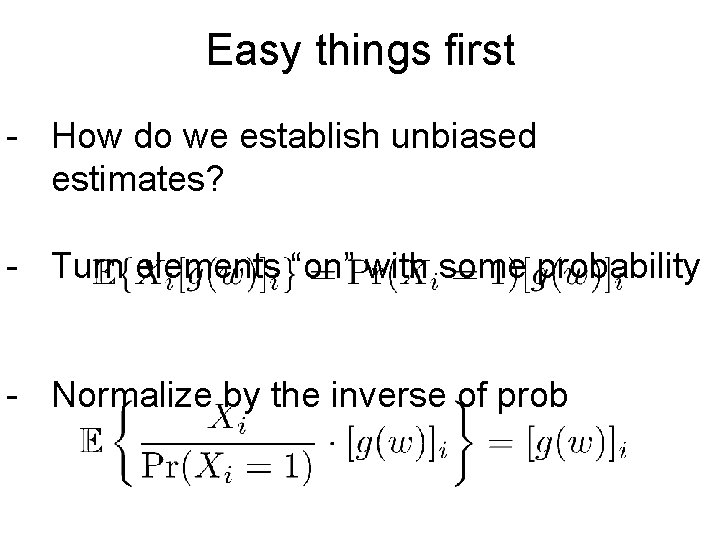
Easy things first - How do we establish unbiased estimates? - Turn elements “on” with some probability - Normalize by the inverse of prob
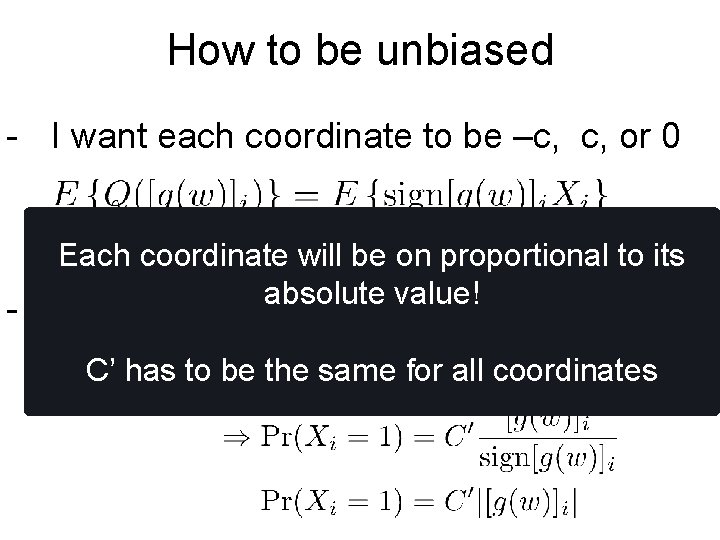
How to be unbiased - I want each coordinate to be –c, c, or 0 Each coordinate will be on proportional to its absolute value! - If I want unbiased, we need C’ has to be the same for all coordinates
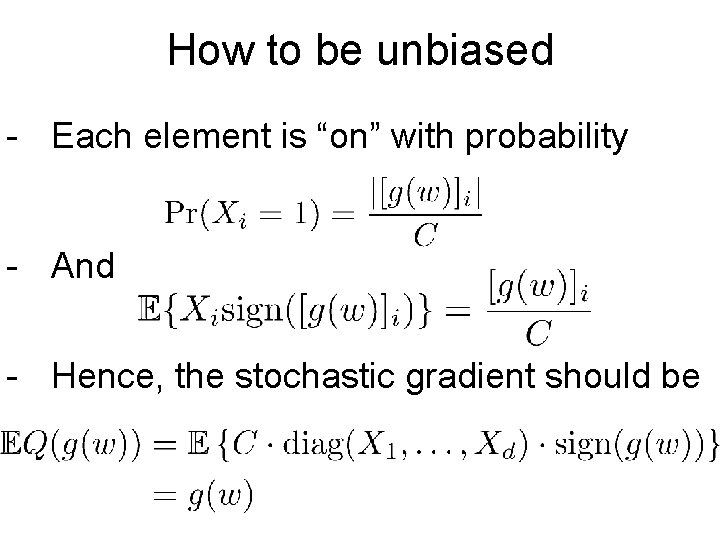
How to be unbiased - Each element is “on” with probability - And - Hence, the stochastic gradient should be
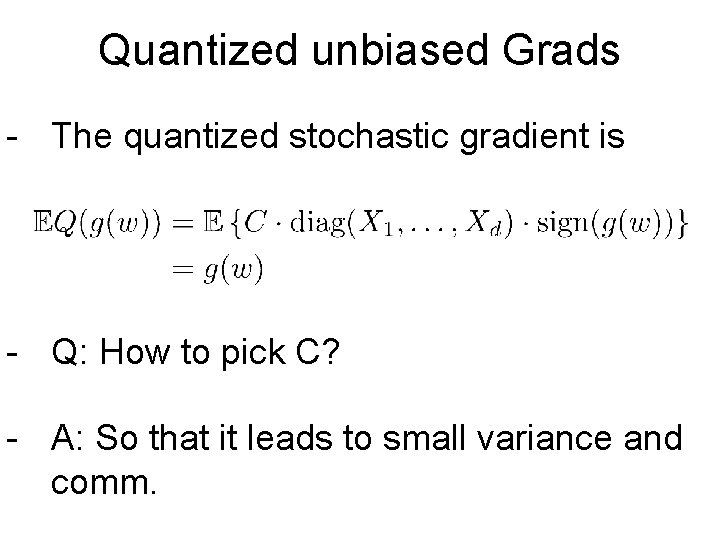
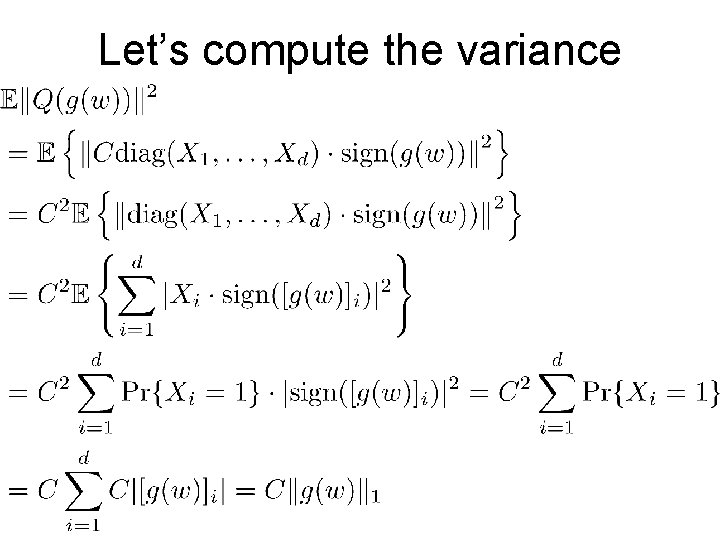
Quantized unbiased Grads - The quantized stochastic gradient is - Q: How to pick C? - A: So that it leads to small variance and comm.
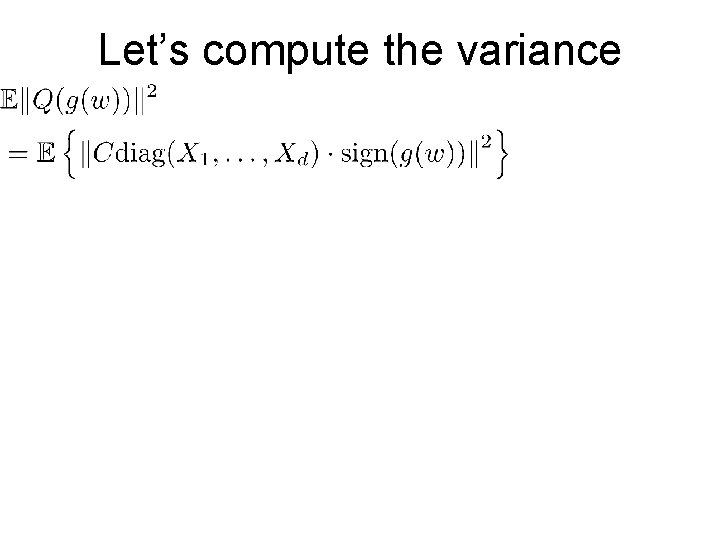
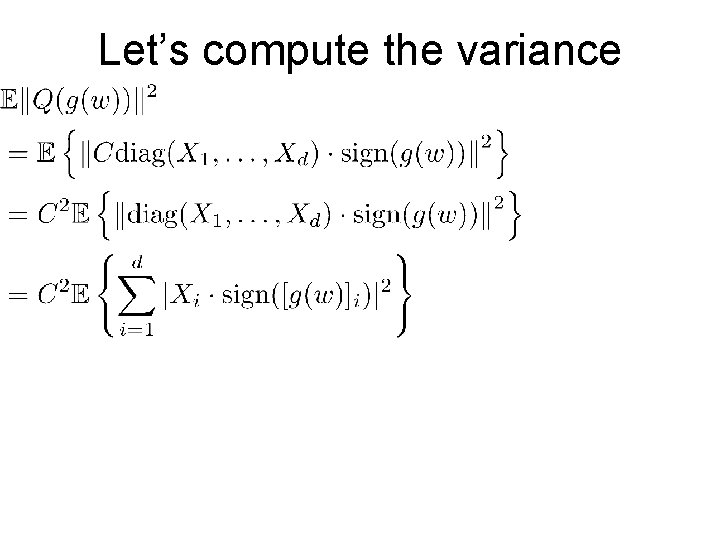
Let’s compute the variance
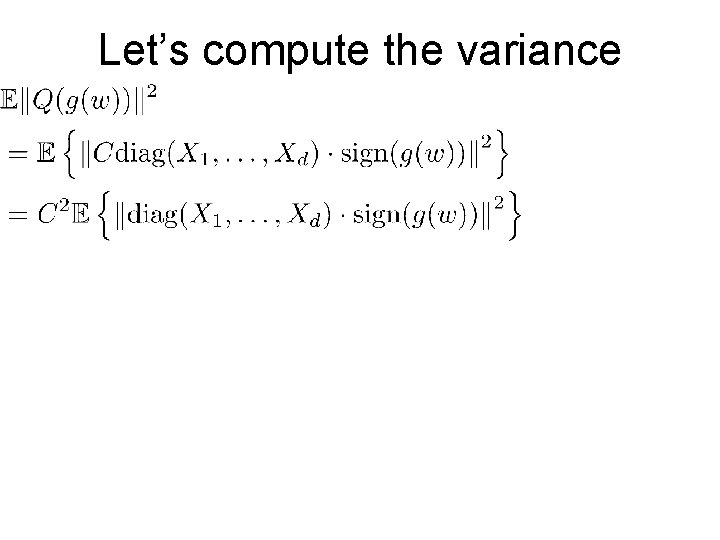
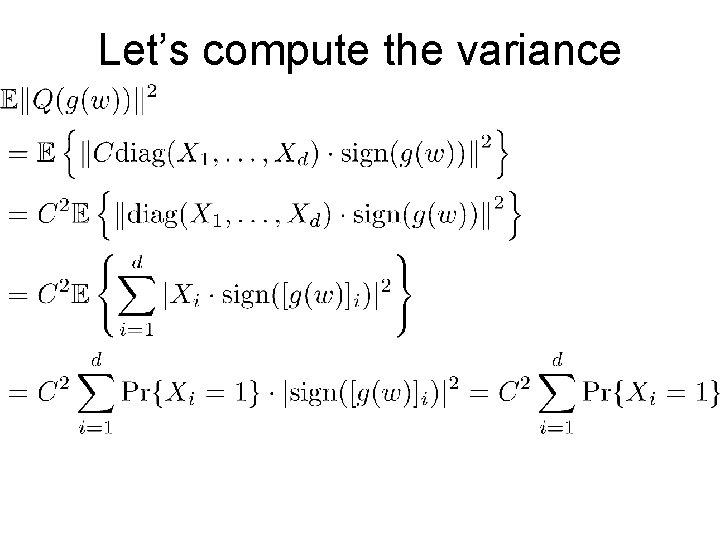
Let’s compute the variance
Let’s compute the variance
Let’s compute the variance
Let’s compute the variance
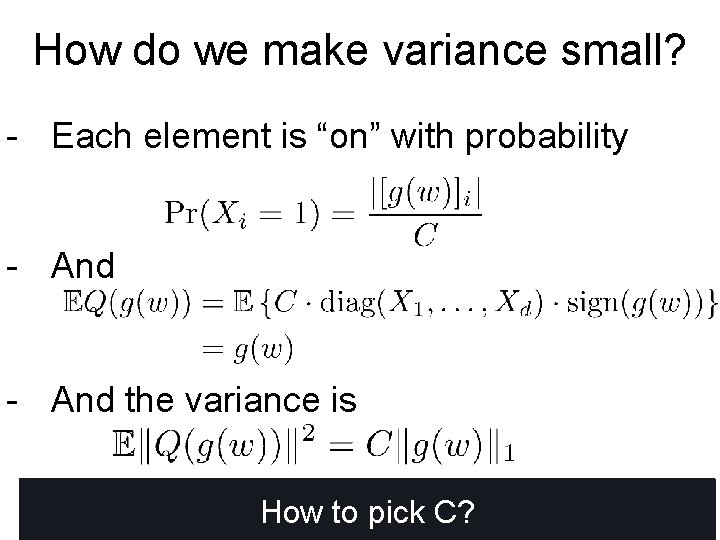
How do we make variance small? - Each element is “on” with probability - And the variance is How to pick C?
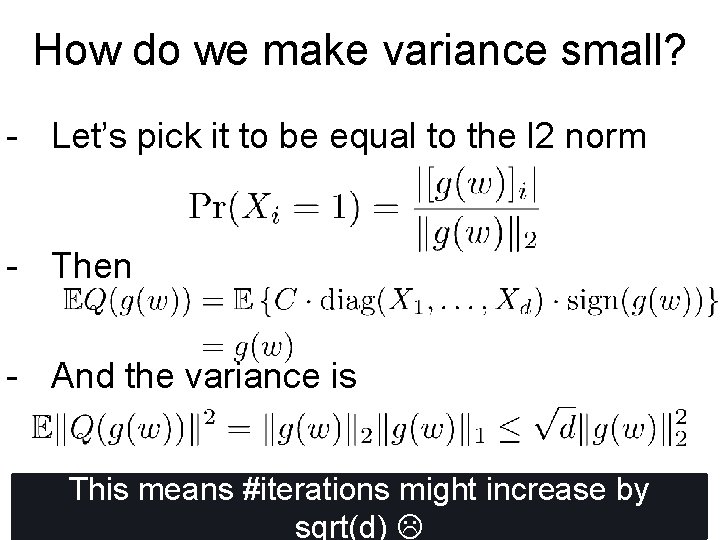
How do we make variance small? - Let’s pick it to be equal to the l 2 norm - Then - And the variance is This means #iterations might increase by sqrt(d)
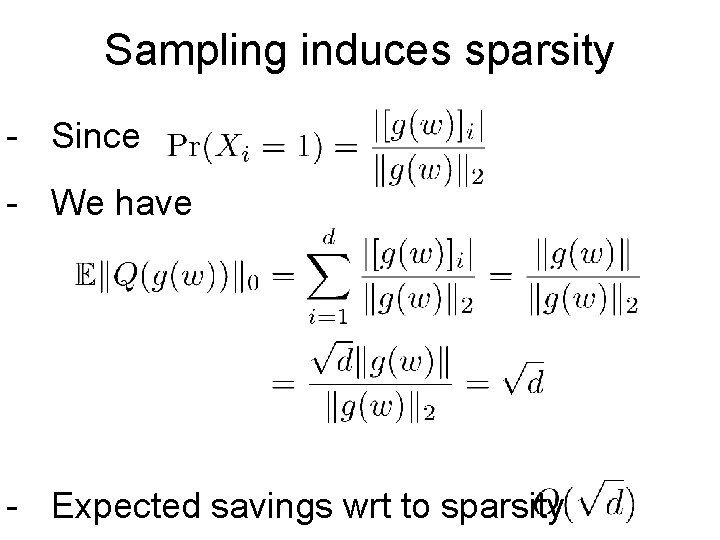
Sampling induces sparsity - Since - We have - Expected savings wrt to sparsity
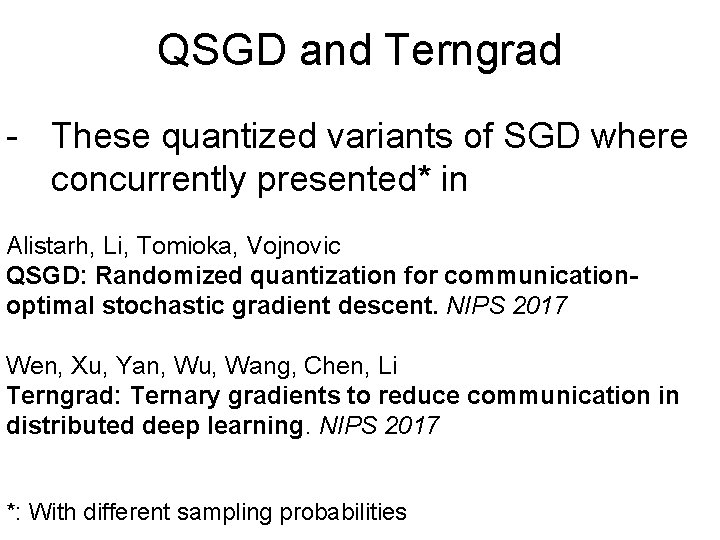
QSGD and Terngrad - These quantized variants of SGD where concurrently presented* in Alistarh, Li, Tomioka, Vojnovic QSGD: Randomized quantization for communicationoptimal stochastic gradient descent. NIPS 2017 Wen, Xu, Yan, Wu, Wang, Chen, Li Terngrad: Ternary gradients to reduce communication in distributed deep learning. NIPS 2017 *: With different sampling probabilities
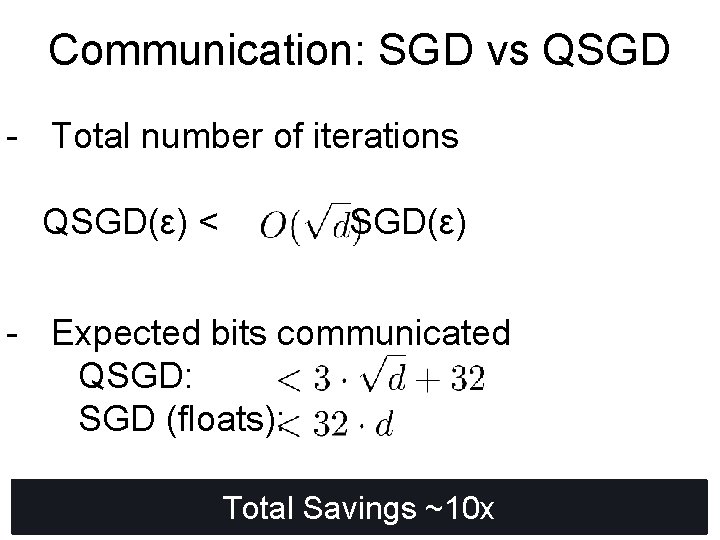
Communication: SGD vs QSGD - Total number of iterations QSGD(ε) < SGD(ε) - Expected bits communicated QSGD: SGD (floats): Total Savings ~10 x
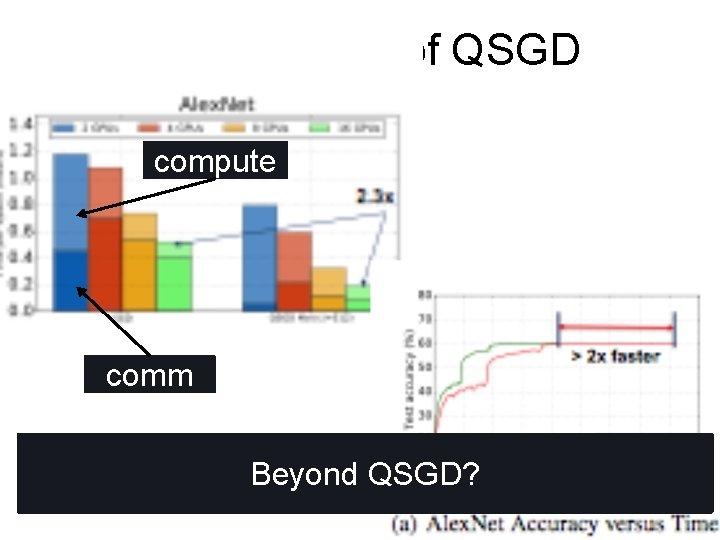
Performance of QSGD compute comm Beyond QSGD?
Beyond QSGD?
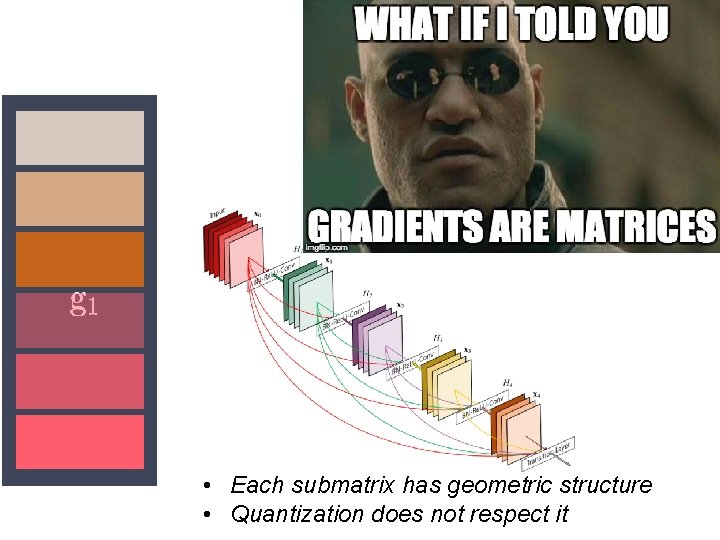
• Each submatrix has geometric structure • Quantization does not respect it
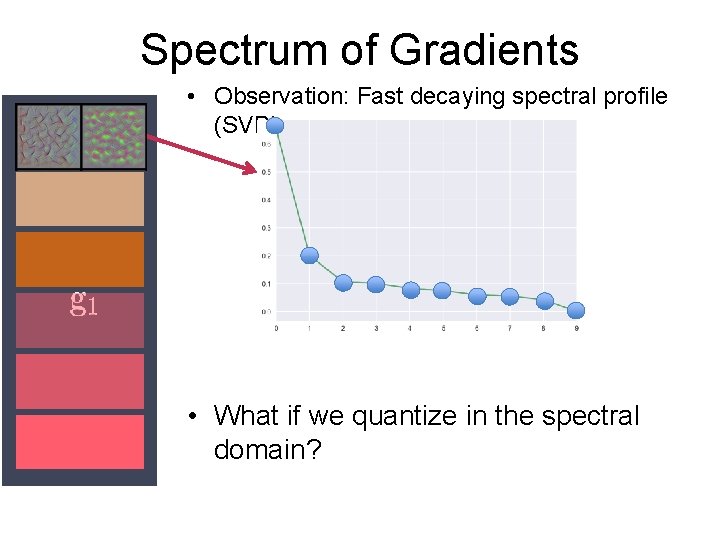
Spectrum of Gradients • Observation: Fast decaying spectral profile (SVD) • What if we quantize in the spectral domain?
![[insert absurd name]-SGD • Step 1: G(i) = Compute Grad at Layer i •](http://slidetodoc.com/presentation_image_h2/f5634d28253f7a39bac97547e69abc71/image-54.jpg "[insert absurd name]-SGD • Step 1: G(i) = Compute Grad at Layer i •")
[insert absurd name]-SGD • Step 1: G(i) = Compute Grad at Layer i • Step 2: L(i) = spectrally compressed G(i) (rank-r approx. ) • Step 3: Send L(i) to master 2. 5 x more iterations 8 x reduction in communication Currently testing
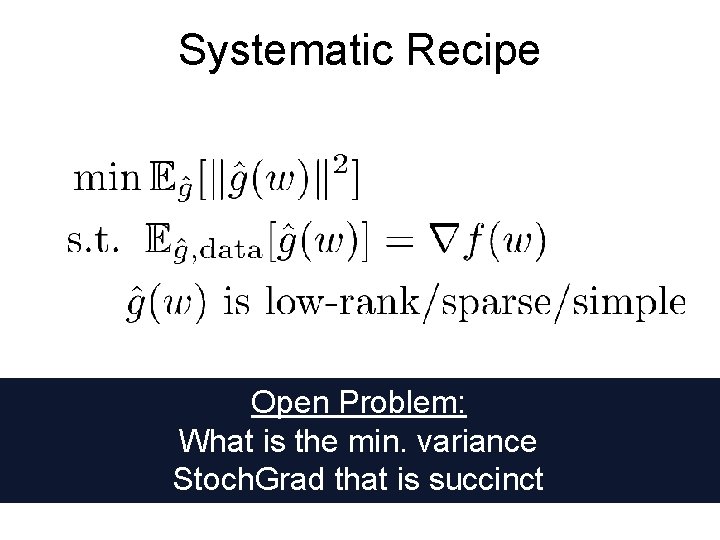
Systematic Recipe Open Problem: What is the min. variance Stoch. Grad that is succinct
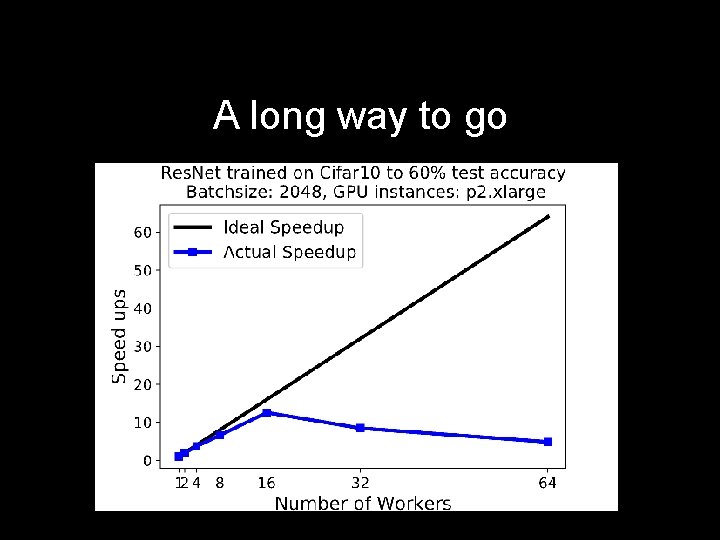
Conclusions A long way to go - Novel analysis of minibatch SGD based on gradient interference - Batch size cannot increase beyond a fundamental point - Tight lower bound - Open Problems: - Lower bound for generalization - Fundamental trade-off between parallelizability and statistical accuracy - Stragglers
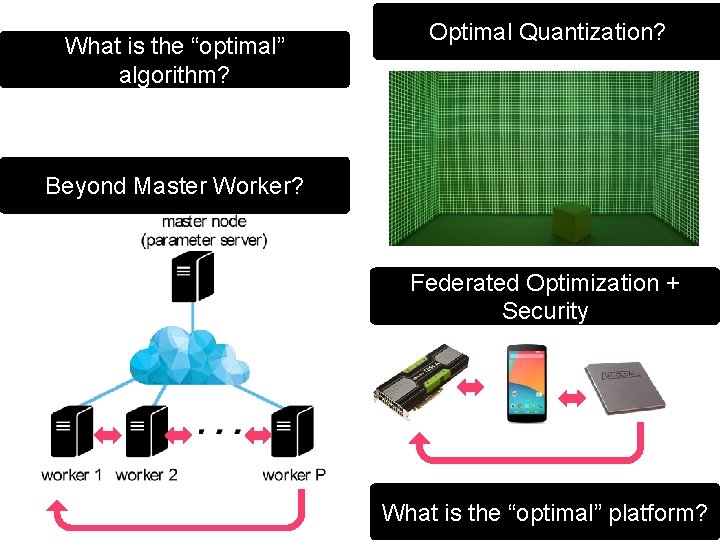
What is the “optimal” algorithm? Optimal Quantization? Beyond Master Worker? Federated Optimization + Security What is the “optimal” platform?
- Slides: 57