
Communication between 9 th Edition cultures Chapter 2
Communication between 9 th Edition cultures Chapter 2 Communication and Culture: The Voice and the Echo © Cengage 2017 Chapter 2: Communication and Culture: The Voice and the Echo 1
Key Ideas • • • The world Stage: Global Interdependence Communication and Culture Defined Venturing into a new culture Ethical Issues Intercultural Communication Challenges Cengage © 2017 Chapter 2: Communication and Culture: The Voice and the Echo 2
Human communication • Communication is the basis of all human contact • To understand a culture we must examine communication first • Communication is the ability to share ideas and feelings • While verbal and nonveral symbols may be different reasons people communicate are the same © Cengage 2012 Chapter 2 Communication and Culture: The Voice and the Echo 3
Defining Communication Human communication is a dynamic process in which people attempt to share their thoughts with other people through the use of symbols in particular settings. © Cengage 2012 Chapter 2 Communication and Culture: The Voice and the Echo 4
Uses of communication • Communication and identity – Defines who you are – Defines loyalties – Defines where you belong • Communication and person perception – Enables you to learn about another person – Assists in how you will describe yourself to others © Cengage 2012 Chapter 2 Communication and Culture: The Voice and the Echo 5

Uses of communication • Communication and interpersonal needs – Communication satisfies a basic social need – Provides a sense of inclusion and affection • Communication and persuasion © Cengage 2012 Chapter 2 Communication and Culture: The Voice and the Echo 6
Components of communication • • Source Encoding Messages Channel Receiver Decoding Feedback Noise © Cengage 2012 Chapter 2 Communication and Culture: The Voice and the Echo 7
Characteristics of communication • It is a dynamic process – it is not static • It is symbolic – inferences are drawn from the symbols people produce • It is contextual – it is part of a larger system – Location – Occasion – Time – Number of participants © Cengage 2012 Chapter 2 Communication and Culture: The Voice and the Echo 8
Characteristics of communication • It is a learned behavior – Language – Non-verbal • It has a consequence – Messages “do” something to someone else – You change people when you exchange messages with them © Cengage 2012 Chapter 2 Communication and Culture: The Voice and the Echo 9
Culture • Culture is communication and communication is culture. (Hall 1977 p. 14) • Culture is shared and has shared meanings • Culture Defined -Culture is a set of human-made objective and subjective elements that in the past have increased the probability of survival and resulted in satisfaction for the participants in an ecological niche, and thus became shared among those who could communicate with each other because they had a common language and they lived in the same time and place. (Triandis 1994 p. 23) © Cengage 2012 Chapter 2 Communication and Culture: The Voice and the Echo 10
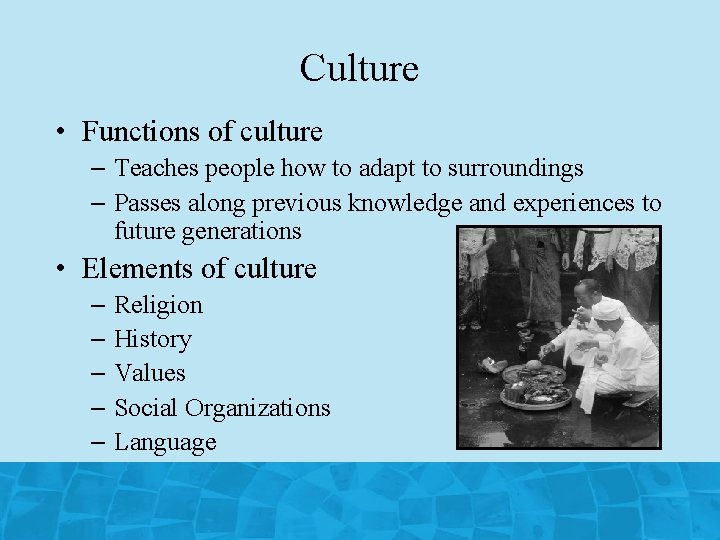
Culture • Functions of culture – Teaches people how to adapt to surroundings – Passes along previous knowledge and experiences to future generations • Elements of culture – Religion – History – Values – Social Organizations – Language © Cengage 2012 Chapter 2 Communication and Culture: The Voice and the Echo 11
Characteristics of culture: Culture is learned • Informal through interpersonal means • Formal teaching often through social institutions – Teaching through proverb – Teaching through folktales, legends and myths – Teaching through art • Learning culture through mass media © Cengage 2012 Chapter 2 Communication and Culture: The Voice and the Echo 12
Characteristics of culture: Culture is passed along • Culture is based on symbols – symbols tie people together • People can package, store and transmit symbols • Symbols can be verbal or nonverbal © Cengage 2012 Chapter 2 Communication and Culture: The Voice and the Echo 13
Characteristics of culture: Culture is dynamic • Cultures are subject to change • Changes can be brought about by new technology • Changes today are more prolific – Promoted by rise of American capitalism – Promoted by worldwide population growth – Promoted by large movement of immigrants – Promoted by proliferation of information technology © Cengage 2012 Chapter 2 Communication and Culture: The Voice and the Echo 14
Dynamic culture and Communication • Culture is deeply rooted in tradition • Cultures seek to endure • The deep structure of a culture resists major alterations – Popular culture may be open to change – Values, beliefs, role of government, ethics, morals, religious practices etc. persist from generation to generation © Cengage 2012 Chapter 2 Communication and Culture: The Voice and the Echo 15
Characteristics of culture: Culture is an integrated system • All parts of a culture are interconnected • You touch a culture in one place and everything else is affected. (Hall 1976, p. 1314) • Values can influence things like family size, work ethic, use of time and spiritual pursuits • Changes in technology can influence other cultural values, attitudes and behaviors © Cengage 2012 Chapter 2 Communication and Culture: The Voice and the Echo 16
- Slides: 16