
Communication and Optimal Resolution CANDOR Toolkit Module 5




- Slides: 17
Communication and Optimal Resolution (CANDOR) Toolkit Module 5: Response and Disclosure Communication
Objectives • Define the Response and Disclosure component of the CANDOR Process. • Describe the importance of disclosure communication and transparency with patients and families. • Define the elements of disclosure communication. • Describe the knowledge, skills, and attitudes necessary for an individual to serve as a CANDOR Disclosure Lead. • Identify the essential role of communication throughout the CANDOR process. Module 5 2
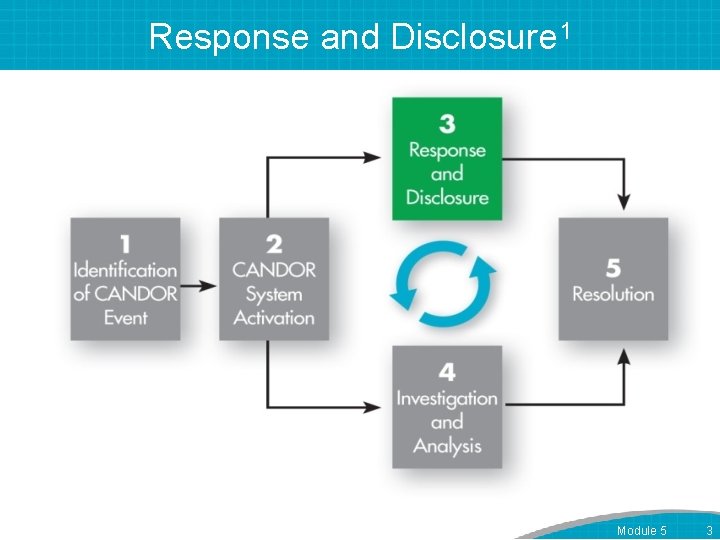
Response and Disclosure 1 Module 5 3
Role of the Disclosure Lead • Notified during CANDOR System Activation. • Oversees and coordinates disclosure communications with the patient/family. • Consults with designated communicator during initial disclosure conversation. • Guides staff in ensuring ongoing consistent communication with the patient/family. • Engages in subsequent disclosure communications with the patient/family about the harm event. Module 5 4
Disclosure Communication and Transparency 2, 3 • Meets patient expectations of health care organizations to: – Be truthful. – Provide accurate information and support. – Engage patients in their care. • Assures informed consent. • Addresses regulatory requirements. Additional Resource: AHRQ’s Guide to Patient and Family Engagement in Hospital Quality and Safety Module 5 5
Inappropriate Disclosure to A Patient Module 5 6
Disclosure is a Process 4 • Initial Conversation – Conducted by designated communicators, in consultation with the Disclosure Lead. – Within 60 minutes after the CANDOR event is identified. • Followup communications – Conducted by Disclosure Lead or other designated communicators. – Upon completion of the Event Investigation and Analysis, and as needed. Module 5 7
Disclosure Communication 2 • Following Event Investigation and Analysis, the disclosure should include – – An explicit statement that an event has occurred. – What happened exactly? – What are the implications for the patient’s health? – Why did it happen? – How will the organization prevent the event from happening to another patient? – An apology. Additional Resource: AHRQ's “Working With Patient and Families as Advisors Implementation Handbook” Module 5 8
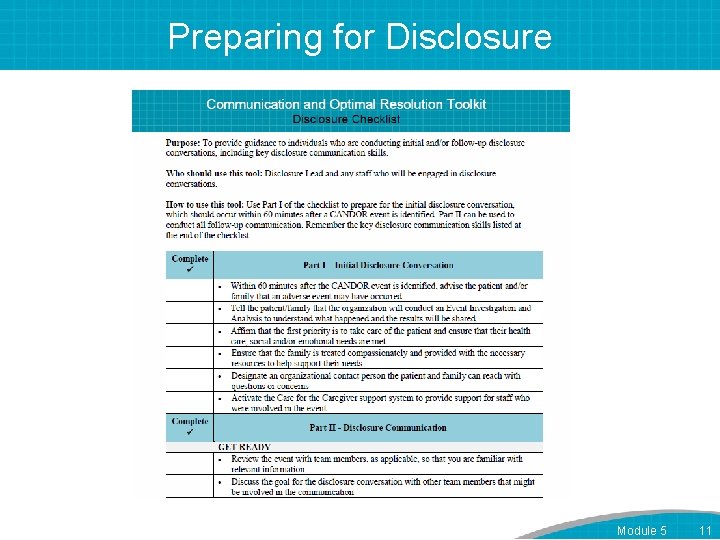
Tools to Assist in Identifying and Training Disclosure Leads • Communication Assessment Guide – Help identify a team of Disclosure Leads. • Case Scenarios: Handling Challenging Communications – Provides factual scenarios to practice interpersonal communications. • Disclosure Checklist – Serves as a quick reference tool to prepare for disclosure communication. Module 5 9
Communication Skills for Disclosure Lead • • • Show empathy. Be honest. Show sincere interest. Use good non-verbal expression. Avoid medical jargon. Check for the patient’s understanding. Module 5 10
Preparing for Disclosure Module 5 11
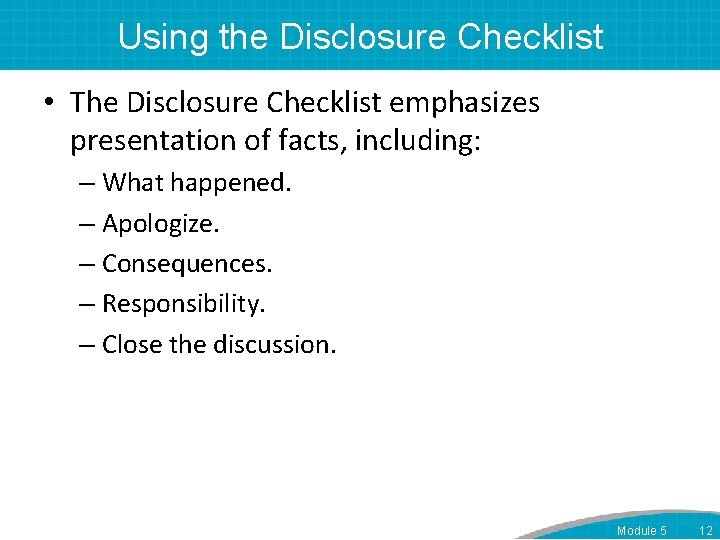
Using the Disclosure Checklist • The Disclosure Checklist emphasizes presentation of facts, including: – What happened. – Apologize. – Consequences. – Responsibility. – Close the discussion. Module 5 12
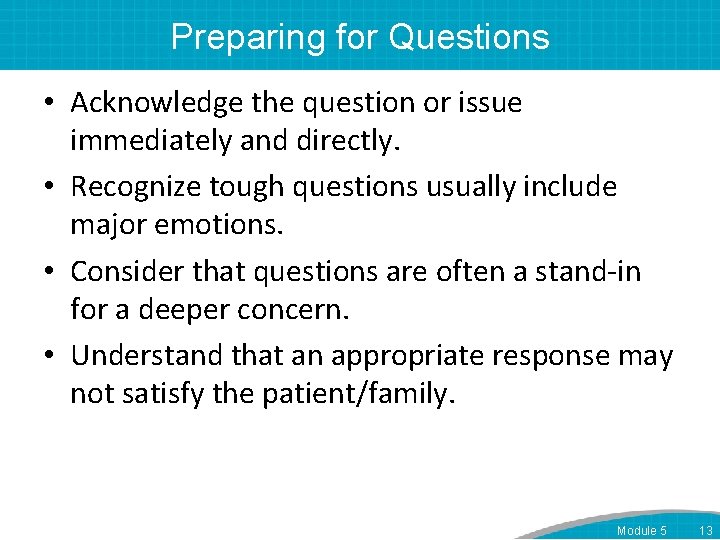
Preparing for Questions • Acknowledge the question or issue immediately and directly. • Recognize tough questions usually include major emotions. • Consider that questions are often a stand-in for a deeper concern. • Understand that an appropriate response may not satisfy the patient/family. Module 5 13
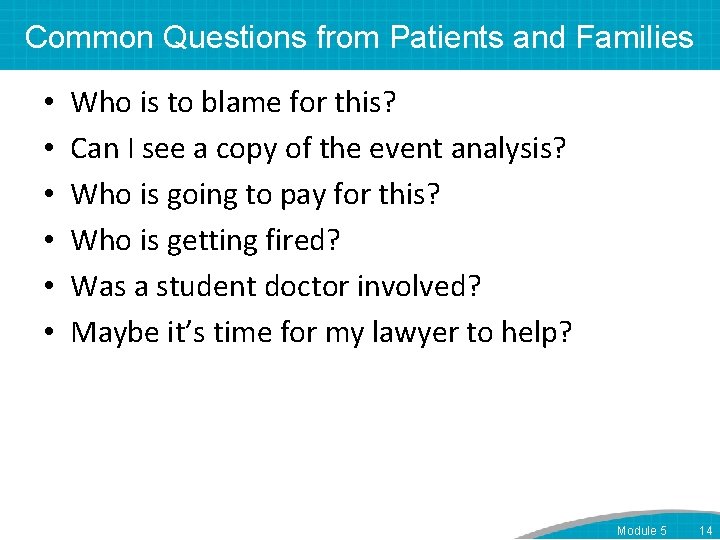
Common Questions from Patients and Families • • • Who is to blame for this? Can I see a copy of the event analysis? Who is going to pay for this? Who is getting fired? Was a student doctor involved? Maybe it’s time for my lawyer to help? Module 5 14
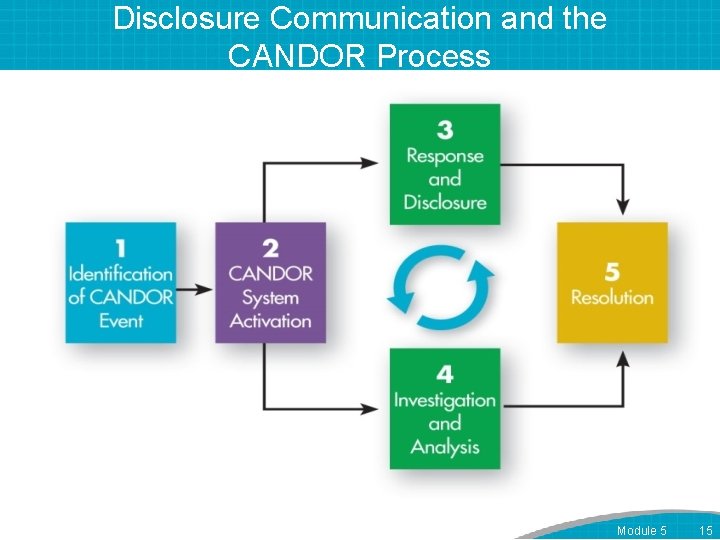
Disclosure Communication and the CANDOR Process Module 5 15
Appropriate Disclosure to A Patient Module 5 16
References 1. HIPAA Administrative Simplification Regulation Text. US Department of Health and Human Services. March 2013. Accessed on August 21, 2015. 2. Guide to Patient and Family Engagement in Hospital Quality and Safety, Rockville, MD: Agency for Healthcare Research and Quality. Accessed August 19, 2015. 3. Golann D. Dropped Medical Malpractice Claims: Their Surprising Frequency, Apparent Causes, And Potential Remedies. Health Affairs; 2011. 30. 7: 1343 -1350. 4. Hilfiker D. Facing our mistakes. The New England Journal of Medicine; 1984. 310. 2: 118. Module 5 17