
COMMUNICATION 1 DEFINITION OF COMMUNICATION COMMUNICATION from Latin
- Slides: 43
COMMUNICATION 1
• DEFINITION OF COMMUNICATION • COMMUNICATION (from Latin communicare meaning (“to share”) is the act of conveying meanings from once entity or group to another through the use of mutually understood signs, symbols, and semiotic rules. • Communication is simply the act of transferring information from one place to another. 2
• THE COMMUNICATION PROCESS • A massage or command is sent by the sender through communication channel to receiver or to multiple receivers. • The sender must encode the message (the information being conveyed) into a form that is appropriate to the communication channel, and the receiver(s) then decodes the message to understand its meaning and significance. His understanding can occur at any stage of the communication process. 3
• Effective communication involves minimizing potential misunderstanding and overcoming any barriers to communication at each stage in the communication process. There are various categories of communication and more than once may occur at any time. 4
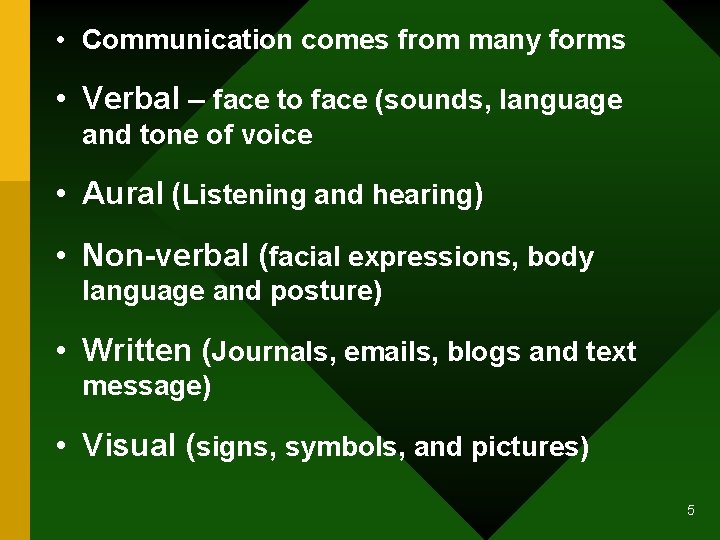
• Communication comes from many forms • Verbal – face to face (sounds, language and tone of voice • Aural (Listening and hearing) • Non-verbal (facial expressions, body language and posture) • Written (Journals, emails, blogs and text message) • Visual (signs, symbols, and pictures) 5
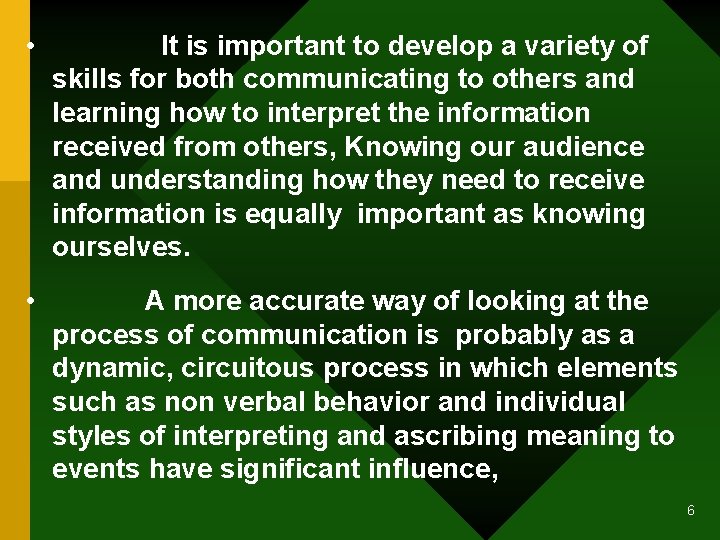
• It is important to develop a variety of skills for both communicating to others and learning how to interpret the information received from others, Knowing our audience and understanding how they need to receive information is equally important as knowing ourselves. • A more accurate way of looking at the process of communication is probably as a dynamic, circuitous process in which elements such as non verbal behavior and individual styles of interpreting and ascribing meaning to events have significant influence, 6
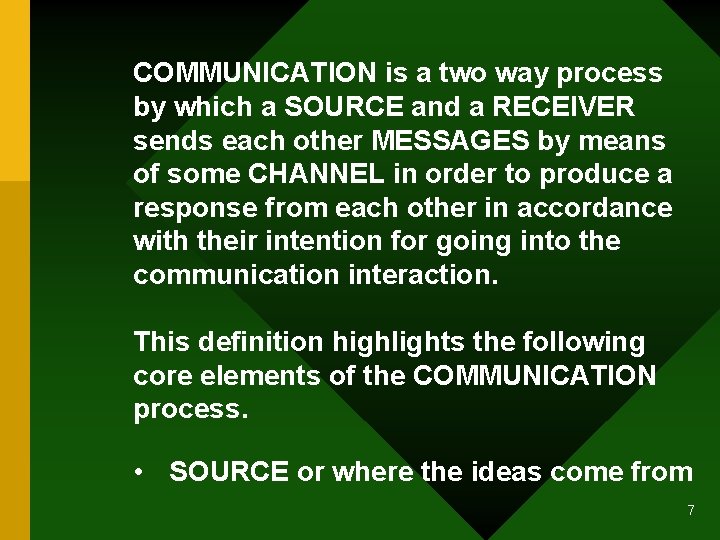
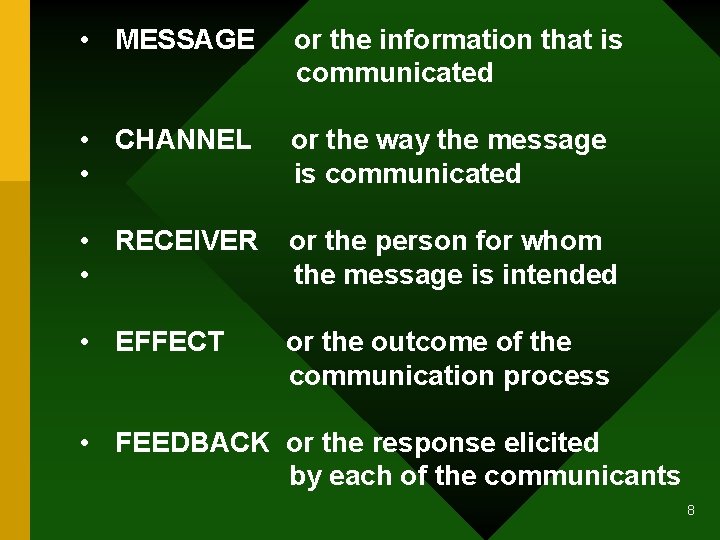
COMMUNICATION is a two way process by which a SOURCE and a RECEIVER sends each other MESSAGES by means of some CHANNEL in order to produce a response from each other in accordance with their intention for going into the communication interaction. This definition highlights the following core elements of the COMMUNICATION process. • SOURCE or where the ideas come from 7
• MESSAGE or the information that is communicated • CHANNEL • or the way the message is communicated • RECEIVER • or the person for whom the message is intended • EFFECT or the outcome of the communication process • FEEDBACK or the response elicited by each of the communicants 8
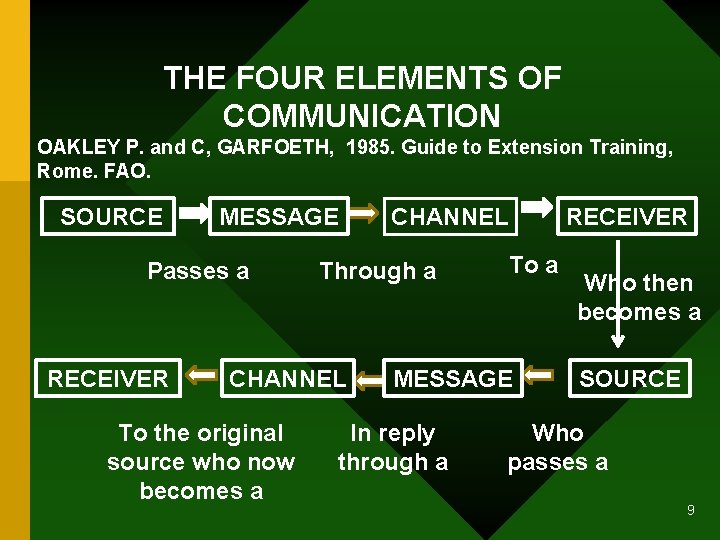
THE FOUR ELEMENTS OF COMMUNICATION OAKLEY P. and C, GARFOETH, 1985. Guide to Extension Training, Rome. FAO. SOURCE MESSAGE Passes a RECEIVER Through a CHANNEL To the original source who now becomes a CHANNEL RECEIVER To a MESSAGE In reply through a Who then becomes a SOURCE Who passes a 9
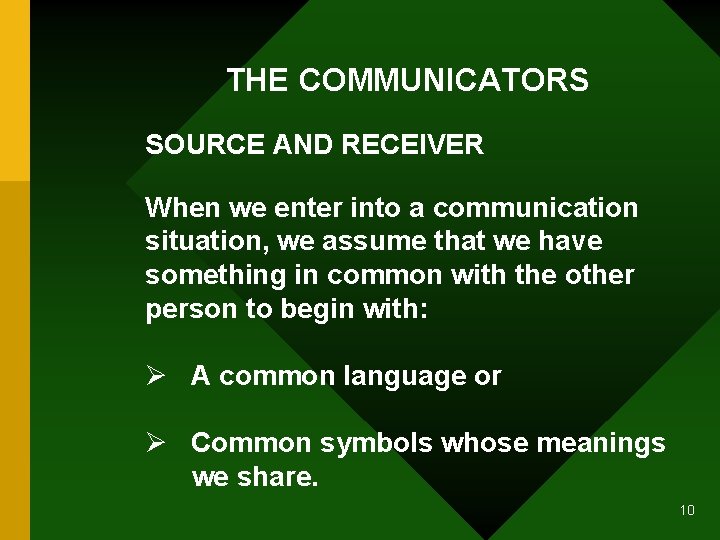
THE COMMUNICATORS SOURCE AND RECEIVER When we enter into a communication situation, we assume that we have something in common with the other person to begin with: Ø A common language or Ø Common symbols whose meanings we share. 10
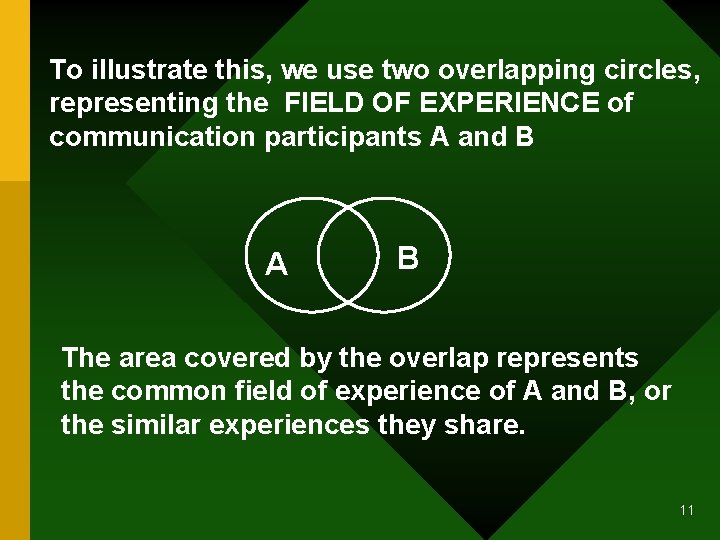
To illustrate this, we use two overlapping circles, representing the FIELD OF EXPERIENCE of communication participants A and B A B The area covered by the overlap represents the common field of experience of A and B, or the similar experiences they share. 11
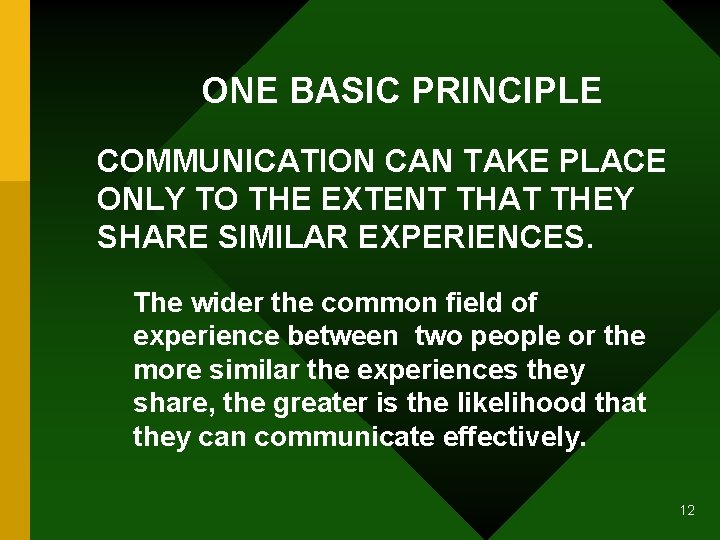
ONE BASIC PRINCIPLE COMMUNICATION CAN TAKE PLACE ONLY TO THE EXTENT THAT THEY SHARE SIMILAR EXPERIENCES. The wider the common field of experience between two people or the more similar the experiences they share, the greater is the likelihood that they can communicate effectively. 12
If the common field of experience is narrow, communication that can take place is limited and likely to be ineffective. This means that communication is only successful when the receiver can interpret the information that the source has put into the message. It is important that the same meanings, for the words, pictures and symbols used in communication be used by the source and the receiver. If this does not happen problems can arise. 13
• COMMUNICATION SKILLS • The Ability to communicate effectively with superiors, Colleagues and staff is essential. • 1. LISTENING • Being a good listener is one of the best ways to be a good communicator, if you are not a good listener, it’s going to be hard to comprehend what you are being asked to do. 14
• Active listening involves paying close attention to what the other person is saying, asking clarifying questions and rephrasing what the person says to ensure understanding. • 2. NONVERBAL COMMUNICATION • Your body language, eye contact, hand gestures and tone of voice all color the message you are trying to convey. 15
• Eye contact is also important. You want to look the person in the eye to demonstrate that you are focused on the person and the conversation. • Also pay attention to other people, non verbal signals while you are talking. Often nonverbal signals convey how a person is really feeling. 16
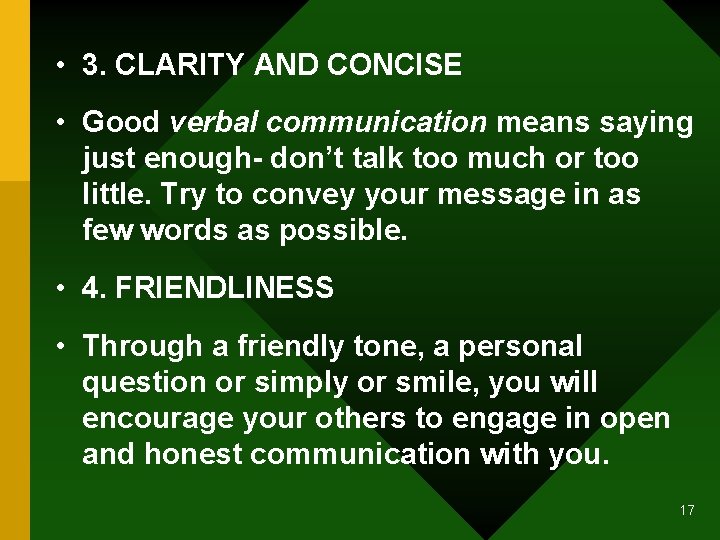
• 3. CLARITY AND CONCISE • Good verbal communication means saying just enough- don’t talk too much or too little. Try to convey your message in as few words as possible. • 4. FRIENDLINESS • Through a friendly tone, a personal question or simply or smile, you will encourage your others to engage in open and honest communication with you. 17
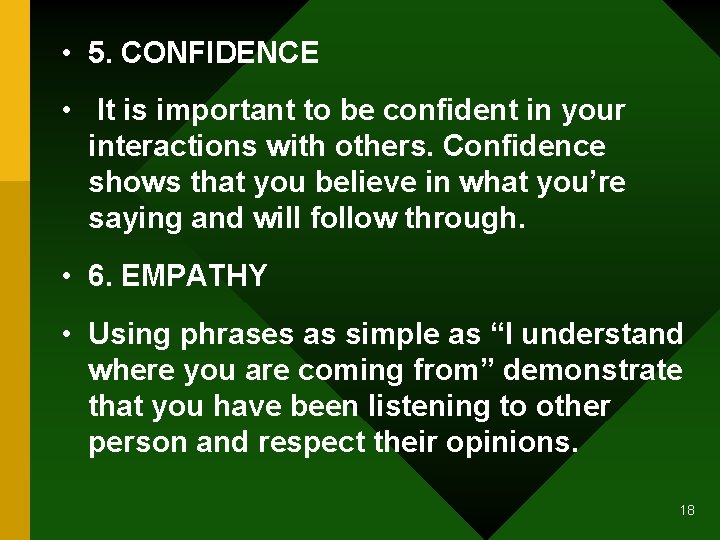
• 5. CONFIDENCE • It is important to be confident in your interactions with others. Confidence shows that you believe in what you’re saying and will follow through. • 6. EMPATHY • Using phrases as simple as “I understand where you are coming from” demonstrate that you have been listening to other person and respect their opinions. 18
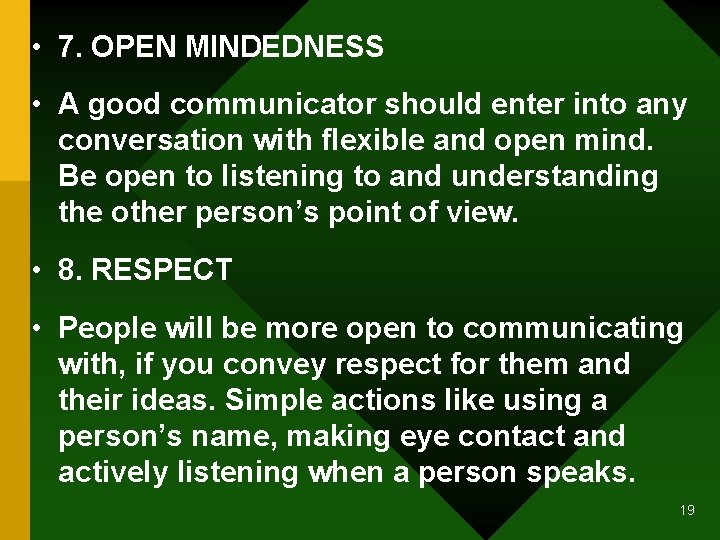
• 7. OPEN MINDEDNESS • A good communicator should enter into any conversation with flexible and open mind. Be open to listening to and understanding the other person’s point of view. • 8. RESPECT • People will be more open to communicating with, if you convey respect for them and their ideas. Simple actions like using a person’s name, making eye contact and actively listening when a person speaks. 19
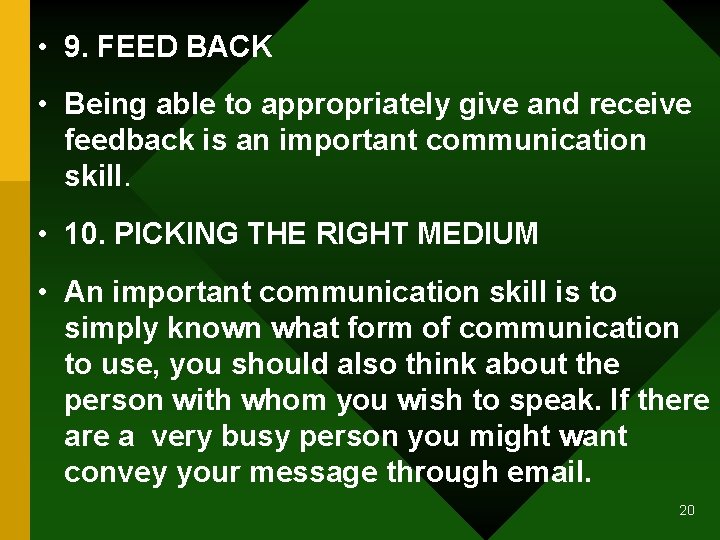
• 9. FEED BACK • Being able to appropriately give and receive feedback is an important communication skill. • 10. PICKING THE RIGHT MEDIUM • An important communication skill is to simply known what form of communication to use, you should also think about the person with whom you wish to speak. If there a very busy person you might want convey your message through email. 20
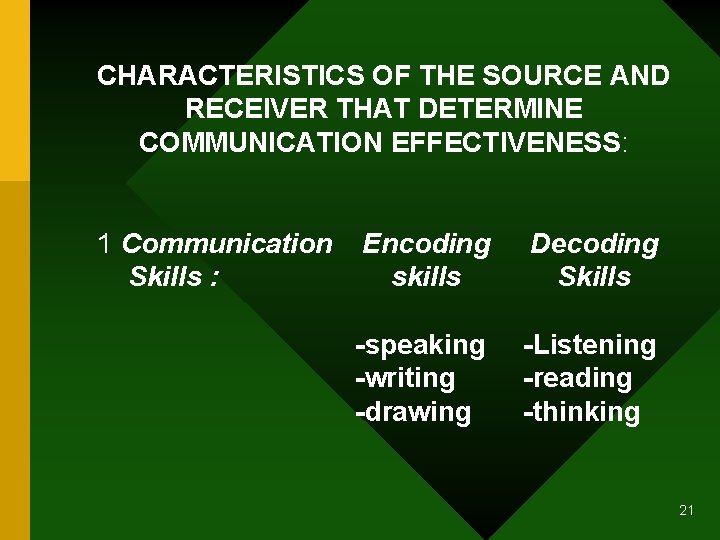
CHARACTERISTICS OF THE SOURCE AND RECEIVER THAT DETERMINE COMMUNICATION EFFECTIVENESS: 1 Communication Skills : Encoding skills Decoding Skills -speaking -writing -drawing -Listening -reading -thinking 21
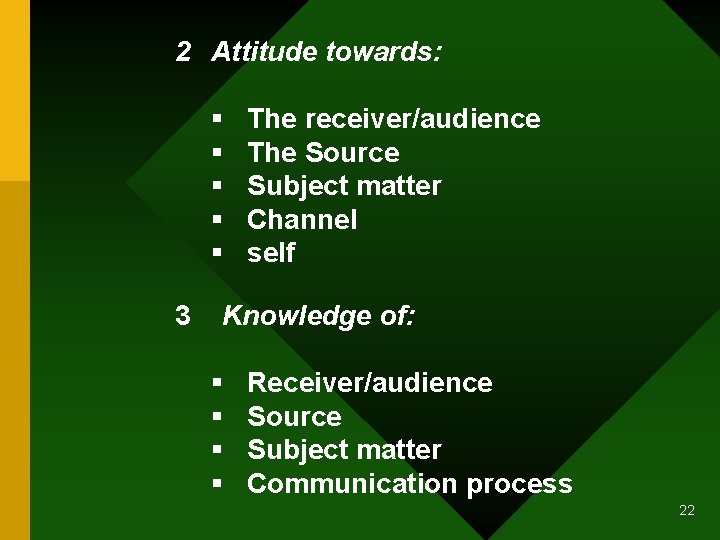
2 Attitude towards: § § § 3 The receiver/audience The Source Subject matter Channel self Knowledge of: § § Receiver/audience Source Subject matter Communication process 22
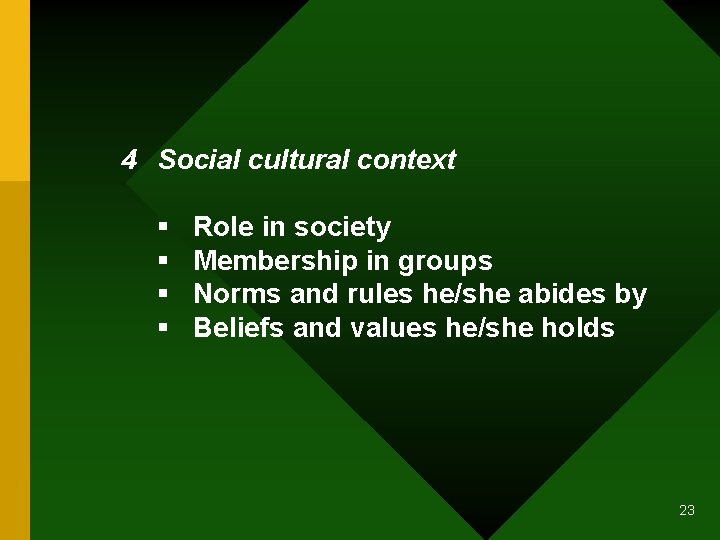
4 Social cultural context § § Role in society Membership in groups Norms and rules he/she abides by Beliefs and values he/she holds 23
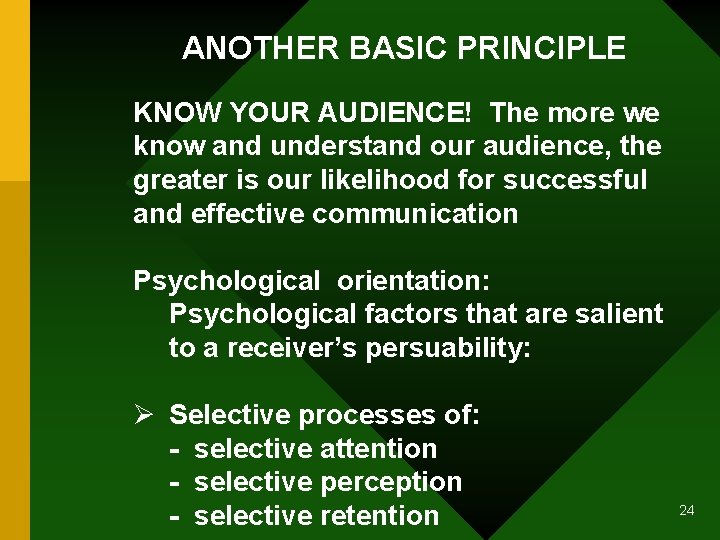
ANOTHER BASIC PRINCIPLE KNOW YOUR AUDIENCE! The more we know and understand our audience, the greater is our likelihood for successful and effective communication Psychological orientation: Psychological factors that are salient to a receiver’s persuability: Ø Selective processes of: - selective attention - selective perception - selective retention 24
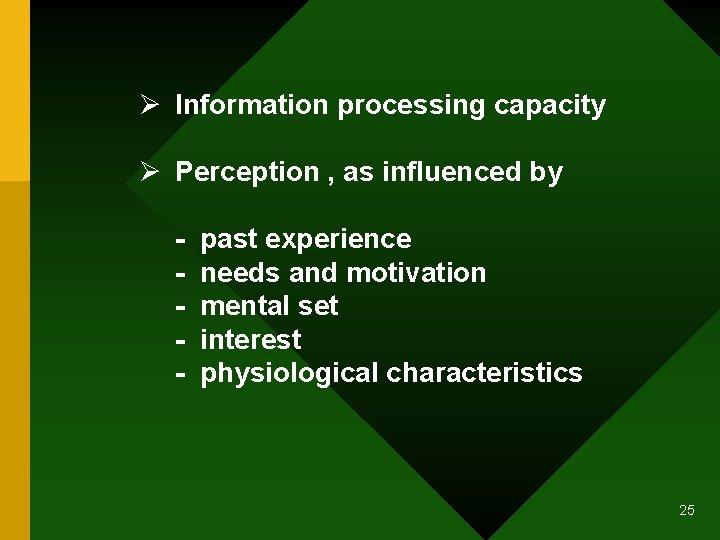
Ø Information processing capacity Ø Perception , as influenced by - past experience needs and motivation mental set interest physiological characteristics 25
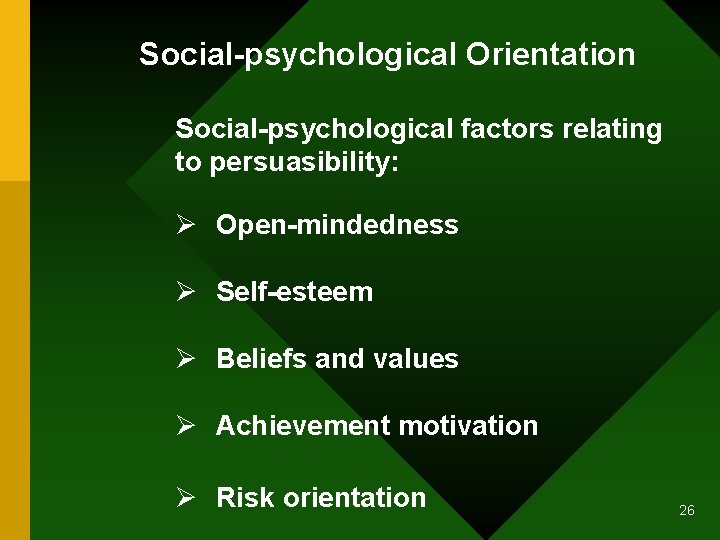
Social-psychological Orientation Social-psychological factors relating to persuasibility: Ø Open-mindedness Ø Self-esteem Ø Beliefs and values Ø Achievement motivation Ø Risk orientation 26
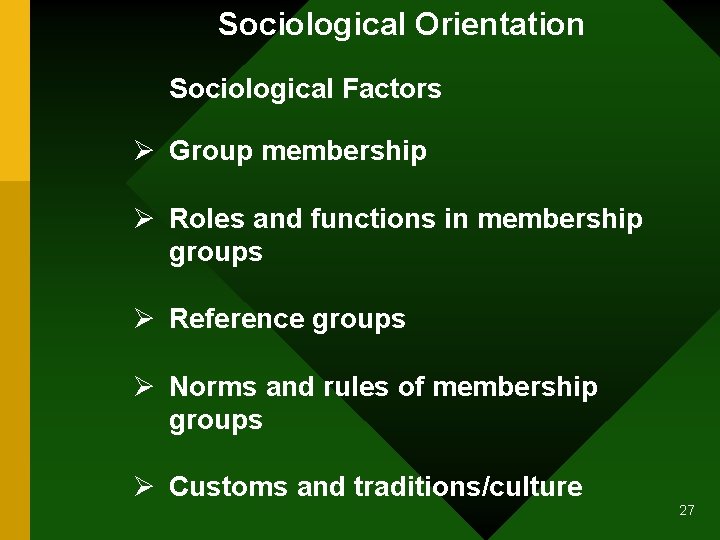
Sociological Orientation Sociological Factors Ø Group membership Ø Roles and functions in membership groups Ø Reference groups Ø Norms and rules of membership groups Ø Customs and traditions/culture 27
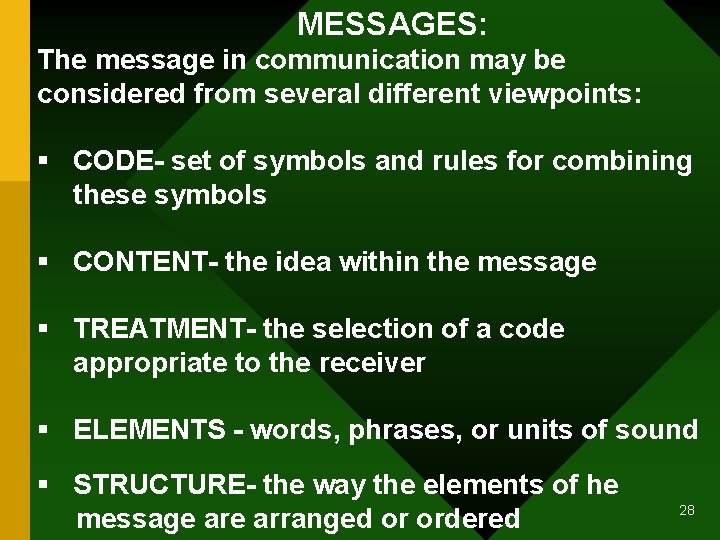
MESSAGES: The message in communication may be considered from several different viewpoints: § CODE- set of symbols and rules for combining these symbols § CONTENT- the idea within the message § TREATMENT- the selection of a code appropriate to the receiver § ELEMENTS - words, phrases, or units of sound § STRUCTURE- the way the elements of he message arranged or ordered 28
WHEN WE SAY: “MEANINGS ARE WITH PEOPLE , NOT IN WORDS” OR “MEANINGS ARE NOT IN THE MESSAGE; THEY ARE IN THE MESSAGE USERS”, This implies that: § The meaning that man attaches to a certain object or event is the result of § his/her past learning and experiences. 29
§ Since no two individuals can have exactly the same experiences, they cannot have exactly the same meaning. § It is only to the extent that people have had similar experiences that they can share similar meanings. § To the extent that they share similar meanings, they can COMMUNICATE. 30
The following should be considered when formulating in messages: LANGUAGE: Even if source and receiver speak the same language, local variations and dialects may use similar words with different meanings. 31
JARGON: The technical language of specialists has to be translated into words that are familiar to the receiver. We need to learn what words or phrases our clients use when talking about these activities. PICTURES AND SYMBOLS: Attempts to communicate through pictures and visual symbols often fail because the receiver does not recognize what they represent. 32
CHANNELS A channel is the medium or means by which a message travels between a source and a receiver A channel can be considered in terms of the path for moving messages from one communicator to another. We define these paths as being the five senses: SIGHT , HEAR, TOUCH, SMELL AND TASTE. Thus a message can be seen, or heard, or touched, or smelled, or tasted. 33
A channel can be a pattern of sound waves or light waves where messages can pass. Or we can talk about channels in terms of the disseminating channels of: § Print § Broadcast § Audio-visual § Indigenous/folk § Modern technology 34
v Remember: when sources utilize more than one channel of communication, the chance of receiving communicative effectiveness is generally increased. Or we can talk about face to face interactions which generally involve many of the five senses. It has an advantage over channels because of better FEEDBACK. 35
The interaction also provides the opportunity for both the source and the receiver to exchange beneficial or useful experiences. FEEDBACK is information that is sent or fed back by the receiver intentionally or unintentionally to the source. 36
FEEDBACK may also come from any of the other communication elements: v MESSAGE : when we listen to what we are saying and know that we have mispronounced a word, and we repeat it with the correct pronunciation. v CHANNEL: When we find out that the channel we are using, for example, print is not suited to our receivers who are unable to read so that we change to audiovisuals. 37
v RECEIVER: When the receiver nods his head, laughs, claps his hands, yawns, gives a puzzled look, asks questions, etc. COMMUNICATION EFFECTS Communication effects are the changes that takes place in the behavior of the source and the receiver of communication on exposure to stimuli. 38
Communication stimuli may include: VERBAL STIMULI such as a speech or writing, NON-VERBAL STIMULI such as music, art or a gesture and, all the INTENTIONAL and UNINTENTIONAL STIMULI which might influence a communication receiver 39
Dimensions of communication effects: Ø Changes that are observable and non -observable; overt or covert Ø Changes in attitude, opinion, perception, action, emotions. 40
THE PURPOSE OF COMMUNICATION Because the aim of communication is to influence the behavior of others, we are not just communicators per se, but we ought to be PERSUASIVE COMMUNICATORS. PERSUASIVE COMMUNICATION is the process which involves a conscious attempt by an individual (or group) to change the attitude, beliefs or overt behavior of another individual (or group) through the transmission of some messages. 41
An effective communicator is someone who is able to elicit the effects he/she intended from the receiver after communicating with him/her. EFFECT is the difference between what a receiver thinks, feels and does before and after exposure to a message. Effect is always expressed in behavioral terms. Before one enters in to communication situation, a communicator must have a purpose, an objective. 42
THE PURPOSE MUST ALSO BE EXPRESSED IN BEHAVIORAL TERMS: § To gain attention § To create awareness § To promote understanding § To gain acceptance § To motivate to action § To elicit participation § To teach skills THE END 43