
Communicating in a businesslike way developing oracy skills
‘Communicating in a business-like way’: developing oracy skills in higher education Marion Heron Department of Higher Education BALEAP PIM, Newcastle University, 9 th June 2018 19 February 2021
Outline • Oracy skills - definition • Role of oracy skills in higher education • Oracy skills framework (Mercer et al, 2017) • Oracy as process & Oracy as product • The study • Classroom implications • Discussion

Oracy skills • Wilkinson (1965) – speaking and listening (vs. literacy) • Oracy skills allow students to “express [their] thoughts and communicate with others in education and life” (Alexander, 2013, p. 10) • Growing focus on embedding literacy skills into the curriculum (Wingate et al, 2011) • Assumptions about undergraduates’ existing skills

Role of oracy skills in higher education • Active learning strategies • Employability skills – in particular oral presentation skills (Andrew & Higson, 2014) • New cultural capital – “regimes of talk” (Doherty et al, 2011, p. 28) • Tool for thinking (Alexander, 2013; Mercer, 1995; Michaels et al, 2008) • Oral assessments common form of HE assessments (Huxham et al, 2016) – in particular oral presentations (Joughin, 2007)
Oracy skills framework (Mercer et al, 2017)
Oracy as process vs oracy as product • Oracy as process: tool for learning, implicit oracy demands • Oracy as product: subject in its own right, explicit oracy demands • Oracy needs to be explicit because “[By] assessing skills that were not explicitly developed in the curriculum , the exercise became an assessment of what prior skills and dispositions students brought to the task” (Doherty et al, 2011, p. 34)
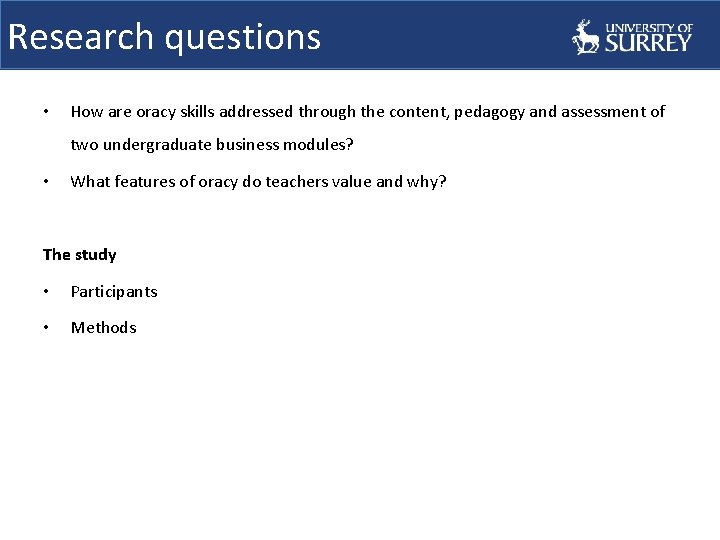
Research questions • How are oracy skills addressed through the content, pedagogy and assessment of two undergraduate business modules? • What features of oracy do teachers value and why? The study • Participants • Methods
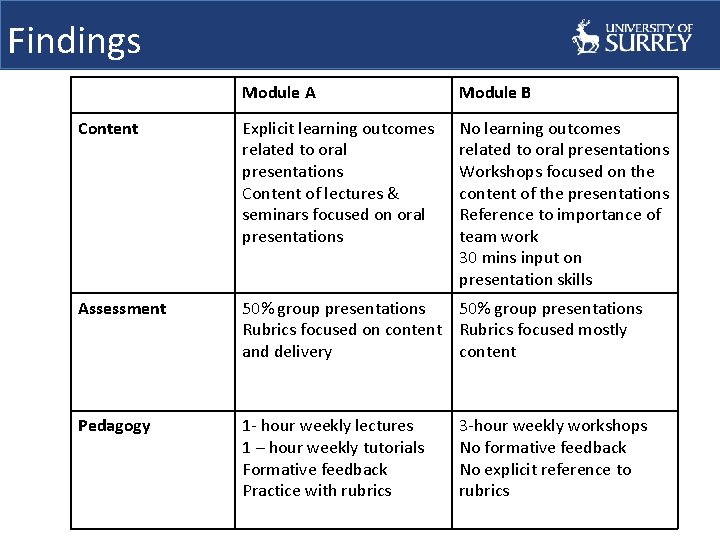
Findings Module A Module B Content Explicit learning outcomes related to oral presentations Content of lectures & seminars focused on oral presentations No learning outcomes related to oral presentations Workshops focused on the content of the presentations Reference to importance of team work 30 mins input on presentation skills Assessment 50% group presentations Rubrics focused on content Rubrics focused mostly and delivery content Pedagogy 1 - hour weekly lectures 1 – hour weekly tutorials Formative feedback Practice with rubrics 3 -hour weekly workshops No formative feedback No explicit reference to rubrics
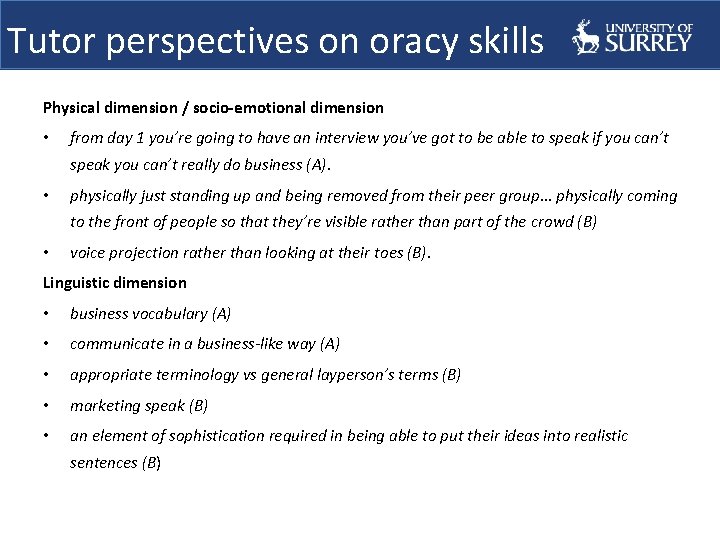
Tutor perspectives on oracy skills Physical dimension / socio-emotional dimension • from day 1 you’re going to have an interview you’ve got to be able to speak if you can’t speak you can’t really do business (A). • physically just standing up and being removed from their peer group. . . physically coming to the front of people so that they’re visible rather than part of the crowd (B) • voice projection rather than looking at their toes (B). Linguistic dimension • business vocabulary (A) • communicate in a business-like way (A) • appropriate terminology vs general layperson’s terms (B) • marketing speak (B) • an element of sophistication required in being able to put their ideas into realistic sentences (B)
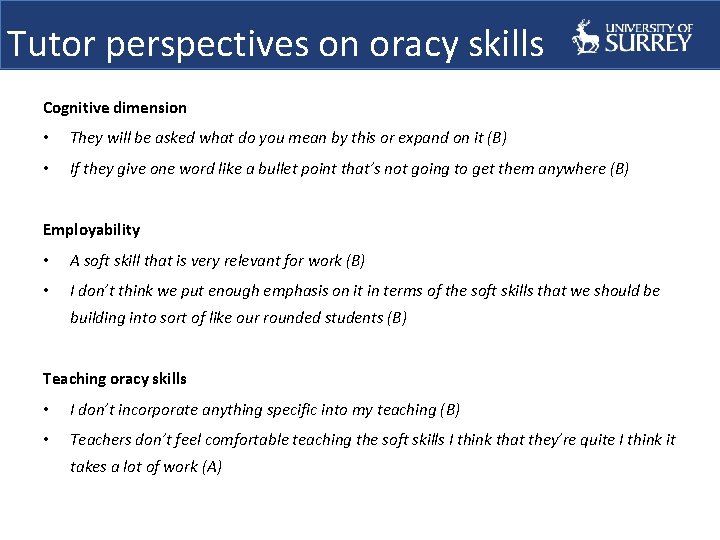
Tutor perspectives on oracy skills Cognitive dimension • They will be asked what do you mean by this or expand on it (B) • If they give one word like a bullet point that’s not going to get them anywhere (B) Employability • A soft skill that is very relevant for work (B) • I don’t think we put enough emphasis on it in terms of the soft skills that we should be building into sort of like our rounded students (B) Teaching oracy skills • I don’t incorporate anything specific into my teaching (B) • Teachers don’t feel comfortable teaching the soft skills I think that they’re quite I think it takes a lot of work (A)
Issues • Oracy as process vs oracy as product • Tensions between beliefs of oracy and practice • Restricted view of oracy - little focus on cognitive dimension • Develop rubrics which incorporate all four dimensions of oracy skills framework • Explicit reference to rubrics which incorporate all dimensions (Ritchie, 2016)
Implications • Explore uses of the Oracy skills framework in the pre-sessional context: planning, self-evaluation, peer evaluation, formative feedback • Familiarise students with Oracy skills framework for independent learning beyond pre-sessional course • Consider oracy as central to content, pedagogy, assessment • Introduce the notion of oracy as process and oracy as product to students • Make explicit links between the oracy skills developed in pre-sessional with expectations of their discipline and their tutors “HE providers have a responsibility to remediate any deficiencies” (Jackson, 2014, p. 32)
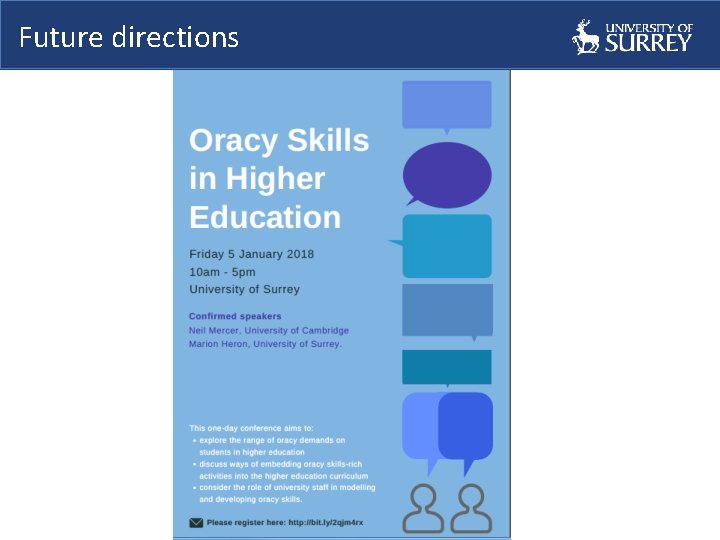
Future directions
References Alexander, R. (2013). Improving oracy and classroom talk in English schools: Achievements and challenges. Available at http: //cprtrust. org. uk/downloads_/news/2012/02/2012_02_20 Df. E_oracy_Alexander. pdf Doherty, C. , Kettle, M. , May, L. , & Caukill, E. (2011). Talking the talk: oracy demands in first year university assessment tasks. Assessment in Education: Principles, Policy & Practice, 18(1), 27 -39. Hathaway, J. (2015). Developing that voice: locating academic writing tuition in the mainstream of higher education. Teaching in Higher Education, 20(5), 506 -517. Huxham, M. , Campbell, F. , & Westwood, J. (2012). Oral versus written assessments: a test of student performance and attitudes. Assessment & Evaluation in Higher Education, 37(1), 125 -136. Jackson, D. (2014). Business graduate performance in oral communication skills and strategies for improvement. The International Journal of Management Education, 12(1), 2234. Joughin, G. (2007). Student conceptions of oral presentations. Studies in Higher Education, 32(3), 323 -336.
References Mah, A. S. H. (2016). Oracy Is as Important as Literacy: Interview with Christine CM Goh. RELC Journal, 47(3), 399 -404. Mercer, N. (1995). The guided construction of knowledge: Talk amongst teachers and learners. Multilingual matters. Mercer, N. , Warwick, P. , & Ahmed, A. (2017). An oracy assessment toolkit: Linking research and development in the assessment of students' spoken language skills at age 11 -12. Learning and Instruction, 48, 51 -60. Michaels, S. , O’Connor, C. , & Resnick, L. B. (2008). Deliberative discourse idealized and realized: Accountable talk in the classroom and in civic life. Studies in Philosophy and Education, 27(4), 283 -297. Ritchie, S. M. (2016). Self-assessment of video-recorded presentations: Does it improve skills? Active Learning in Higher Education, 17(3), 207 -221. Wilkinson, A. (1965). The concept of oracy. Educational Review, 17(4), 11 -15. Wingate, U. , Andon, N. , and Cogo, A. (2011). Embedding academic writing instruction into subject teaching: A case study. Active Learning in Higher Education, 12(1), 69 -81.
- Slides: 15