
Communicating for Results 9 e 9 Key Ideas
- Slides: 27
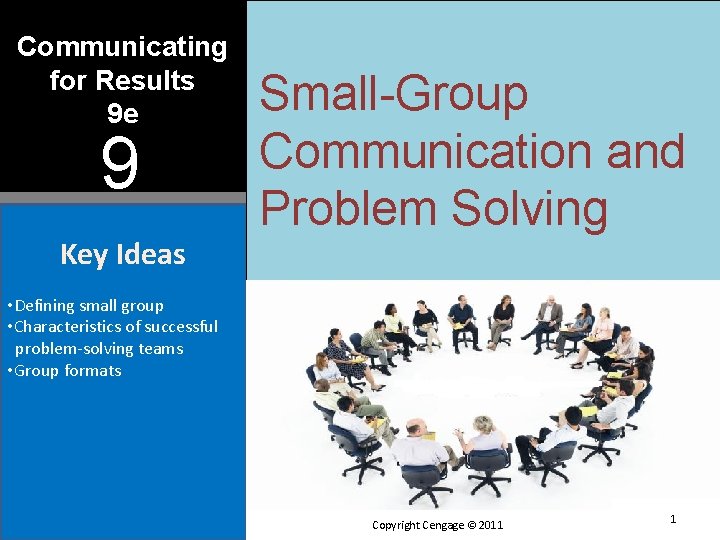
Communicating for Results 9 e 9 Key Ideas Small-Group Communication and Problem Solving • Defining small group • Characteristics of successful problem-solving teams • Group formats Copyright Cengage © 2011 1
Consider this. . . Groups are like individuals – no two are alike. The better equipped you are to analyze what is happening in and around the group, the more successful and satisfying your group experience will be. Copyright Cengage © 2011 2
Associated Press Columbia Space Shuttle Disaster NASA Case Study q Read or describe the case study q Answer the following questions: q. What symptoms of groupthink contributed to this disaster? q. What role did email play in the engineers attempts to communicate? q. Explain why summary report cites “management practices” as a cause? Copyright Cengage © 2011 3
Definition of a small group Small-group communication involves a small number of people, usually engaged in face-toface interaction, actively working together toward a common goal. Copyright Cengage © 2011 4
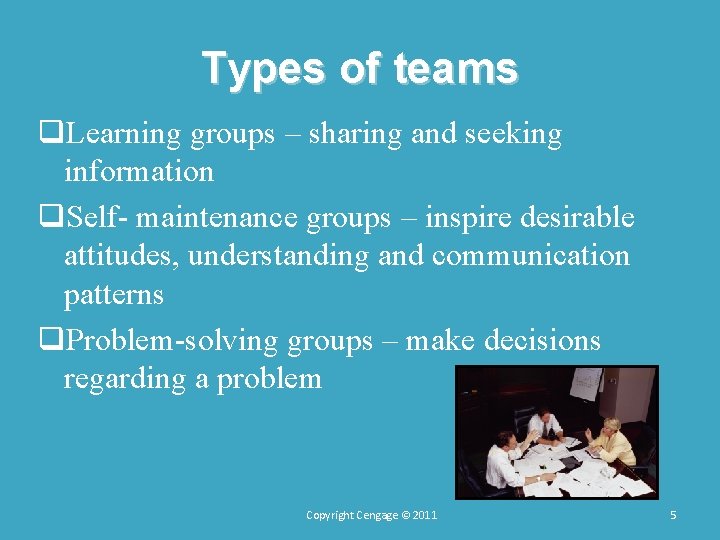
Types of teams q. Learning groups – sharing and seeking information q. Self- maintenance groups – inspire desirable attitudes, understanding and communication patterns q. Problem-solving groups – make decisions regarding a problem Copyright Cengage © 2011 5
Effective Problem-Solving Teams q. Well organized q. Receive periodic training q. Examine assumptions and opinions q. Evaluate possible solutions q. Operate Virtually q. Avoid groupthink q. Manage cultural diversity Copyright Cengage © 2011 6
Groupthink symptoms q Illusion of invulnerability q Shared stereotypes q Rationalization q Illusion of morality Copyright Cengage © 2011 7
Groupthink symptoms q Self-censorship q Illusion of unanimity q Direct pressure q Mind guarding Copyright Cengage © 2011 8
Avoiding groupthink q Bring in outside experts q Ask members to be “critical evaluators” q Leader should voice opinions after others q Provide “second chance” to rethink choices Copyright Cengage © 2011 9
Managing cultural diversity q Recognize differences q Select members for task-related abilities q Find purpose that transcends differences q Develop mutual respect q Seek high level of feedback Copyright Cengage © 2011 Bob Daemmrich/The Image works q Avoid cultural dominance 10
Operating Virtually q. Computer-mediated communication (CMC) through technology q. Differences between FTF (face-to-face) teams and CMC teams q. CMC teams communicate and share less q. CMC teams outperform FTF teams in tasks where there is a correct answer q. CMC teams are able to better predict the success of their decisions Copyright Cengage © 2011 11
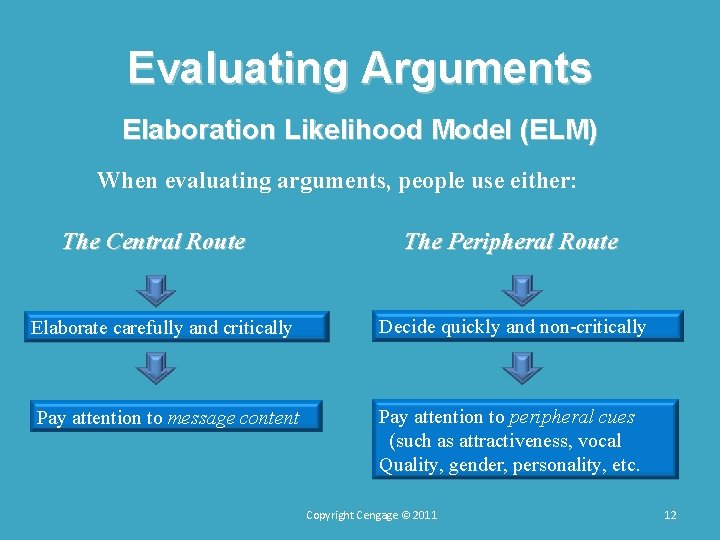
Evaluating Arguments Elaboration Likelihood Model (ELM) When evaluating arguments, people use either: The Central Route The Peripheral Route Elaborate carefully and critically Decide quickly and non-critically Pay attention to message content Pay attention to peripheral cues (such as attractiveness, vocal Quality, gender, personality, etc. Copyright Cengage © 2011 12
Basic problem-solving procedure q. Define the problem q. Research and Analyze the problem q. Establish checklist of criteria q. List possible alternatives q. Evaluate each alternative q. Select best alternative and discuss implementation Copyright Cengage © 2011 13
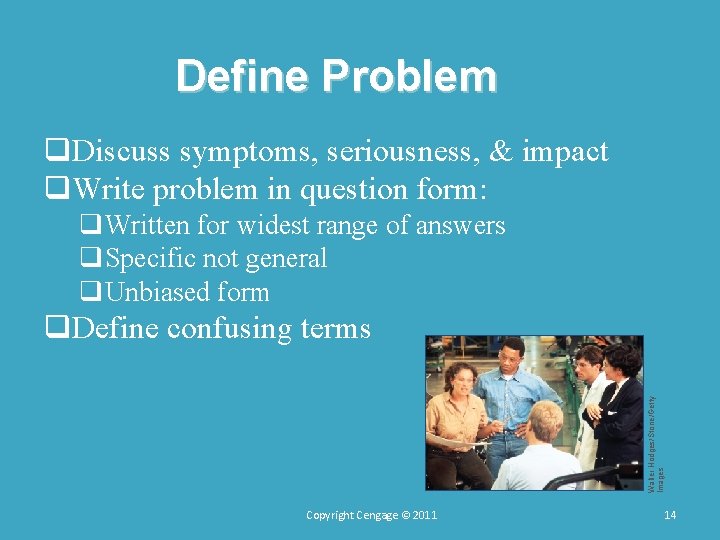
Define Problem q. Discuss symptoms, seriousness, & impact q. Write problem in question form: q. Written for widest range of answers q. Specific not general q. Unbiased form Walter Hodges/Stone/Getty Images q. Define confusing terms Copyright Cengage © 2011 14
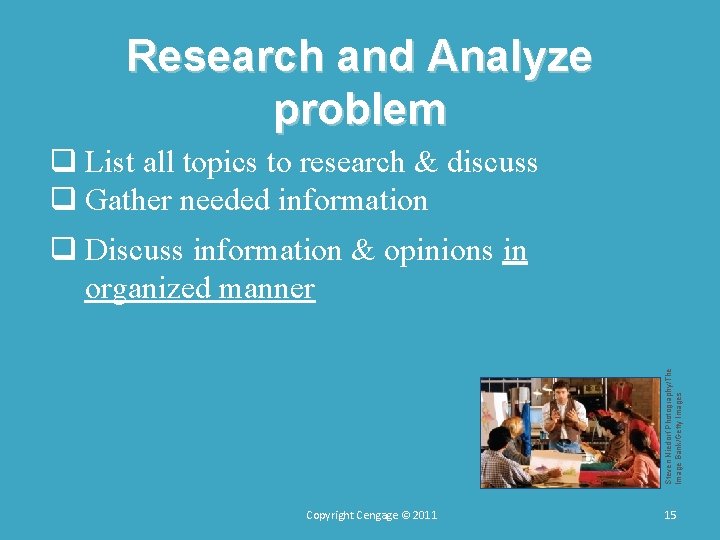
Research and Analyze problem q List all topics to research & discuss q Gather needed information Steven Niedorf Photography/The Image Bank/Getty Images q Discuss information & opinions in organized manner Copyright Cengage © 2011 15
Establish Criteria q. Establishing a criteria checklist q. Brainstorm for possible critera q. Discuss criteria to • Reduce the List • Divide into groups of musts and wants • Assign each want a rank and numerical weight q. Types of criteria q. Task criteria q. Operational criteria Copyright Cengage © 2011 16
When to establish criteria q. When the task is complex q. The topic involves emotional or value judgments q. Team members have little or no problem-solving experience Copyright Cengage © 2011 17
Using criteria effectively q. List all possible criteria q. Evaluate each criterion to determine importance q. Reduce the list into workable lengths by combining or eliminating q. Divide remaining criteria into wants and musts Copyright Cengage © 2011 18
Listing possible alternatives q. Brainstorming q. Avoid negative feedback q. Strive for longest list possible q. Strive for creative, unusual ideas q. Build from previously mentioned ideas q. Electronic Brainstorming Copyright Cengage © 2011 19
Listing possible alternatives q. Brainstorming q. Electronic Brainstorming q. Ideas typed on computer by each member q. Ideas stored for later group viewing q. Software gives option of concealing identities q. Generally produces more ideas; sometimes better ideas q. Very effective with large groups Copyright Cengage © 2011 20
Listing possible alternatives q. Brainstorming q. Electronic Brainstorming q. Nominal Group Technique (NGT) q. Ideas generated silently by each member q. Ideas recorded on board for flip chart q. Ideas discussed for clarification only q. Each member privately selects top five ideas Copyright Cengage © 2011 21
Evaluate each alternative q. Eliminate unacceptable alternatives q. Combine similar alternatives q. Eliminate alternatives that don’t meet the criteria q. Combine remaining alternatives to want criteria and assign numerical values q. Calculate totals Copyright Cengage © 2011 22
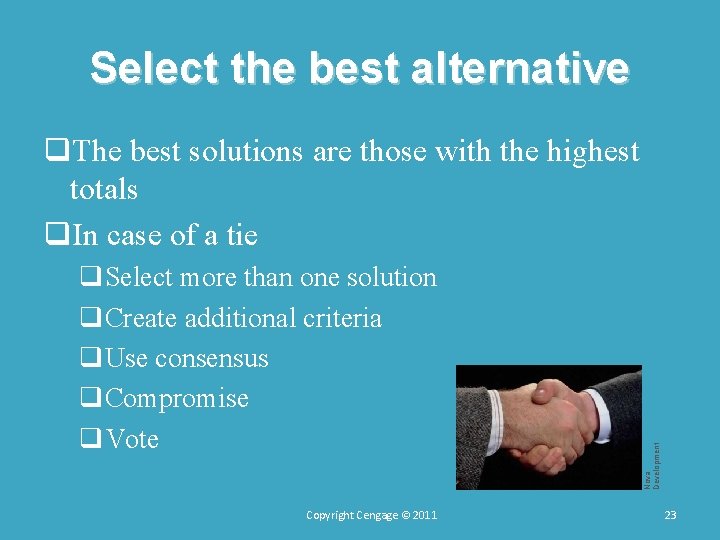
Select the best alternative q. Select more than one solution q. Create additional criteria q. Use consensus q. Compromise q. Vote Copyright Cengage © 2011 Nova Development q. The best solutions are those with the highest totals q. In case of a tie 23
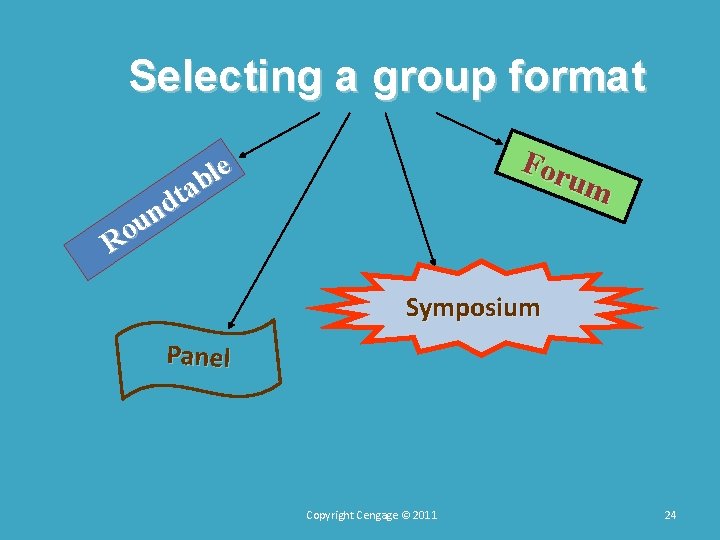
Selecting a group format For um le b a t d n u o R Symposium Panel Copyright Cengage © 2011 24
Group formats q. Roundtable – private small group discussion using problem-solving procedure q. Panel – small group of well-informed individuals discussing a topic or problem in front of a large group Copyright Cengage © 2011 25
Group formats q. Symposium – small group of experts in front of a large group using timed presentations. q. Forum – a panel or discussion in which audience members can participate in the discussion Copyright Cengage © 2011 26
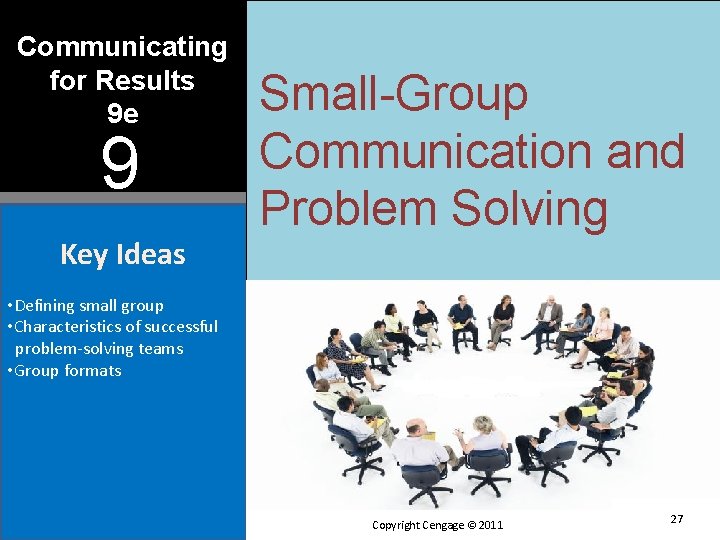
Communicating for Results 9 e 9 Key Ideas Small-Group Communication and Problem Solving • Defining small group • Characteristics of successful problem-solving teams • Group formats Copyright Cengage © 2011 27