
Communicating for Results 9 e 7 Key Ideas


- Slides: 41
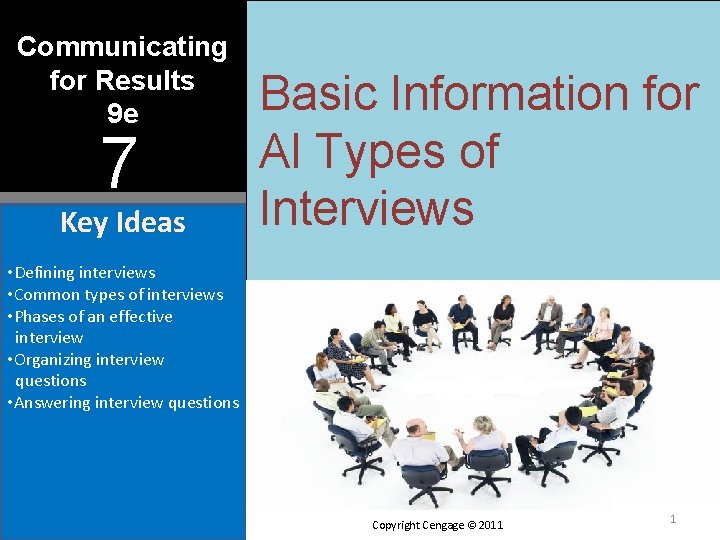
Communicating for Results 9 e 7 Key Ideas Basic Information for Al Types of Interviews • Defining interviews • Common types of interviews • Phases of an effective interview • Organizing interview questions • Answering interview questions Copyright Cengage © 2011 1
Consider this. . . In a few communication formats – public speaking, conferences, or interviewing – is greater involvement expected of a participant than interview. . . It is only in the interview that approximately equal participation is expected of both parties. Copyright Cengage © 2011 2
Rubberball/Jupiter Images Case Study: Interview gone bad q Read or describe the case study q Answer the following questions: q. What types of questions did Mandy and Ken ask? q. What was the quality of the responses? q Were Ken’s observations correct? Copyright Cengage © 2011 3
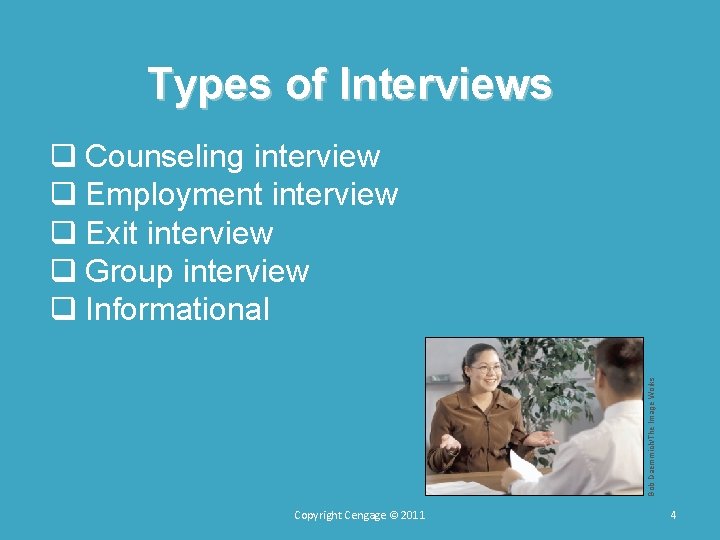
Types of Interviews Bob Daemmich/The Image Works q Counseling interview q Employment interview q Exit interview q Group interview q Informational Copyright Cengage © 2011 4
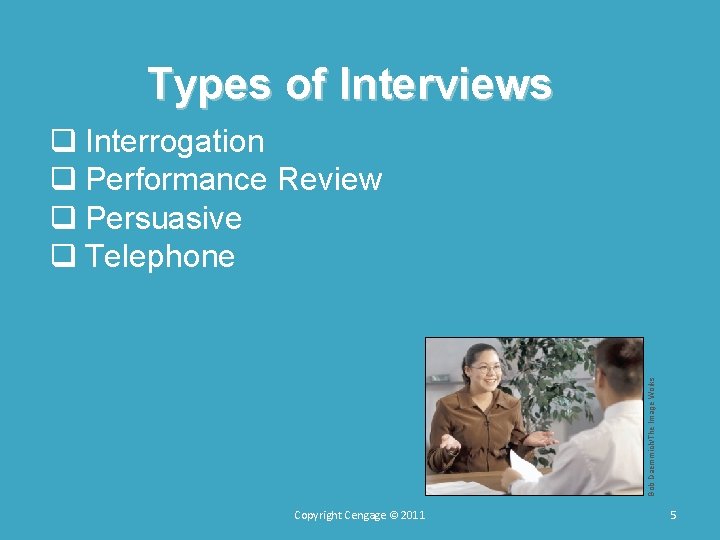
Types of Interviews Bob Daemmich/The Image Works q Interrogation q Performance Review q Persuasive q Telephone Copyright Cengage © 2011 5
Counseling Interview q. Helps interviewee uncover and solve career-related personal or interpersonal problems. (Bell 1989, p. 169) q. Communication skills needed: q. Empathetic listening, q. Non-evluative feedback, q. Careful paraphrasing q. Sympathetic nonverbal responses Copyright Cengage © 2011 6
Employment Interview q. Critical to making organizational and personal decisions q. Usually one-on-one between interviewer and perspective employee q. Employer usually takes the lead Copyright Cengage © 2011 7
Exit Interview q. Done when employee is laird off, fired or quits q. Requires careful listening and reading between the lines q. Employees usually only hint at their real reason for leaving Copyright Cengage © 2011 8
Grievance Interview q. One-to-one encounter for conflict resolution q. Emotions may run high q. Participants should express their feelings honestly and remain cooperative q. Interviewer must be a good listener and problem solver Copyright Cengage © 2011 9
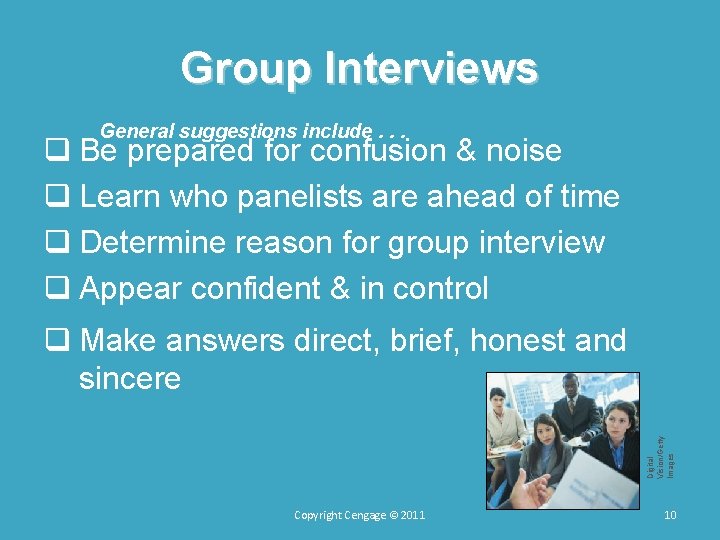
Group Interviews General suggestions include. . . q Be prepared for confusion & noise q Learn who panelists are ahead of time q Determine reason for group interview q Appear confident & in control Digital Vision/Getty Images q Make answers direct, brief, honest and sincere Copyright Cengage © 2011 10
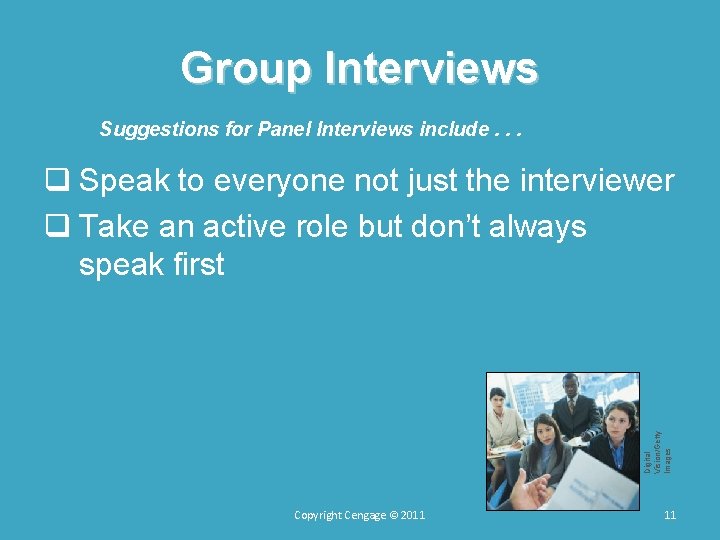
Group Interviews Suggestions for Panel Interviews include. . . Digital Vision/Getty Images q Speak to everyone not just the interviewer q Take an active role but don’t always speak first Copyright Cengage © 2011 11
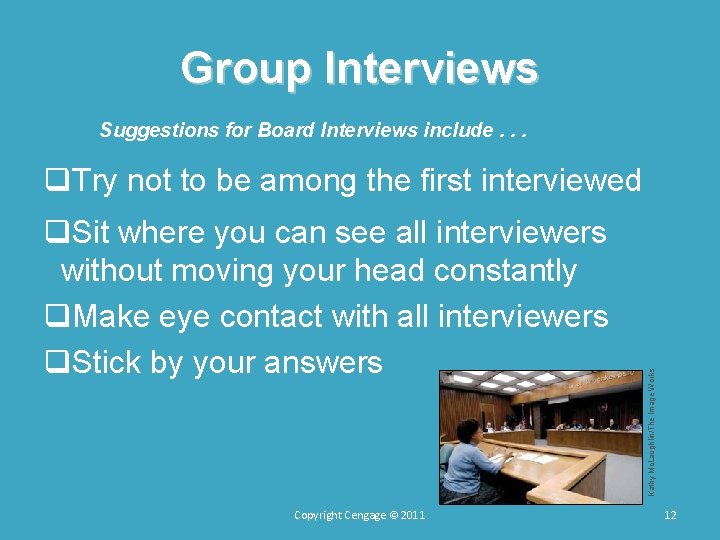
Group Interviews Suggestions for Board Interviews include. . . © Jason Harris q. Sit where you can see all interviewers without moving your head constantly q. Make eye contact with all interviewers q. Stick by your answers Copyright Cengage © 2011 Kathy Mc. Laughlin/The Image Works q. Try not to be among the first interviewed 12
Informational Interview q. Information-giving interview -Interviewer imparts important information q. Information-seeking interview – interviewer wants information from the interviewee q. Use standard interview structure q. No longer than 15 minutes Copyright Cengage © 2011 13
Interrogation Interview q. Done when an offence is committed q. Begin by discussing a topic of interest to assess nonverbal behaviors q. Use open-ended questions Copyright Cengage © 2011 14
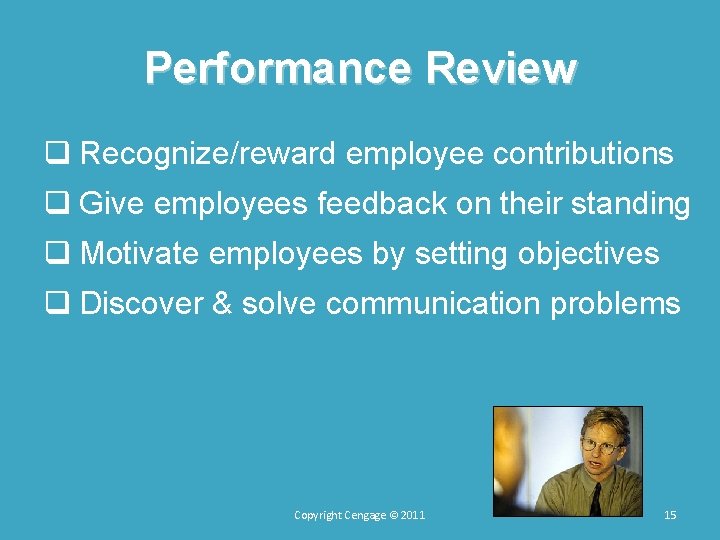
Performance Review q Recognize/reward employee contributions q Give employees feedback on their standing q Motivate employees by setting objectives q Discover & solve communication problems Copyright Cengage © 2011 15
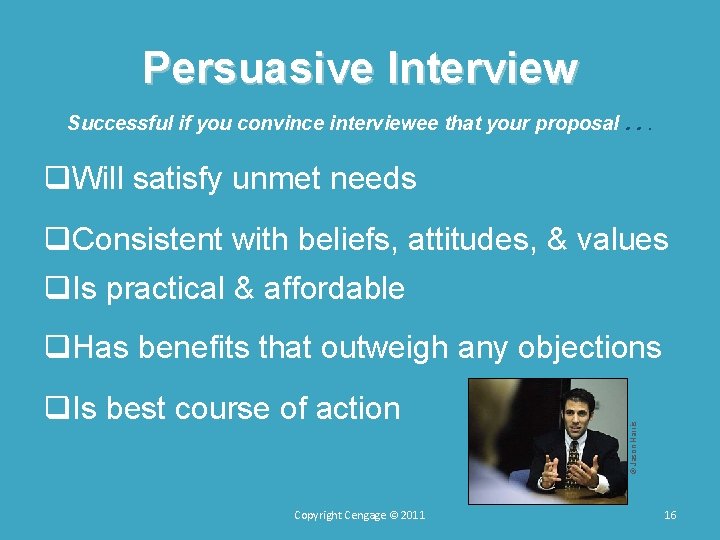
Persuasive Interview Successful if you convince interviewee that your proposal. . . q. Will satisfy unmet needs q. Consistent with beliefs, attitudes, & values q. Is practical & affordable q. Is best course of action Copyright Cengage © 2011 © Jason Harris q. Has benefits that outweigh any objections 16
Telephone Interview q. Prepare like face-to-face interview q. Keep file of personal information by the telephone q. Keep answering machine messages brief and professional q. Plan for detailed interview that might last an hour Copyright Cengage © 2011 17
Telephone Interview q. Show complete attention to interviewer q. Prepare to sound friendly, sincere, enthusiastic and professional q. Listen carefully to questions before answering q. Thank interviewer and ask for contact information Copyright Cengage © 2011 18
Basic Interview Organization q. Opening Phase q. Question-Response Phase q. Closing Phase Copyright Cengage © 2011 19
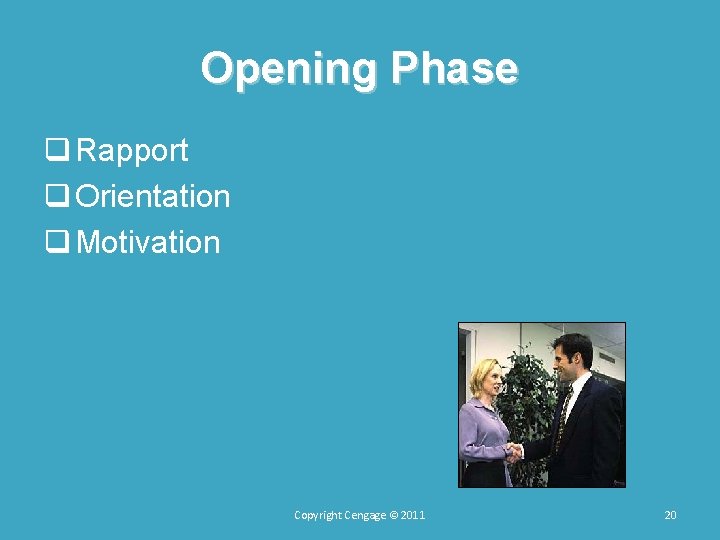
Opening Phase q Rapport q Orientation q Motivation Copyright Cengage © 2011 20
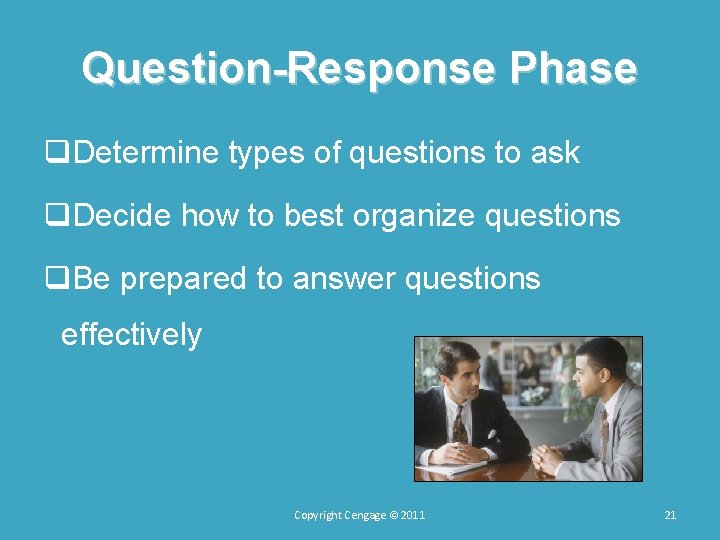
Question-Response Phase q. Determine types of questions to ask q. Decide how to best organize questions q. Be prepared to answer questions effectively Copyright Cengage © 2011 21
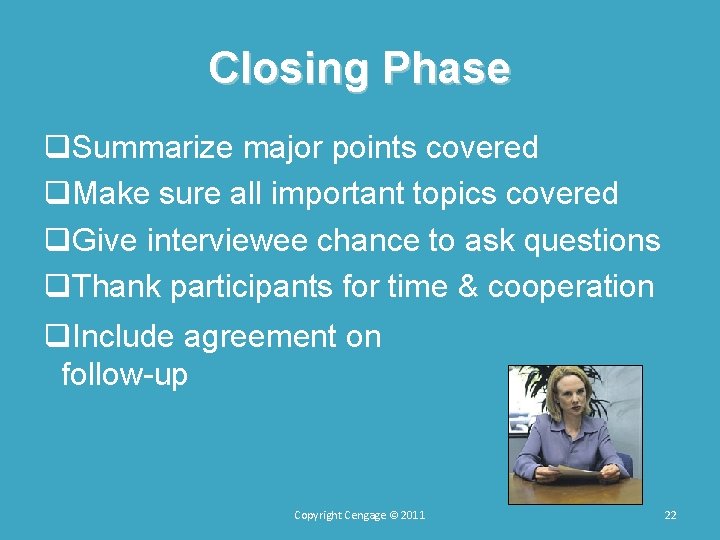
Closing Phase q. Summarize major points covered q. Make sure all important topics covered q. Give interviewee chance to ask questions q. Thank participants for time & cooperation q. Include agreement on follow-up Copyright Cengage © 2011 22
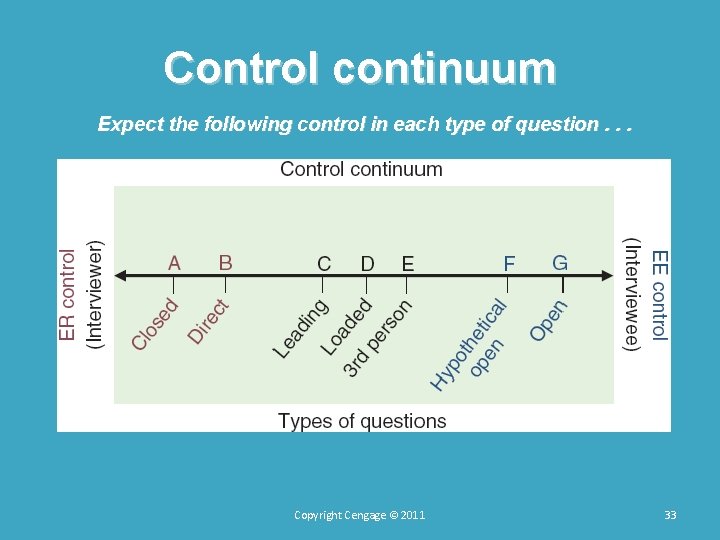
Types of Interview questions q. Open-ended questions q. Hypothetical questions q. Direct questions q. Closed questions > Copyright Cengage © 2011 23
Types of Interview questions (cont. ) q. Loaded questions q. Leading questions q. Third person questions q. Verbal and Nonverbal proves Copyright Cengage © 2011 24
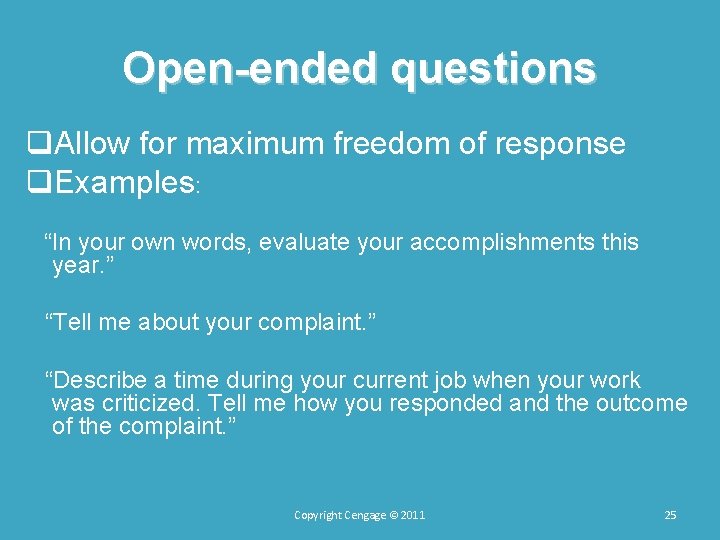
Open-ended questions q. Allow for maximum freedom of response q. Examples: “In your own words, evaluate your accomplishments this year. ” “Tell me about your complaint. ” “Describe a time during your current job when your work was criticized. Tell me how you responded and the outcome of the complaint. ” Copyright Cengage © 2011 25
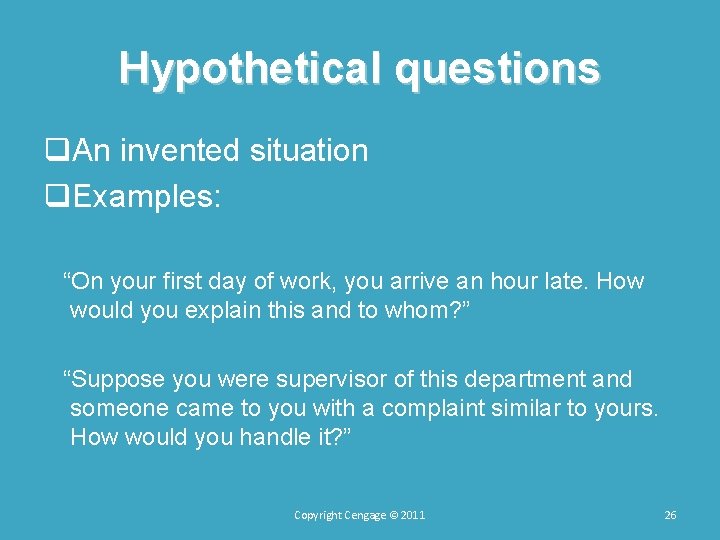
Hypothetical questions q. An invented situation q. Examples: “On your first day of work, you arrive an hour late. How would you explain this and to whom? ” “Suppose you were supervisor of this department and someone came to you with a complaint similar to yours. How would you handle it? ” Copyright Cengage © 2011 26
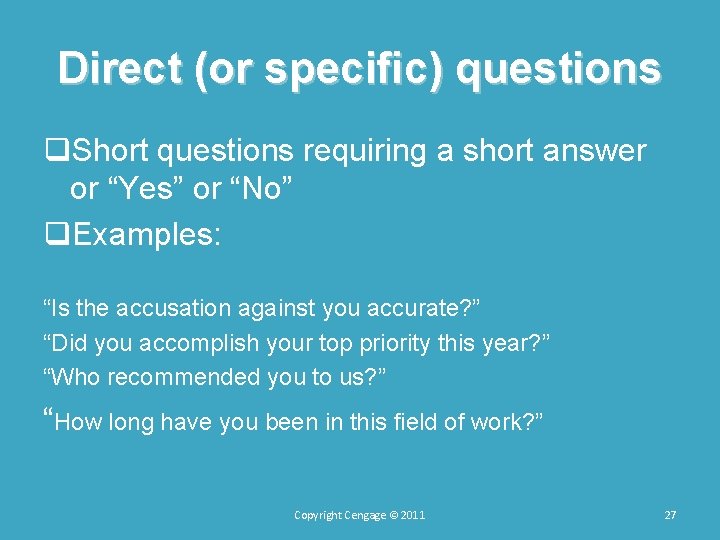
Direct (or specific) questions q. Short questions requiring a short answer or “Yes” or “No” q. Examples: “Is the accusation against you accurate? ” “Did you accomplish your top priority this year? ” “Who recommended you to us? ” “How long have you been in this field of work? ” Copyright Cengage © 2011 27
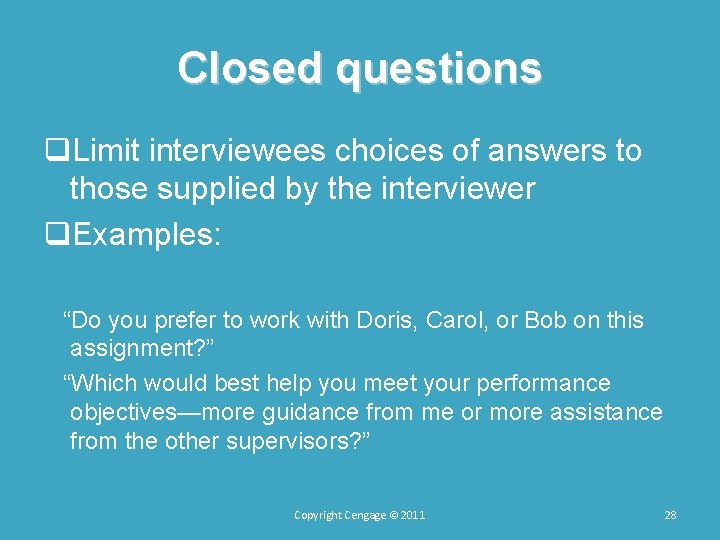
Closed questions q. Limit interviewees choices of answers to those supplied by the interviewer q. Examples: “Do you prefer to work with Doris, Carol, or Bob on this assignment? ” “Which would best help you meet your performance objectives—more guidance from me or more assistance from the other supervisors? ” Copyright Cengage © 2011 28
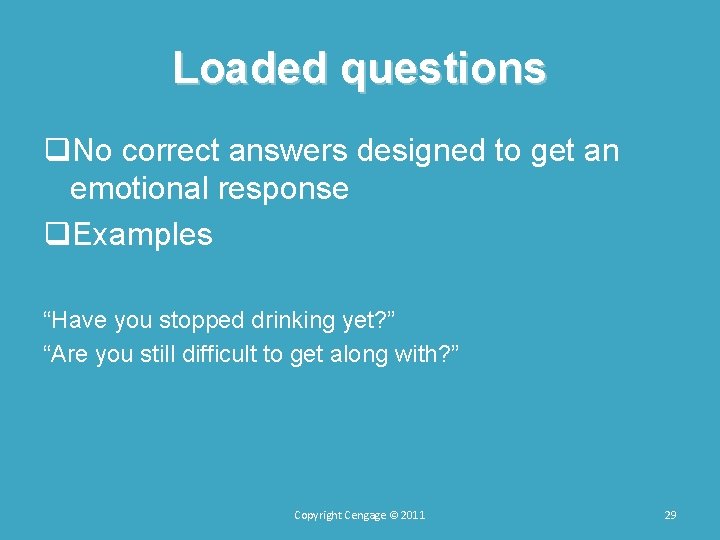
Loaded questions q. No correct answers designed to get an emotional response q. Examples “Have you stopped drinking yet? ” “Are you still difficult to get along with? ” Copyright Cengage © 2011 29
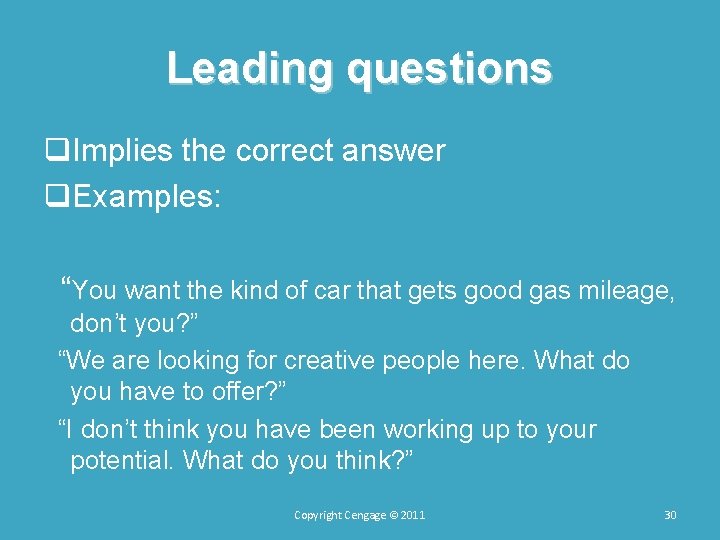
Leading questions q. Implies the correct answer q. Examples: “You want the kind of car that gets good gas mileage, don’t you? ” “We are looking for creative people here. What do you have to offer? ” “I don’t think you have been working up to your potential. What do you think? ” Copyright Cengage © 2011 30
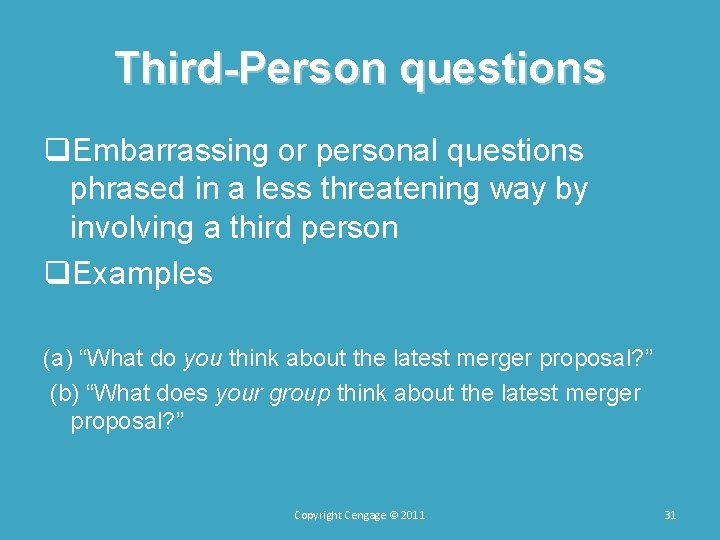
Third-Person questions q. Embarrassing or personal questions phrased in a less threatening way by involving a third person q. Examples (a) “What do you think about the latest merger proposal? ” (b) “What does your group think about the latest merger proposal? ” Copyright Cengage © 2011 31
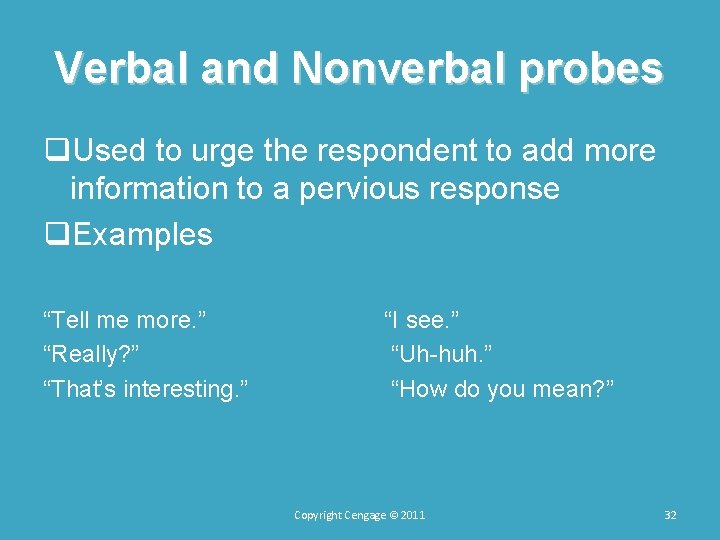
Verbal and Nonverbal probes q. Used to urge the respondent to add more information to a pervious response q. Examples “Tell me more. ” “Really? ” “That’s interesting. ” “I see. ” “Uh-huh. ” “How do you mean? ” Copyright Cengage © 2011 32
Control continuum Expect the following control in each type of question. . . Copyright Cengage © 2011 33
Organizing interview questions q. Funnel sequence q. Inverted Funnel sequence q. Hourglass sequence q. Diamond sequence Copyright Cengage © 2011 34
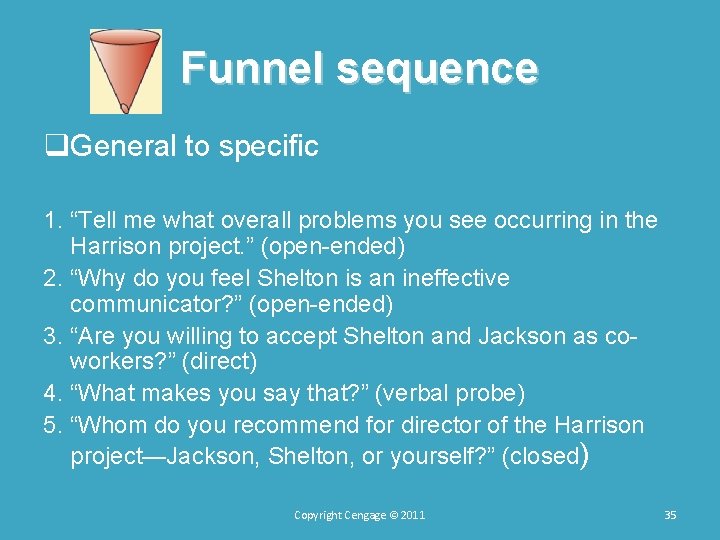
Funnel sequence q. General to specific 1. “Tell me what overall problems you see occurring in the Harrison project. ” (open-ended) 2. “Why do you feel Shelton is an ineffective communicator? ” (open-ended) 3. “Are you willing to accept Shelton and Jackson as coworkers? ” (direct) 4. “What makes you say that? ” (verbal probe) 5. “Whom do you recommend for director of the Harrison project—Jackson, Shelton, or yourself? ” (closed) Copyright Cengage © 2011 35
Inverted Funnel sequence q. Specific to general 1. “Whom do you recommend as director of the Harrison project—Jackson, Shelton, or yourself? ” (closed) 2. “What makes you say that? ” (verbal probe) 3. “Are you willing to accept Shelton and Jackson as coworkers? ” (direct) 4. “Why do you feel Shelton is an ineffective communicator? ” (open-ended) 5. “Tell me what overall problems you see occurring in the Harrison project. ” (open-ended) Copyright Cengage © 2011 36
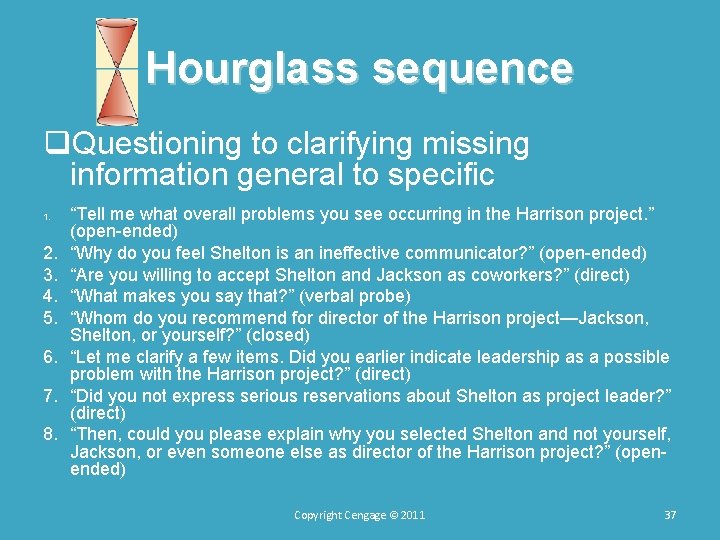
Hourglass sequence q. Questioning to clarifying missing information general to specific 1. 2. 3. 4. 5. 6. 7. 8. “Tell me what overall problems you see occurring in the Harrison project. ” (open-ended) “Why do you feel Shelton is an ineffective communicator? ” (open-ended) “Are you willing to accept Shelton and Jackson as coworkers? ” (direct) “What makes you say that? ” (verbal probe) “Whom do you recommend for director of the Harrison project—Jackson, Shelton, or yourself? ” (closed) “Let me clarify a few items. Did you earlier indicate leadership as a possible problem with the Harrison project? ” (direct) “Did you not express serious reservations about Shelton as project leader? ” (direct) “Then, could you please explain why you selected Shelton and not yourself, Jackson, or even someone else as director of the Harrison project? ” (openended) Copyright Cengage © 2011 37
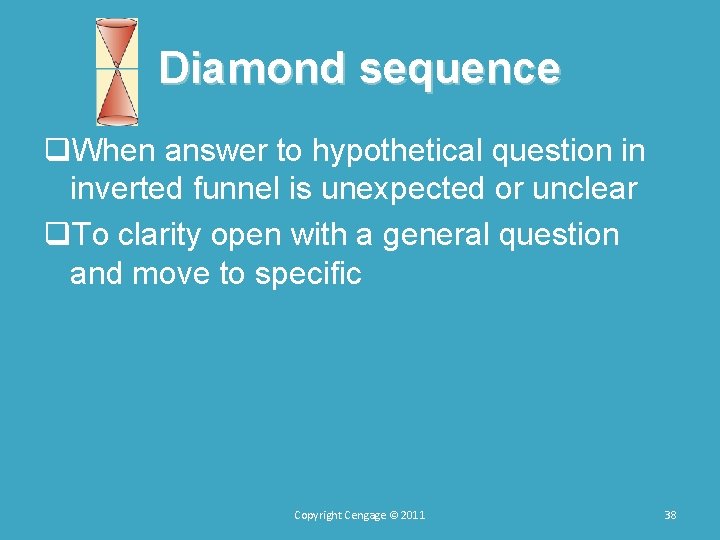
Diamond sequence q. When answer to hypothetical question in inverted funnel is unexpected or unclear q. To clarity open with a general question and move to specific Copyright Cengage © 2011 38
Answering questions effectively q Relax and be yourself q If caught off guard, don’t rush answer q If don’t know or remember, say so q Don’t say more than you want to say q Use open-ended questions to present info q Listen carefully Copyright Cengage © 2011 39
Answering questions effectively(cont) q Be attentive to interviewer’s intentions q Don’t let closed questions limit you q Avoid answering yes or no to loaded questions q Beware of leading questions q Be aware that 3 rd-person questions are aimed at getting you to say more Copyright Cengage © 2011 40
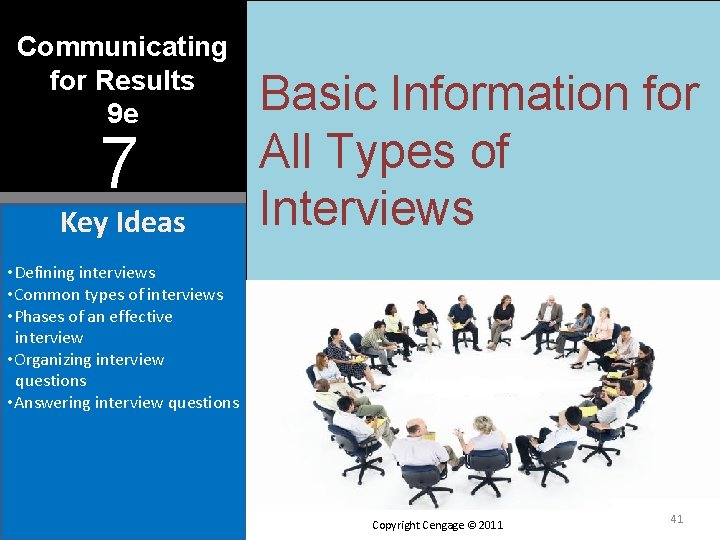
Communicating for Results 9 e 7 Key Ideas Basic Information for All Types of Interviews • Defining interviews • Common types of interviews • Phases of an effective interview • Organizing interview questions • Answering interview questions Copyright Cengage © 2011 41