
Communicating for Results 9 e 3 Key Ideas
- Slides: 49
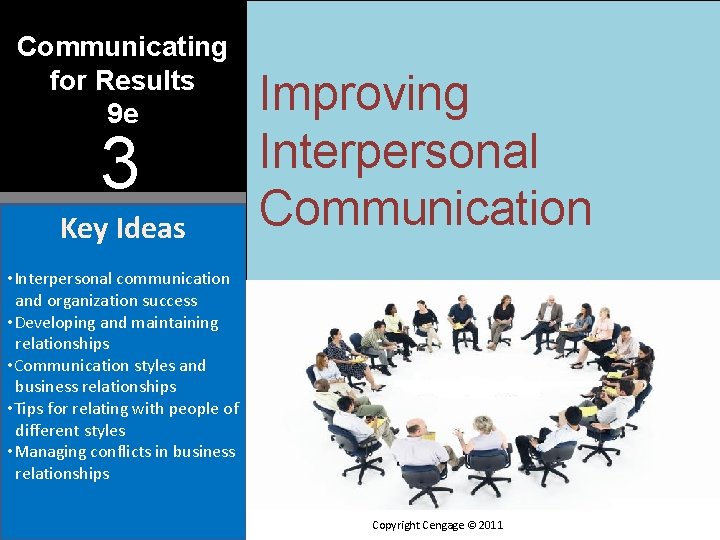
Communicating for Results 9 e 3 Key Ideas Improving Interpersonal Communication • Interpersonal communication and organization success • Developing and maintaining relationships • Communication styles and business relationships • Tips for relating with people of different styles • Managing conflicts in business relationships Copyright Cengage © 2011 1
Consider this. . . Positive interpersonal relationships are crucial to the survival of individuals, teams, and organizations. Eisenberg & Goodall, Organizational Communication, 2004, p. 5 Copyright Cengage © 2011 2
Case Study: AIG Bailout Controversy q. Read or Describe the case q. Answer the following questions: q. What is the main problem that triggered the controversy? q. What four communication styles fits De. Santis based on his letter? q. Why did De. Santis choose this method? Copyright Cengage © 2011 3
Employee Relationships have positive affects on the following: q. Job Satisfaction q. Morale q. Others’ communication needs Jose Luis Pelaez, Inc. /CORBIS q. Commitment to & knowledge of the organization Copyright Cengage © 2011 4
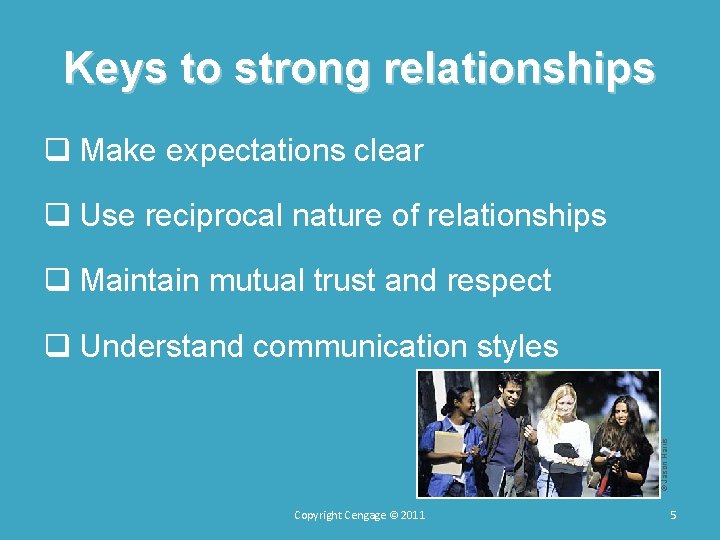
Keys to strong relationships q Make expectations clear q Use reciprocal nature of relationships q Maintain mutual trust and respect © Jason Harris q Understand communication styles Copyright Cengage © 2011 5
Using communication styles q. Determine personal communication style q. Understand the strength and weaknesses of each style q. Learn how to communicate using different styles Copyright Cengage © 2011 6
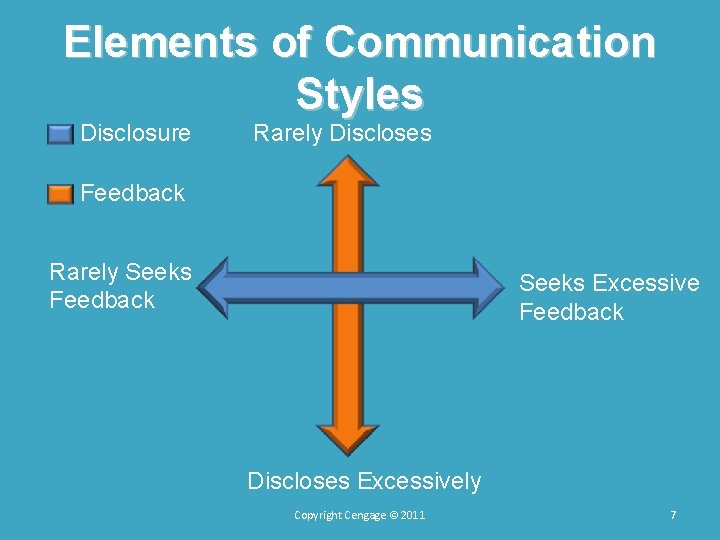
Elements of Communication Styles Disclosure Rarely Discloses Feedback Rarely Seeks Feedback Seeks Excessive Feedback Discloses Excessively Copyright Cengage © 2011 7
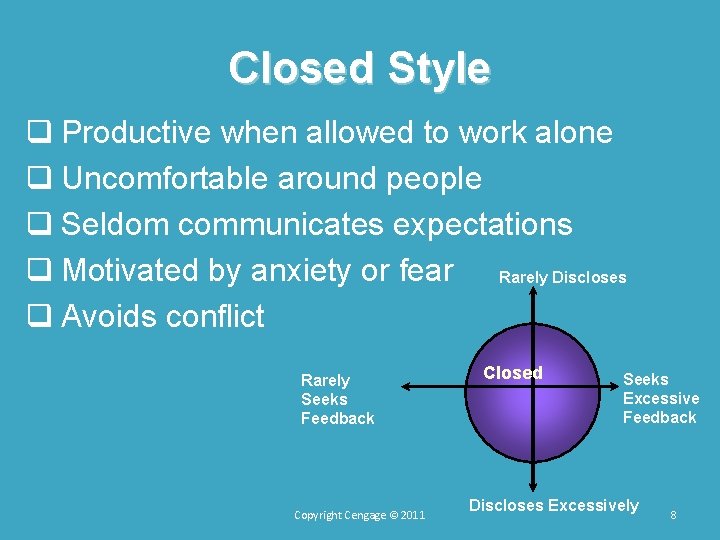
Closed Style q Productive when allowed to work alone q Uncomfortable around people q Seldom communicates expectations q Motivated by anxiety or fear Rarely Discloses q Avoids conflict Rarely Seeks Feedback Copyright Cengage © 2011 Closed Seeks Excessive Feedback Discloses Excessively 8
Closed Communicators at their best q. Productive as long as they can work in an environment free of interpersonal demands. q. Seen as reserved. q. Considered similar to the laissez faire leader, who lets employees do whatever they want. Copyright Cengage © 2011 9
Closed Communicators at their worst q. Low productivity due to spending energy looking for security q. Difficult to get to know q. Unresponsive to needs of others. q. Thought to be aloof and noncommunicative. Copyright Cengage © 2011 10
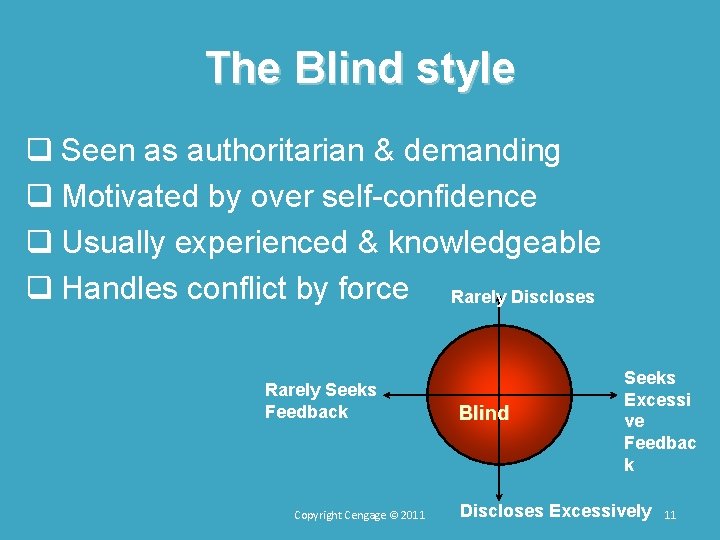
The Blind style q Seen as authoritarian & demanding q Motivated by over self confidence q Usually experienced & knowledgeable q Handles conflict by force Rarely Discloses Rarely Seeks Feedback Copyright Cengage © 2011 Blind Seeks Excessi ve Feedbac k Discloses Excessively 11
Blind Communicators best q. Clear on what you want and where you stand with them q. Loyal, organized, dependable q. Helpful to those who want to learn as long as help is appreciated Copyright Cengage © 2011 12
Blind Communicators worst q. Unable to delegate effectively q. Insist in their way; impatient q. Offer advice and criticism but can’t take it q. Prefer to be in control at all times Copyright Cengage © 2011 13
Blind Communicators worst q. Stifle growth and creativity q. Expect others to mess things up q. Punish failure q. Often poor listeners Copyright Cengage © 2011 14
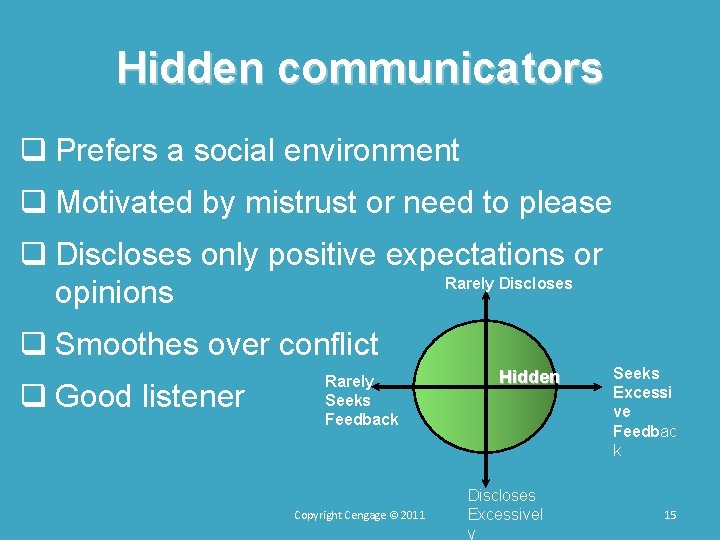
Hidden communicators q Prefers a social environment q Motivated by mistrust or need to please q Discloses only positive expectations or Rarely Discloses opinions q Smoothes over conflict q Good listener Rarely Seeks Feedback Copyright Cengage © 2011 Hidden Discloses Excessivel y Seeks Excessi ve Feedbac k 15
Hidden Communicators best q. Well liked and fun to be around q. Concerned with people q. Willing to listen q. Smooth over minor office conflicts Copyright Cengage © 2011 16
Hidden communicators worst q. Suspicious of others’ motives q. Adequate performance accepted q. Yes people q. Unable to disclose opinions or ideas that may be rejected q. Not always loyal q. Appear to be two faced Copyright Cengage © 2011 17
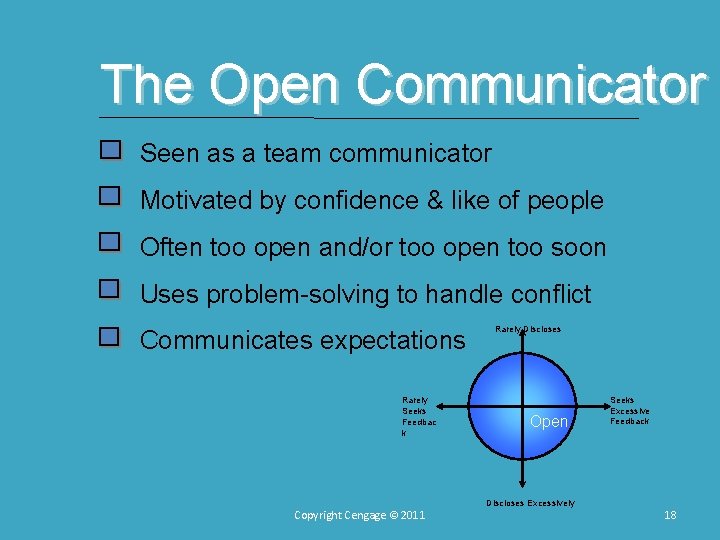
The Open Communicator Seen as a team communicator Motivated by confidence & like of people Often too open and/or too open too soon Uses problem solving to handle conflict Communicates expectations Rarely Seeks Feedbac k Rarely Discloses Open Seeks Excessive Feedback Discloses Excessively Copyright Cengage © 2011 18
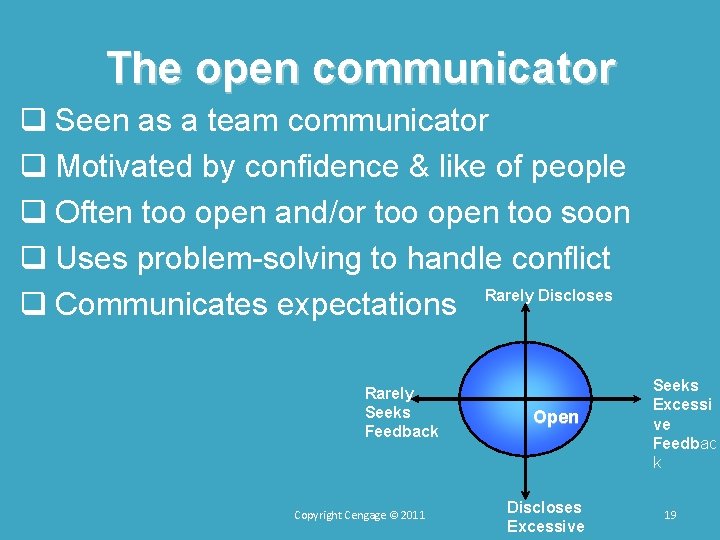
The open communicator q Seen as a team communicator q Motivated by confidence & like of people q Often too open and/or too open too soon q Uses problem solving to handle conflict q Communicates expectations Rarely Discloses Rarely Seeks Feedback Copyright Cengage © 2011 Open Discloses Excessive Seeks Excessi ve Feedbac k 19
Open communicators best q. Flexible in meeting needs and using communication styles q. Give and receive praise and criticism q. Genuinely like others and listens carefully q. Trusting, friendly and dependable q. Productive q. Empower others through team feedback and decisions Copyright Cengage © 2011 20
Open communicators worst q. Seen as ineffective managers by blind managers q. Frustrated by lack of creative opportunities under non open bosses q. Impatient with time needed to complement organizational changes q. So open others are uncomfortable q. Open at inappropriate times Copyright Cengage © 2011 21
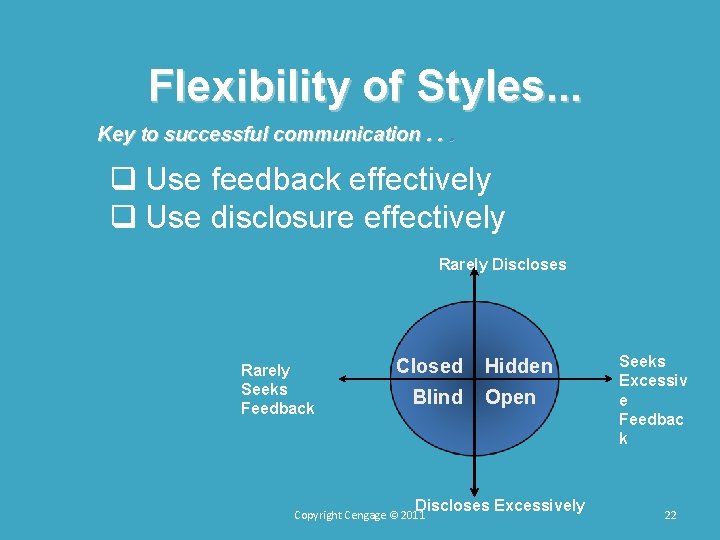
Flexibility of Styles. . . Key to successful communication. . . q Use feedback effectively q Use disclosure effectively Rarely Discloses Rarely Seeks Feedback Closed Blind Hidden Open Discloses Excessively Copyright Cengage © 2011 Seeks Excessiv e Feedbac k 22
Using feedback q Is directed toward behavior (not person) q Uses descriptive language (not evaluative) q Involves sharing (not giving advice) q Includes limited information q Is immediate & well timed q Allows for face saving Copyright Cengage © 2011 23
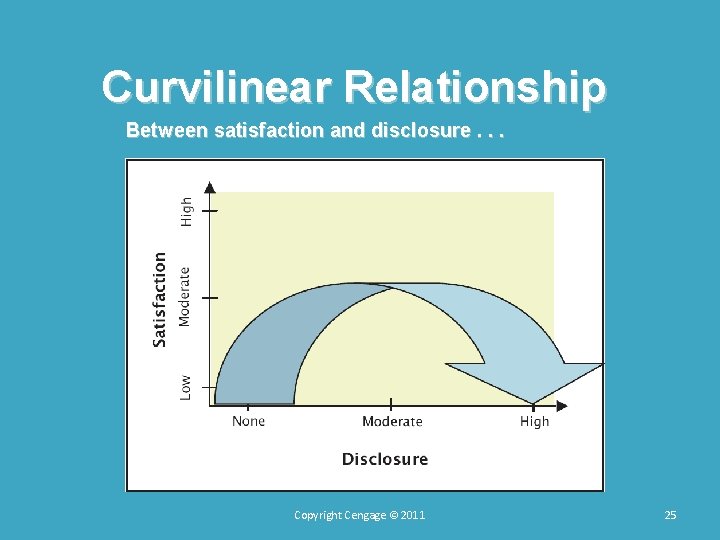
Effective disclosure q Used to develop/maintain relationships q Should be mutually shared q Should be gradual q Involves risk q Moderate level of disclosure usually best Copyright Cengage © 2011 24
Curvilinear Relationship Between satisfaction and disclosure. . . Copyright Cengage © 2011 25
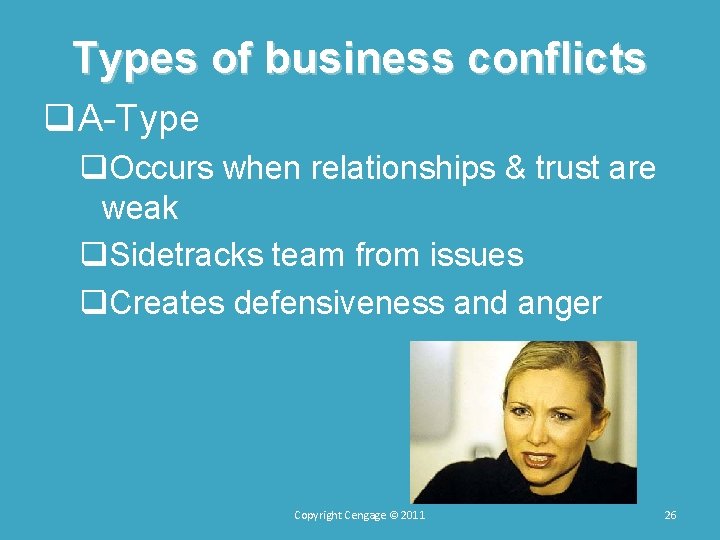
Types of business conflicts q. A Type q. Occurs when relationships & trust are weak q. Sidetracks team from issues q. Creates defensiveness and anger Copyright Cengage © 2011 26
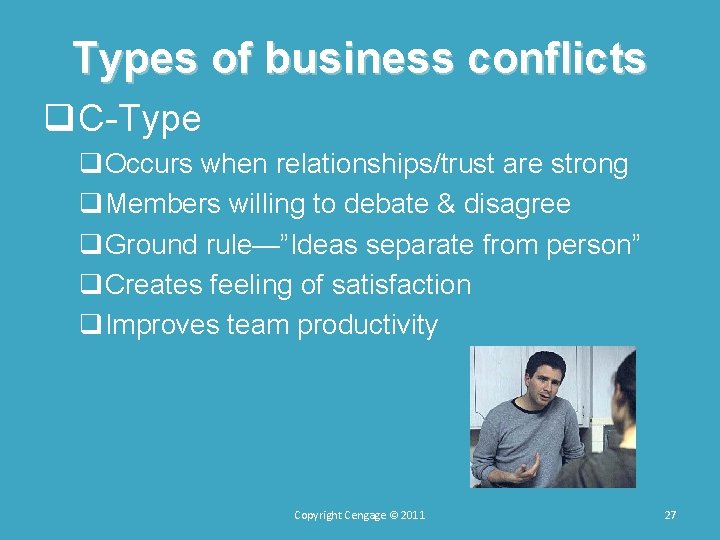
Types of business conflicts q. C Type q. Occurs when relationships/trust are strong q. Members willing to debate & disagree q. Ground rule—”Ideas separate from person” q. Creates feeling of satisfaction q. Improves team productivity Copyright Cengage © 2011 27
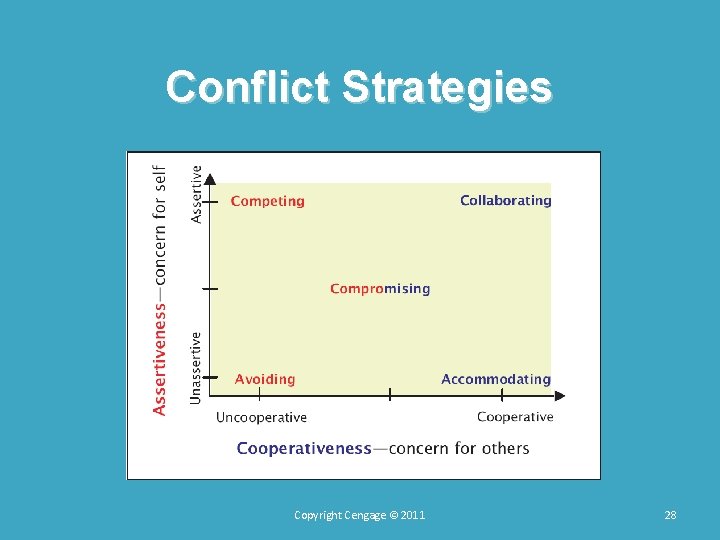
Conflict Strategies Copyright Cengage © 2011 28
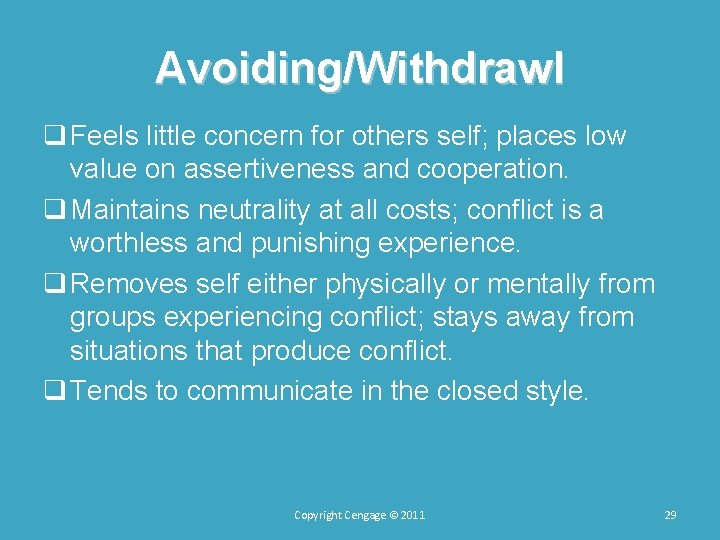
Avoiding/Withdrawl q Feels little concern for others self; places low value on assertiveness and cooperation. q Maintains neutrality at all costs; conflict is a worthless and punishing experience. q Removes self either physically or mentally from groups experiencing conflict; stays away from situations that produce conflict. q Tends to communicate in the closed style. Copyright Cengage © 2011 29
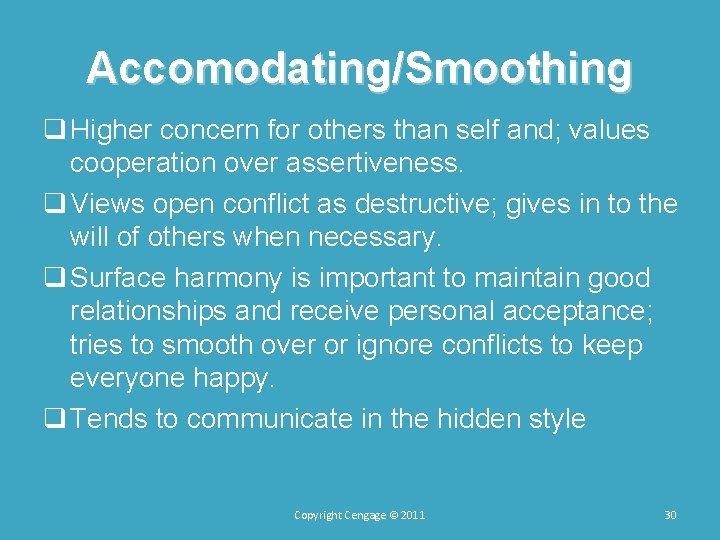
Accomodating/Smoothing q Higher concern for others than self and; values cooperation over assertiveness. q Views open conflict as destructive; gives in to the will of others when necessary. q Surface harmony is important to maintain good relationships and receive personal acceptance; tries to smooth over or ignore conflicts to keep everyone happy. q Tends to communicate in the hidden style Copyright Cengage © 2011 30
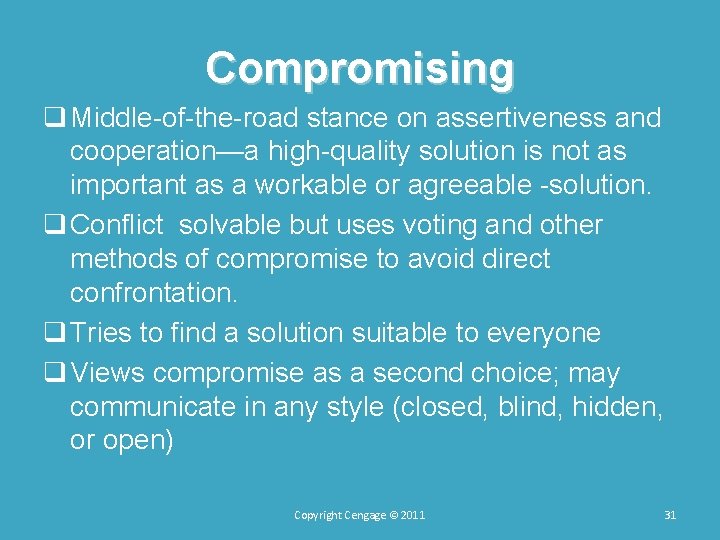
Compromising q Middle of the road stance on assertiveness and cooperation—a high quality solution is not as important as a workable or agreeable solution. q Conflict solvable but uses voting and other methods of compromise to avoid direct confrontation. q Tries to find a solution suitable to everyone q Views compromise as a second choice; may communicate in any style (closed, blind, hidden, or open) Copyright Cengage © 2011 31
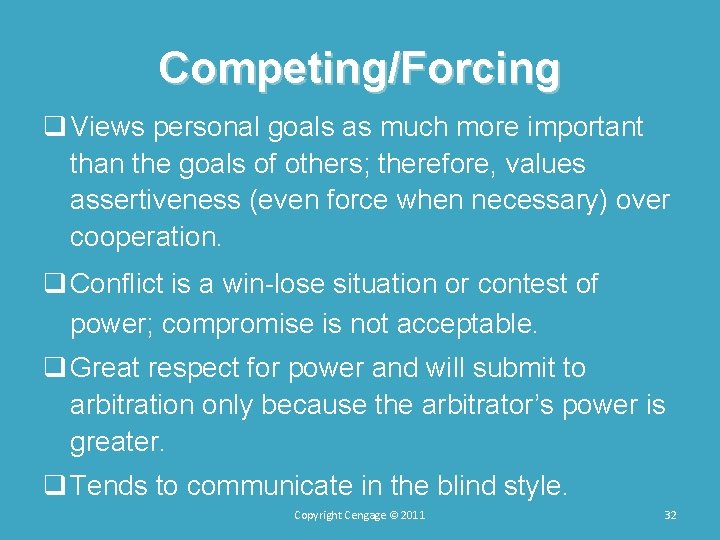
Competing/Forcing q Views personal goals as much more important than the goals of others; therefore, values assertiveness (even force when necessary) over cooperation. q Conflict is a win lose situation or contest of power; compromise is not acceptable. q Great respect for power and will submit to arbitration only because the arbitrator’s power is greater. q Tends to communicate in the blind style. Copyright Cengage © 2011 32
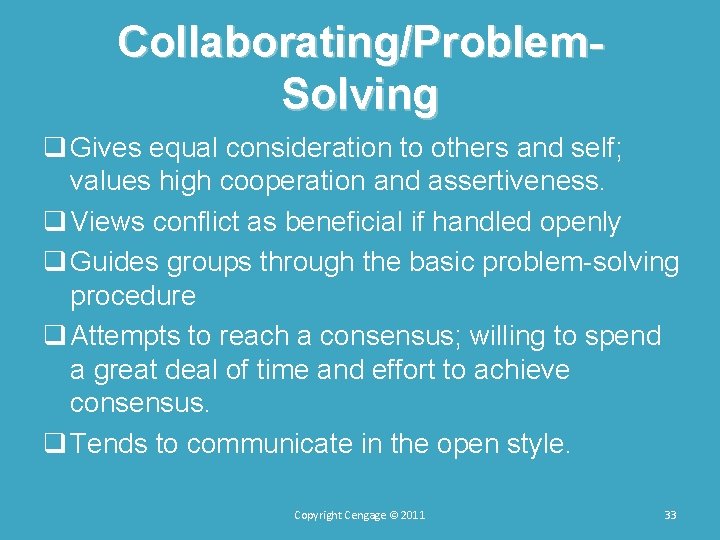
Collaborating/Problem. Solving q Gives equal consideration to others and self; values high cooperation and assertiveness. q Views conflict as beneficial if handled openly q Guides groups through the basic problem solving procedure q Attempts to reach a consensus; willing to spend a great deal of time and effort to achieve consensus. q Tends to communicate in the open style. Copyright Cengage © 2011 33
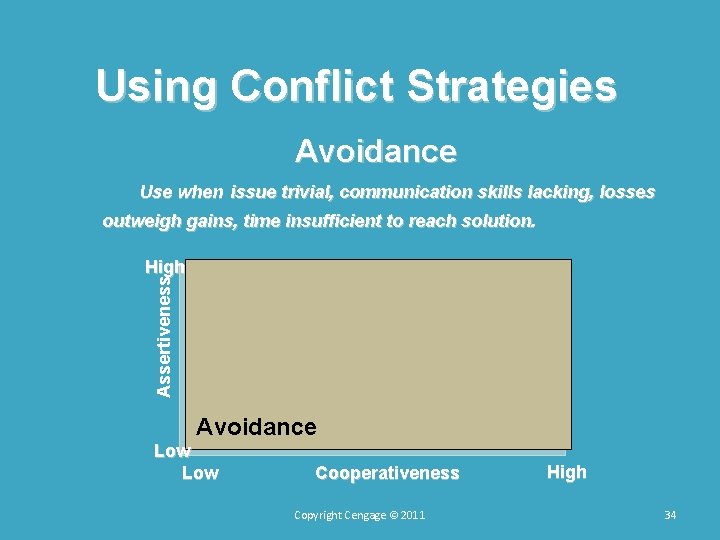
Using Conflict Strategies Avoidance Use when issue trivial, communication skills lacking, losses outweigh gains, time insufficient to reach solution. Assertiveness High Avoidance Avoiding Low Cooperativeness Copyright Cengage © 2011 High 34
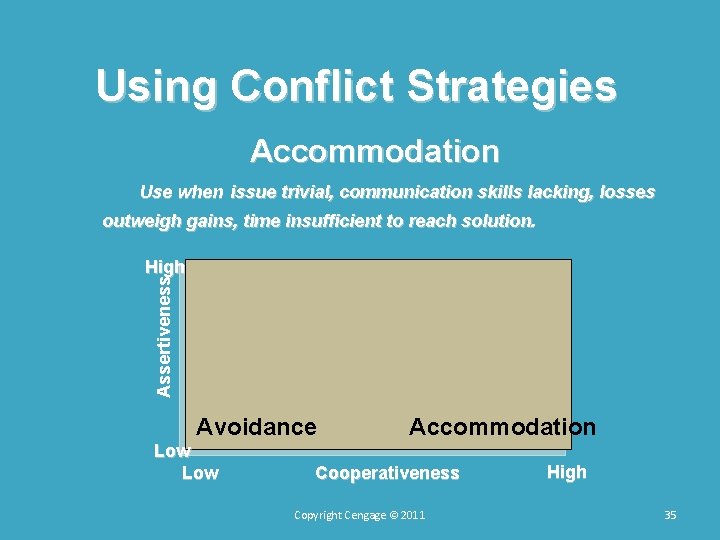
Using Conflict Strategies Accommodation Use when issue trivial, communication skills lacking, losses outweigh gains, time insufficient to reach solution. Assertiveness High Avoidance Avoiding Low Accommodation Cooperativeness Copyright Cengage © 2011 High 35
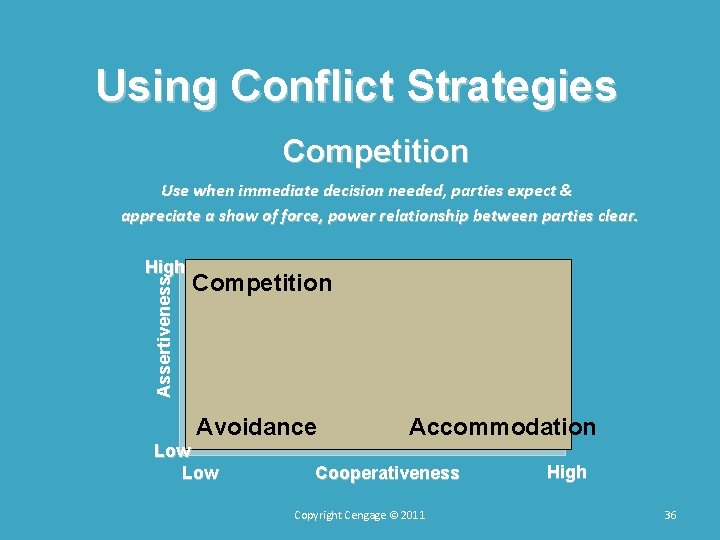
Using Conflict Strategies Competition Use when immediate decision needed, parties expect & appreciate a show of force, power relationship between parties clear. Assertiveness High Competition Avoidance Avoiding Low Accommodation Cooperativeness Copyright Cengage © 2011 High 36
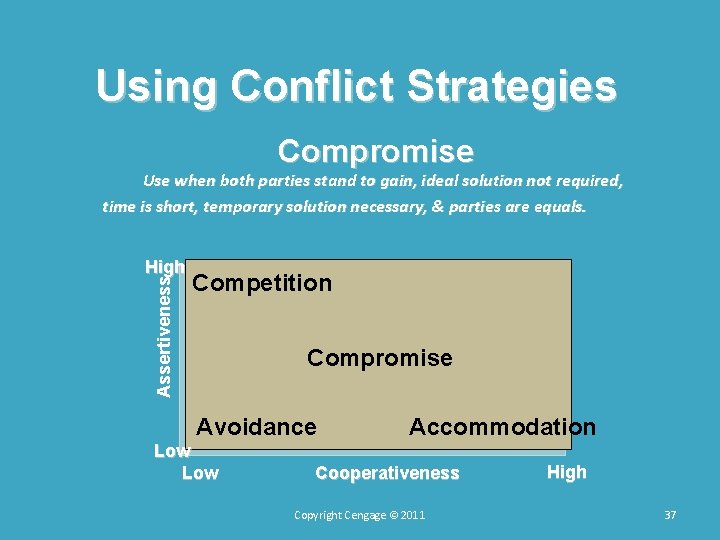
Using Conflict Strategies Compromise Use when both parties stand to gain, ideal solution not required, time is short, temporary solution necessary, & parties are equals. Assertiveness High Competition Compromise Avoidance Avoiding Low Accommodation Cooperativeness Copyright Cengage © 2011 High 37
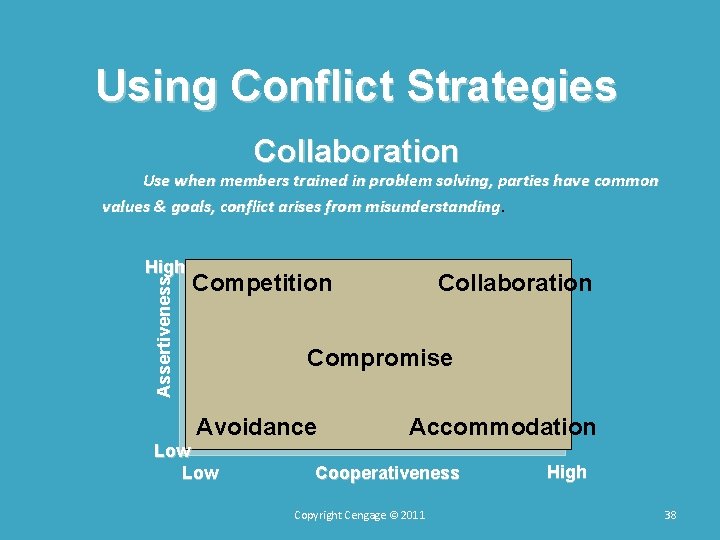
Using Conflict Strategies Collaboration Use when members trained in problem solving, parties have common values & goals, conflict arises from misunderstanding Assertiveness High Collaboration Competition Compromise Avoidance Avoiding Low Accommodation Cooperativeness Copyright Cengage © 2011 High 38
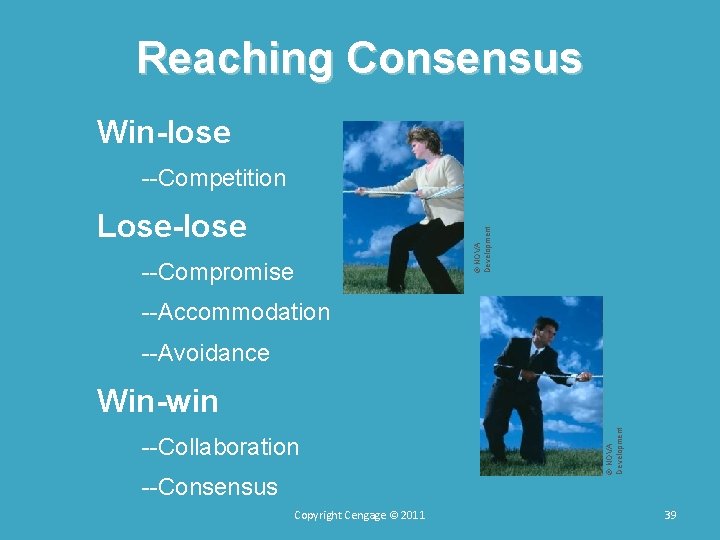
Reaching Consensus Win-lose Competition © NOVA Development Lose-lose Compromise Accommodation Avoidance Collaboration Consensus Copyright Cengage © 2011 © NOVA Development Win-win 39
Breaking a stalemate © Jason Harris q Clarify situation q Set aside conflicting solutions temporarily q Seek new solutions through brainstorming q Compare new & original solutions to see which is now “best” Copyright Cengage © 2011 40
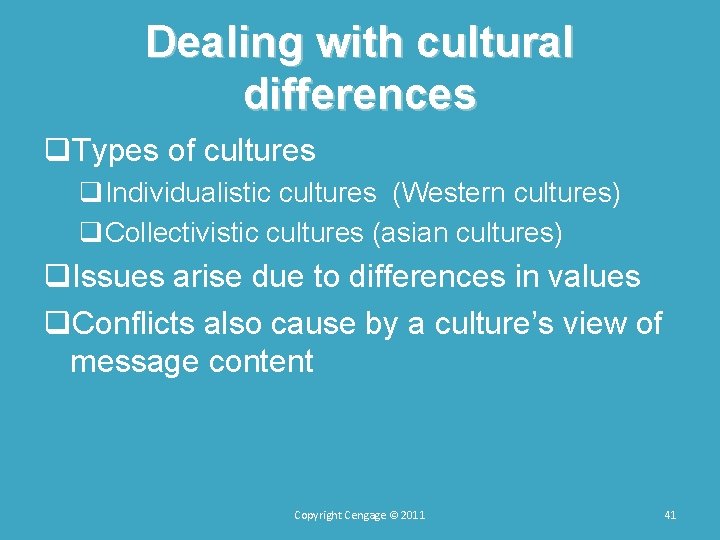
Dealing with cultural differences q. Types of cultures q. Individualistic cultures (Western cultures) q. Collectivistic cultures (asian cultures) q. Issues arise due to differences in values q. Conflicts also cause by a culture’s view of message content Copyright Cengage © 2011 41
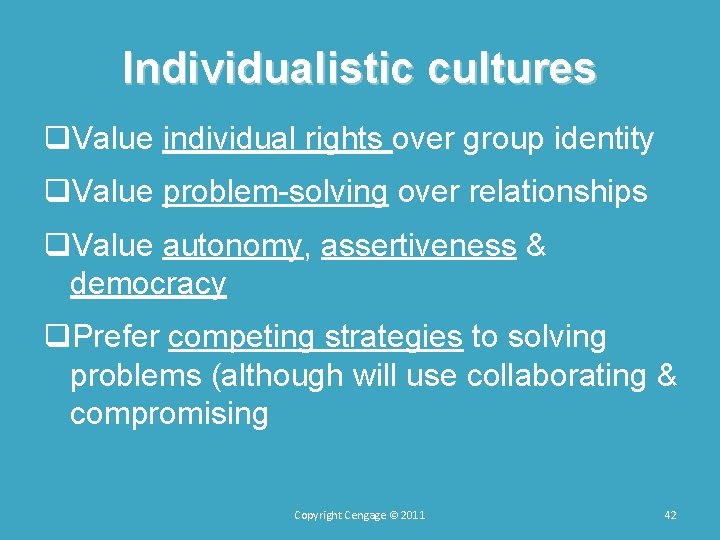
Individualistic cultures q. Value individual rights over group identity q. Value problem solving over relationships q. Value autonomy, assertiveness & democracy q. Prefer competing strategies to solving problems (although will use collaborating & compromising Copyright Cengage © 2011 42
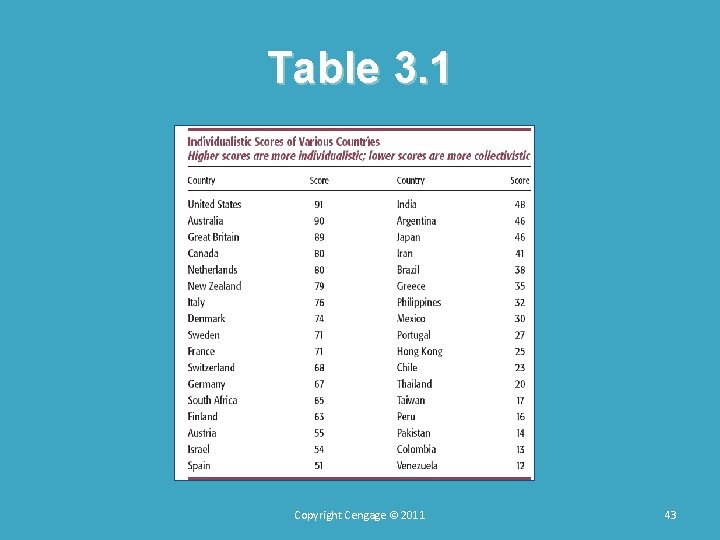
Table 3. 1 Copyright Cengage © 2011 43
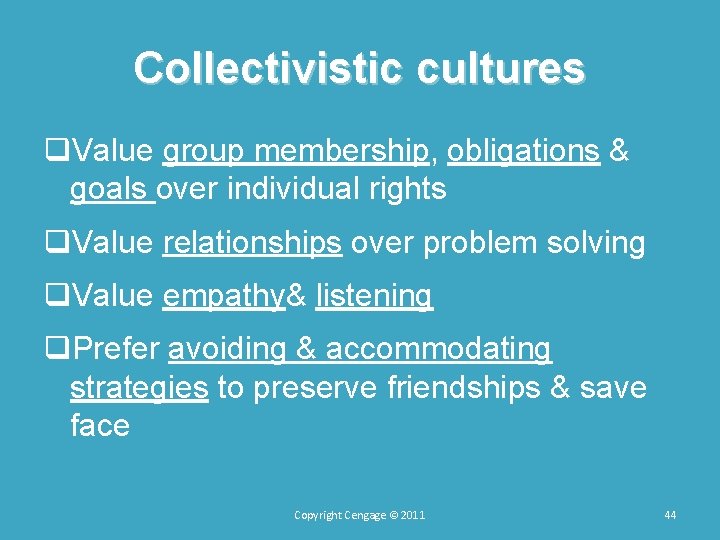
Collectivistic cultures q. Value group membership, obligations & goals over individual rights q. Value relationships over problem solving q. Value empathy& listening q. Prefer avoiding & accommodating strategies to preserve friendships & save face Copyright Cengage © 2011 44
High-Context q. Usually collectivistic q. Messages tend to be brief, indirect & implicit q. Receivers responsible for meaning q. Meaning obtained from setting, culture, & nonverbal communication—words of minimal importance Copyright Cengage © 2011 45
Low-Context cultures q. Usually individualistic q. Messages direct, explicit (clearly spelled out) q. Speakers expected to be organized & responsible for meaning q. Meaning conveyed by words; nonverbal of minimal importance Copyright Cengage © 2011 46
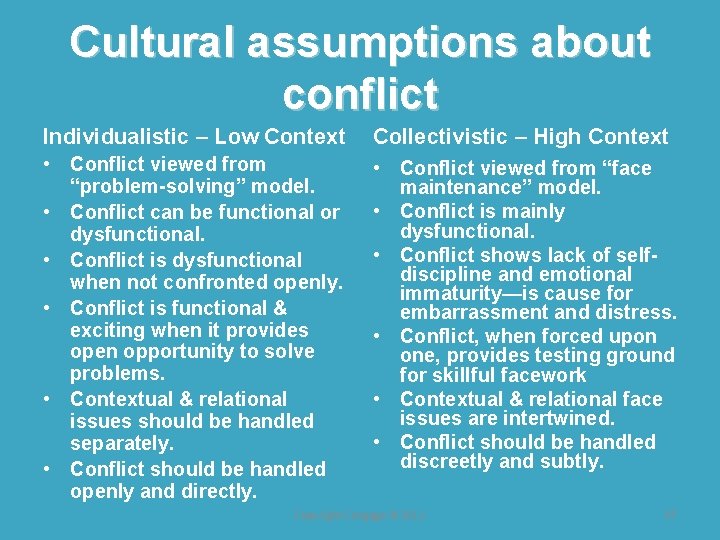
Cultural assumptions about conflict Individualistic – Low Context Collectivistic – High Context • Conflict viewed from “problem-solving” model. • Conflict can be functional or dysfunctional. • Conflict is dysfunctional when not confronted openly. • Conflict is functional & exciting when it provides open opportunity to solve problems. • Contextual & relational issues should be handled separately. • Conflict should be handled openly and directly. • Conflict viewed from “face maintenance” model. • Conflict is mainly dysfunctional. • Conflict shows lack of selfdiscipline and emotional immaturity—is cause for embarrassment and distress. • Conflict, when forced upon one, provides testing ground for skillful facework • Contextual & relational face issues are intertwined. • Conflict should be handled discreetly and subtly. Copyright Cengage © 2011 47
Handling intercultural conflict q Remember—there’s more than one reason able position in a conflict q Look for the “trigger” to the conflict q Use storytelling to talk about conflict q Use a neutral third party to mediate Copyright Cengage © 2011 48
Communicating for Results 9 e 3 Key Ideas Improving Interpersonal Communication • Interpersonal communication and organization success • Developing and maintaining relationships • Communication styles and business relationships • Tips for relating with people of different styles • Managing conflicts in business relationships Copyright Cengage © 2011 49