
Communicat ion Thursday October 18 th 2007 Alex
Communicat ion Thursday October 18 th, 2007 Alex Hernandez Summer Johnson Sean Sullivan Brent Snead
Class Telephone Demonstration Lets play…
Explanation Of Demonstration § And connection to Communication and Conversational styles
Brent Snead § Conversational Styles and Conceptual Background Of Communication

Conversational Styles § § § § § Each individual has their own distinct style of communication. There are seven different major conversational styles: 1. ) Dominant 2. ) Interruptive 3. ) Manipulative 4. ) Polite 5. ) Creative 6. ) Sarcastic 7. ) Passive
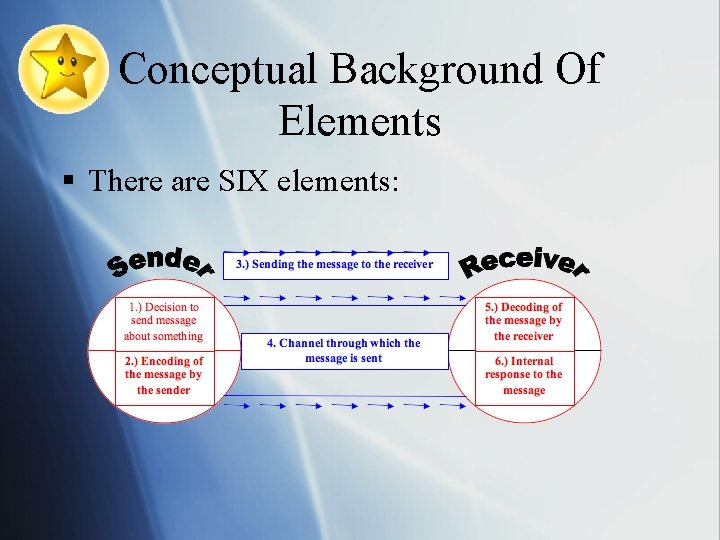
Conceptual Background Of Elements § There are SIX elements:
1) Decision § - Deciding to speak and choosing what thoughts the individual would like to put forth in conversation.
2) Encoding § - The process in which the speaker attempts to translate his or her thoughts and perceptions into words.
3)Sending § - The articulation of the words the individual would like to convey
4)Channel § - The message sent travels to the receiver via a channel, (i. e. sound waves, sign language, or video recording, and so forth).
5)Decoding § - A process in which the listener attempts to understand interpret what the speaker has encoded in his or her message.
6)Internal Response § - The receiver contemplates the message and has an internal response, (i. e. angry, upset, relieved, and uninterested).
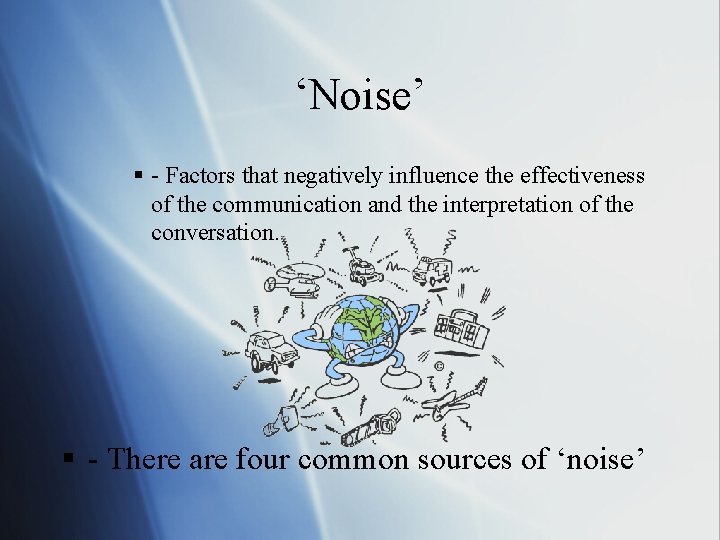
‘Noise’ § - Factors that negatively influence the effectiveness of the communication and the interpretation of the conversation. § - There are four common sources of ‘noise’
1)Personality § - The senders past experience provides a frame of reference for sending the message such as beliefs, attitudes, and personality. § -These factors may vary from person to person and can distort the message
2)Lack Of Skills § - The sender lacks sufficient skills in encoding. (Can not put their thoughts into words).
3)External Factors § - The communication can have noise, such as other people making a lot of noise, a bad telephone connection, as well as speech impediments (stuttering), or distracting mannerisms.
Receivers Past Experiences § - The receiver’s past experiences form a frame of reference for receiving and interpreting the message which can affect the decoding process.
Sean Sullivan Non Verbal Communication
Non-Verbal Communication § All aspects of communication other than words themselves. It includes how we utter words, features of environments that affect interactions and that influence personal images & interaction patterns.
Three Types Of Non Verbal Communication § 1. Kinesics § 2. Proxemics § 3. Paralanguage
Kinesics § · Body language- Shows peoples feelings without communicating them verbally.
§ · Physical Appearance- in each culture stereotypes develop that are based on physical appearance.
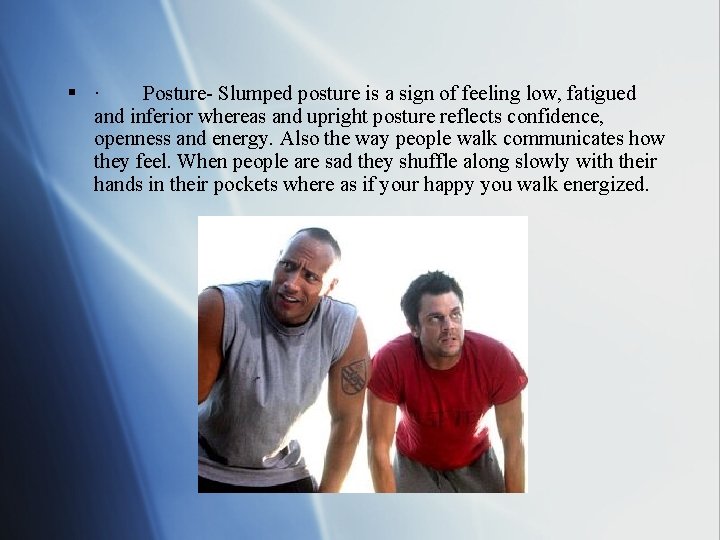
§ · Posture- Slumped posture is a sign of feeling low, fatigued and inferior whereas and upright posture reflects confidence, openness and energy. Also the way people walk communicates how they feel. When people are sad they shuffle along slowly with their hands in their pockets where as if your happy you walk energized.
§ · Gestures- many people communicate with gestures and various body movements. This allows for a person to show different feelings such as anger, sadness, sincerity and etc.
§ · Touching- is a common form of body language. Used to express affection, to calm, or to interrupt. Hand shakes, hugs, kissing, pats on back.
§ · Facial expressions- our face is our most expressive body part. Eye contact shows interest and shows that you are listening. Loping looks into another persons eyes conveys either romantic notions or conflict and anger.
Proxemics § Is the study of how we communicate by the way we use space - The distance between you and others, how you arrange furniture, and other objects for social interaction, and how you respond to the invasion of territory.

A Little Too Close?

Not Close Enough
Paralanguage § * refers to all vocal components of speech. Reflects what a person is feeling § * Pitch-the highness or lowness of the sound of your voice § * Resonance- the richness or thinness of your voice. § * Articulation- the way you enunciate. § * Tempo- the speed at which words are spoken § * Volume- the loudness or softness with which you speak. § * Rhythm- the emphasis placed on different words and the cadence of the speech.

Got To Go
§ Importance of Nonverbal Communication § * Non Verbal communication is essential to fully understand a message when two or more people are communicating. § * Albert Mehrabian (1968) analyzed typical communication between two people and concluded that the total impact of the message was divided in this way: § Verbal (words) 7% § Paralanguage 38% § Body Language 55%
Summer § Listening, Attending, and Responding Skills
Listening Skills Test
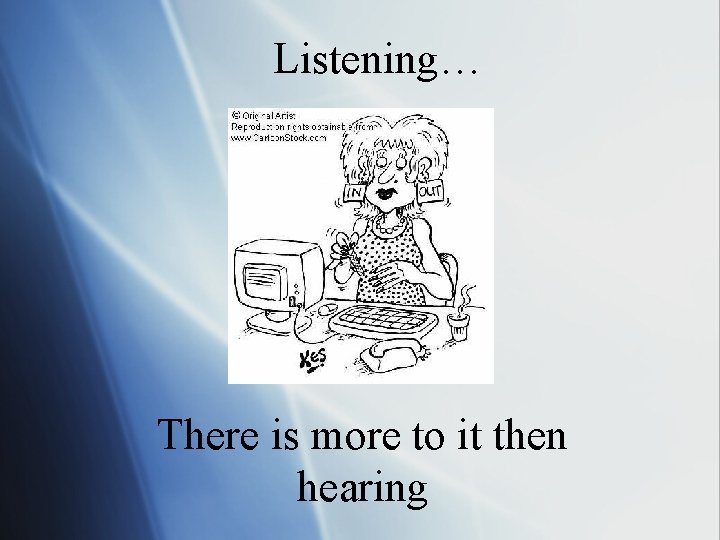
Listening… There is more to it then hearing
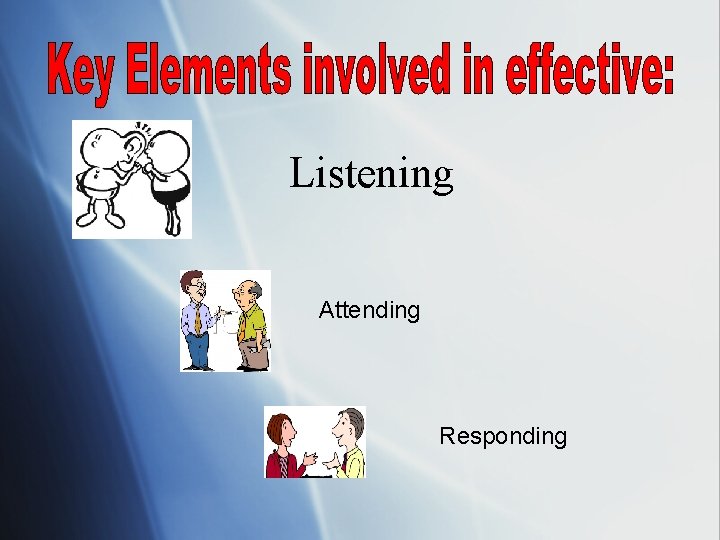
Listening Attending Responding
Listening, Attending & Responding 1. Assume the role of the listener
Listening, Attending & Responding 2. Maintaining eye contact Eye Contact No Eye Contact
Listening, Attending & Responding 3. Avoid word prejudice
Listening, Attending & Responding 4. Use “minimal encouragers” (ex: “oh? ” and “uh-huh? ”)
Listening, Attending & Responding 5. Paraphrase what was said to ensure understanding An elaboration of minimal encourager Key phrase plus personal observation
Listening, Attending & Responding 6. Ask questions to improve clarity of statement
Listening, Attending & Responding 7. Use empathy to reflect and share feelings
Listening, Attending & Responding 8. Provide feedback
Listening, Attending & Responding 9. Summarize the content of what was said
Research Journal Article: Title: Measurement of communication skills. Journal: International Journal of Listening Author: Nichols, Ralph Brown, James I. Keller, Robert J. Purpose: Discover if listening skills can be taught
Research Journal Article: Title: Measurement of communication skills. 1. Basic methods used: • Directly trained 2 sections of College students for 6 weeks (This group had the lowest pre-test scores) • Incidentally trained 2 sections of College students (This group had the highest pre-test scores) 2. Results: • Directly trained group made significant gains in scores during the period of training • Incidentally trained group did not • Major findings: • No significant differences were noted between 1. the groups on the post-test results
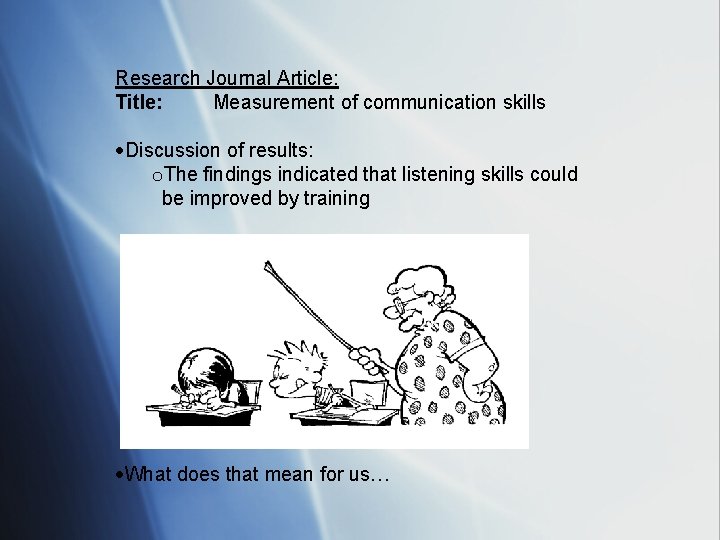
Research Journal Article: Title: Measurement of communication skills Discussion of results: o. The findings indicated that listening skills could be improved by training What does that mean for us…
…We can improve our listening skills ! • lead to better communication skills ~better listeners to friends / family ~better employees ~better students ~better in many areas of our life • Help us reach our Peak Performance all around “The key to being an outstanding communicator is not so much the words of wisdom that come out of your mouth, but how well you listen to the words of wisdom that come out of the mouths of others. ” -Della Menechella
Alex Steps To Enhance Communication Skills And Conflict Resolution
Conflict Resolution § Content Conflict: Disagreement occurs over the perception of information available
§ Value Conflict: When a person has conflicting values within his or her own value system.

Ego Conflict: Ego Conflict is based on win-lose mentality. Hardest type to resolve.
Conflict Management Styles § Withdrawal: When Conflict seems overwhelming, the first reaction is usually avoidance. § Surrender: To habitually give into a situation or problem is also construed as a negative conflict management style. § Hostile Aggression: Aggression is often used as a form of intimidation to manipulate others into submissive agreement. § Persuasion: An attempt to alter another persons attitude or behavior. § Dialogue: A verbal exchange of opinions, attitudes, facts and perceptions that opens the doors to greater understandings of the nature of the problem.
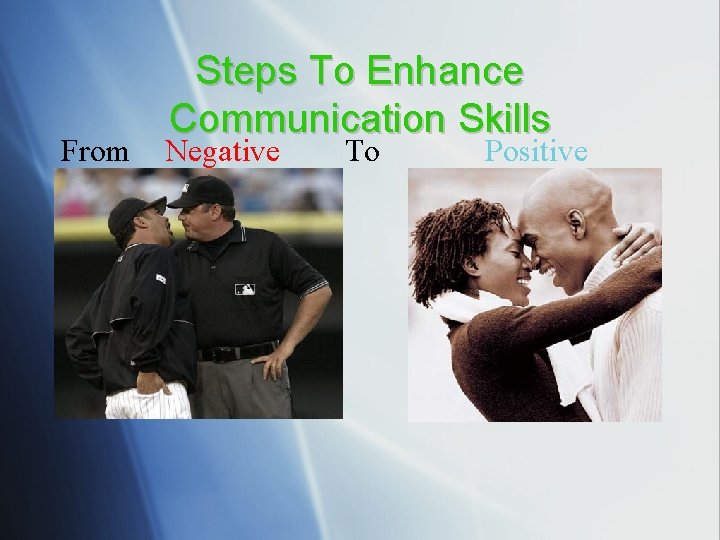
From Steps To Enhance Communication Skills Negative To Positive
1. Speak With Precision And Directness Select words that accurately describe your thoughts and feelings. How are you today? …. I’m OK
2. Enhance Your vocabulary § A small vocabulary decreases the ability to express yourself, whereas a greater number of words to choose from provides you with greater flexibility to say what you want to say. § Sound more professional, classy, educated.
3. Use Language Appropriate For Your Listening Audience § Assess which words, expressions, and gestures are most conductive to getting your point across. § Child or Adult
4. Attack Issue Not People § Avoid Character Assassination. Attacking people clouds the issue and makes it harder, if not impossible to resolve issues. § Not good for effective arguments
5. Avoid Putting Others On The Defensive § Placing the responsibility of understanding on yourself rather than blaming others minimizes defensiveness. § “I perceive…. ”
6. Avoid Asking Someone To Pass On Your Thoughts Or Feelings To A Third Party § The most effective communication involves talking with someone face to face. * § Effective in the workplace. *But you can still Myspace me and get a faster response.
7. Avoid Information Overload § Attention span is limited, as is the amount of information that can be received and processed. * *Like 65 slides on Communication
8. Validate Your Assumptions § Confirm what you think to be true with those that have given you this impression.
9. Resolve Problems When They Arise § If you feel there is a misunderstanding, there probably is. § Try to deal with issues as they surface by talking it out with those involved. § Drama free zone.
For Skills To Be Effective, They Must Be Practiced Regularly
Fin Thank You § The more we remind ourselves of these skills, the more likely we will use them
- Slides: 66