
Commonsense Knowledge and Language Generation Minlie Huang CS
- Slides: 39
Commonsense Knowledge and Language Generation Minlie Huang (黄民烈) CS Department, Tsinghua University aihuang@tsinghua. edu. cn http: //coai. cs. tsinghua. edu. cn/hml 1
Knowledge is a familiarity, awareness, or understanding of someone or something, such as facts, information, descriptions, or skills, which is acquired through experience or education by perceiving, discovering, or learning. 2 Knowledge can refer to a theoretical or practical understanding of a subject Plato(柏拉图): justified, true, believed Francis Bacon: Knowledge is Power
Knowledge Types World facts Commonsense knowledge Model knowledge (prior distribution, knowledge distillation, knowledge transfer) 3
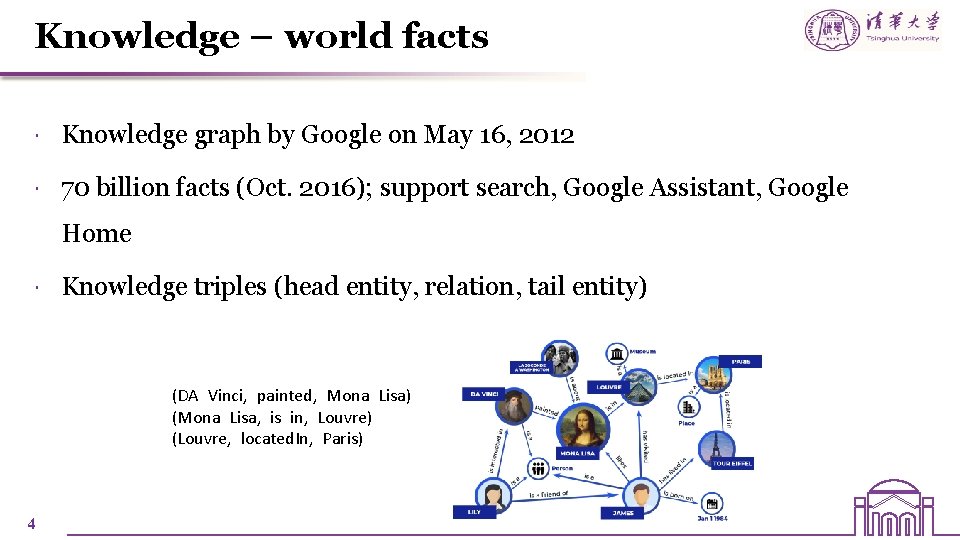
Knowledge – world facts Knowledge graph by Google on May 16, 2012 70 billion facts (Oct. 2016); support search, Google Assistant, Google Home Knowledge triples (head entity, relation, tail entity) (DA Vinci, painted, Mona Lisa) (Mona Lisa, is in, Louvre) (Louvre, located. In, Paris) 4
Knowledge – commonsense Commonsense knowledge consists of facts about the everyday world, that all humans are expected to know. (Wikipedia) u. Lemons are sour u. Tree has leaves u. Dog has four legs Commonsense knowledge bases u Concept. Net u Cyc u Open Mind Common Sense 5
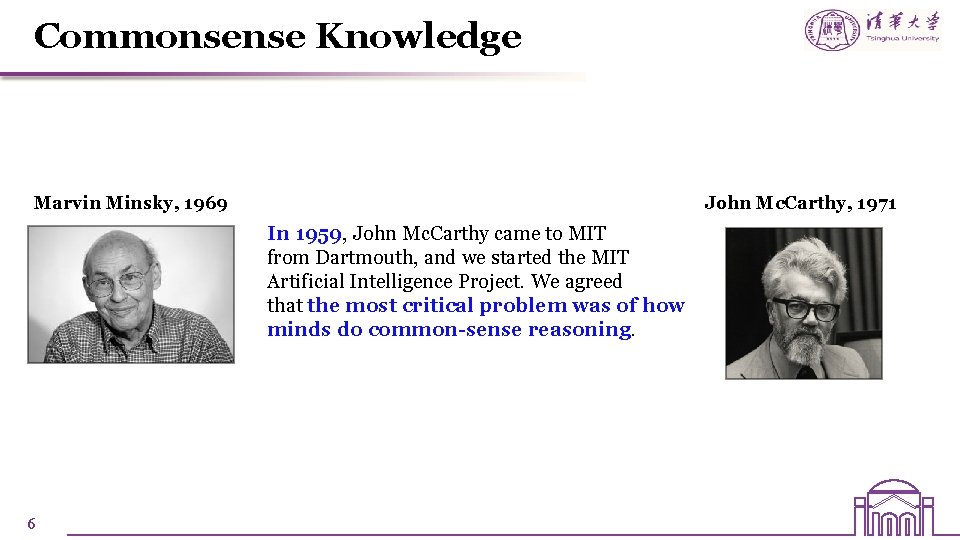
Commonsense Knowledge Marvin Minsky, 1969 John Mc. Carthy, 1971 In 1959, John Mc. Carthy came to MIT from Dartmouth, and we started the MIT Artificial Intelligence Project. We agreed that the most critical problem was of how minds do common-sense reasoning. 6
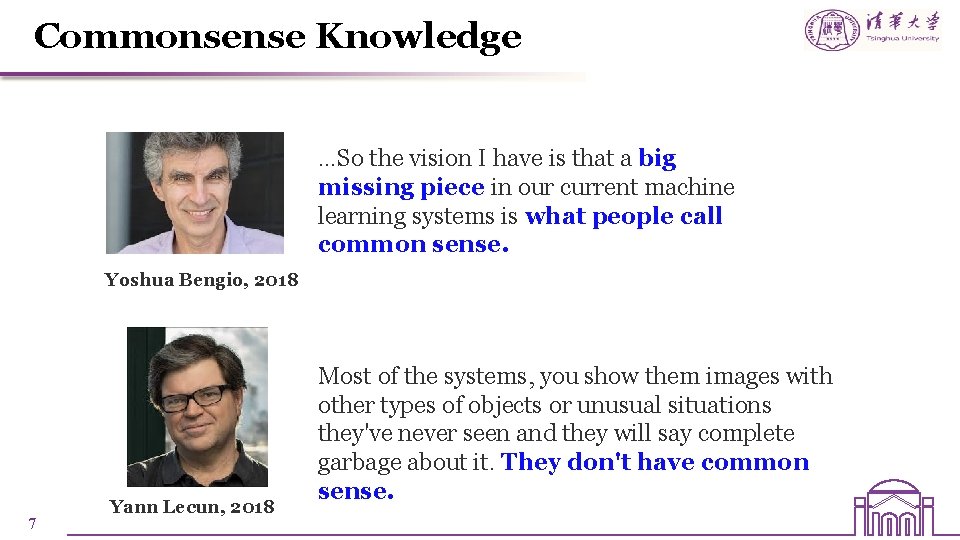
Commonsense Knowledge …So the vision I have is that a big missing piece in our current machine learning systems is what people call common sense. Yoshua Bengio, 2018 7 Yann Lecun, 2018 Most of the systems, you show them images with other types of objects or unusual situations they've never seen and they will say complete garbage about it. They don't have common sense.
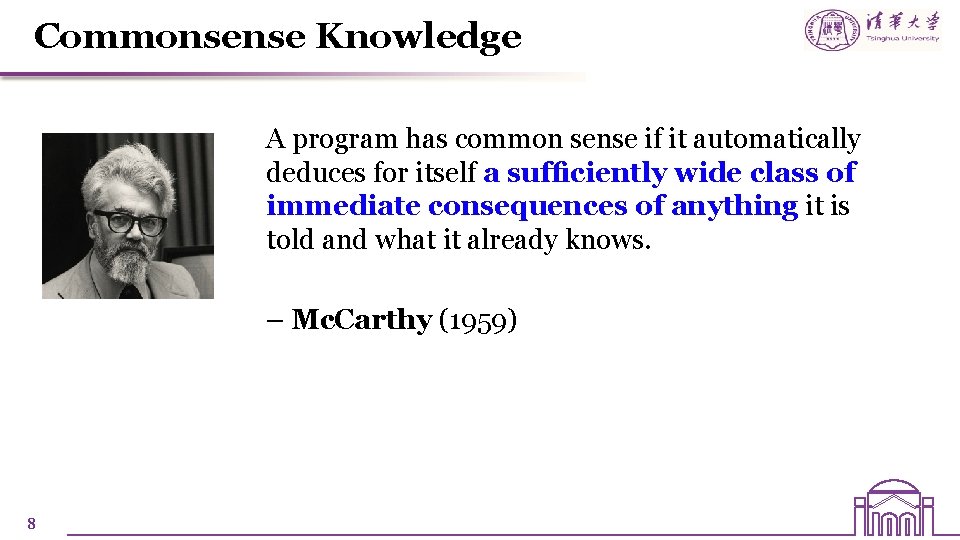
Commonsense Knowledge A program has common sense if it automatically deduces for itself a sufficiently wide class of immediate consequences of anything it is told and what it already knows. – Mc. Carthy (1959) 8
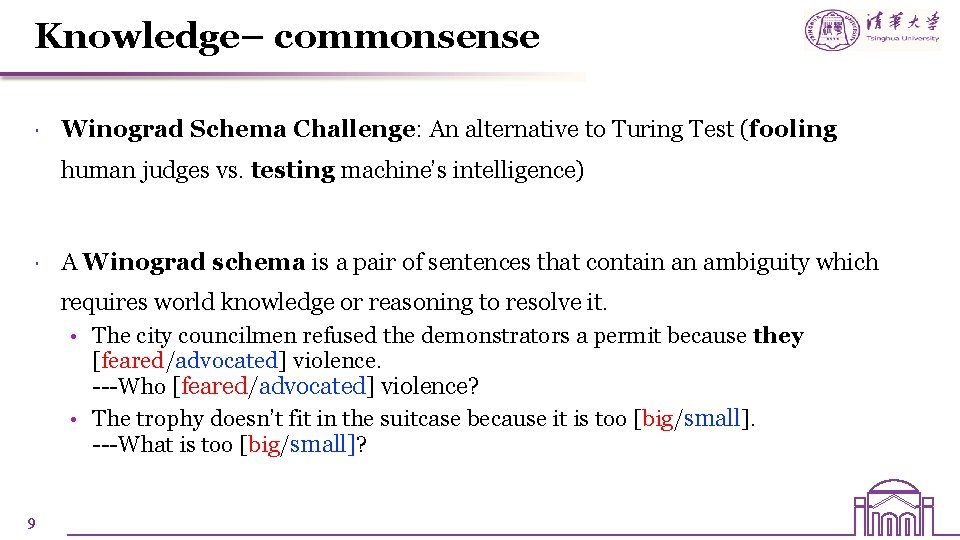
Knowledge– commonsense Winograd Schema Challenge: An alternative to Turing Test (fooling human judges vs. testing machine’s intelligence) A Winograd schema is a pair of sentences that contain an ambiguity which requires world knowledge or reasoning to resolve it. • The city councilmen refused the demonstrators a permit because they [feared/advocated] violence. ---Who [feared/advocated] violence? • The trophy doesn’t fit in the suitcase because it is too [big/small]. ---What is too [big/small]? 9
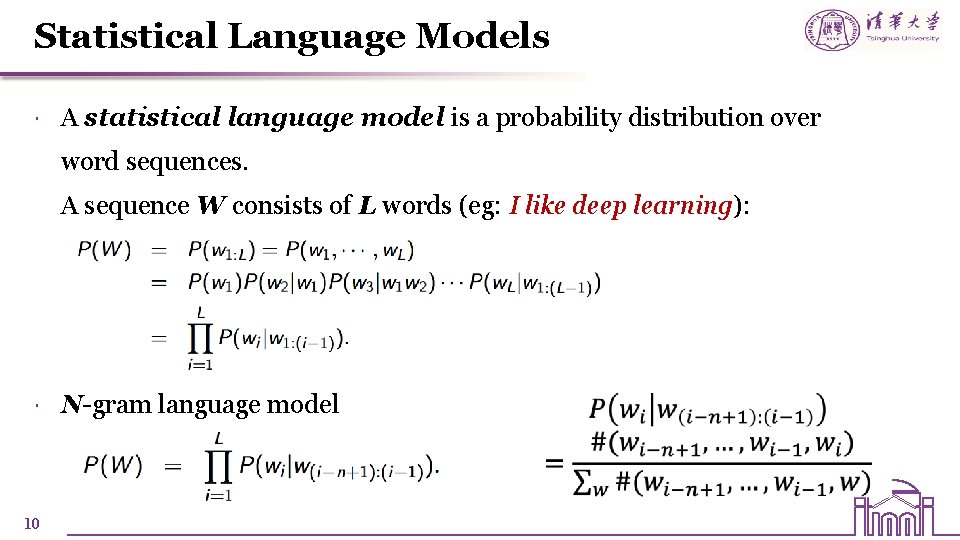
Statistical Language Models A statistical language model is a probability distribution over word sequences. A sequence W consists of L words (eg: I like deep learning): 10 N-gram language model
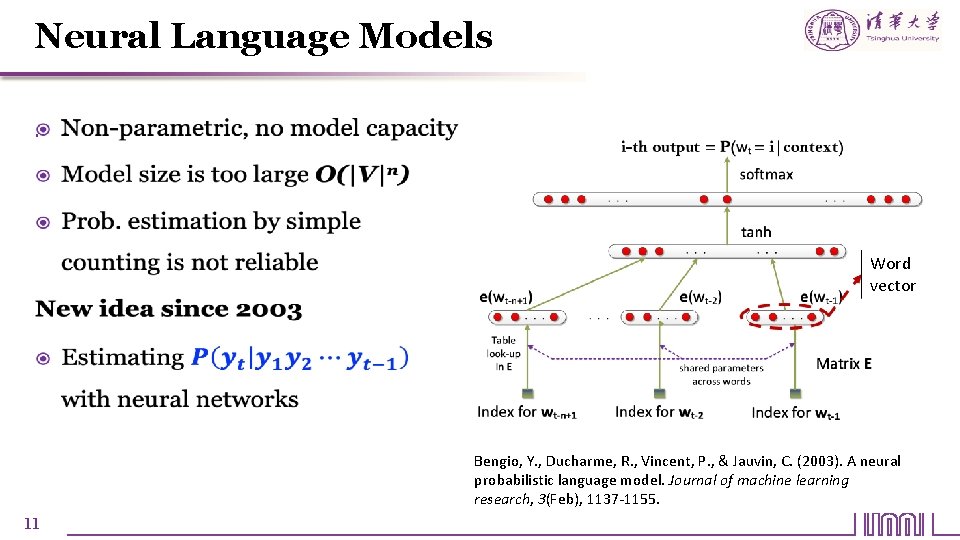
Neural Language Models Word vector Bengio, Y. , Ducharme, R. , Vincent, P. , & Jauvin, C. (2003). A neural probabilistic language model. Journal of machine learning research, 3(Feb), 1137 -1155. 11
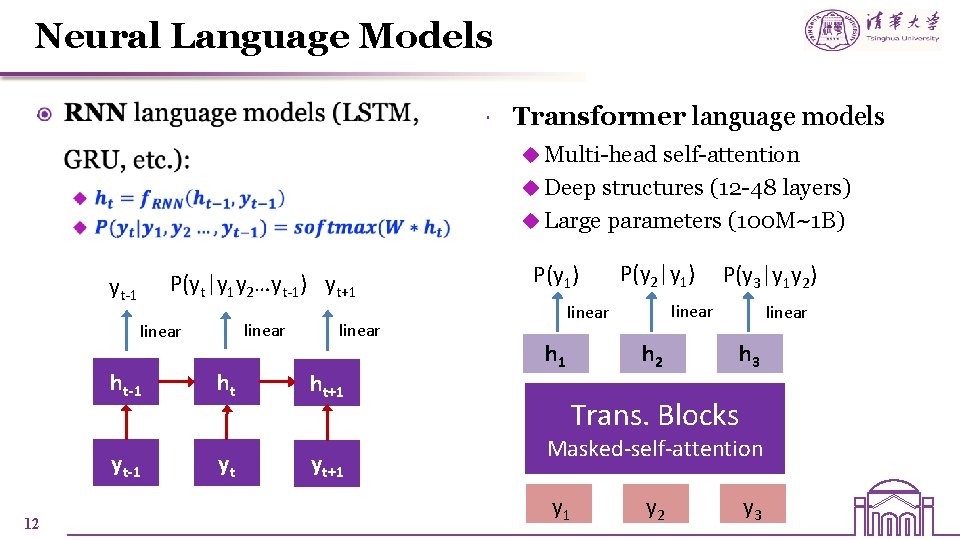
Neural Language Models Transformer language models u Multi-head self-attention u Deep structures (12 -48 layers) u Large parameters (100 M~1 B) P(yt|y 1 y 2…yt-1) yt+1 yt-1 linear ht-1 yt-1 12 ht yt linear ht+1 yt+1 P(y 1) P(y 2|y 1) linear h 1 P(y 3|y 1 y 2) h 2 linear h 3 Trans. Blocks Masked-self-attention y 1 y 2 y 3
Problems to be Answered RNN language model has commonsense/factual knowledge? 13 GPT language model has commonsense/factual knowledge?
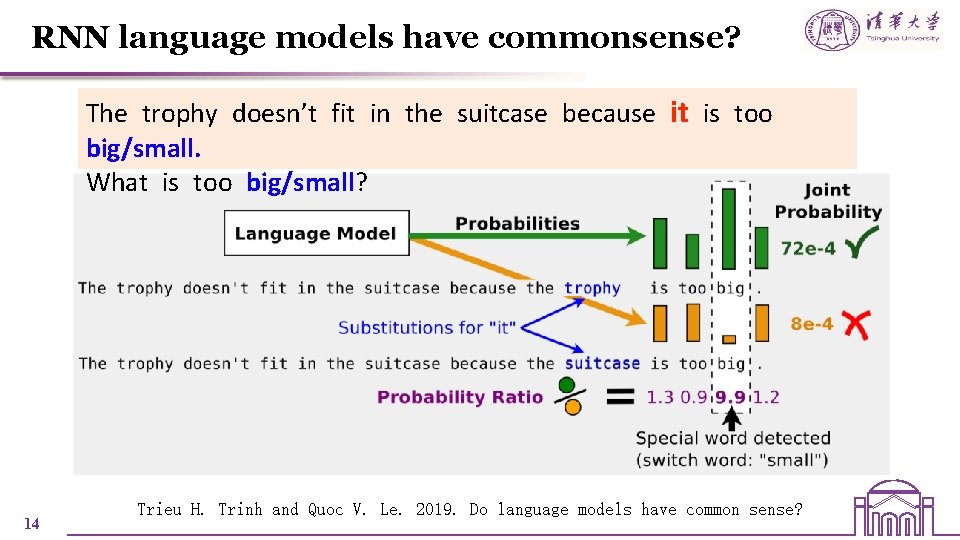
RNN language models have commonsense? The trophy doesn’t fit in the suitcase because it is too big/small. What is too big/small? 14 Trieu H. Trinh and Quoc V. Le. 2019. Do language models have common sense?
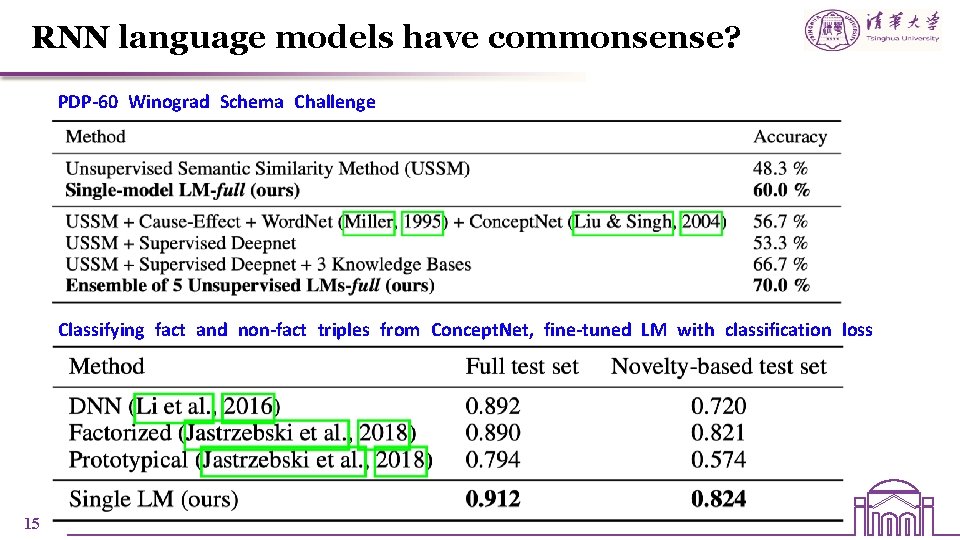
RNN language models have commonsense? PDP-60 Winograd Schema Challenge Classifying fact and non-fact triples from Concept. Net, fine-tuned LM with classification loss 15
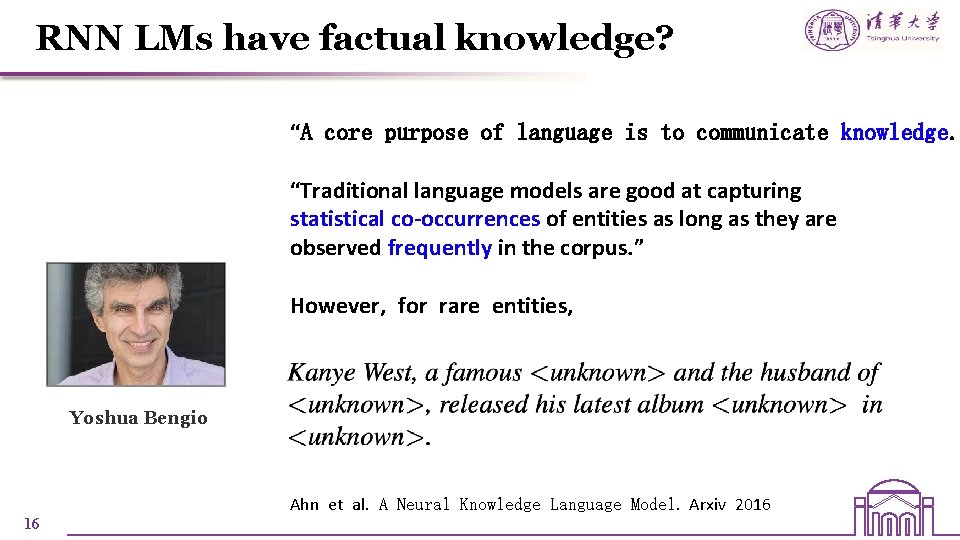
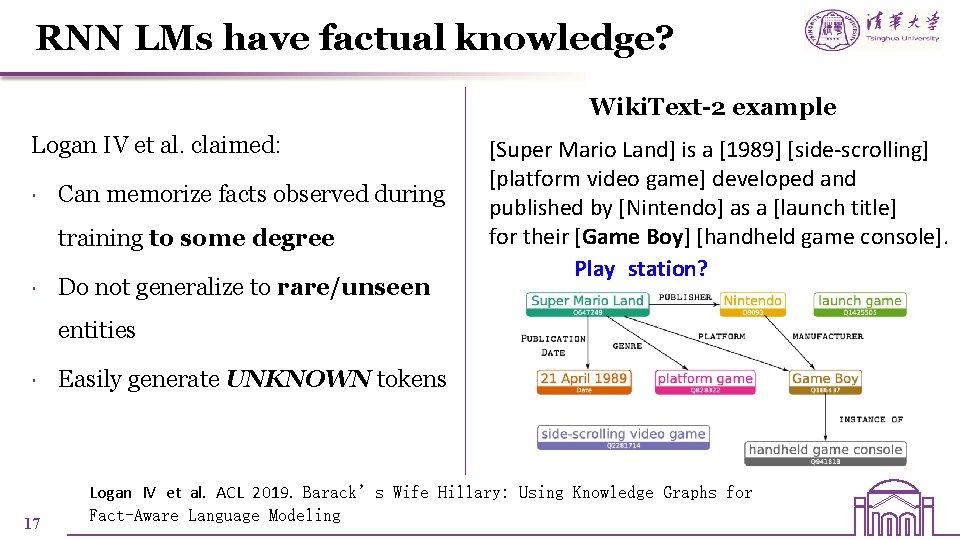
RNN LMs have factual knowledge? “A core purpose of language is to communicate knowledge. “Traditional language models are good at capturing statistical co-occurrences of entities as long as they are observed frequently in the corpus. ” However, for rare entities, Yoshua Bengio 16 Ahn et al. A Neural Knowledge Language Model. Arxiv 2016
RNN LMs have factual knowledge? Wiki. Text-2 example Logan IV et al. claimed: Can memorize facts observed during training to some degree Do not generalize to rare/unseen [Super Mario Land] is a [1989] [side-scrolling] [platform video game] developed and published by [Nintendo] as a [launch title] for their [Game Boy] [handheld game console]. Play station? entities 17 Easily generate UNKNOWN tokens Logan IV et al. ACL 2019. Barack’s Wife Hillary: Using Knowledge Graphs for Fact-Aware Language Modeling
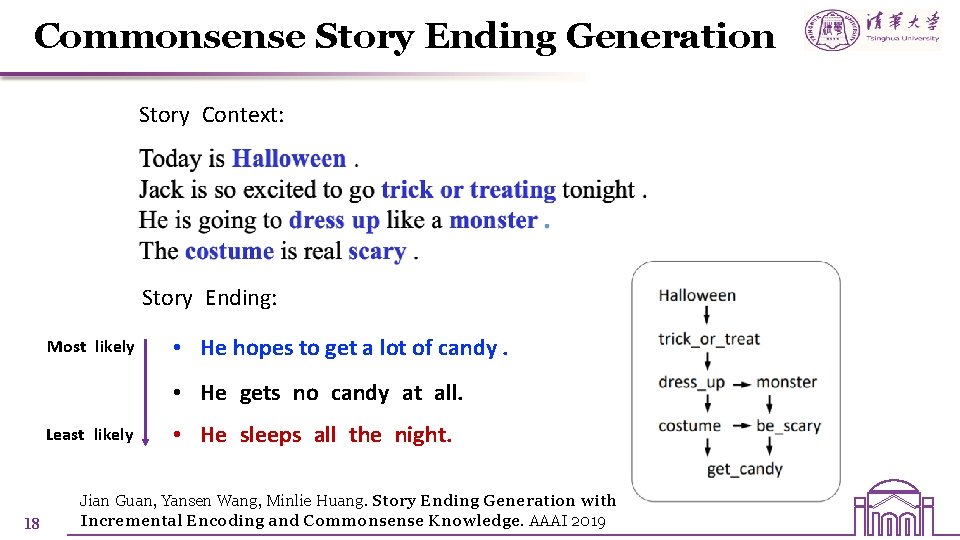
Commonsense Story Ending Generation Story Context: Story Ending: Most likely • He hopes to get a lot of candy. • He gets no candy at all. Least likely 18 • He sleeps all the night. Jian Guan, Yansen Wang, Minlie Huang. Story Ending Generation with Incremental Encoding and Commonsense Knowledge. AAAI 2019
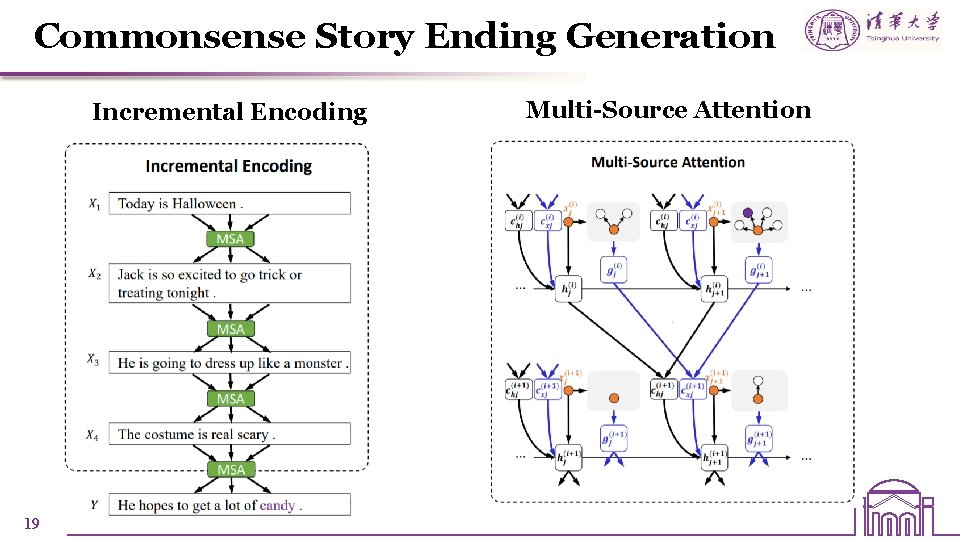
Commonsense Story Ending Generation Incremental Encoding 19 Multi-Source Attention
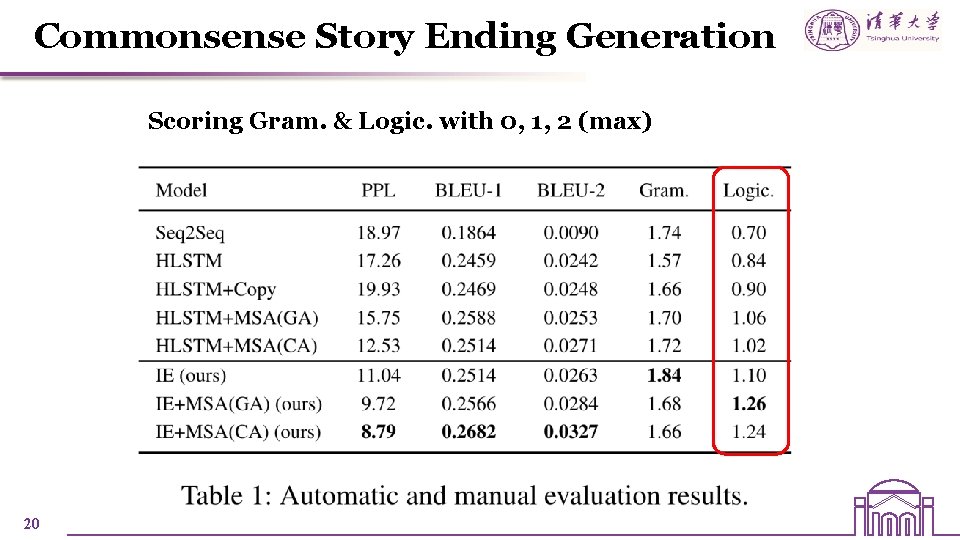
Commonsense Story Ending Generation Scoring Gram. & Logic. with 0, 1, 2 (max) 20
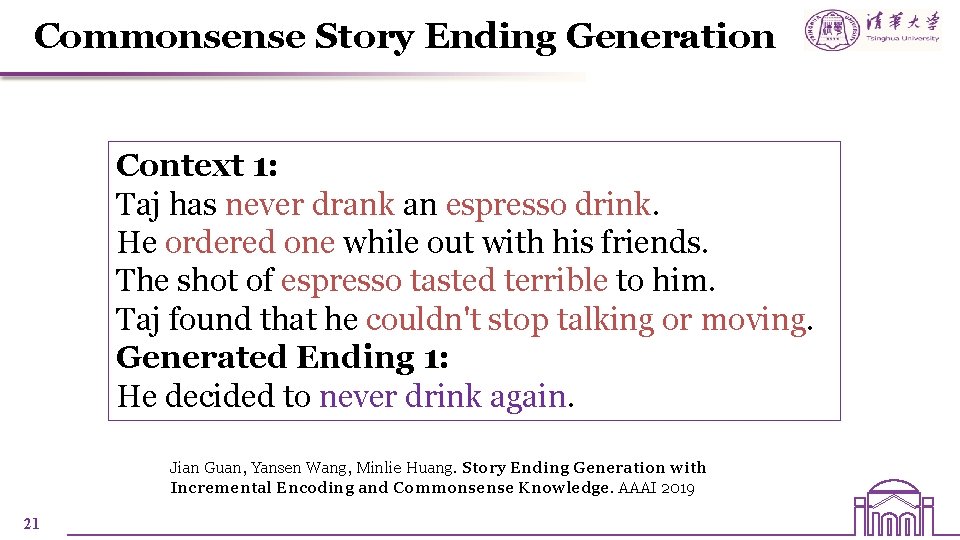
Commonsense Story Ending Generation Context 1: Taj has never drank an espresso drink. He ordered one while out with his friends. The shot of espresso tasted terrible to him. Taj found that he couldn't stop talking or moving. Generated Ending 1: He decided to never drink again. Jian Guan, Yansen Wang, Minlie Huang. Story Ending Generation with Incremental Encoding and Commonsense Knowledge. AAAI 2019 21
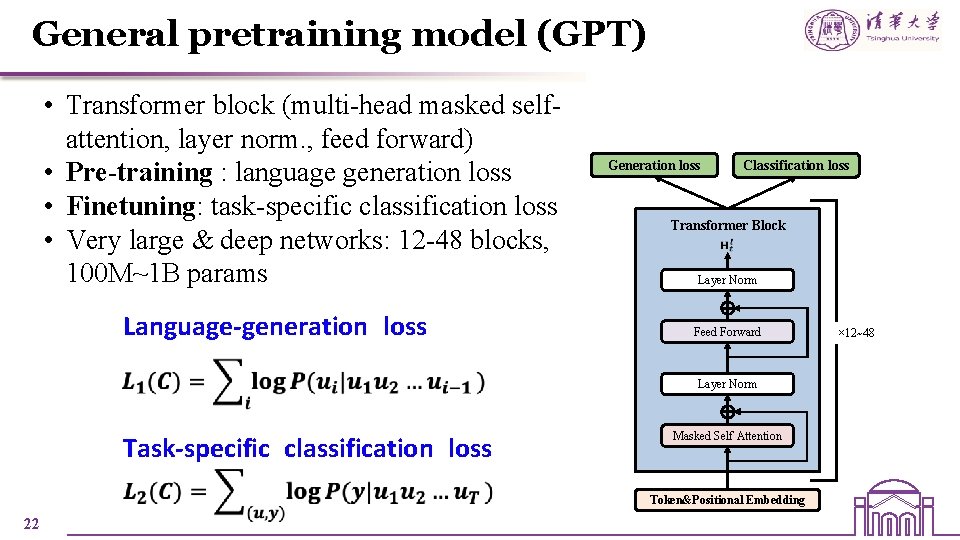
General pretraining model (GPT) • Transformer block (multi-head masked selfattention, layer norm. , feed forward) • Pre-training : language generation loss • Finetuning: task-specific classification loss • Very large & deep networks: 12 -48 blocks, 100 M~1 B params Language-generation loss Task-specific classification loss Generation loss Classification loss Transformer Block Layer Norm Feed Forward Layer Norm Masked Self Attention Token&Positional Embedding 22 × 12~48
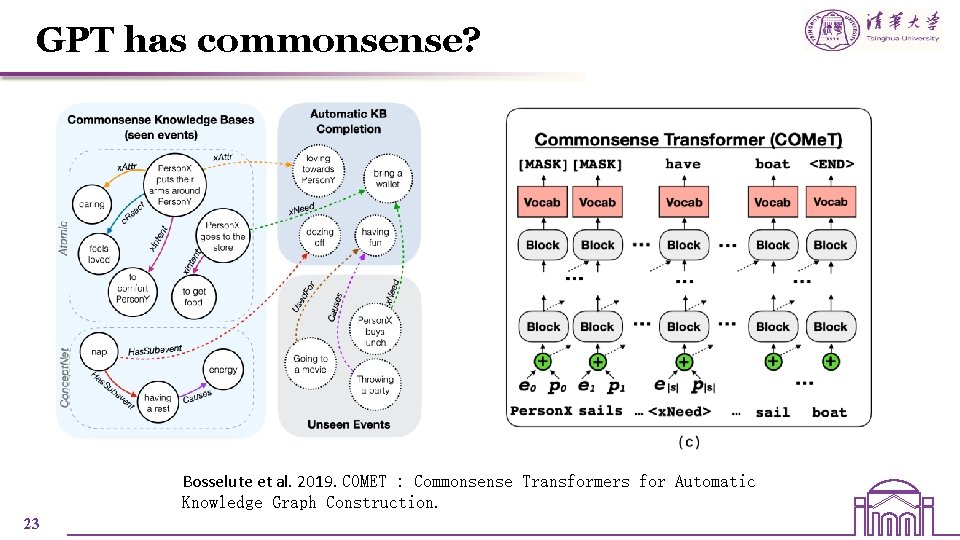
GPT has commonsense? Bosselute et al. 2019. COMET : Commonsense Transformers for Automatic Knowledge Graph Construction. 23
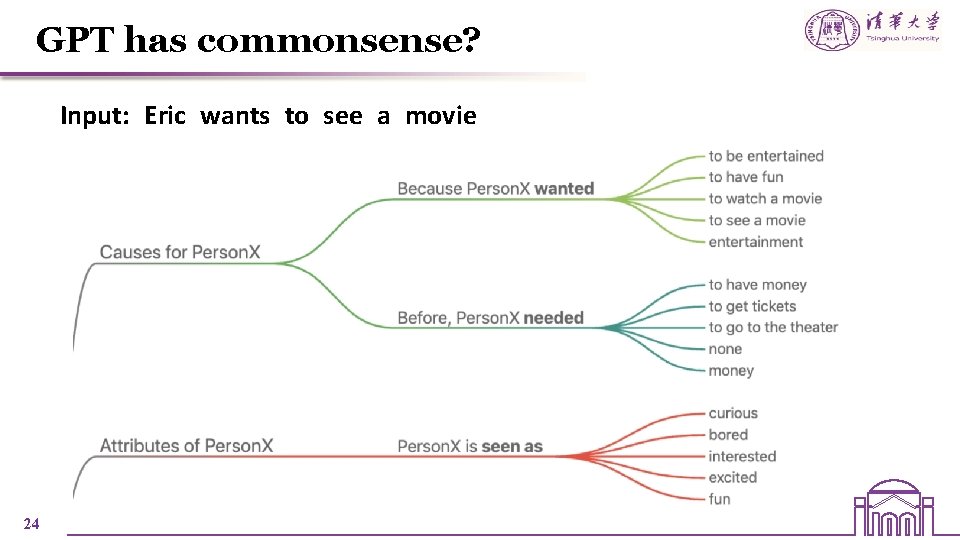
GPT has commonsense? Input: Eric wants to see a movie 24
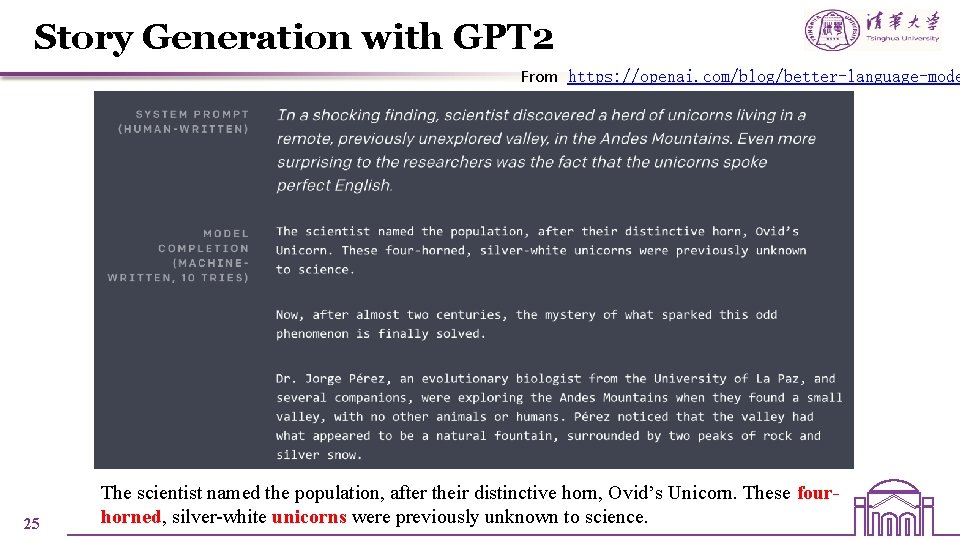
Story Generation with GPT 2 From https: //openai. com/blog/better-language-mode 25 The scientist named the population, after their distinctive horn, Ovid’s Unicorn. These fourhorned, silver-white unicorns were previously unknown to science.
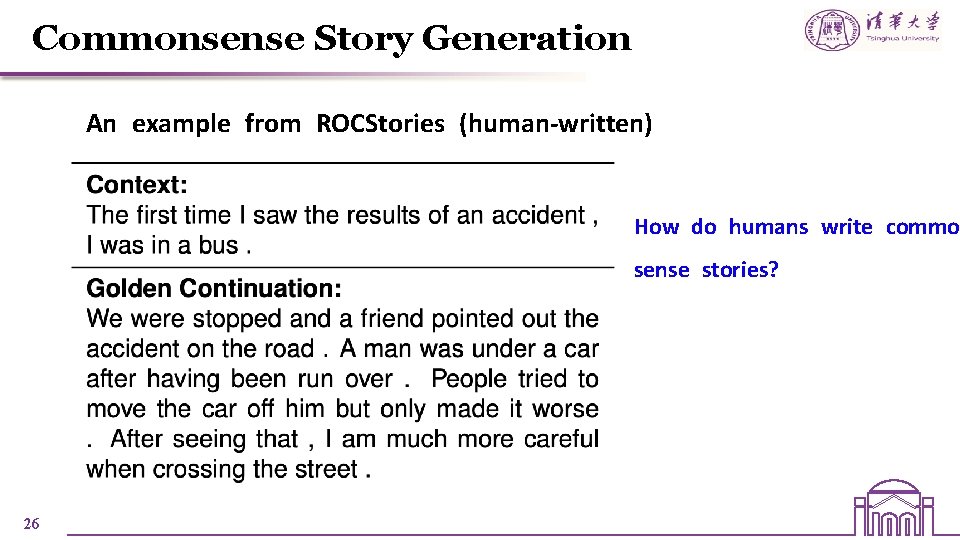
Commonsense Story Generation An example from ROCStories (human-written) How do humans write commo sense stories? 26
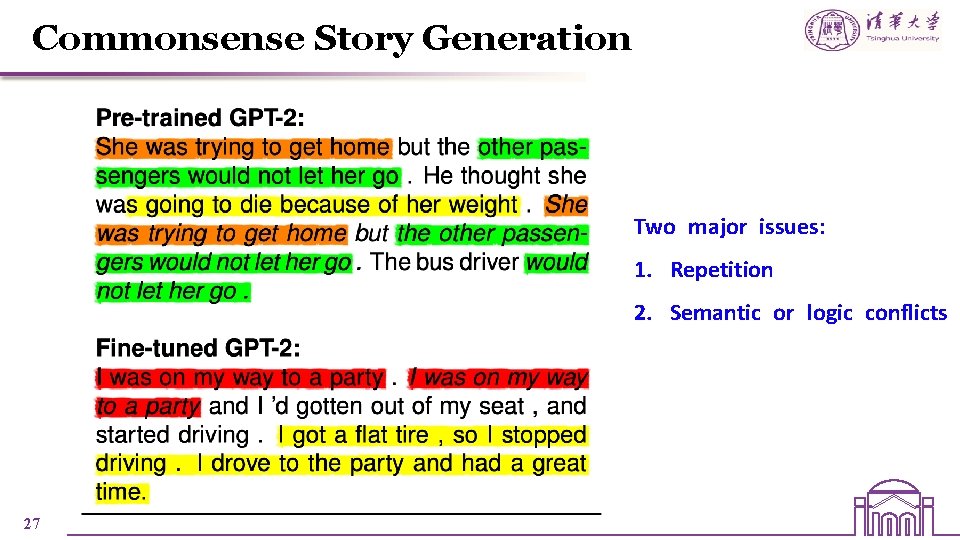
Commonsense Story Generation Two major issues: 1. Repetition 2. Semantic or logic conflicts 27
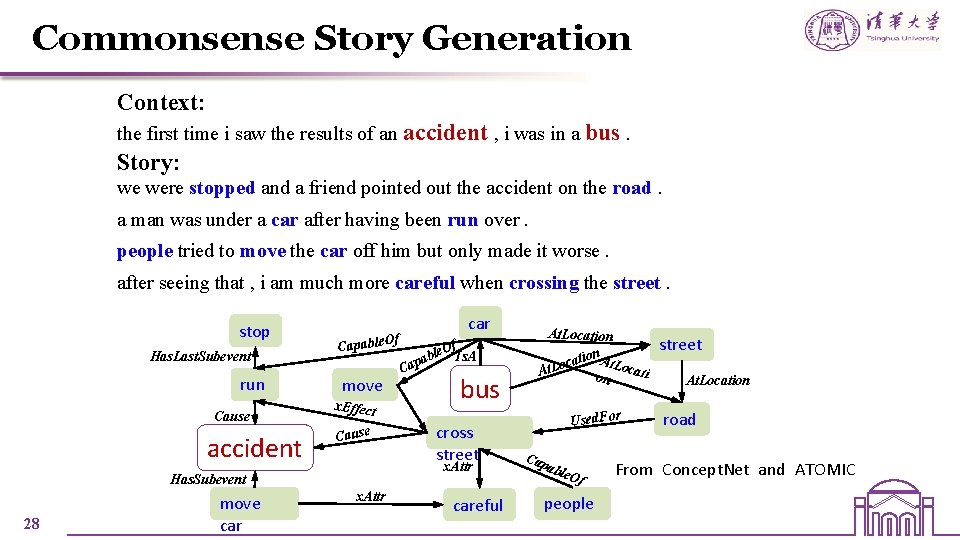
Commonsense Story Generation Context: the first time i saw the results of an accident , i was in a bus. Story: we were stopped and a friend pointed out the accident on the road. a man was under a car after having been run over. people tried to move the car off him but only made it worse. after seeing that , i am much more careful when crossing the street. stop Has. Last. Subevent run Cause accident Ca pable. Of move x. Effect Cause 28 f le. O Is. A b a Cap bus cross street x. Attr Has. Subevent move car x. Attr careful At. Location. At. L a c o ocat At. L i on Used. For Cap abl e. O f people street At. Location road From Concept. Net and ATOMIC
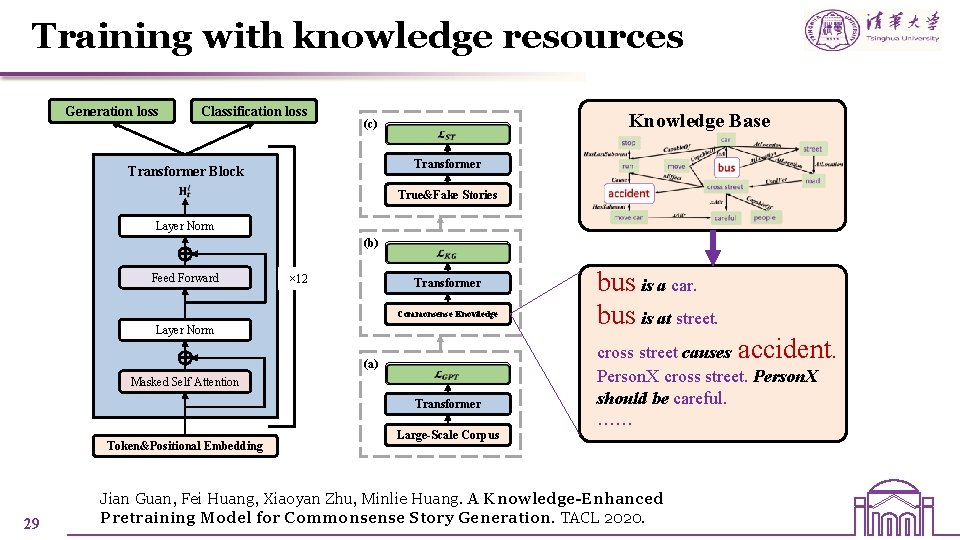
Training with knowledge resources Generation loss Classification loss (c) Knowledge Base Transformer Block True&Fake Stories Layer Norm (b) Feed Forward × 12 Transformer Commonsense Knowledge Layer Norm (a) Masked Self Attention Transformer Token&Positional Embedding 29 Large-Scale Corpus bus is a car. bus is at street. cross street causes accident. Person. X cross street. Person. X should be careful. …… Jian Guan, Fei Huang, Xiaoyan Zhu, Minlie Huang. A Knowledge-Enhanced Pretraining Model for Commonsense Story Generation. TACL 2020.
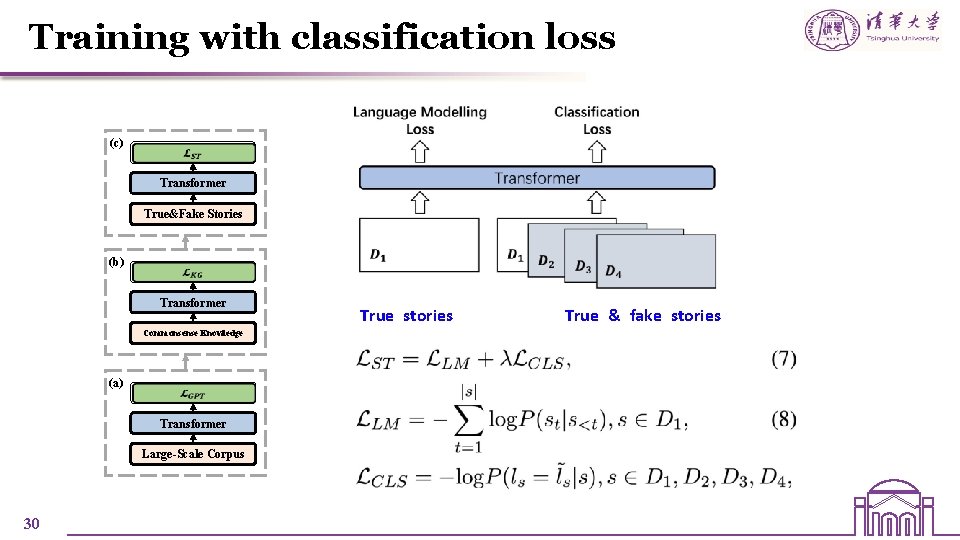
Training with classification loss (c) Transformer True&Fake Stories (b) Transformer Commonsense Knowledge (a) Transformer Large-Scale Corpus 30 True stories True & fake stories
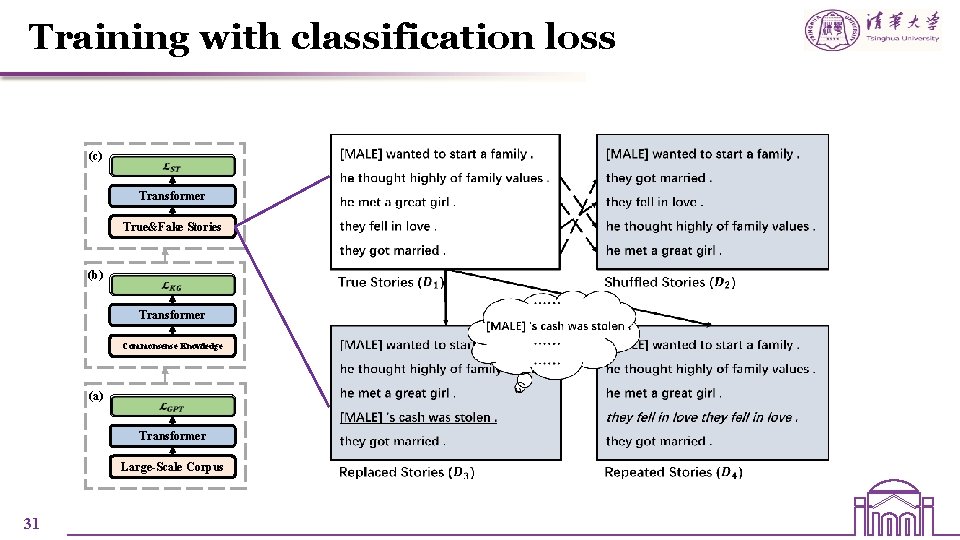
Training with classification loss (c) Transformer True&Fake Stories (b) Transformer Commonsense Knowledge (a) Transformer Large-Scale Corpus 31
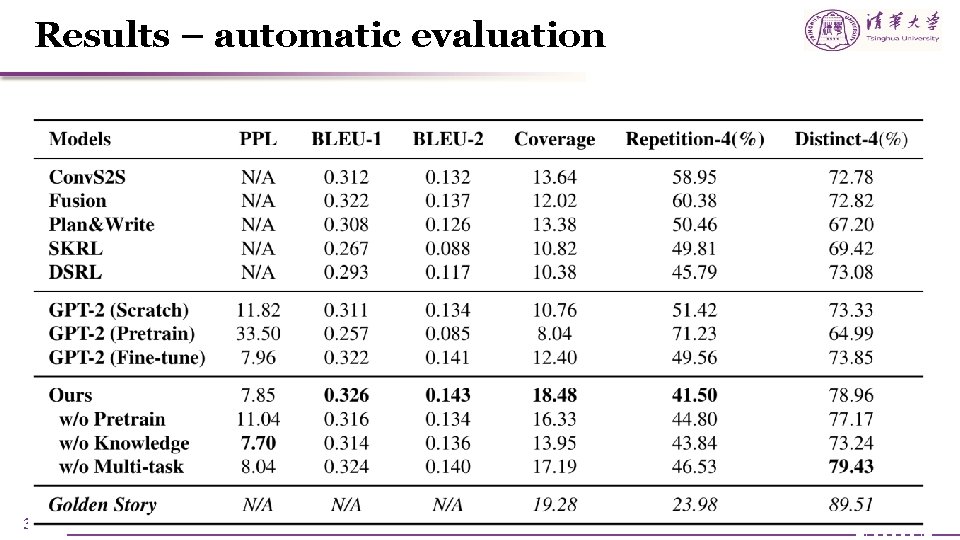
Results – automatic evaluation 32
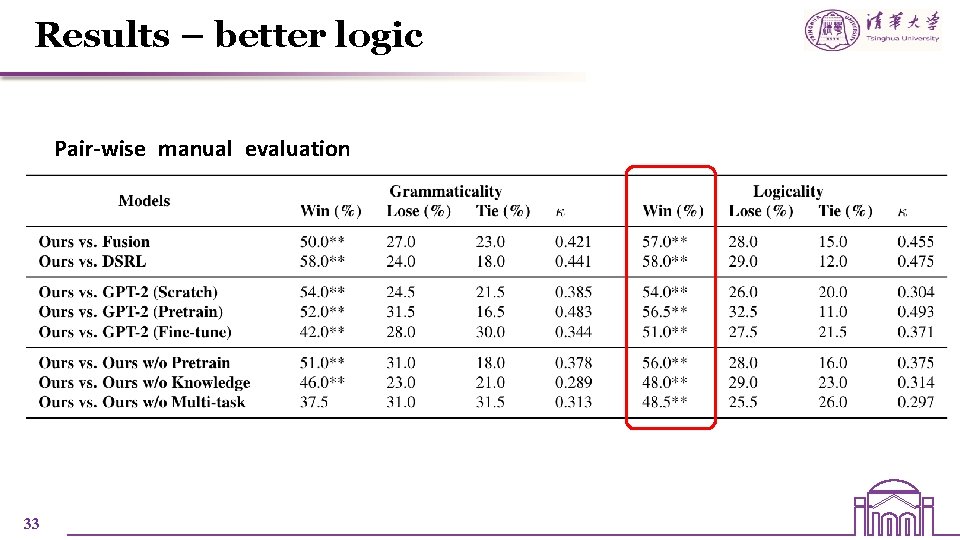
Results – better logic Pair-wise manual evaluation 33
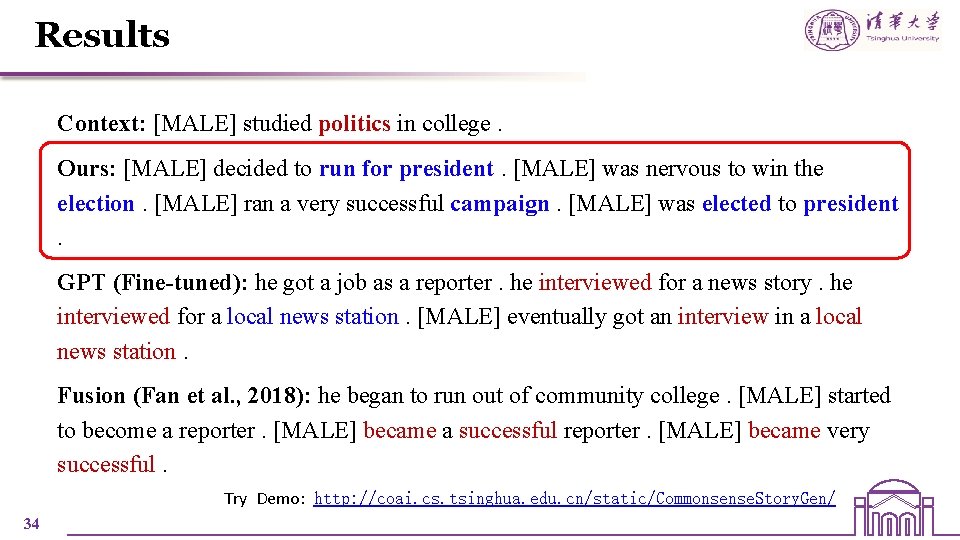
Results Context: [MALE] studied politics in college. Ours: [MALE] decided to run for president. [MALE] was nervous to win the election. [MALE] ran a very successful campaign. [MALE] was elected to president . GPT (Fine-tuned): he got a job as a reporter. he interviewed for a news story. he interviewed for a local news station. [MALE] eventually got an interview in a local news station. Fusion (Fan et al. , 2018): he began to run out of community college. [MALE] started to become a reporter. [MALE] became a successful reporter. [MALE] became very successful. Try Demo: http: //coai. cs. tsinghua. edu. cn/static/Commonsense. Story. Gen/ 34
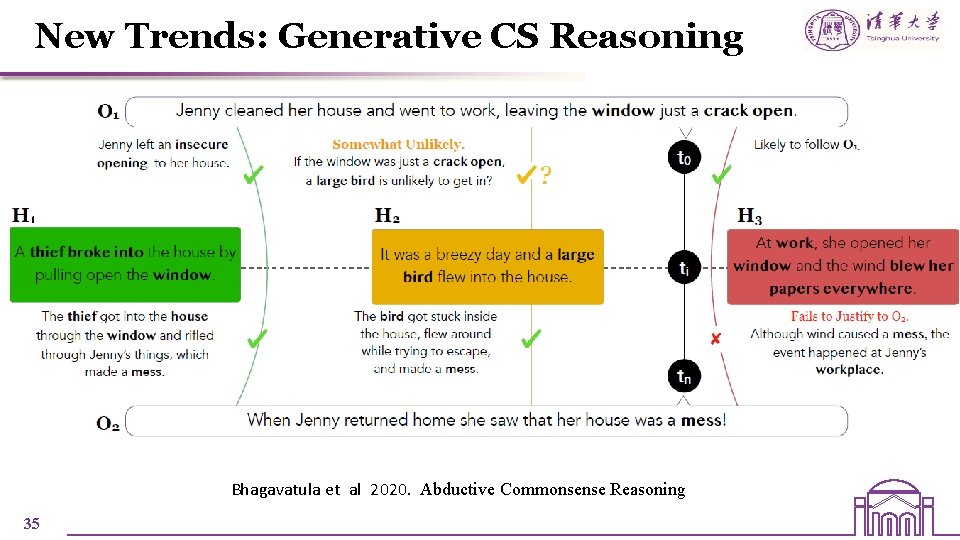
New Trends: Generative CS Reasoning Bhagavatula et al 2020. Abductive Commonsense Reasoning 35
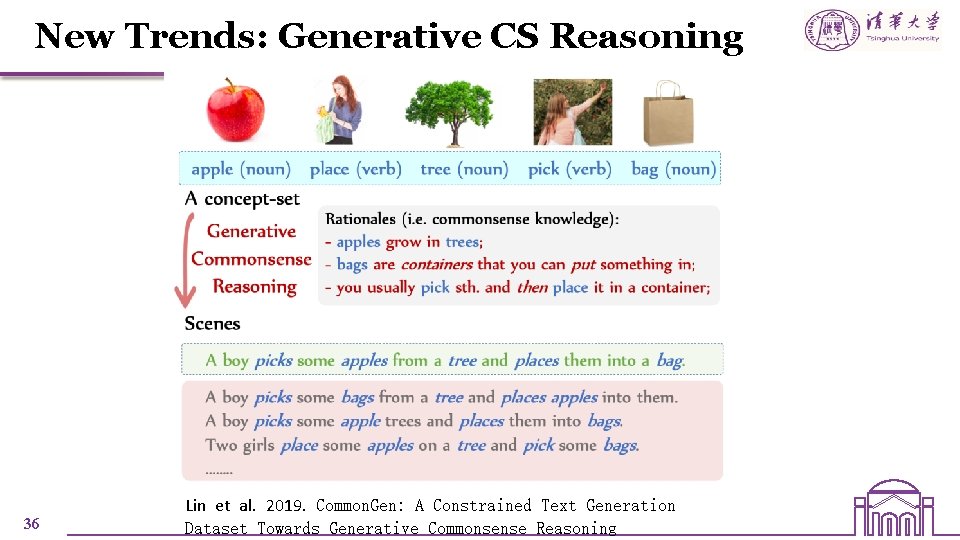
New Trends: Generative CS Reasoning 36 Lin et al. 2019. Common. Gen: A Constrained Text Generation Dataset Towards Generative Commonsense Reasoning
Summary Commonsense reasoning in question answering, reading comprehension, language inference Commonsense in language generation (dialog/story generation) Generative commonsense reasoning 37
Recent papers from Co. AI group Hao Zhou, Tom Yang, Minlie Huang, Haizhou Zhao, Jingfang Xu, Xiaoyan Zhu. Commonsense Knowledge Aware Conversation Generation with Graph Attention. IJCAI-ECAI 2018, Stockholm, Sweden. [IJCAI 2018 Distinguished Paper] Jian Guan, Yansen Wang, Minlie Huang. Story Ending Generation with Incremental Encoding and Commonsense Knowledge. AAAI 2019, Honolulu, Hawaii, USA Jian Guan, Fei Huang, Zhihao Zhao, Minlie Huang. A Knowledge-Enhanced Pretraining Model for Commonsense Story Generation. TACL 2020 38
Thanks for Your Attention Contact: u Minlie Huang, Tsinghua University u aihuang@tsinghua. edu. cn u http: //coai. cs. tsinghua. edu. cn/hml u http: //coai. cs. tsinghua. edu. cn/dialtk 39