
Common Stock Valuation Chapter 10 Jones Investments Analysis
- Slides: 23
Common Stock Valuation Chapter 10 Jones, Investments: Analysis and Management
Fundamental Analysis n Present value approach – – n Capitalization of expected income Intrinsic value based on the discounted value of the expected stream of cash flows Multiple of earnings approach – – Valuation relative to a financial performance measure Justified P/E ratio 2
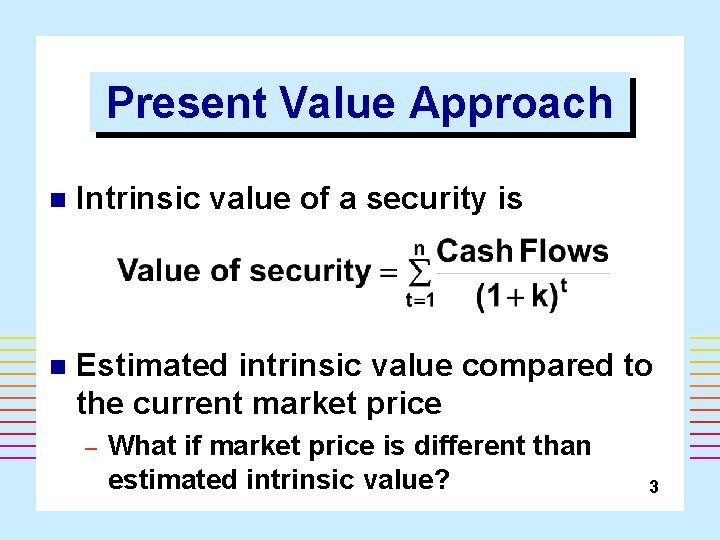
Present Value Approach n Intrinsic value of a security is n Estimated intrinsic value compared to the current market price – What if market price is different than estimated intrinsic value? 3
Required Inputs n Discount rate – – n Required rate of return: minimum expected rate to induce purchase The opportunity cost of dollars used for investment Expected cash flows – Stream of dividends or other cash payouts over the life of the investment 4
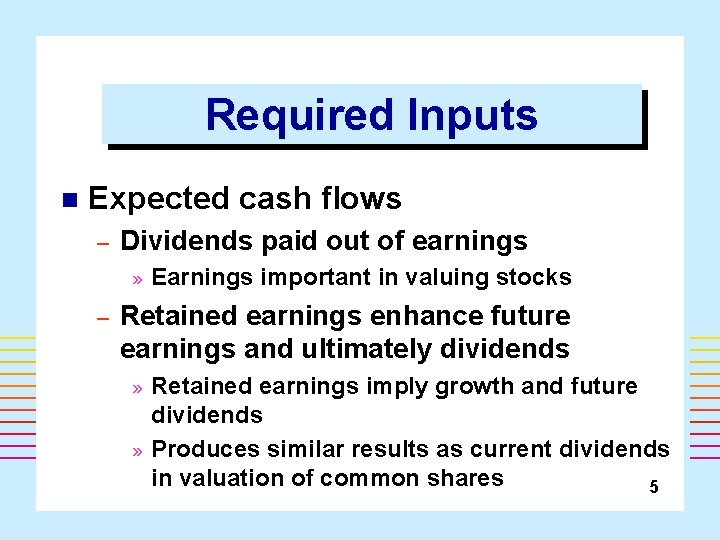
Required Inputs n Expected cash flows – Dividends paid out of earnings » – Earnings important in valuing stocks Retained earnings enhance future earnings and ultimately dividends » » Retained earnings imply growth and future dividends Produces similar results as current dividends in valuation of common shares 5
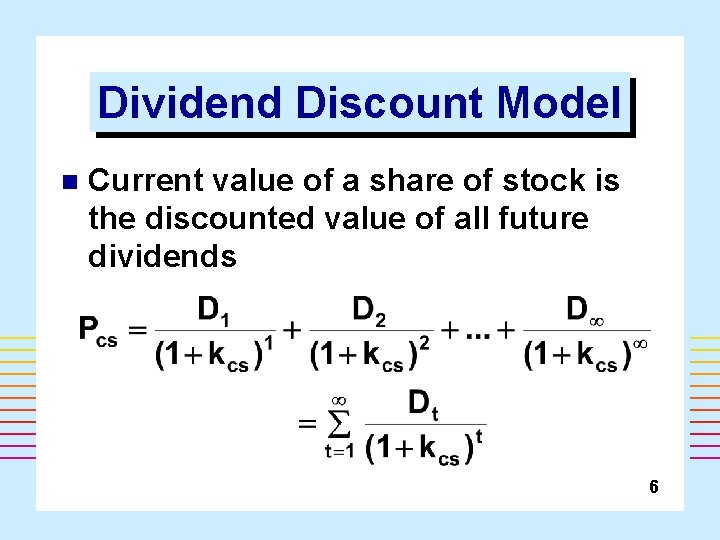
Dividend Discount Model n Current value of a share of stock is the discounted value of all future dividends 6
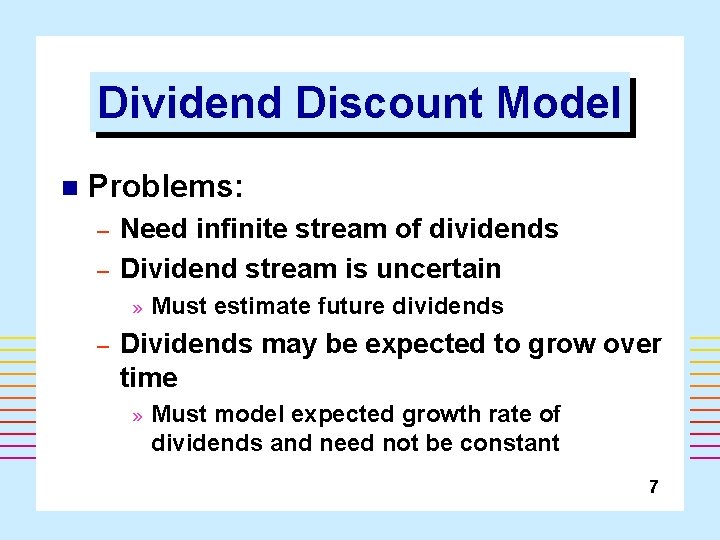
Dividend Discount Model n Problems: – – Need infinite stream of dividends Dividend stream is uncertain » – Must estimate future dividends Dividends may be expected to grow over time » Must model expected growth rate of dividends and need not be constant 7
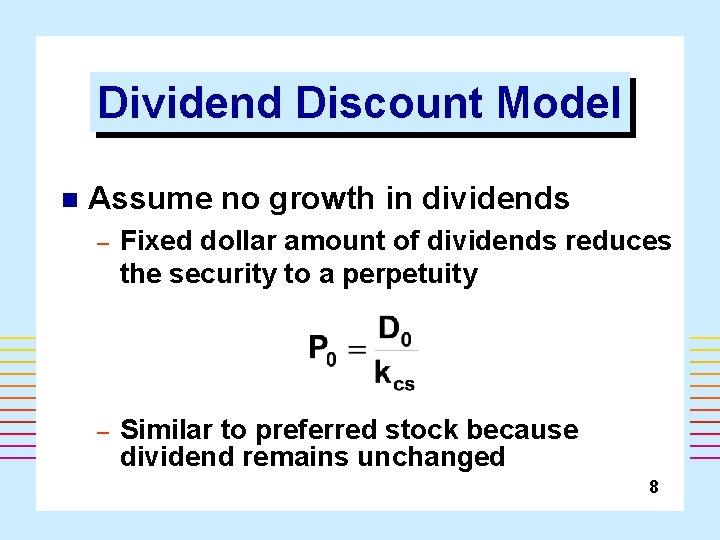
Dividend Discount Model n Assume no growth in dividends – Fixed dollar amount of dividends reduces the security to a perpetuity – Similar to preferred stock because dividend remains unchanged 8
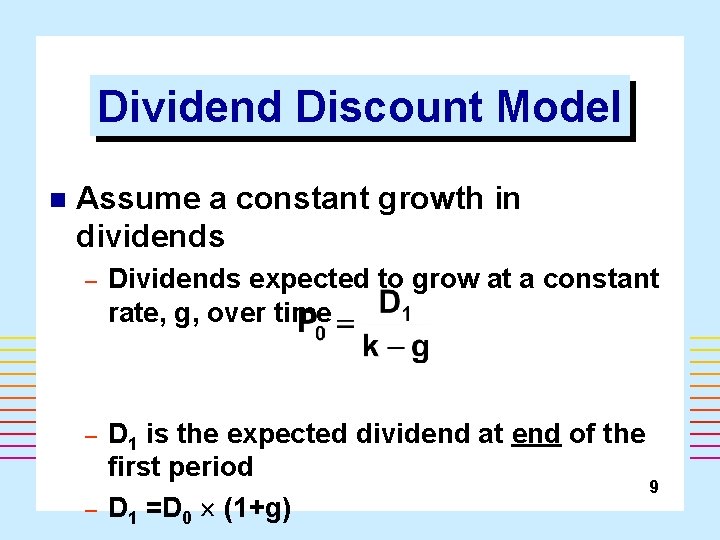
Dividend Discount Model n Assume a constant growth in dividends – Dividends expected to grow at a constant rate, g, over time – D 1 is the expected dividend at end of the first period 9 D 1 =D 0 (1+g) –
Dividend Discount Model n Implications of constant growth – – Stock prices grow at the same rate as the dividends Stock total returns grow at the required rate of return » – Growth rate in price plus growth rate in dividends equals k, the required rate of return A lower required return or a higher expected growth in dividends raises prices 10
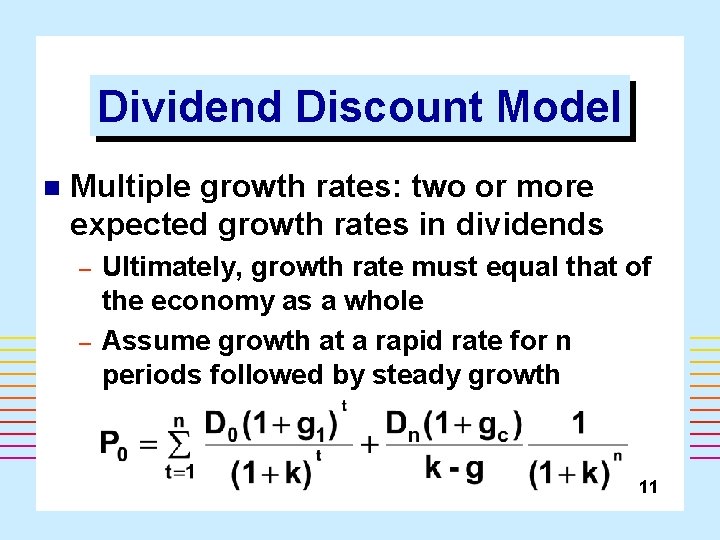
Dividend Discount Model n Multiple growth rates: two or more expected growth rates in dividends – – Ultimately, growth rate must equal that of the economy as a whole Assume growth at a rapid rate for n periods followed by steady growth 11
Dividend Discount Model n Multiple growth rates – – First present value covers the period of super-normal (or sub-normal) growth Second present value covers the period of stable growth » » Expected price uses constant-growth model as of the end of super- (sub-) normal period Value at n must be discounted to time period zero 12
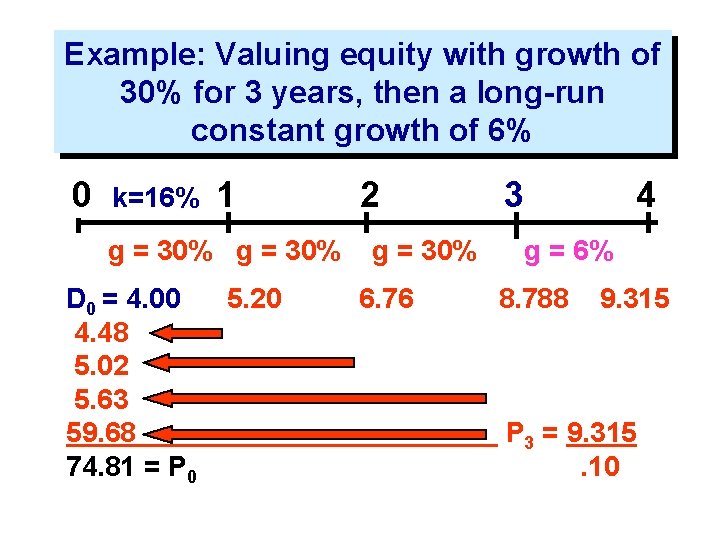
Example: Valuing equity with growth of 30% for 3 years, then a long-run constant growth of 6% 0 k=16% 1 g = 30% D 0 = 4. 00 4. 48 5. 02 5. 63 59. 68 74. 81 = P 0 5. 20 2 g = 30% 6. 76 3 4 g = 6% 8. 788 9. 315 P 3 = 9. 315. 10
What About Capital Gains? n Is the dividend discount model only capable of handling dividends? – n Capital gains are also important Price received in future reflects expectations of dividends from that point forward – Discounting dividends or a combination of dividends and price produces same results 14
Intrinsic Value n “Fair” value based on the capitalization of income process – n The objective of fundamental analysis If intrinsic value >(<) current market price, hold or purchase (avoid or sell) because the asset is undervalued (overvalued) – Decision will always involve estimates 15
P/E Ratio or Earnings Multiplier Approach Alternative approach often used by security analysts n P/E ratio is the strength with which investors value earnings as expressed in stock price n – – Divide the current market price of the stock by the latest 12 -month earnings Price paid for each $1 of earnings 16
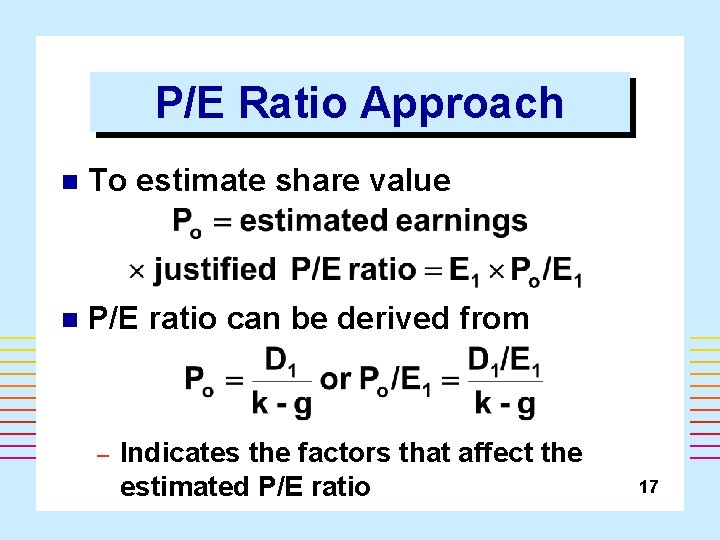
P/E Ratio Approach n To estimate share value n P/E ratio can be derived from – Indicates the factors that affect the estimated P/E ratio 17
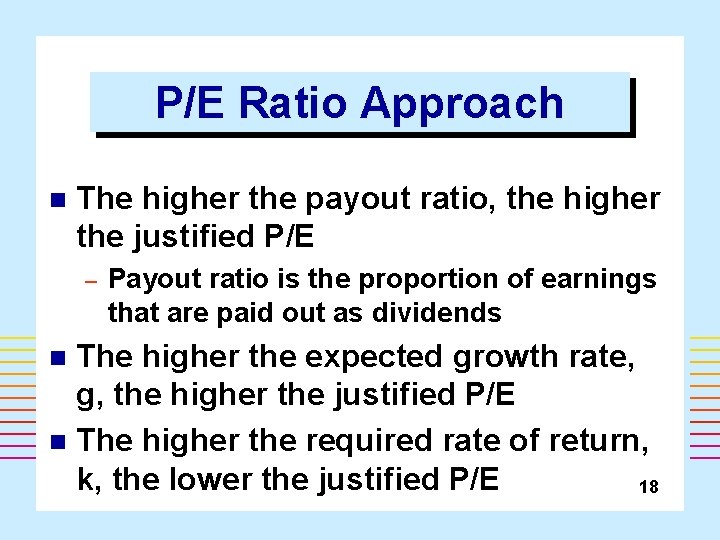
P/E Ratio Approach n The higher the payout ratio, the higher the justified P/E – Payout ratio is the proportion of earnings that are paid out as dividends The higher the expected growth rate, g, the higher the justified P/E n The higher the required rate of return, k, the lower the justified P/E 18 n
Understanding the P/E Ratio n Can firms increase payout ratio to increase market price? – n Does rapid growth affect the riskiness of earnings? – – n Will future growth prospects be affected? Will the required return be affected? Are some growth factors more desirable than others? P/E ratios reflect expected growth and 19 risk
P/E Ratios and Interest Rates n A P/E ratio reflects investor optimism and pessimism – Related to the required rate of return As interest rates increase, required rates of return on all securities generally increase n P/E ratios and interest rates are inversely related n 20
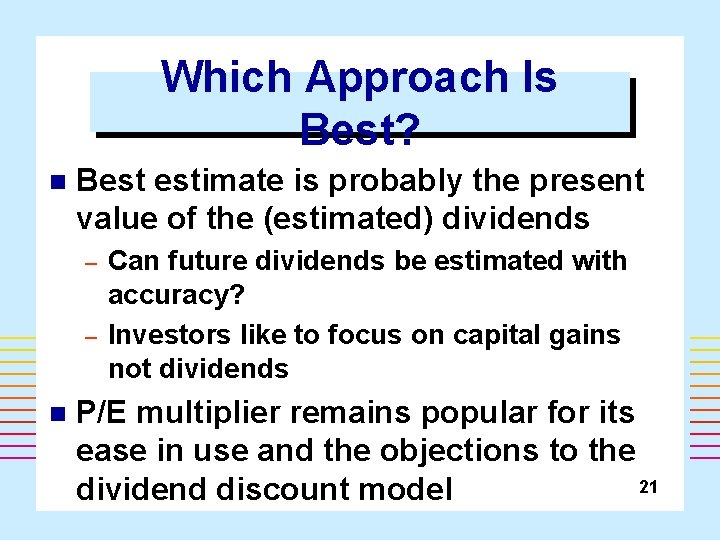
Which Approach Is Best? n Best estimate is probably the present value of the (estimated) dividends – – n Can future dividends be estimated with accuracy? Investors like to focus on capital gains not dividends P/E multiplier remains popular for its ease in use and the objections to the 21 dividend discount model
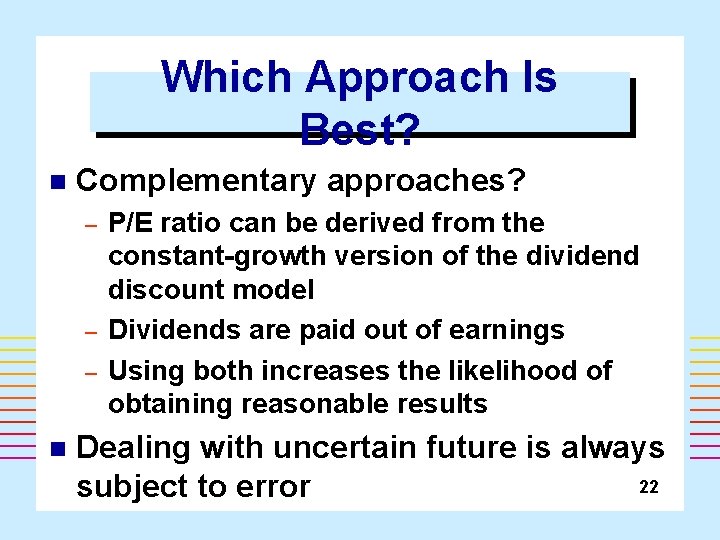
Which Approach Is Best? n Complementary approaches? – – – n P/E ratio can be derived from the constant-growth version of the dividend discount model Dividends are paid out of earnings Using both increases the likelihood of obtaining reasonable results Dealing with uncertain future is always 22 subject to error
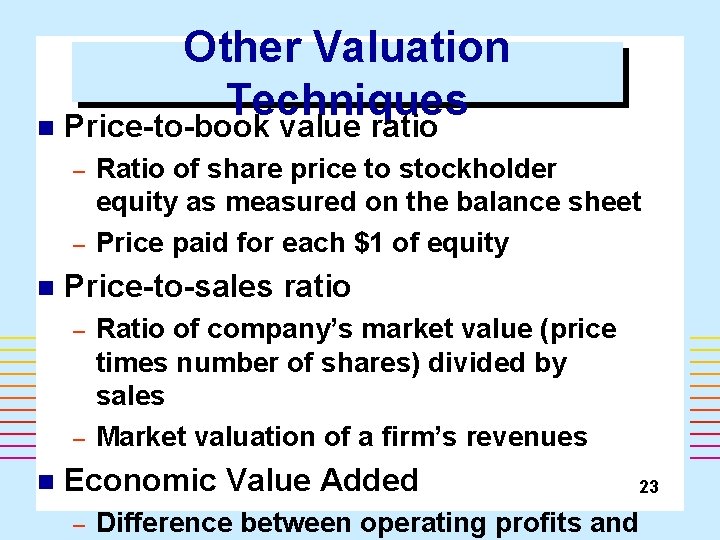
Other Valuation Techniques n Price-to-book value ratio – – n Price-to-sales ratio – – n Ratio of share price to stockholder equity as measured on the balance sheet Price paid for each $1 of equity Ratio of company’s market value (price times number of shares) divided by sales Market valuation of a firm’s revenues Economic Value Added – 23 Difference between operating profits and