
Common Problems in Law Enforcement Principles of LPSCS
Common Problems in Law Enforcement Principles of LPSCS

2
Copyright and Terms of Service Copyright © Texas Education Agency, 2011. These materials are copyrighted © and trademarked ™ as the property of the Texas Education Agency (TEA) and may not be reproduced without the express written permission of TEA, except under the following conditions: 1) Texas public school districts, charter schools, and Education Service Centers may reproduce and use copies of the Materials and Related Materials for the districts’ and schools’ educational use without obtaining permission from TEA. 2) Residents of the state of Texas may reproduce and use copies of the Materials and Related Materials for individual personal use only, without obtaining written permission of TEA. 3) Any portion reproduced must be reproduced in its entirety and remain unedited, unaltered and unchanged in any way. 4) No monetary charge can be made for the reproduced materials or any document containing them; however, a reasonable charge to cover only the cost of reproduction and distribution may be charged. Private entities or persons located in Texas that are not Texas public school districts, Texas Education Service Centers, or Texas charter schools or any entity, whether public or private, educational or noneducational, located outside the state of Texas MUST obtain written approval from TEA and will be required to enter into a license agreement that may involve the payment of a licensing fee or a royalty. Contact TEA Copyrights with any questions you may have. Copyright © Texas Education Agency 2012. All rights reserved. Images and other multimedia content used with permission. 3
Electronic Crime Definition • Cybercrime is defined as a crime in which a computer is the object of the crime (hacking, phishing, spamming) or is used as a tool to commit an offense (child pornography, hate crimes). Cybercriminals may use computer technology to access personal information, business trade secrets, or use the Internet for exploitive or malicious purposes. Criminals can also use computers for communication and document or data storage. Criminals who perform these illegal activities are often referred to as hackers. History • In the late 1990’s there was a large increase in electronic crimes and profound measures were proposed to resolve the problem • In 1999, the Federal Computer Investigations Committee (FCIC) performed a scenario to further substantiate the emerging problem of electronic crime as well as the challenges it presents for law enforcement Copyright © Texas Education Agency 2012. All rights reserved. Images and other multimedia content used with permission. 4
Electronic Crime (continued) • Types • Cyber bullying – Harassing someone online by sending or posting mean messages, usually anonymously • Cyber stalking – Using the Internet to meet a person that one intends to criminally victimize • E-mail harassment – Sending multiple e-mails to annoy or threaten a person • Theft of wireless services – The unauthorized use of a wireless Internet connection that may impose costs on a residential subscriber or a corporate network operator Copyright © Texas Education Agency 2012. All rights reserved. Images and other multimedia content used with permission. 5
Types Continued… • Hacking – Using a computer to gain unauthorized access to data in a system. • Phishing - The activity of defrauding an online account holder of financial information by posing as a legitimate company. • Spamming – Sending the same message to a large number of users on the internet. • Child Pornography – Accessing or producing any image depicting a minor engaged in sexual conduct • Hate Crimes – Using a computer to commit a hate crime 6
Hacking and Extradition Copyright © Texas Education Agency 2012. All rights reserved. Images and other multimedia content used with permission. 7
Electronic Crime (continued) • The Role of law enforcement • • • Investigate and dismantle computer crimes Collect evidence properly Gather evidence in a timely manner Prepare the evidence properly for transfer to federal agents Transfer the evidence to federal agents • Issues for law enforcement • Establishing jurisdiction is unclear due to the lack of a physical location • Clarifying privacy rights in regard to social networking websites • Determining the appropriate time to apprehend the suspect or suspects Copyright © Texas Education Agency 2012. All rights reserved. Images and other multimedia content used with permission. 8

http: //www. cbsnews. com/videos/inside-thesecret-services-cyber-crimes-division 9
Hate Crimes • Criminal actions against an individual or group which is motivated by hatred of race, religion, sexual orientation, handicap, ethnicity, or national origin; a hate crime can be an act of intimidation, threats, property damage, assault, and even murder • In 2013 police agencies reported 5, 928 hate crime incidents, 48. 5 % which were based on race and 20. 8% which were based on sexual orientation (FBI, 2014) • Historic Legislation – Hate Crime Statistics Act of 1990 – Hate Crime Sentencing Enhancement Act of 1994 – Church Arson Prevention Act of 1996 – The Matthew Shepard and James Byrd, Jr. Hate Crimes Prevention Act of 2009 Copyright © Texas Education Agency 2012. All rights reserved. Images and other multimedia content used with permission. 10

Matthew Shepard https: //www. youtube. com/watch? v=_v. SY 7 d. W 0 CJs Copyright © Texas Education Agency 2012. All rights reserved. Images and other multimedia content used with permission. 11
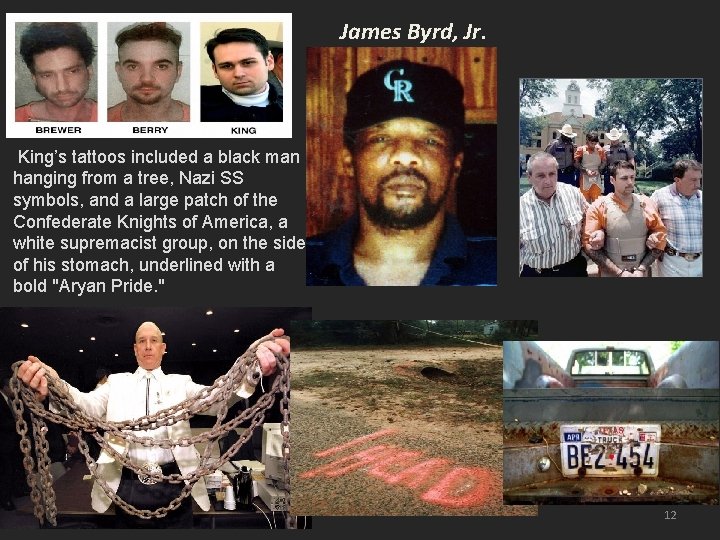
James Byrd, Jr. King’s tattoos included a black man hanging from a tree, Nazi SS symbols, and a large patch of the Confederate Knights of America, a white supremacist group, on the side of his stomach, underlined with a bold "Aryan Pride. " 12

https: //www. youtube. com/watch? v=z. M 9 p_Qd kx. Io 13
Hate Crimes (continued) • Role of law enforcement – Implement measures to prevent hate crimes – Respond to hate crime incidents – Preserve/secure crime scenes – Stabilize the victim(s) and request medical attention when/if necessary – Ensure the safety of all involved: the victims, witnesses, and perpetrators – Collect physical evidence Copyright © Texas Education Agency 2012. All rights reserved. Images and other multimedia content used with permission. 14
Hot Pursuit/Police Chases • Pursuit of an actual or suspected violator of the law by law enforcement • History – Pursuits are often inevitable, but they create dangerous situations for everyone involved, especially when the police go to extreme lengths while pursuing suspects for minor violations – Scott v. Harris – a police officer terminated a highspeed pursuit resulting in a crash that rendered the suspect quadriplegic. The suspect sued but the court ruled that the officer did not violate the Fourth Amendment Copyright © Texas Education Agency 2012. All rights reserved. Images and other multimedia content used with permission. 15
Scott v. Harris Pursuit Video Copyright © Texas Education Agency 2012. All rights reserved. Images and other multimedia content used with permission. 16
Hot Pursuit/Police Chases (continued) • The dilemma for law enforcement is whether the benefits of potential apprehension outweigh the risks of endangering the public and the police • Role of law enforcement – Ensure public safety – Determine if pursuing misdemeanor offenses outweighs the cost; quick decisions – Remember that pursuit is not negotiable for felony stops Copyright © Texas Education Agency 2012. All rights reserved. Images and other multimedia content used with permission. 17
Human Trafficking • A form of modern-day slavery where people profit from the control and exploitation of others; victims include children involved in the sex trade, adults age 18 or over who are coerced or deceived into commercial sex acts, and anyone forced into different forms of "labor or services, " such as domestic workers held in a home, or farm-workers forced to labor against their will. Copyright © Texas Education Agency 2012. All rights reserved. Images and other multimedia content used with permission. 18
Human Trafficking (continued) • History – forms of slavery have existed since the ancient Greek and Roman times • United States v. Kyo Hwa Adler – agents of the US Immigration and Customs Enforcement (ICE) and the Federal Bureau of Investigation (FBI) arrested 31 Korean nationals throughout the northeast US in a federal human trafficking case • United States v. Do Hyup Bae – involves human trafficking of individuals from Canada and Mexico Copyright © Texas Education Agency 2012. All rights reserved. Images and other multimedia content used with permission. 19
Human Trafficking (continued) • Role of law enforcement • Awareness that the victims suffer a violation of human rights and need protection • Promotion of the safety and wellbeing of victims is paramount • Have a plan of action when it relates to the incidents involving human trafficking • Use relationship building skills when it relates to the victims of this kind of crime Copyright © Texas Education Agency 2012. All rights reserved. Images and other multimedia content used with permission. 20
Human Trafficking (continued) • Issues for law enforcement • Knowing which laws have been violated • Understanding the process for addressing the various kinds of traffickers and victims (i. e. Coyotes and illegal immigrants) Copyright © Texas Education Agency 2012. All rights reserved. Images and other multimedia content used with permission. 21
Use of Force Involving Special Populations • “Any physical coercion used to effect, influence, or persuade an individual to comply with an order from an officer, above unresisted handcuffing, including actively pointing a firearm at a person” (http: //www. portlandcopwatch. org/PPB_Settlement_ Agreement 111212. pdf) Copyright © Texas Education Agency 2012. All rights reserved. Images and other multimedia content used with permission. 22
Use of Force Involving Special Populations (continued) • History • Marshall v. City of Portland – this case involved a mentally ill individual who died while law enforcement was exhibiting use of force • Champion v. Outlook Nashville, Inc. – this case involved police officers continuously spraying mace in the face of a mentally challenged individual that was handcuffed and obviously not a threat Copyright © Texas Education Agency 2012. All rights reserved. Images and other multimedia content used with permission. 23
Use of Force Involving Special Populations (continued) • Role of law enforcement • Offer and participate in efficient and effective training • Recognize mental illness early when addressing individuals • Issues for law enforcement • Civil Rights Laws violations • Police misconduct/abuse of power Copyright © Texas Education Agency 2012. All rights reserved. Images and other multimedia content used with permission. 24
Assignment In groups of 3: Using the following words your group needs to create song lyrics (with 15 -20 of the words) The words must be used appropriately/non-offensively, they must be used to show knowledge of terminology (words must be in context) and make sense, lyrics should be clean and not cruel or hurtful to anyone. BE RESPECTFUL to ALL!!! I will NOT tolerate anything offensive either in language or to someone’s feelings!!!! Cybercrime-Cyberbullying-Cyberstalking-Hacking Phishing-Spamming-Investigate-Jurisdiction-Hate Crimes Race-Religion-Sexual Orientation-Handicap-Ethnicity Prevent-Respond-Pursuit-4 th Amendment-Public Safety Use of Force-Handcuffing-Firearm-Mental Illness-Church Arson Prevention Act of 1996 -Hate Crime Prevention Act of 2009 -Hate Crimes Sentencing Enhancement Act of 1994 -Hate Crime Statistics 25 Act of 1990
Resources • 0135074096, Criminal Justice Today: An Introductory Text for The 21 st Century, Frank Schmalleger, Prentice Hall, 2010 • 0132318865, Crimes of the Internet Prentice Hall, Frank Schmalleger and Michael Pittaro, 2008 • http: //www. fbi. gov/news/pressrel/press-releases/uniform-crimereporting-program-releases-hate-crime-statistics-for-2002 • http: //www. law. cornell. edu/supct/html/05 -1631. ZS. html • http: //www. polarisproject. org/human-trafficking/overview • http: //www. eden. rutgers. edu/~yongpatr/425/final/timeline. htm • http: //www. portlandcopwatch. org/PPB_Settlement_Agreement 1112 12. pdf Copyright © Texas Education Agency 2012. All rights reserved. Images and other multimedia content used with permission. 26
- Slides: 26