
Common Precautions in the Cardiopulmonary Acute Care Setting

- Slides: 10
Common Precautions in the Cardiopulmonary Acute Care Setting Omar Baiyasi, SPT Central Michigan University
Cardiopulmonary Physical Therapy • Focus on cardiovascular and/or pulmonary conditions • Some commonly seen diagnoses: • • Chronic Obstructive Pulmonary Disease (COPD) Congestive Heart Failure (CHF) Post-Myocardial Infarction (MI) Cystic Fibrosis (CF) • As a clinical specialty, Cardiovascular and Pulmonary PT was first recognized in 1978
Common Precautions • Pacemaker Precautions • Sternal Precautions • Thoracotomy Precautions • Clamshell Precautions
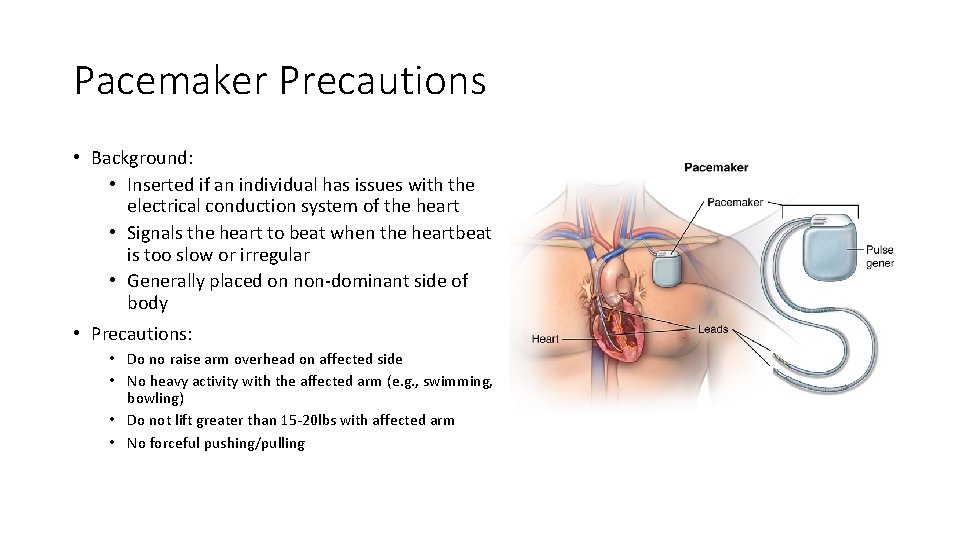
Pacemaker Precautions • Background: • Inserted if an individual has issues with the electrical conduction system of the heart • Signals the heart to beat when the heartbeat is too slow or irregular • Generally placed on non-dominant side of body • Precautions: • Do no raise arm overhead on affected side • No heavy activity with the affected arm (e. g. , swimming, bowling) • Do not lift greater than 15 -20 lbs with affected arm • No forceful pushing/pulling
Sternal Precautions • Background: • Precautions following cardiac surgery (often CABG) in which a sternotomy is performed • Guidelines in place to protect the sternum • Precautions: • • • Do not push or pull with excessive force Do not reach overhead or backwards with both arms at the same time Hold pillow across chest when coughing or sneezing Do not push, pull, or lift more than 10 lbs Do not let others push or pull arms when assisting with mobility tasks
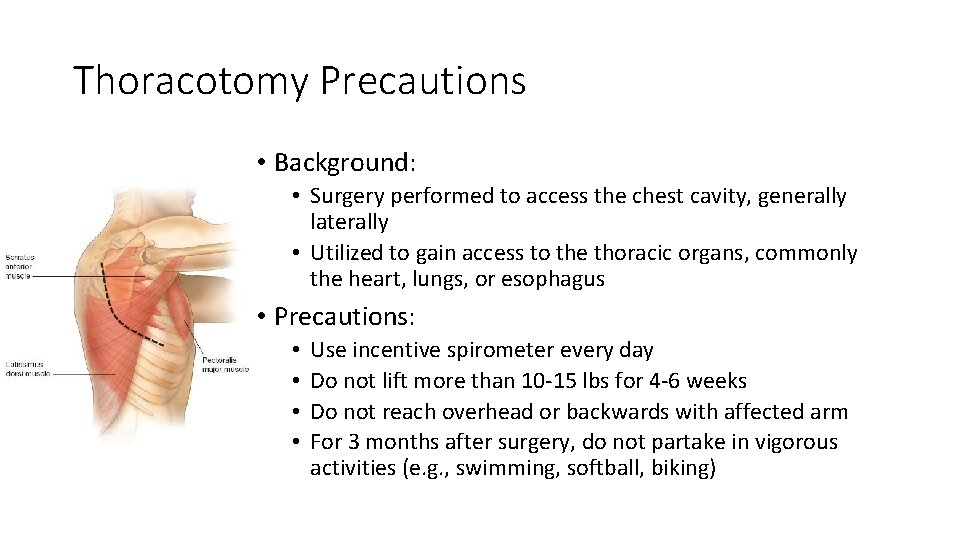
Thoracotomy Precautions • Background: • Surgery performed to access the chest cavity, generally laterally • Utilized to gain access to the thoracic organs, commonly the heart, lungs, or esophagus • Precautions: • • Use incentive spirometer every day Do not lift more than 10 -15 lbs for 4 -6 weeks Do not reach overhead or backwards with affected arm For 3 months after surgery, do not partake in vigorous activities (e. g. , swimming, softball, biking)
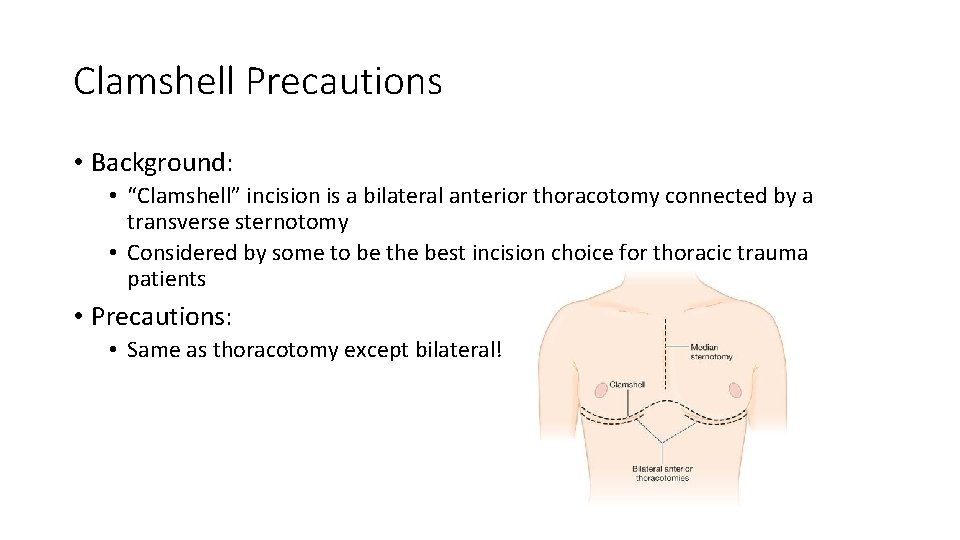
Clamshell Precautions • Background: • “Clamshell” incision is a bilateral anterior thoracotomy connected by a transverse sternotomy • Considered by some to be the best incision choice for thoracic trauma patients • Precautions: • Same as thoracotomy except bilateral!
Remember! • Always double check with the surgeon if you’re unsure • Printed patient education forms are highly recommended • Be aware of incisions when applying gait belt • Watch out for chest tubes/drains!
Questions?
References • 1. Swisher AK, Sciaky A, Campbell AA, Lowman JD. Cardiovascular and Pulmonary Physical Therapy Specialty Practice: Determining the Current Status. Cardiopulm Phys Ther J. 2008; 19(1): 11 -16. • 2. American Physical Therapy Association. About physical therapist (PT) careers. American Physical Therapy Association. http: //www. apta. org/PTCareers/Overview/. Updated November 10 2016. Accessed February 3 2018. • 3. Johns Hopkins Medicine. Pacemaker Insertion. The Johns Hopkins University. https: //www. hopkinsmedicine. org/healthlibrary/test_procedures/cardiovascular/pacemaker_insertion_92, P 07980. Accessed February 3 2018. • 4. The University of Kansas Hospital. Post Procedure Patient Discharge Instructions: Permanent Pacemaker. The University of Kansas. http: //www. kansashealthsystem. com/~/media/Files/KUMED/pdf/Cardiac%20 Intervention/Permanent%20 Pacemaker%20 dc%20 in structions%205 -11. ashx? la=en. Accessed February 3, 2018. • 5. The Ohio State University. Activity Guide after Chest Surgery: Sternal Precautions. The Ohio State University. https: //patienteducation. osumc. edu/Documents/activity-after-chest-surgery. pdf. Accessed February 3 2018. • 6. Thoracic Key. Techniques/Complications of Thoracotomy. Thoracic Key. https: //thoracickey. com/techniquescomplications-ofthoracotomy/. Published June 18 2016. Accessed February 3 2018. • 7. University of Washington. Exercise After Lung Surgery with Thoracotomy Incision: To help you live a healthy, active lifes. UW Medicine. https: //healthonline. washington. edu/document/health_online/pdf/Exercise-After-Lung-Surgery-Thoracotomy. Incision. pdf. Accessed February 4 2018. • 8. Simms ER, Flaris AN, Franchino X, Thomas MS, Caillot JL, Voiglio EJ. Bilateral anterior thoracotomy (clamshell incision) is the ideal emergency thoracotomy incision: an anatomic study. World J Surg. 2013; 37(6): 1277 -1285.