
COMMON PATTERN OF ENGLISH SENTENCE A QUESTION SENTENCES


- Slides: 21
COMMON PATTERN OF ENGLISH SENTENCE
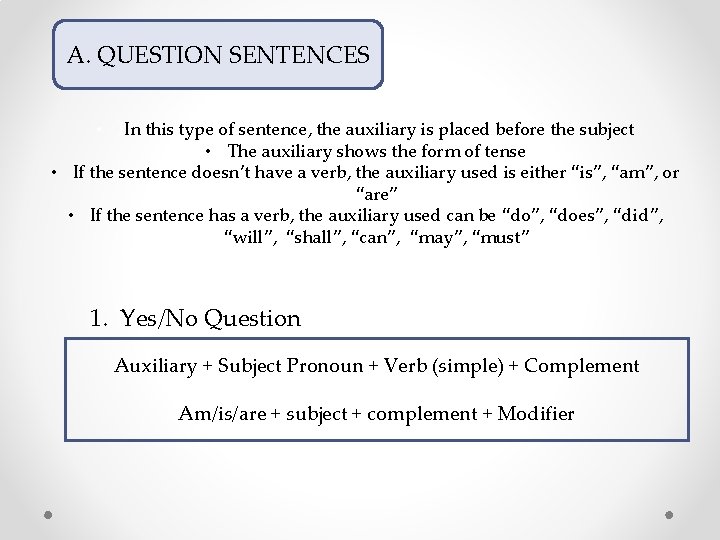
A. QUESTION SENTENCES • IIn this type of sentence, the auxiliary is placed before the subject • The auxiliary shows the form of tense • If the sentence doesn’t have a verb, the auxiliary used is either “is”, “am”, or “are” • If the sentence has a verb, the auxiliary used can be “do”, “does”, “did”, “will”, “shall”, “can”, “may”, “must” 1. Yes/No Question Auxiliary + Subject Pronoun + Verb (simple) + Complement Am/is/are + subject + complement + Modifier
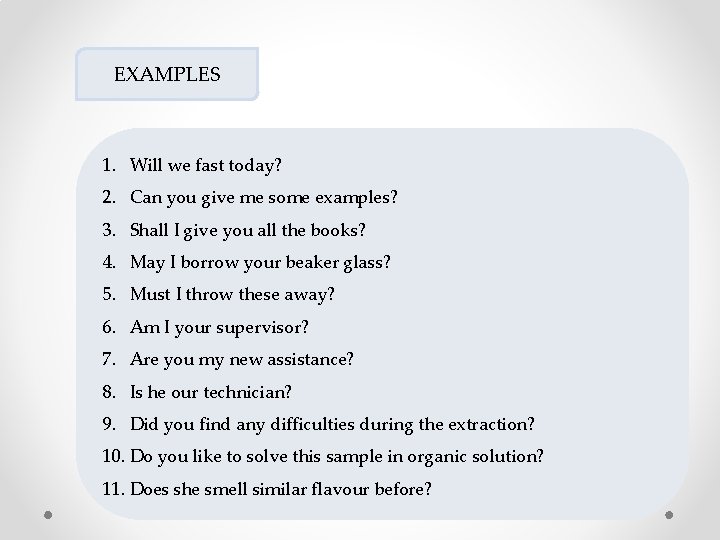
EXAMPLES 1. Will we fast today? 2. Can you give me some examples? 3. Shall I give you all the books? 4. May I borrow your beaker glass? 5. Must I throw these away? 6. Am I your supervisor? 7. Are you my new assistance? 8. Is he our technician? 9. Did you find any difficulties during the extraction? 10. Do you like to solve this sample in organic solution? 11. Does she smell similar flavour before?
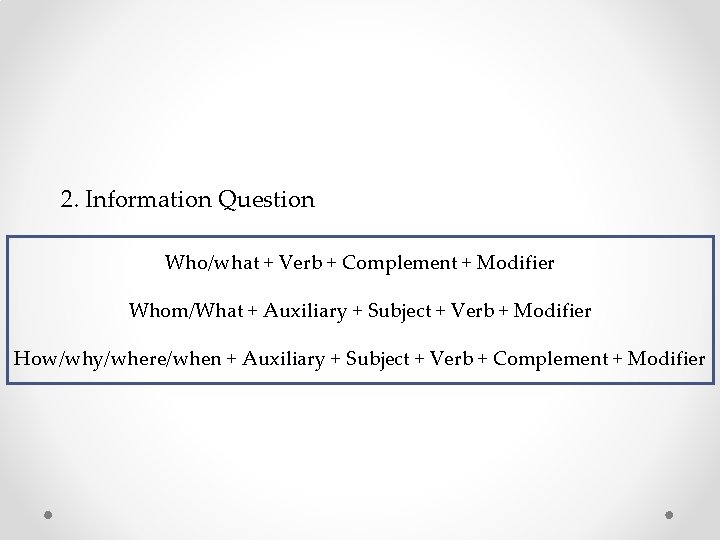
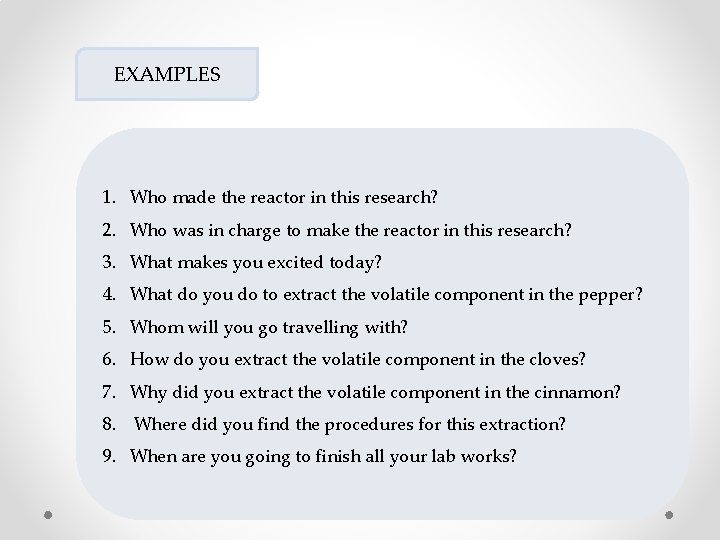
2. Information Question Who/what + Verb + Complement + Modifier Whom/What + Auxiliary + Subject + Verb + Modifier How/why/where/when + Auxiliary + Subject + Verb + Complement + Modifier
EXAMPLES 1. Who made the reactor in this research? 2. Who was in charge to make the reactor in this research? 3. What makes you excited today? 4. What do you do to extract the volatile component in the pepper? 5. Whom will you go travelling with? 6. How do you extract the volatile component in the cloves? 7. Why did you extract the volatile component in the cinnamon? 8. Where did you find the procedures for this extraction? 9. When are you going to finish all your lab works?
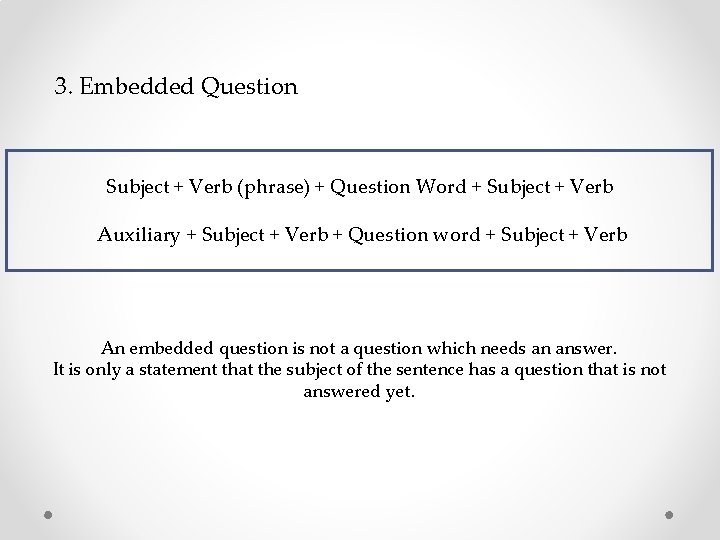
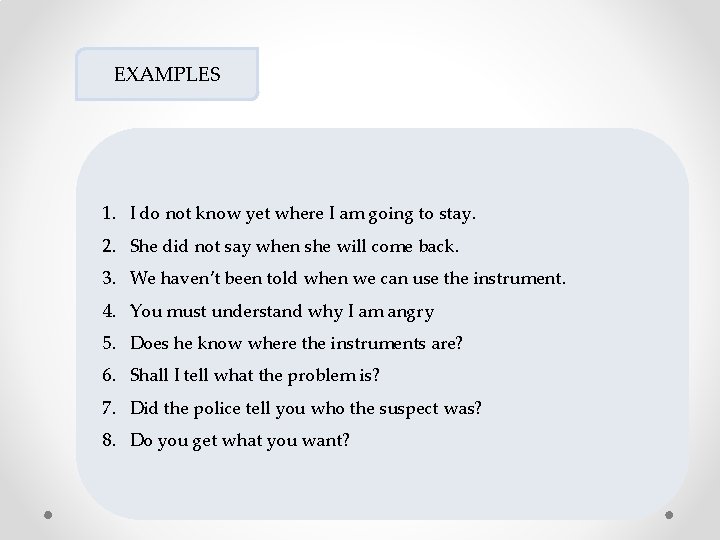
3. Embedded Question Subject + Verb (phrase) + Question Word + Subject + Verb Auxiliary + Subject + Verb + Question word + Subject + Verb An embedded question is not a question which needs an answer. It is only a statement that the subject of the sentence has a question that is not answered yet.
EXAMPLES 1. I do not know yet where I am going to stay. 2. She did not say when she will come back. 3. We haven’t been told when we can use the instrument. 4. You must understand why I am angry 5. Does he know where the instruments are? 6. Shall I tell what the problem is? 7. Did the police tell you who the suspect was? 8. Do you get what you want?
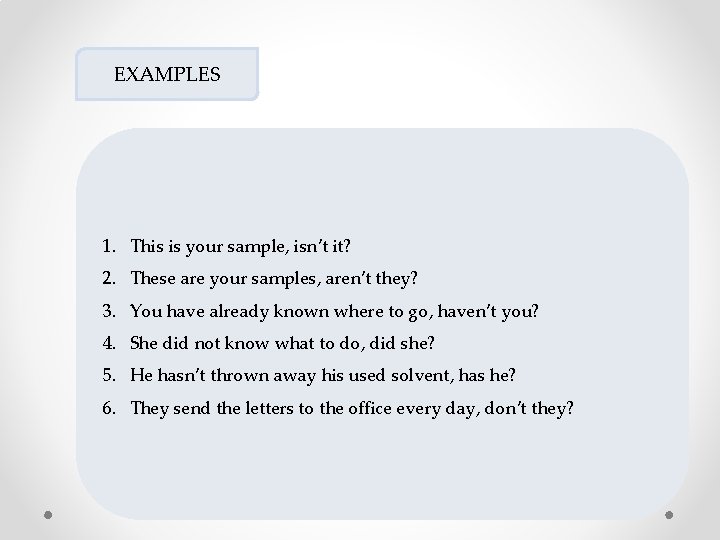
4. Tag Question Main clause + comma + Tag question Tag Question : 1. Use the same auxiliary verb as in the main clause 2. If the main clause is affirmative, the question tag is negative 3. If the main clause is negative, the question tag is positive
EXAMPLES 1. This is your sample, isn’t it? 2. These are your samples, aren’t they? 3. You have already known where to go, haven’t you? 4. She did not know what to do, did she? 5. He hasn’t thrown away his used solvent, has he? 6. They send the letters to the office every day, don’t they?
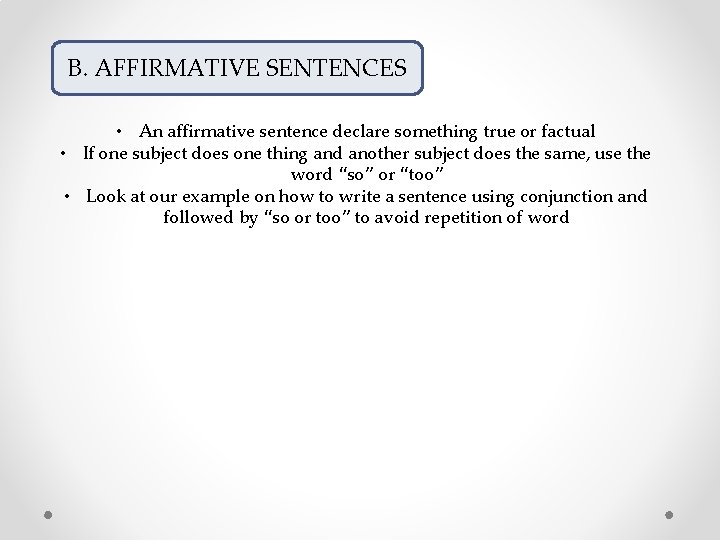
B. AFFIRMATIVE SENTENCES • An affirmative sentence declare something true or factual • If one subject does one thing and another subject does the same, use the word “so” or “too” • Look at our example on how to write a sentence using conjunction and followed by “so or too” to avoid repetition of word
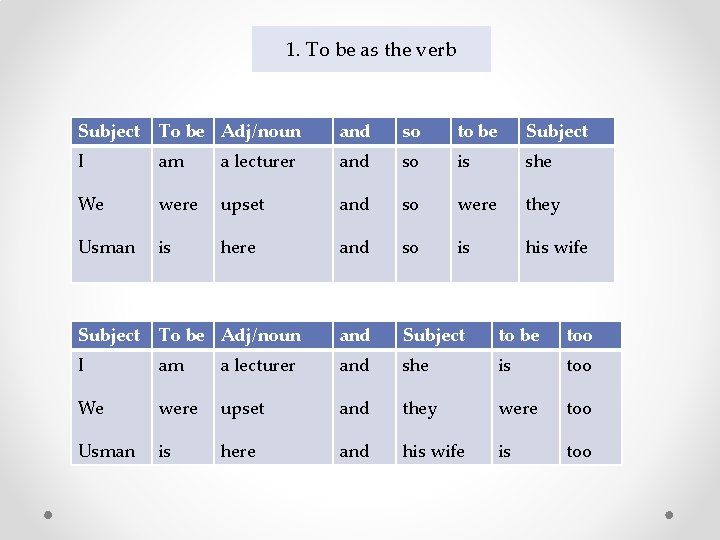
1. To be as the verb Subject To be Adj/noun and so to be Subject I am a lecturer and so is she We were upset and so were they Usman is here and so is his wife Subject To be Adj/noun and Subject to be too I am a lecturer and she is too We were upset and they were too Usman is here and his wife is too
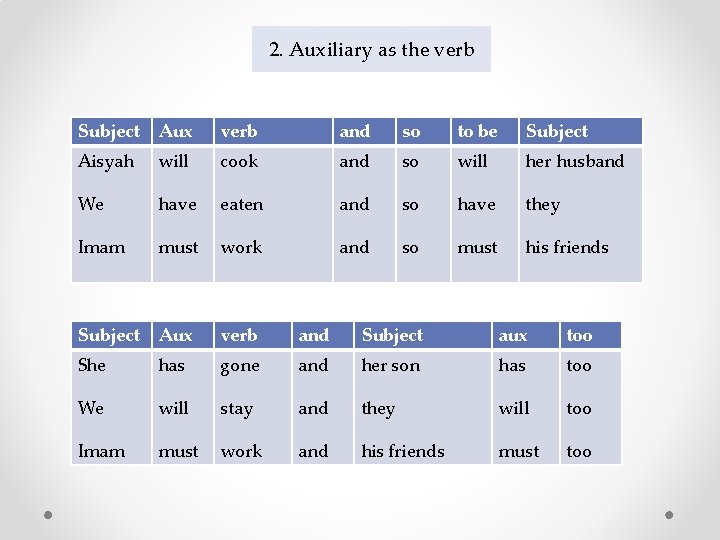
2. Auxiliary as the verb Subject Aux verb and so to be Subject Aisyah will cook and so will her husband We have eaten and so have they Imam must work and so must his friends Subject Aux verb and Subject aux too She has gone and her son has too We will stay and they will too Imam must work and his friends must too
3. Any verb except to be or auxiliary Subject verb and so Do/does/did Subject Aisyah cooks dinner and so does her husband We ate our dinner and so did they I work at night and so do my classmates Subject verb and Subject Do/does/did too She cooks dinner and her husband does too We ate our dinner and they did too Imam works at night and his friends do too
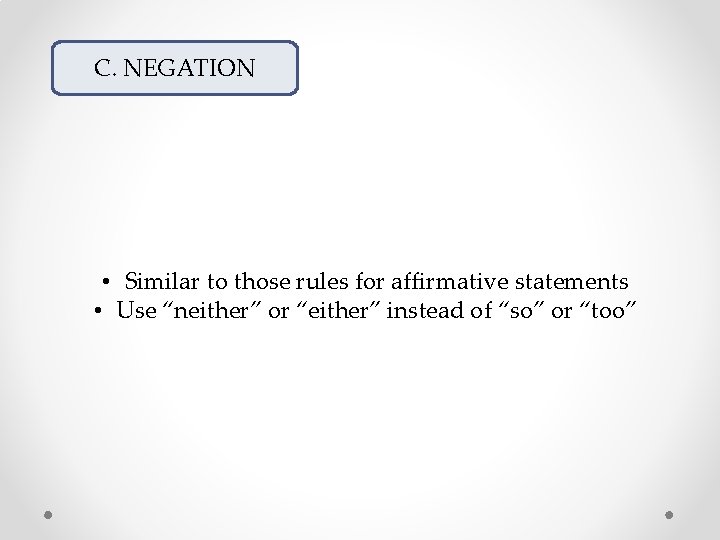
C. NEGATION • Similar to those rules for affirmative statements • Use “neither” or “either” instead of “so” or “too”
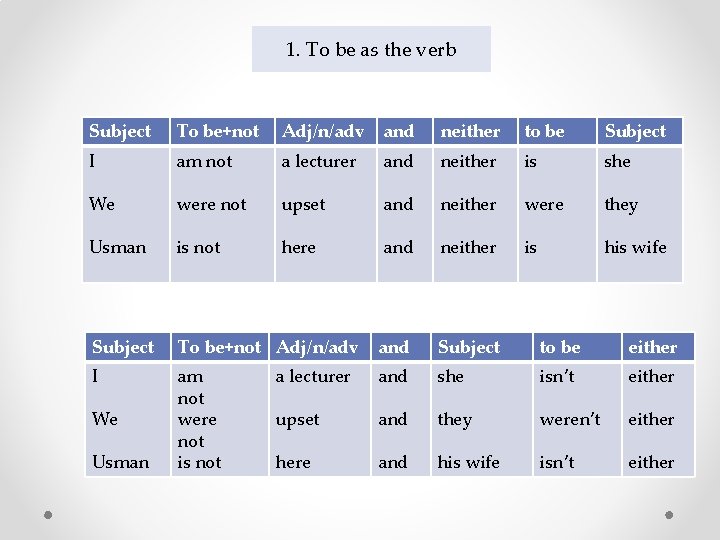
1. To be as the verb Subject To be+not Adj/n/adv and neither to be Subject I am not a lecturer and neither is she We were not upset and neither were they Usman is not here and neither is his wife Subject To be+not Adj/n/adv and Subject to be either I am not were not is not a lecturer and she isn’t either upset and they weren’t either here and his wife isn’t either We Usman
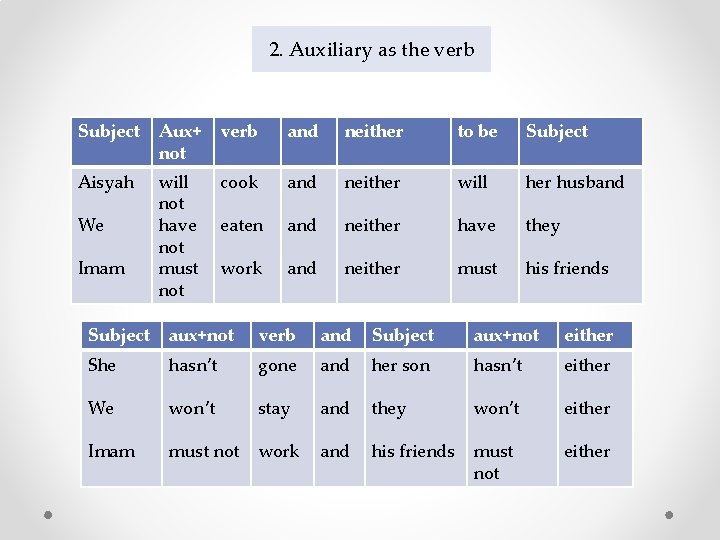
2. Auxiliary as the verb Subject Aux+ not verb and neither to be Subject Aisyah will not have not must not cook and neither will her husband eaten and neither have they work and neither must his friends We Imam Subject aux+not verb and Subject aux+not either She hasn’t gone and her son hasn’t either We won’t stay and they won’t either Imam must not work and his friends must not either
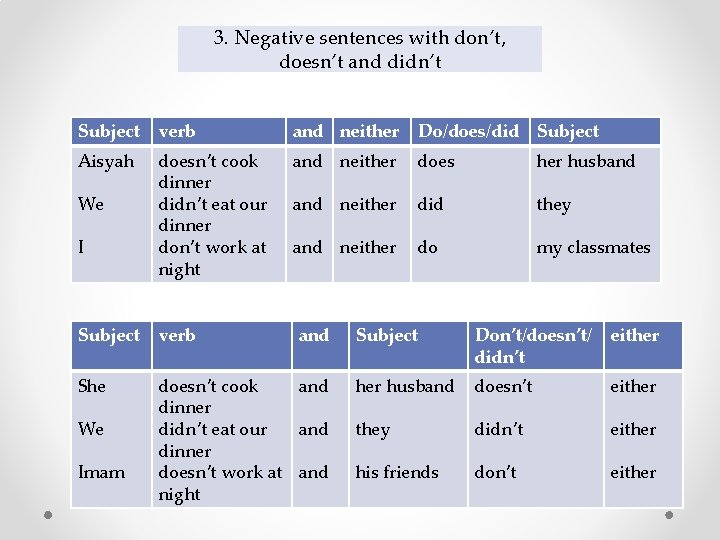
3. Negative sentences with don’t, doesn’t and didn’t Subject verb and neither Do/does/did Subject Aisyah doesn’t cook dinner didn’t eat our dinner don’t work at night and neither does her husband neither did they and neither do my classmates We I Subject verb She doesn’t cook and dinner didn’t eat our and dinner doesn’t work at and night We Imam and Subject Don’t/doesn’t/ didn’t either husband doesn’t either they didn’t either his friends don’t either
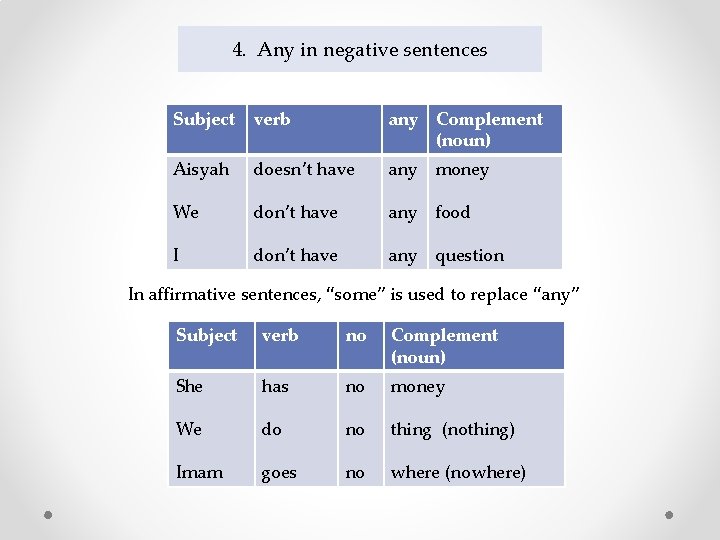
4. Any in negative sentences Subject verb any Complement (noun) Aisyah doesn’t have any money We don’t have any food I don’t have any question In affirmative sentences, “some” is used to replace “any” Subject verb no Complement (noun) She has no money We do no thing (nothing) Imam goes no where (nowhere)
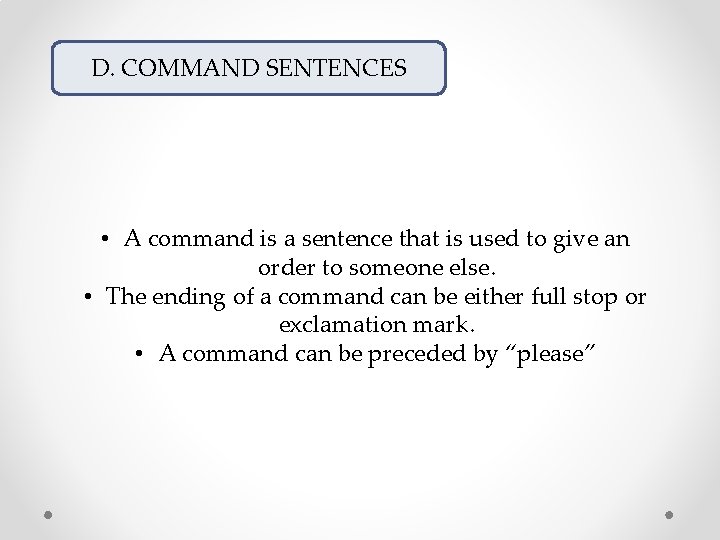
D. COMMAND SENTENCES • A command is a sentence that is used to give an order to someone else. • The ending of a command can be either full stop or exclamation mark. • A command can be preceded by “please”
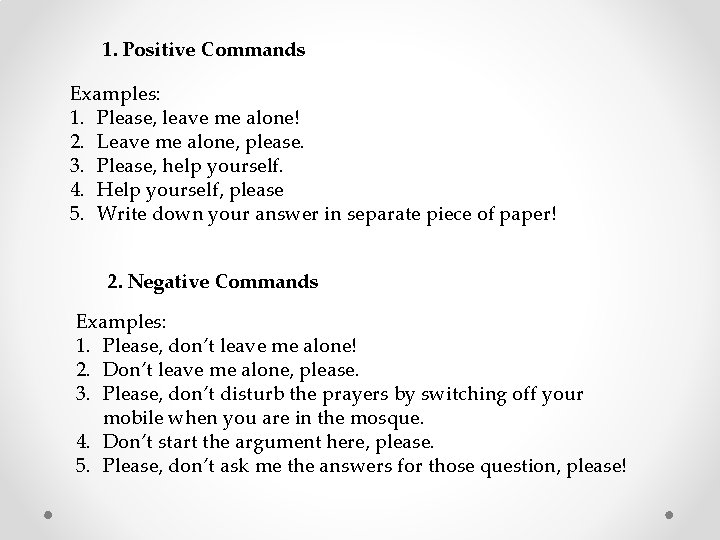
1. Positive Commands Examples: 1. Please, leave me alone! 2. Leave me alone, please. 3. Please, help yourself. 4. Help yourself, please 5. Write down your answer in separate piece of paper! 2. Negative Commands Examples: 1. Please, don’t leave me alone! 2. Don’t leave me alone, please. 3. Please, don’t disturb the prayers by switching off your mobile when you are in the mosque. 4. Don’t start the argument here, please. 5. Please, don’t ask me the answers for those question, please!
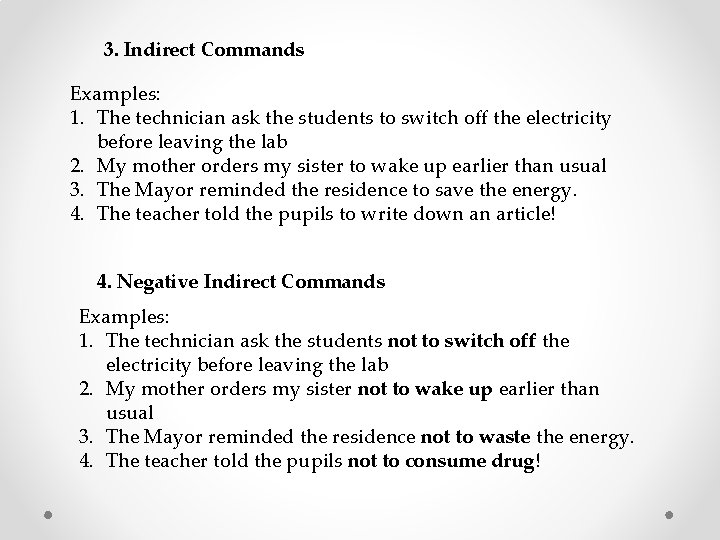
3. Indirect Commands Examples: 1. The technician ask the students to switch off the electricity before leaving the lab 2. My mother orders my sister to wake up earlier than usual 3. The Mayor reminded the residence to save the energy. 4. The teacher told the pupils to write down an article! 4. Negative Indirect Commands Examples: 1. The technician ask the students not to switch off the electricity before leaving the lab 2. My mother orders my sister not to wake up earlier than usual 3. The Mayor reminded the residence not to waste the energy. 4. The teacher told the pupils not to consume drug!