
Common NFVI Telco Taskforce Technical F 2 F

- Slides: 24
Common NFVI Telco Taskforce Technical F 2 F Work Shop – January 13 -16, 2020 RC Workstream: Key Updates Facilitators: Mike Fix, Cedric Ollivier, Rajesh Rajamani, Kanagaraj Manickam
Content & MVP Targets 2
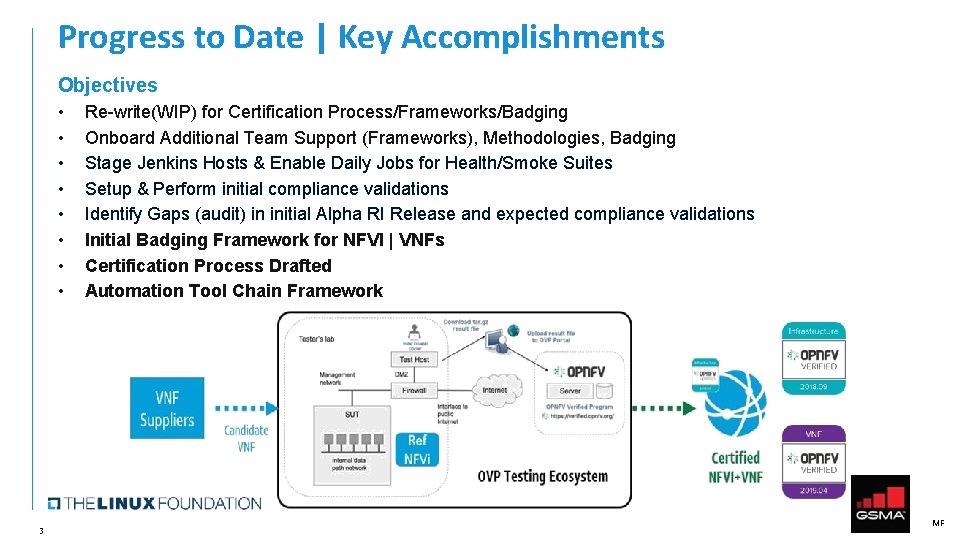
Progress to Date | Key Accomplishments Objectives • • 3 Re-write(WIP) for Certification Process/Frameworks/Badging Onboard Additional Team Support (Frameworks), Methodologies, Badging Stage Jenkins Hosts & Enable Daily Jobs for Health/Smoke Suites Setup & Perform initial compliance validations Identify Gaps (audit) in initial Alpha RI Release and expected compliance validations Initial Badging Framework for NFVI | VNFs Certification Process Drafted Automation Tool Chain Framework MF
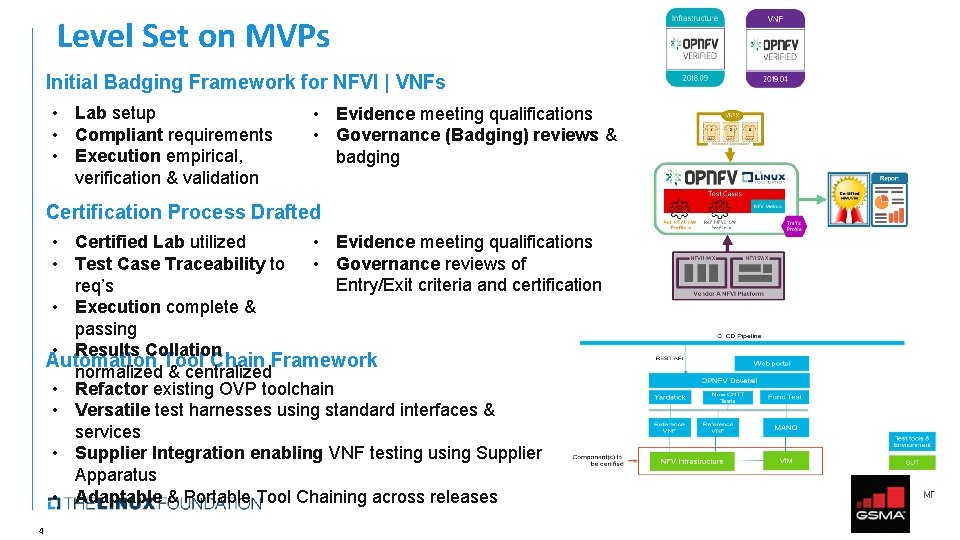
Level Set on MVPs Initial Badging Framework for NFVI | VNFs • Lab setup • Compliant requirements • Execution empirical, verification & validation • Evidence meeting qualifications • Governance (Badging) reviews & badging Certification Process Drafted • Evidence meeting qualifications • Certified Lab utilized • Governance reviews of • Test Case Traceability to Entry/Exit criteria and certification req’s • Execution complete & passing • Results Collation Automation Tool Chain Framework normalized & centralized • Refactor existing OVP toolchain • Versatile test harnesses using standard interfaces & services • Supplier Integration enabling VNF testing using Supplier Apparatus • Adaptable & Portable Tool Chaining across releases 4
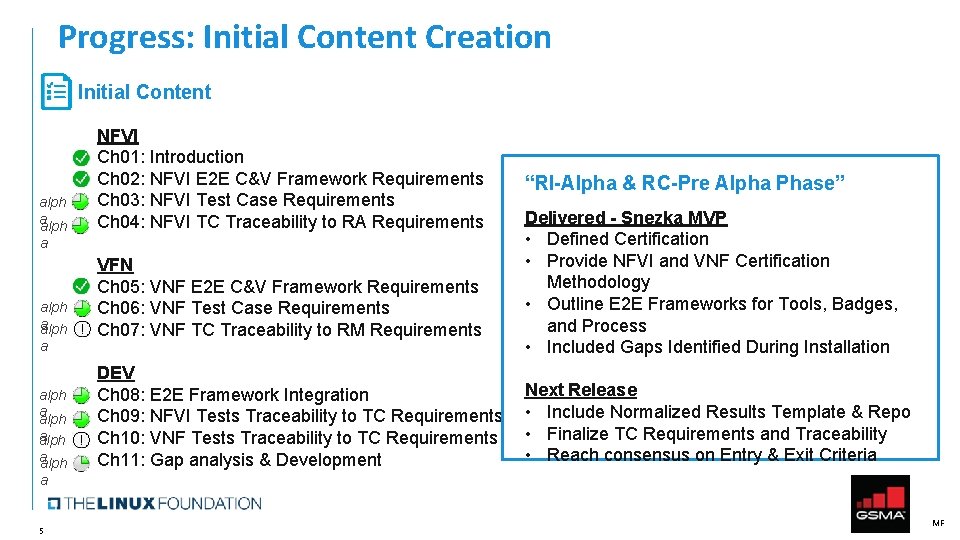
Progress: Initial Content Creation Initial Content alph a alph aalph NFVI Ch 01: Introduction Ch 02: NFVI E 2 E C&V Framework Requirements Ch 03: NFVI Test Case Requirements Ch 04: NFVI TC Traceability to RA Requirements VFN Ch 05: VNF E 2 E C&V Framework Requirements Ch 06: VNF Test Case Requirements Ch 07: VNF TC Traceability to RM Requirements DEV Ch 08: E 2 E Framework Integration Ch 09: NFVI Tests Traceability to TC Requirements Ch 10: VNF Tests Traceability to TC Requirements Ch 11: Gap analysis & Development “RI-Alpha & RC-Pre Alpha Phase” Delivered - Snezka MVP • Defined Certification • Provide NFVI and VNF Certification Methodology • Outline E 2 E Frameworks for Tools, Badges, and Process • Included Gaps Identified During Installation Next Release • Include Normalized Results Template & Repo • Finalize TC Requirements and Traceability • Reach consensus on Entry & Exit Criteria a 5 MF
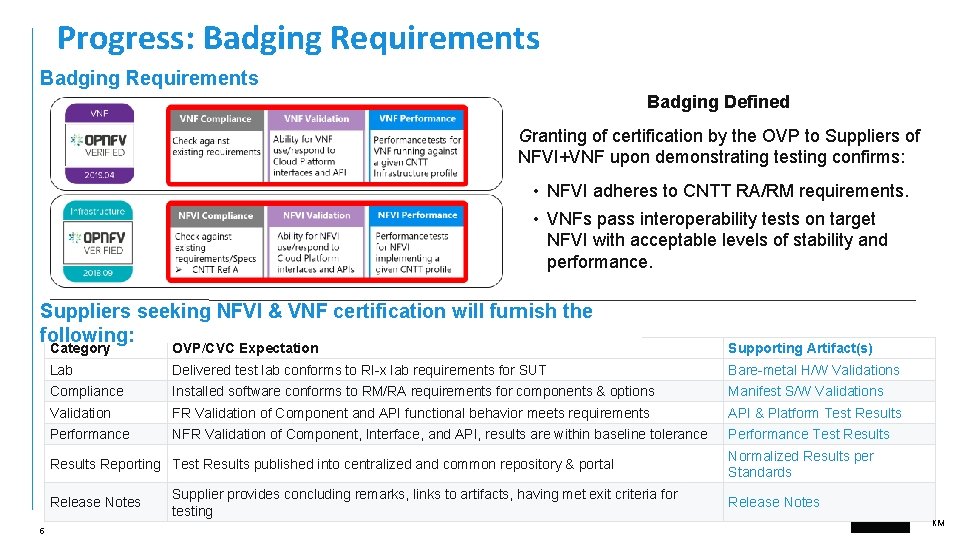
Progress: Badging Requirements Badging Defined Granting of certification by the OVP to Suppliers of NFVI+VNF upon demonstrating testing confirms: • NFVI adheres to CNTT RA/RM requirements. • VNFs pass interoperability tests on target NFVI with acceptable levels of stability and performance. Suppliers seeking NFVI & VNF certification will furnish the following: Category OVP/CVC Expectation Supporting Artifact(s) Lab Delivered test lab conforms to RI-x lab requirements for SUT Bare-metal H/W Validations Compliance Installed software conforms to RM/RA requirements for components & options Manifest S/W Validations Validation FR Validation of Component and API functional behavior meets requirements API & Platform Test Results Performance NFR Validation of Component, Interface, and API, results are within baseline tolerance Performance Test Results Reporting Test Results published into centralized and common repository & portal Release Notes 6 Supplier provides concluding remarks, links to artifacts, having met exit criteria for testing Normalized Results per Standards Release Notes KM
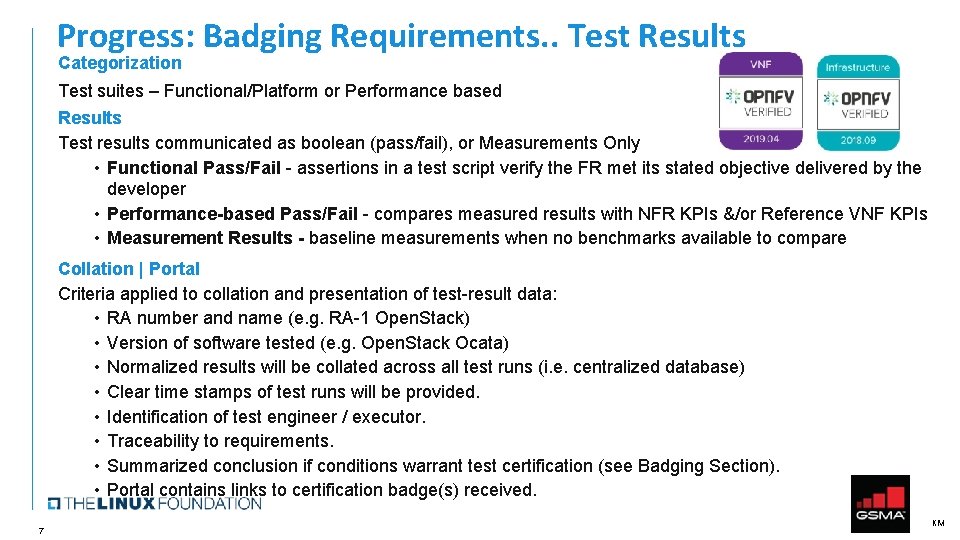
Progress: Badging Requirements. . Test Results Categorization Test suites – Functional/Platform or Performance based Results Test results communicated as boolean (pass/fail), or Measurements Only • Functional Pass/Fail - assertions in a test script verify the FR met its stated objective delivered by the developer • Performance-based Pass/Fail - compares measured results with NFR KPIs &/or Reference VNF KPIs • Measurement Results - baseline measurements when no benchmarks available to compare Collation | Portal Criteria applied to collation and presentation of test-result data: • RA number and name (e. g. RA-1 Open. Stack) • Version of software tested (e. g. Open. Stack Ocata) • Normalized results will be collated across all test runs (i. e. centralized database) • Clear time stamps of test runs will be provided. • Identification of test engineer / executor. • Traceability to requirements. • Summarized conclusion if conditions warrant test certification (see Badging Section). • Portal contains links to certification badge(s) received. 7 KM
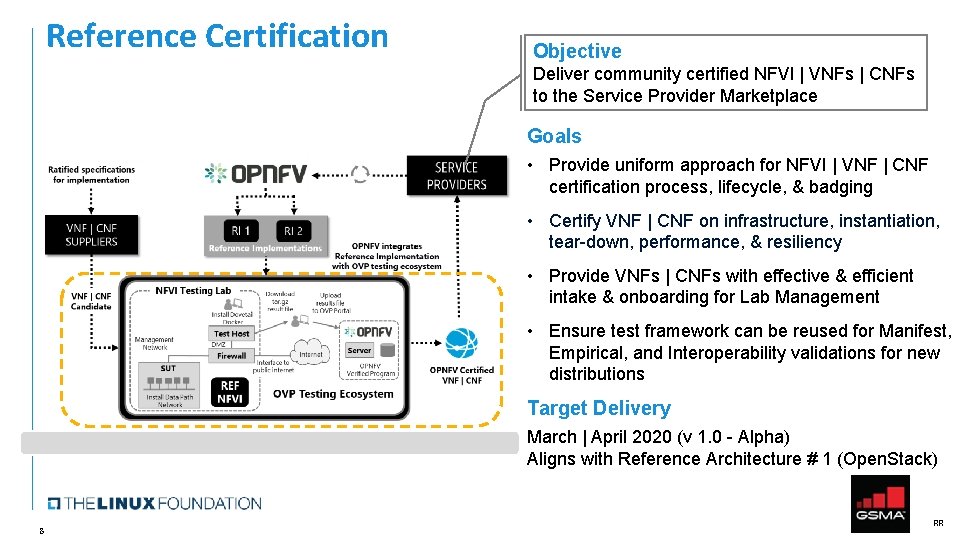
Reference Certification Objective Deliver community certified NFVI | VNFs | CNFs to the Service Provider Marketplace Goals • Provide uniform approach for NFVI | VNF | CNF certification process, lifecycle, & badging • Certify VNF | CNF on infrastructure, instantiation, tear-down, performance, & resiliency • Provide VNFs | CNFs with effective & efficient intake & onboarding for Lab Management • Ensure test framework can be reused for Manifest, Empirical, and Interoperability validations for new distributions Target Delivery March | April 2020 (v 1. 0 - Alpha) Aligns with Reference Architecture # 1 (Open. Stack) 8 RR
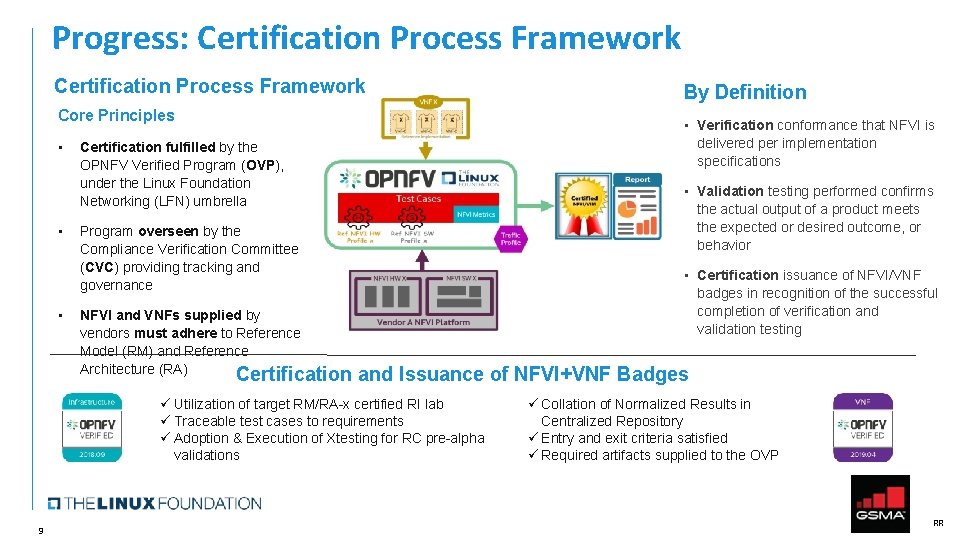
Progress: Certification Process Framework Core Principles • • • Certification fulfilled by the OPNFV Verified Program (OVP), under the Linux Foundation Networking (LFN) umbrella Program overseen by the Compliance Verification Committee (CVC) providing tracking and governance NFVI and VNFs supplied by vendors must adhere to Reference Model (RM) and Reference Architecture (RA) By Definition • Verification conformance that NFVI is delivered per implementation specifications • Validation testing performed confirms the actual output of a product meets the expected or desired outcome, or behavior • Certification issuance of NFVI/VNF badges in recognition of the successful completion of verification and validation testing Certification and Issuance of NFVI+VNF Badges ü Utilization of target RM/RA-x certified RI lab ü Traceable test cases to requirements ü Adoption & Execution of Xtesting for RC pre-alpha validations 9 ü Collation of Normalized Results in Centralized Repository ü Entry and exit criteria satisfied ü Required artifacts supplied to the OVP RR
Reference Certification Achievements | Targets for Alpha 10
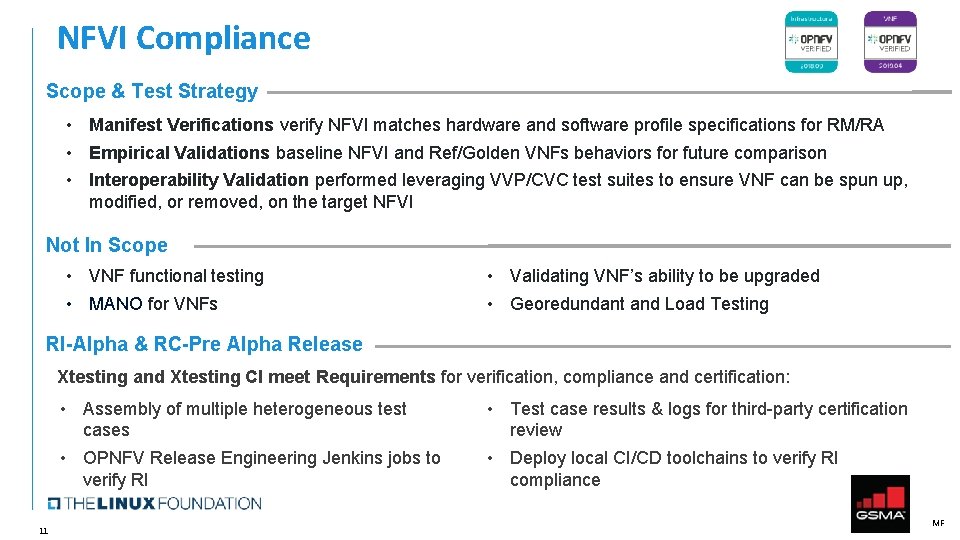
NFVI Compliance Scope & Test Strategy • Manifest Verifications verify NFVI matches hardware and software profile specifications for RM/RA • Empirical Validations baseline NFVI and Ref/Golden VNFs behaviors for future comparison • Interoperability Validation performed leveraging VVP/CVC test suites to ensure VNF can be spun up, modified, or removed, on the target NFVI Not In Scope • VNF functional testing • MANO for VNFs • Validating VNF’s ability to be upgraded • Georedundant and Load Testing RI-Alpha & RC-Pre Alpha Release Xtesting and Xtesting CI meet Requirements for verification, compliance and certification: • Assembly of multiple heterogeneous test cases • OPNFV Release Engineering Jenkins jobs to verify RI 11 • Test case results & logs for third-party certification review • Deploy local CI/CD toolchains to verify RI compliance MF
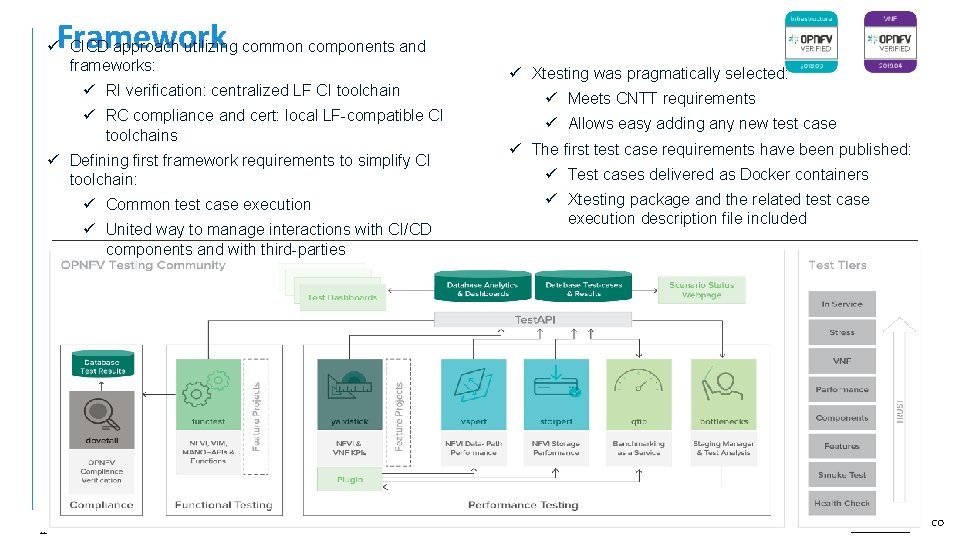
Framework ü CICD approach utilizing common components and frameworks: ü RI verification: centralized LF CI toolchain ü RC compliance and cert: local LF-compatible CI toolchains ü Defining first framework requirements to simplify CI toolchain: ü Common test case execution ü United way to manage interactions with CI/CD components and with third-parties 12 ü Xtesting was pragmatically selected: ü Meets CNTT requirements ü Allows easy adding any new test case ü The first test case requirements have been published: ü Test cases delivered as Docker containers ü Xtesting package and the related test case execution description file included CO
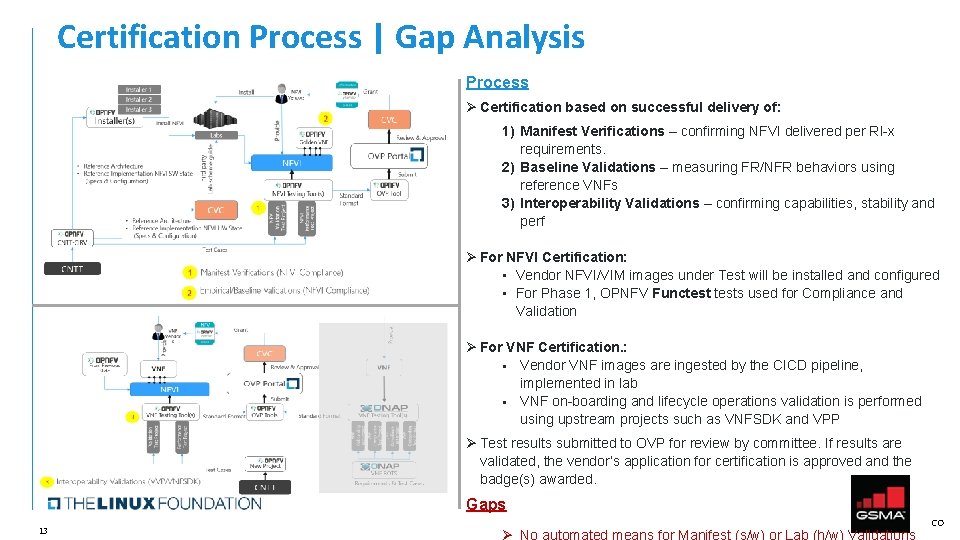
Certification Process | Gap Analysis Process Ø Certification based on successful delivery of: 1) Manifest Verifications – confirming NFVI delivered per RI-x requirements. 2) Baseline Validations – measuring FR/NFR behaviors using reference VNFs 3) Interoperability Validations – confirming capabilities, stability and perf Ø For NFVI Certification: • Vendor NFVI/VIM images under Test will be installed and configured • For Phase 1, OPNFV Functests used for Compliance and Validation Ø For VNF Certification. : Vendor VNF images are ingested by the CICD pipeline, implemented in lab VNF on-boarding and lifecycle operations validation is performed using upstream projects such as VNFSDK and VPP Ø Test results submitted to OVP for review by committee. If results are validated, the vendor’s application for certification is approved and the badge(s) awarded. Gaps 13 CO
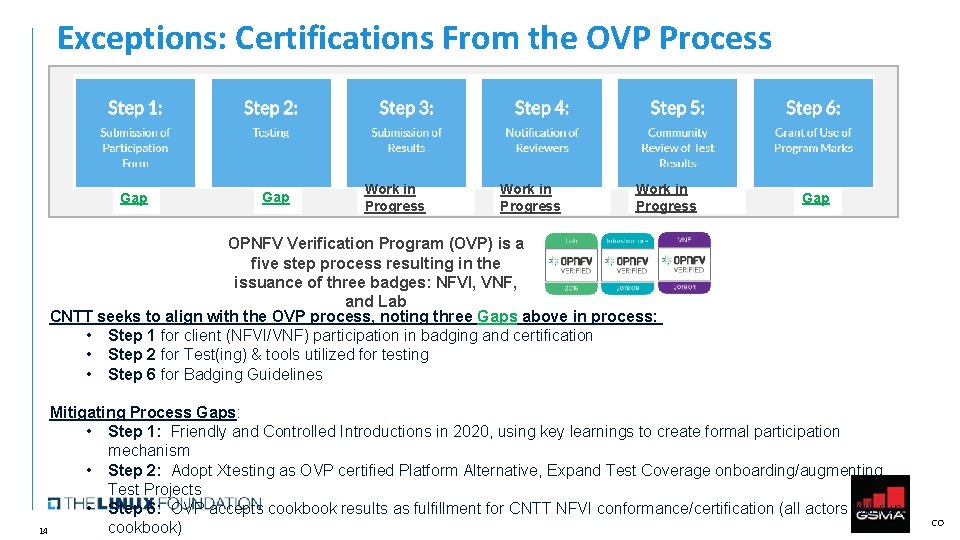
Exceptions: Certifications From the OVP Process Gap Work in Progress Gap OPNFV Verification Program (OVP) is a five step process resulting in the issuance of three badges: NFVI, VNF, and Lab CNTT seeks to align with the OVP process, noting three Gaps above in process: • Step 1 for client (NFVI/VNF) participation in badging and certification • Step 2 for Test(ing) & tools utilized for testing • Step 6 for Badging Guidelines Mitigating Process Gaps: • Step 1: Friendly and Controlled Introductions in 2020, using key learnings to create formal participation mechanism • Step 2: Adopt Xtesting as OVP certified Platform Alternative, Expand Test Coverage onboarding/augmenting Test Projects • Step 6: OVP accepts cookbook results as fulfillment for CNTT NFVI conformance/certification (all actors will run cookbook) 14 CO
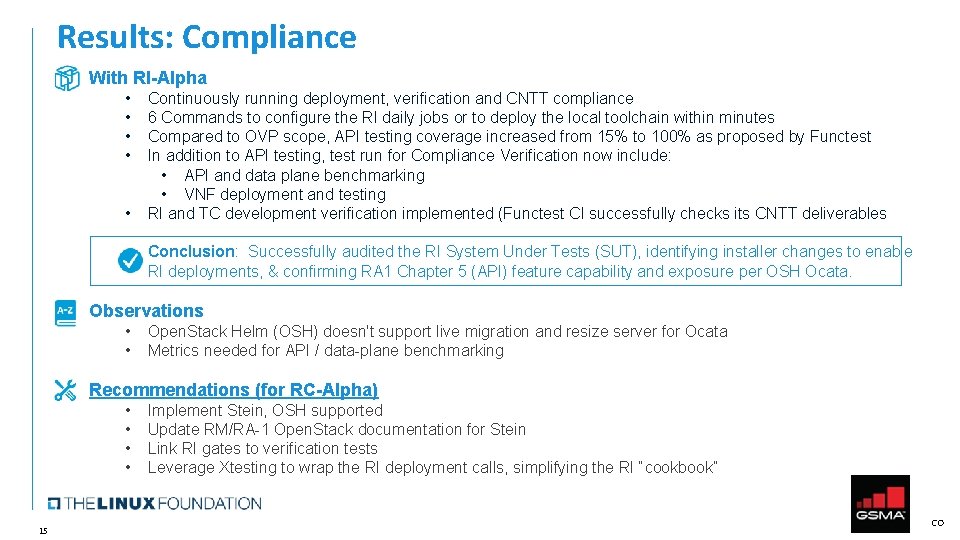
Results: Compliance With RI-Alpha • • • Continuously running deployment, verification and CNTT compliance 6 Commands to configure the RI daily jobs or to deploy the local toolchain within minutes Compared to OVP scope, API testing coverage increased from 15% to 100% as proposed by Functest In addition to API testing, test run for Compliance Verification now include: • API and data plane benchmarking • VNF deployment and testing RI and TC development verification implemented (Functest CI successfully checks its CNTT deliverables Conclusion: Successfully audited the RI System Under Tests (SUT), identifying installer changes to enable RI deployments, & confirming RA 1 Chapter 5 (API) feature capability and exposure per OSH Ocata. Observations • • Open. Stack Helm (OSH) doesn't support live migration and resize server for Ocata Metrics needed for API / data-plane benchmarking Recommendations (for RC-Alpha) • • 15 Implement Stein, OSH supported Update RM/RA-1 Open. Stack documentation for Stein Link RI gates to verification tests Leverage Xtesting to wrap the RI deployment calls, simplifying the RI “cookbook” CO
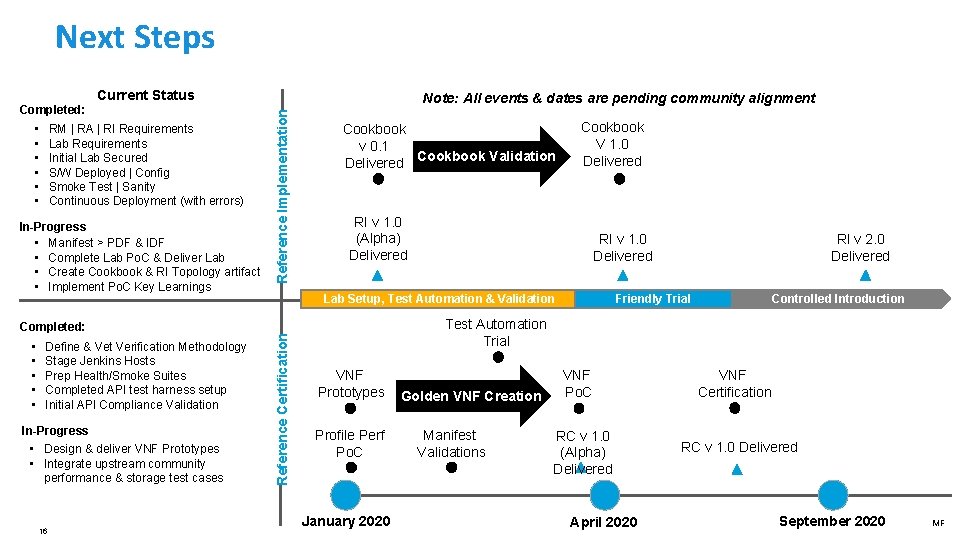
Next Steps Current Status • • • RM | RA | RI Requirements Lab Requirements Initial Lab Secured S/W Deployed | Config Smoke Test | Sanity Continuous Deployment (with errors) In-Progress • Manifest > PDF & IDF • Complete Lab Po. C & Deliver Lab • Create Cookbook & RI Topology artifact • Implement Po. C Key Learnings Note: All events & dates are pending community alignment Reference Implementation Completed: Cookbook v 0. 1 Cookbook Validation Delivered RI v 1. 0 (Alpha) Delivered In-Progress • Design & deliver VNF Prototypes • Integrate upstream community performance & storage test cases 16 Reference Certification Define & Vet Verification Methodology Stage Jenkins Hosts Prep Health/Smoke Suites Completed API test harness setup Initial API Compliance Validation RI v 1. 0 Delivered Lab Setup, Test Automation & Validation RI v 2. 0 Delivered Controlled Introduction Friendly Trial Test Automation Trial Completed: • • • Cookbook V 1. 0 Delivered VNF Prototypes Profile Perf Po. C January 2020 Golden VNF Creation Manifest Validations VNF Po. C RC v 1. 0 (Alpha) Delivered April 2020 VNF Certification RC v 1. 0 Delivered September 2020 MF
Reference Certification Challenges • Availability of OVP | CNTT resources & active engagement • OVP’s ability to scale to demand, & alignment with CNTT objectives, including: • Fully automated ecosystem & badging process • Intuitive and efficient VNF on-boarding processes • Lab optimization & rationalization • Lab-use management & control strategy • Augmentation of OVP processes to include third party certification platforms & process • Clear and efficient third party certification requirements • Audits of lab certifications confirming availability, state (current), & accessibility • Normalized test results with a centralized repository • Manifest validations require an automated check of requirements CNTT will maintain ownership of the Reference Certification until a satisfactory level of support, stability, & maturity is attained 17 RR
Appendix
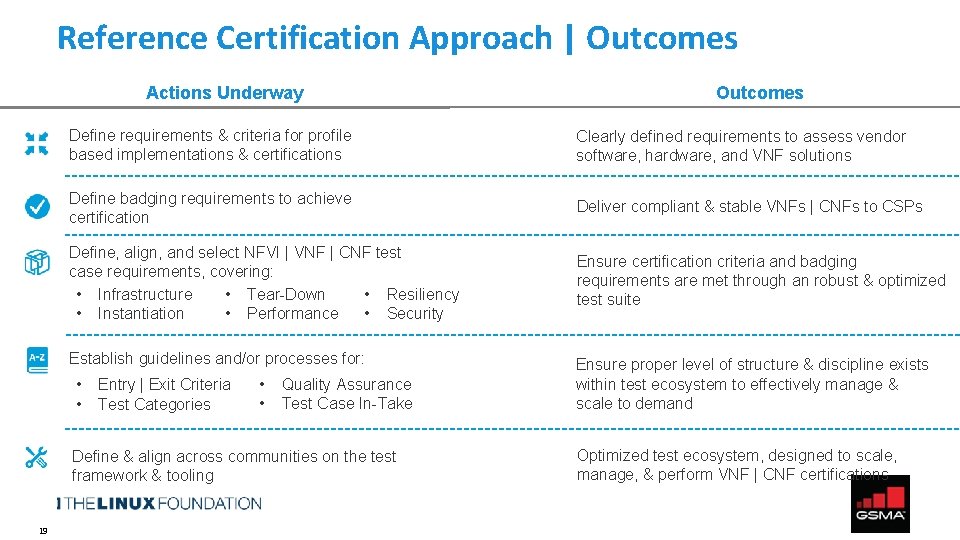
Reference Certification Approach | Outcomes Actions Underway Define requirements & criteria for profile based implementations & certifications Clearly defined requirements to assess vendor software, hardware, and VNF solutions Define badging requirements to achieve certification Deliver compliant & stable VNFs | CNFs to CSPs Define, align, and select NFVI | VNF | CNF test case requirements, covering: • Tear-Down • Infrastructure • Resiliency • Performance • Instantiation • Security Ensure certification criteria and badging requirements are met through an robust & optimized test suite Establish guidelines and/or processes for: • • Entry | Exit Criteria Test Categories • • Quality Assurance Test Case In-Take Define & align across communities on the test framework & tooling 19 Outcomes Ensure proper level of structure & discipline exists within test ecosystem to effectively manage & scale to demand Optimized test ecosystem, designed to scale, manage, & perform VNF | CNF certifications
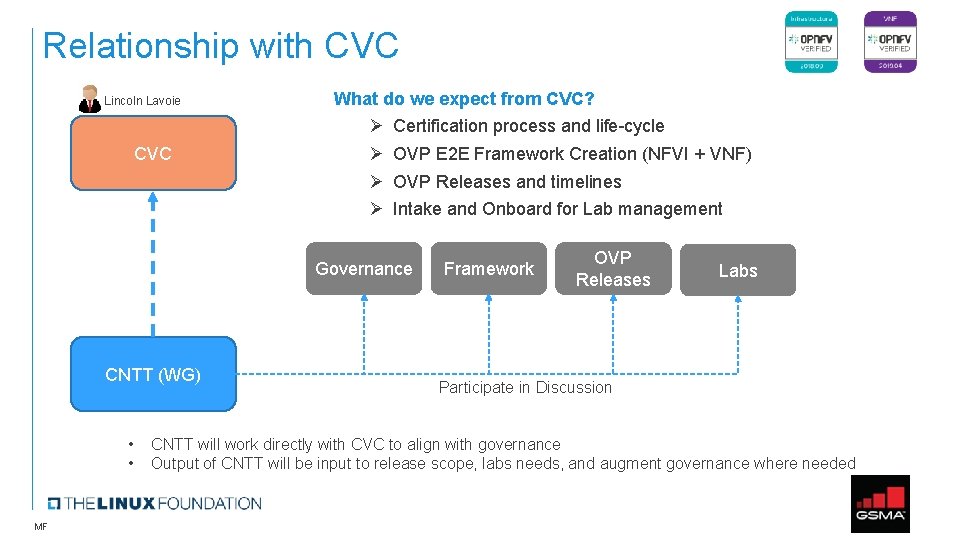
Relationship with CVC Lincoln Lavoie CVC What do we expect from CVC? Ø Ø Certification process and life-cycle OVP E 2 E Framework Creation (NFVI + VNF) OVP Releases and timelines Intake and Onboard for Lab management Governance CNTT (WG) • • MF Framework OVP Releases Labs Participate in Discussion CNTT will work directly with CVC to align with governance Output of CNTT will be input to release scope, labs needs, and augment governance where needed
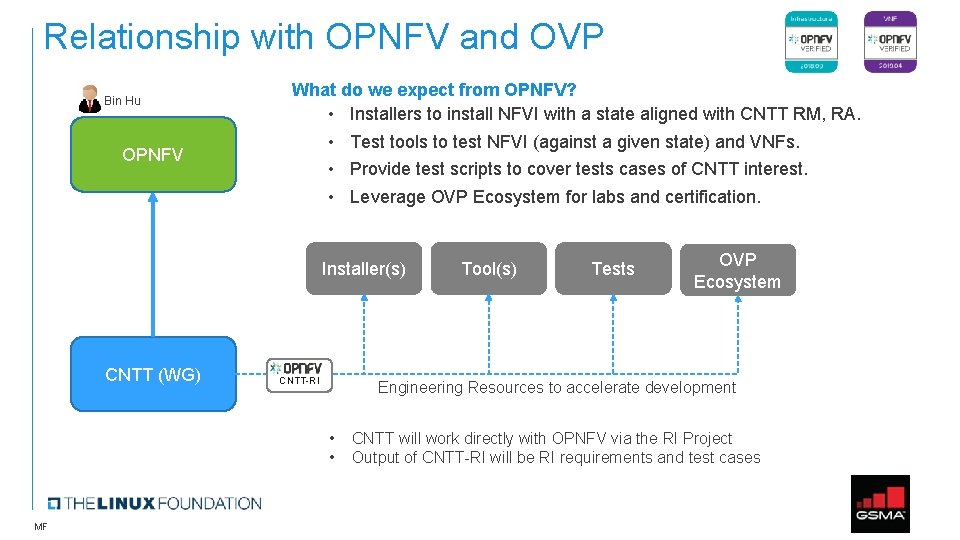
Relationship with OPNFV and OVP Bin Hu What do we expect from OPNFV? • Installers to install NFVI with a state aligned with CNTT RM, RA. • Test tools to test NFVI (against a given state) and VNFs. • Provide test scripts to cover tests cases of CNTT interest. • Leverage OVP Ecosystem for labs and certification. OPNFV Installer(s) CNTT (WG) CNTT-RI Tests OVP Ecosystem Engineering Resources to accelerate development • • MF Tool(s) CNTT will work directly with OPNFV via the RI Project Output of CNTT-RI will be RI requirements and test cases
Chapter 8 Team: North Star Mission Ensure Implementation of CNTT Reference Model and Reference Architecture meets industry driven quality assurance standards for compliance, verification and validation. Objectives • Data Driven RA Verification and Validations • Entry and Exit Quality Standards are satisfied • OPNFV, CVC, and OVP Processes used to onboard and check for NFVI compliance • Ensure test harnesses can be ported and utilized across multiple distributions Guiding Tenets • Verification and Validations determine NFVI+VNF compliance • Verification signals conformance to design requirement specifications • Certifications, are out of scope as this measures adherence to development, however, no code is being delivered by testing • OVP and CVC track and govern RM/RA verification • Validations signals compliance that output of a product meets the expected, or desired outcome MF 22
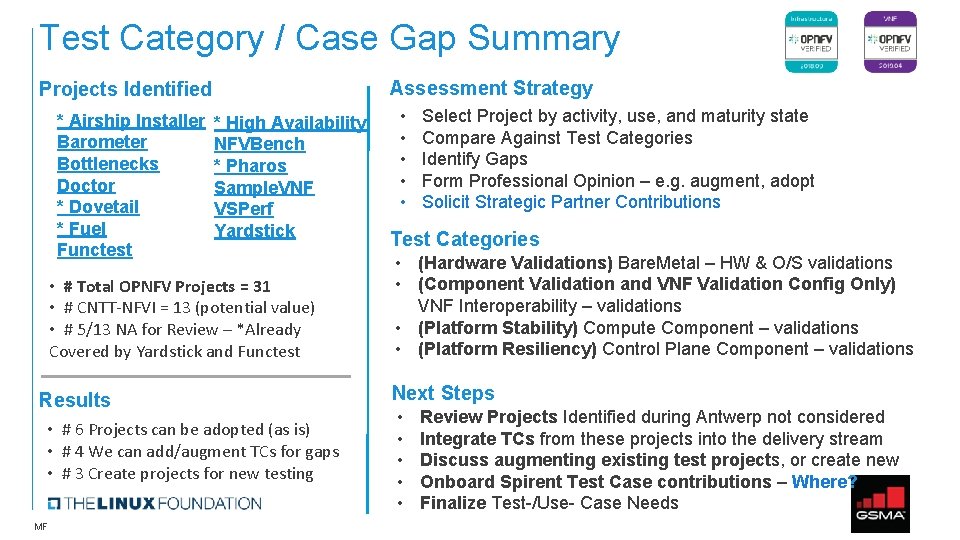
Test Category / Case Gap Summary Assessment Strategy Projects Identified * Airship Installer Barometer Bottlenecks Doctor * Dovetail * Fuel Functest * High Availability NFVBench * Pharos Sample. VNF VSPerf Yardstick • # Total OPNFV Projects = 31 • # CNTT-NFVI = 13 (potential value) • # 5/13 NA for Review – *Already Covered by Yardstick and Functest Results • # 6 Projects can be adopted (as is) • # 4 We can add/augment TCs for gaps • # 3 Create projects for new testing MF • • • Select Project by activity, use, and maturity state Compare Against Test Categories Identify Gaps Form Professional Opinion – e. g. augment, adopt Solicit Strategic Partner Contributions Test Categories • (Hardware Validations) Bare. Metal – HW & O/S validations • (Component Validation and VNF Validation Config Only) VNF Interoperability – validations • (Platform Stability) Compute Component – validations • (Platform Resiliency) Control Plane Component – validations Next Steps • • • Review Projects Identified during Antwerp not considered Integrate TCs from these projects into the delivery stream Discuss augmenting existing test projects, or create new Onboard Spirent Test Case contributions – Where? Finalize Test-/Use- Case Needs
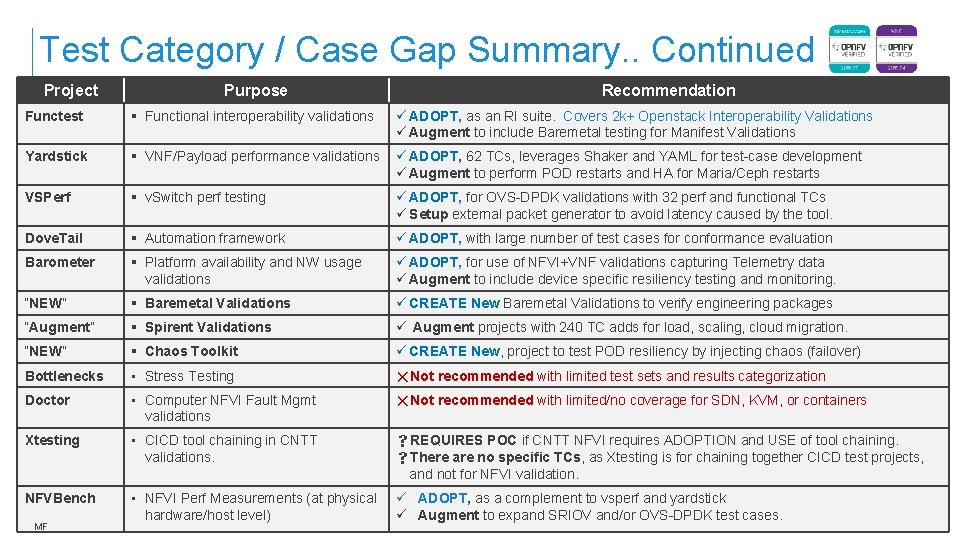
Test Category / Case Gap Summary. . Continued Project Purpose Recommendation Functest Functional interoperability validations ü ADOPT, as an RI suite. Covers 2 k+ Openstack Interoperability Validations ü Augment to include Baremetal testing for Manifest Validations Yardstick VNF/Payload performance validations ü ADOPT, 62 TCs, leverages Shaker and YAML for test-case development ü Augment to perform POD restarts and HA for Maria/Ceph restarts VSPerf v. Switch perf testing ü ADOPT, for OVS-DPDK validations with 32 perf and functional TCs ü Setup external packet generator to avoid latency caused by the tool. Dove. Tail Automation framework ü ADOPT, with large number of test cases for conformance evaluation Barometer Platform availability and NW usage validations ü ADOPT, for use of NFVI+VNF validations capturing Telemetry data ü Augment to include device specific resiliency testing and monitoring. “NEW” Baremetal Validations ü CREATE New Baremetal Validations to verify engineering packages “Augment” Spirent Validations ü Augment projects with 240 TC adds for load, scaling, cloud migration. “NEW” Chaos Toolkit ü CREATE New, project to test POD resiliency by injecting chaos (failover) Bottlenecks • Stress Testing Not recommended with limited test sets and results categorization Doctor • Computer NFVI Fault Mgmt validations Not recommended with limited/no coverage for SDN, KVM, or containers Xtesting • CICD tool chaining in CNTT validations. s. REQUIRES POC if CNTT NFVI requires ADOPTION and USE of tool chaining. s. There are no specific TCs, as Xtesting is for chaining together CICD test projects, and not for NFVI validation. NFVBench • NFVI Perf Measurements (at physical hardware/host level) ü ADOPT, as a complement to vsperf and yardstick ü Augment to expand SRIOV and/or OVS-DPDK test cases. MF