
Common methods forecasting commodity prices Today Historic values

- Slides: 3
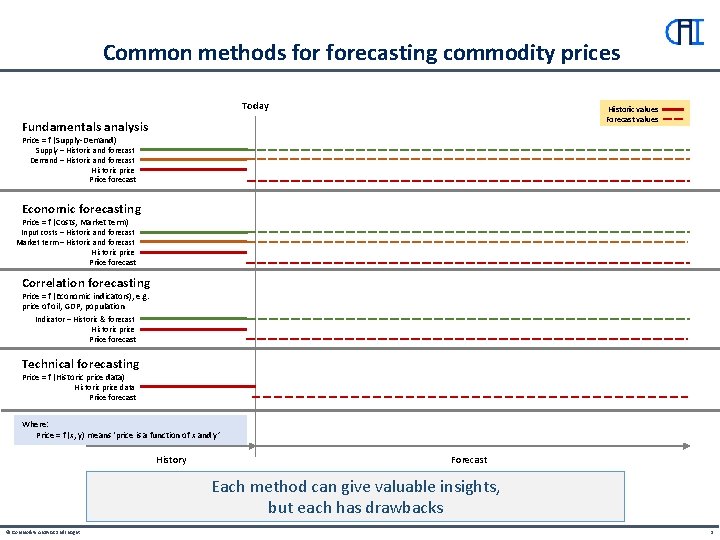
Common methods forecasting commodity prices Today Historic values Forecast values Fundamentals analysis Price = f (Supply-Demand) Supply – Historic and forecast Demand – Historic and forecast Historic price Price forecast Economic forecasting Price = f (Costs, Market term) Input costs – Historic and forecast Market term – Historic and forecast Historic price Price forecast Correlation forecasting Price = f (Economic indicators), e. g. price of oil, GDP, population Indicator – Historic & forecast Historic price Price forecast Technical forecasting Price = f (Historic price data) Historic price data Price forecast Where: Price = f (x, y) means ‘price is a function of x and y’ History Forecast Each method can give valuable insights, but each has drawbacks © Commodity Analysis and Insight 1
No method can be applied in all situations Fundamentals analysis Price = f (Supply-Demand) Supply – Historic and forecast Demand – Historic and forecast Historic price Price forecast Positives • Resonates with industrial players - Capacity utilisation is used to drive investment decisions • Price data is a by-product of the process, not the forecast • • The “supply-demand” balance is difficult to assess Requires granular, often commercially-sensitive data Ignores short-term effects, assumes long-term growth Requires forward-looking, proprietary data Infers demand from the market term, which can be easily assessed, as opposed to supply-demand balance • Uses profitability as an input, a key business metric • Can combine many inputs for deeper forecast • • Market term may be unrelated to the end product May ignore nature of cost-term, e. g. contracts or spot Smooths data into periods, e. g. quarterly, annual Needs sources of trusted data • Quick to implement and often uses free data • Needs no specialist software or understanding of the industry • Easily explainable • Assumes a steady state – Ignores, e. g. changes in technology changes, demand shifts or financialisation • Cannot adapt to short-term effects • Broad-brush, top-line insight only Economic forecasting • Price = f (Costs, Market term) Input costs – Historic and forecast Market term – Historic and forecast Historic price Price forecast Correlation forecasting Price = f (Economic indicators), e. g. price of oil, GDP, population Indicator – Historic & forecast Historic price Price forecast Technical forecasting Price = f (Historic price data) Historic price data Price forecast Negatives • • Can be cheap to develop and use Needs simple forecasting tools Doesn’t require industry knowledge Immediately incorporates freshest data in forecast History • • Affected by non-market effects, e. g. tariffs Time-frame must be relatively short Less intuitive than other methods More modelling produces better forecasts Forecast Use the most appropriate methodology for the company’s needs or combine into a blended forecast © Commodity Analysis and Insight 2
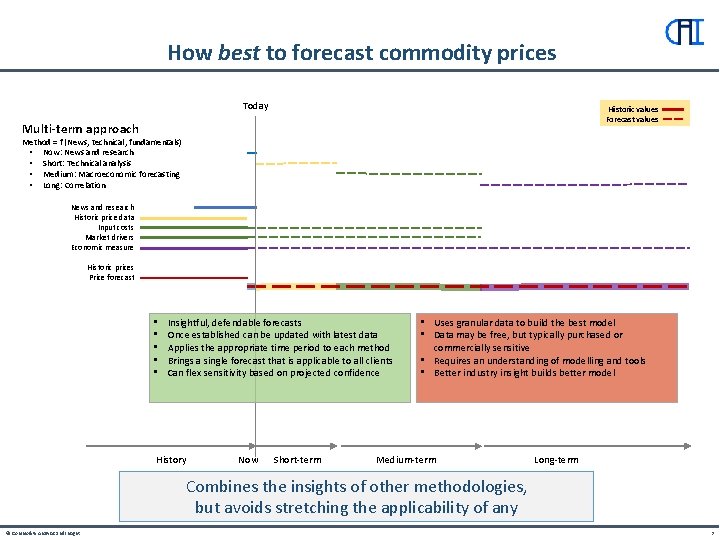
How best to forecast commodity prices Today Historic values Forecast values Multi-term approach Method = f (News, technical, fundamentals) • Now: News and research • Short: Technical analysis • Medium: Macroeconomic forecasting • Long: Correlation News and research Historic price data Input costs Market drivers Economic measure Historic prices Price forecast • • • Insightful, defendable forecasts Once established can be updated with latest data Applies the appropriate time period to each method Brings a single forecast that is applicable to all clients Can flex sensitivity based on projected confidence History Now Short-term • Uses granular data to build the best model • Data may be free, but typically purchased or commercially sensitive • Requires an understanding of modelling and tools • Better industry insight builds better model Medium-term Long-term Combines the insights of other methodologies, but avoids stretching the applicability of any © Commodity Analysis and Insight 3