
Common Logical Fallacies 1 The Ad Hominem Fallacy
- Slides: 26
Common Logical Fallacies
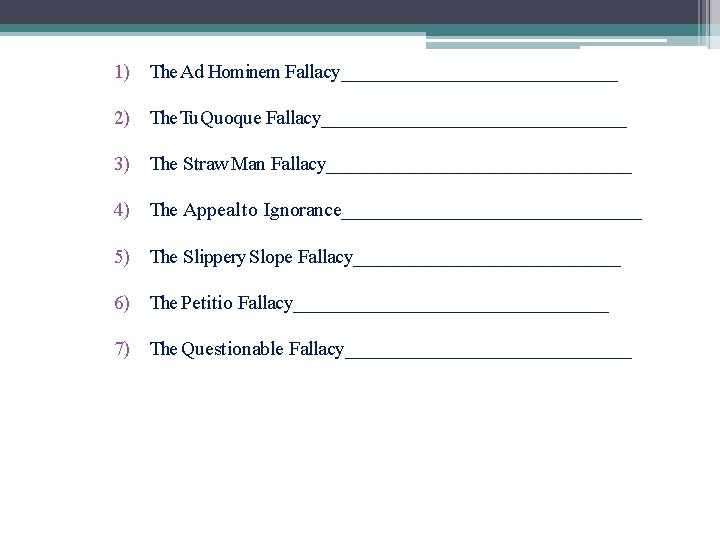
1) The Ad Hominem Fallacy_______________ 2) The Tu. Quoque Fallacy________________ 3) The Straw Man Fallacy________________ 4) The Appeal to Ignorance________________ 5) The Slippery Slope Fallacy______________ 6) The Petitio Fallacy_________________ 7) The Questionable Fallacy_______________
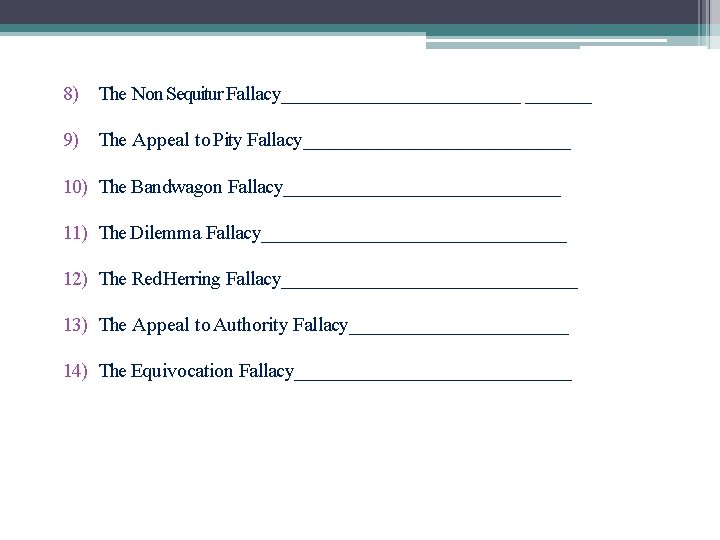
8) The Non Sequitur Fallacy_____________ 9) The Appeal to Pity Fallacy______________ 10) The Bandwagon Fallacy_______________ 11) The Dilemma Fallacy________________ 12) The Red Herring Fallacy________________ 13) The Appeal to Authority Fallacy____________ 14) The Equivocation Fallacy_______________
What is a logical fallacy?
• A logical fallacy is a fault in reasoning. It is an illogical step in the formulation of an argument. • Logical fallacies are used to confuse and convince the other.
1. Ad Hominem • Literally translated as ‘’ to the man’’ subtly or overtly distorts a person’s character, destroying their credibility no matter how valid their argument is. • Example: I was surprised you agreed with her. She is kind of an extremist.
The Tu Quoque Fallacy • “tu quoque”, Latin for “ you too, ” is also called the “appeal to hypocrisy” • it distracts from the argument by pointing out hypocrisy in the opponent Example: Jack says that stealing is wrong, but he is a thief
2. The Straw Man Fallacy • It is responding to an altered version of the argument presented rather than the argument itself. It makes use of misrepresentations to make an argument look weak. • Example: Prolonging semesters might help students get better grades. Why do you want to overwork professors and students? Why do you want the number of those who drop out of school every year increase?
3. The Appeal to Ignorance • Also called “ Ad ignorantiam’’ • A statement is true as long as there’s no evidence that it’s wrong. • Example: Since students have no questions , they have all understood the lesson very well
4. The Slippery Slope Fallacy • It is a conclusion based on the premise that one small step will lead to a chain of events resulting in significant negative effects. • Example 1: -> If you do not wear clothes while it rains, you will be sick -> If you get sick, you will not attend an important test -> If you do not attend the test, you will not succeed. • Example 2: If I give you a raise, then I’ll need to give everyone a raise, and the company will go bankrupt
5. The Petitio Fallacy • Also known as ‘’Begging the question‘’ Or ‘’Circular reasoning’’ • This fallacy leans you an argument that may not be true in the first place. • It’s when the conclusion and the premise are exactly the same. The conclusion is a paraphrased premise
Nike makes the best shoes in the world • The company that makes the best shoes in the world can pay its employees more. • Companies that pay their employees more can hire the best people. • The best people can make the best shoes in the world.
6. The Questionable Fallacy • Also called ‘’ Non Causa Pro Causa ‘’ • The fallacy of Non Causa Pro Causa is presuming that a real or perceived relationship between things means that one thing is the cause of another one.
• Example 1: We have never had a problem with this elevator until you moved into the building • Example 2: They had a very successful business, and then they decided to adopt a child, and they immediately went bankrupt
7. The Non Sequitur Fallacy • Translated as ‘’it does not follow’’ • Non sequitur refers to any claim that doesn’t follow from its premises or is supported by irrelevant premises. • Example: I should not receive a C in this course. I never get Cs
8. The Appeal to Pity Fallacy • The appeal to Pity , is a fallacy through which one tries to gain support for an argument or idea by exploiting their opponent's feeling or Pity or guilt. • Example: I know I made a poor decision, but let’s just look at how hard my job is.
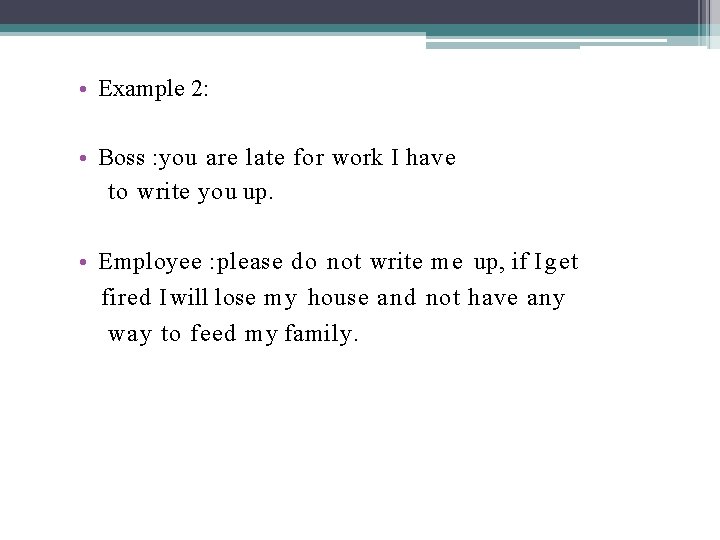
• Example 2: • Boss : you are late for work I have to write you up. • Employee : please do not write m e up, if I get fired I will lose m y house and not have any way to feed m y family.
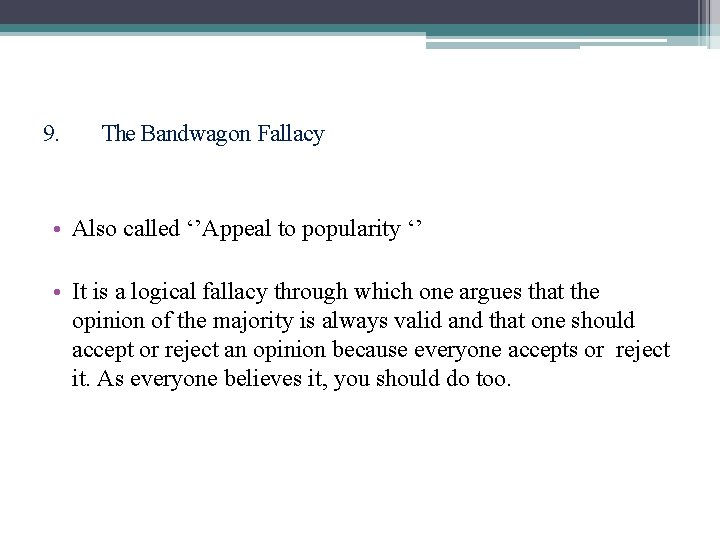
9. The Bandwagon Fallacy • Also called ‘’Appeal to popularity ‘’ • It is a logical fallacy through which one argues that the opinion of the majority is always valid and that one should accept or reject an opinion because everyone accepts or reject it. As everyone believes it, you should do too.
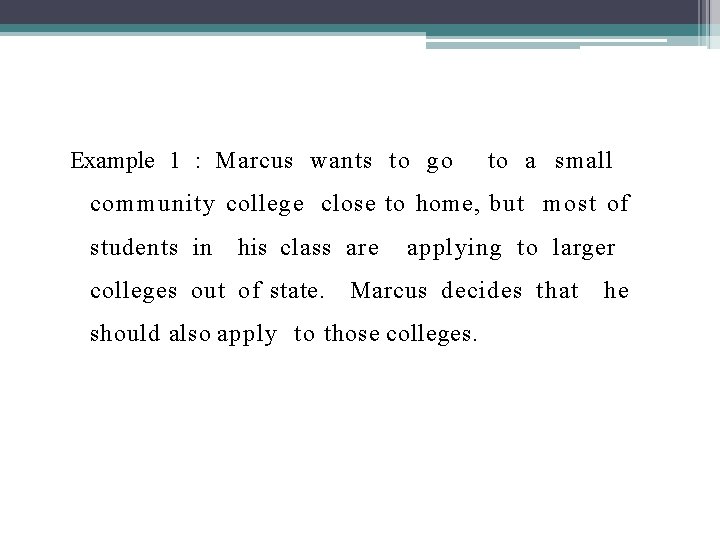
Example 1 : Marcus wants to go to a small community college close to home, but most of students in his class are colleges out of state. applying to larger Marcus decides that should also apply to those colleges. he
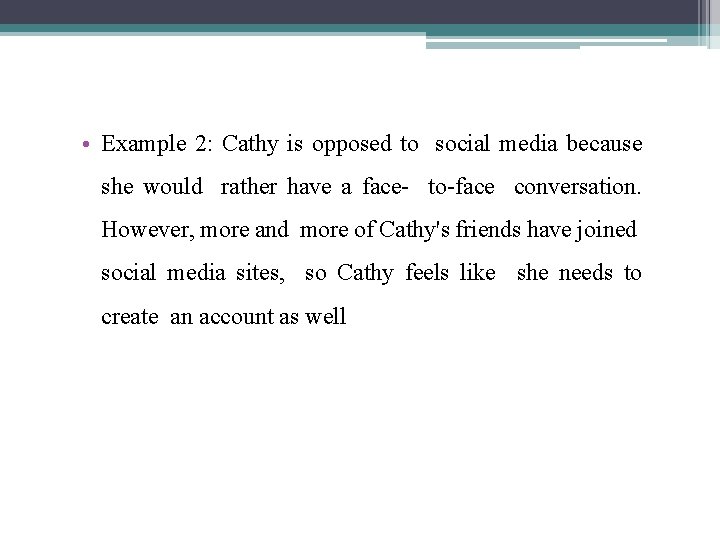
• Example 2: Cathy is opposed to social media because she would rather have a face- to-face conversation. However, more and more of Cathy's friends have joined social media sites, so Cathy feels like she needs to create an account as well
10. The Dilemma Fallacy • This fallacy has a few other names: " black and white fallacy" "either-or fallacy" and "false dichotomy". • Dilemma fallacy is defined as presenting only two choices for an issue when there may actually be additional options.
• Example "one of us has to be right“ • Example 2: ” Either you are with us, or you are with the terrorists” President Bush
11. The Red Herring Fallacy • A red herring is an emotionally charged issue brought up to divert attention from something the manipulator wants to avoid. • Example: ‘’you asked me why the unemployment rate has risen again, but I’ll tell you what’s affecting this country’s morale in even worse ways than that. ’’
12. The Appeal to Authority Fallacy • Traditionally called Argumentum ad Verecundiam • It is when someone uses the testimony of an authority in order to warrant their conclusion, but the authority appealed to is not an expert in the field in question. • Example: “This is a brand Oprah uses” “ Steve jobs used to drink a cup of Twinnings tea every morning at 9. He says it boosted his creativity”
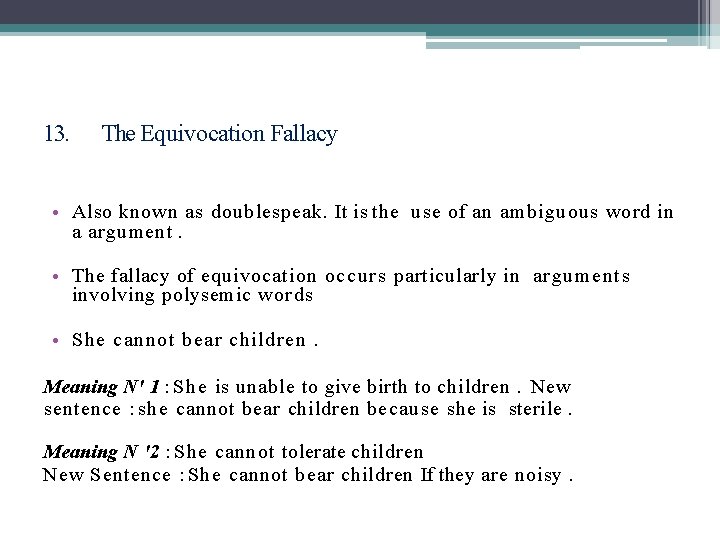
13. The Equivocation Fallacy • Also known as doublespeak. It is the use of an ambiguous word in a argument. • The fallacy of equivocation occurs particularly in arguments involving polysemic words • She cannot bear children. Meaning N' 1 : She is unable to give birth to children. New sentence : she cannot bear children because she is sterile. Meaning N '2 : She cannot tolerate children New Sentence : She cannot bear children If they are noisy.
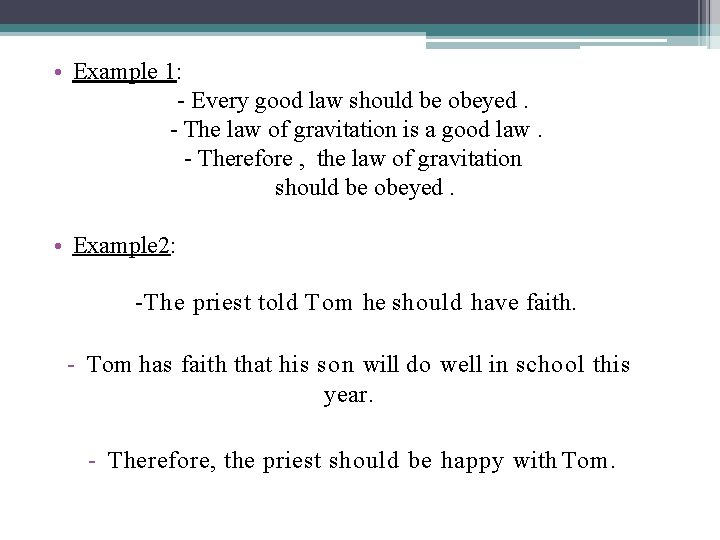
• Example 1: - Every good law should be obeyed. - The law of gravitation is a good law. - Therefore , the law of gravitation should be obeyed. • Example 2: -The priest told Tom he should have faith. - Tom has faith that his son will do well in school this year. - Therefore, the priest should be happy with Tom.