
Common Language Infrastructure CLI Introduction and Class Library
Common Language Infrastructure (CLI) Introduction and Class Library Factorization Hewlett. Packard Intel Microsoft
Outline ® What is the CLI? ® Factoring the Base Class Libraries ® Categories ® Packages by Category ® Questions and Answers
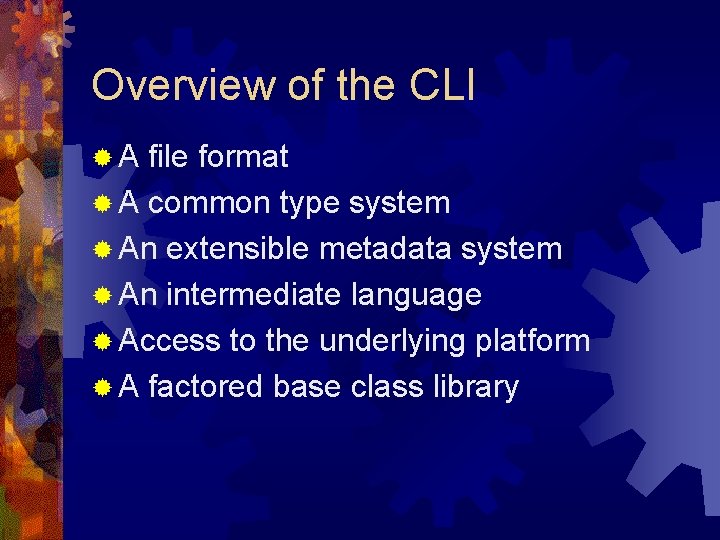
Overview of the CLI ®A file format ® A common type system ® An extensible metadata system ® An intermediate language ® Access to the underlying platform ® A factored base class library

File Format ® Based on COFF ® Uses existing extension mechanism ® Code represented as MSIL instructions ® Metadata stored in read-only area ® EAT / IAT for access to platform only ® Methods include a descriptive header Stack frame size ® Types of local variables and parameters ® Pinned variable information ® Exception handler table ®

Common Type System ® Spans large number of languages ® Object-oriented in flavor ® Supports procedural and functional languages, too ® Includes value types (“structs”), pointers, and by-reference values ® Subset for wide reach ® Common Language Specification (CLS)
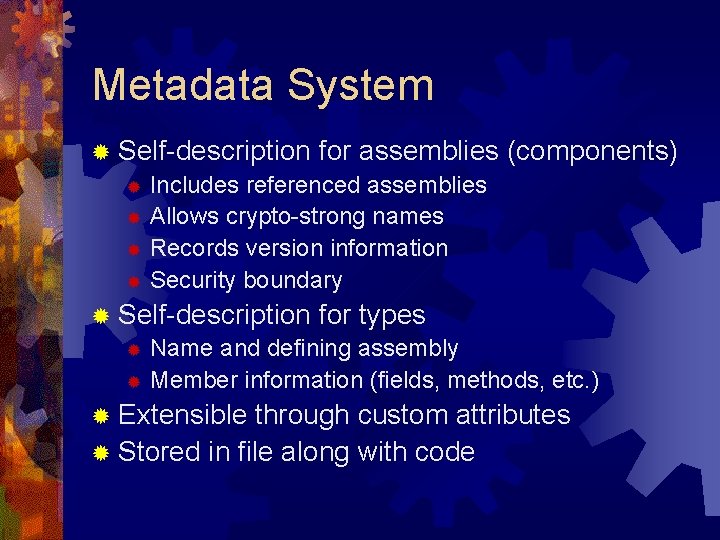
Metadata System ® Self-description for assemblies ® Includes referenced assemblies ® Allows crypto-strong names ® Records version information ® Security boundary (components) ® Self-description for types ® Name and defining assembly ® Member information (fields, methods, etc. ) ® Extensible through custom attributes ® Stored in file along with code
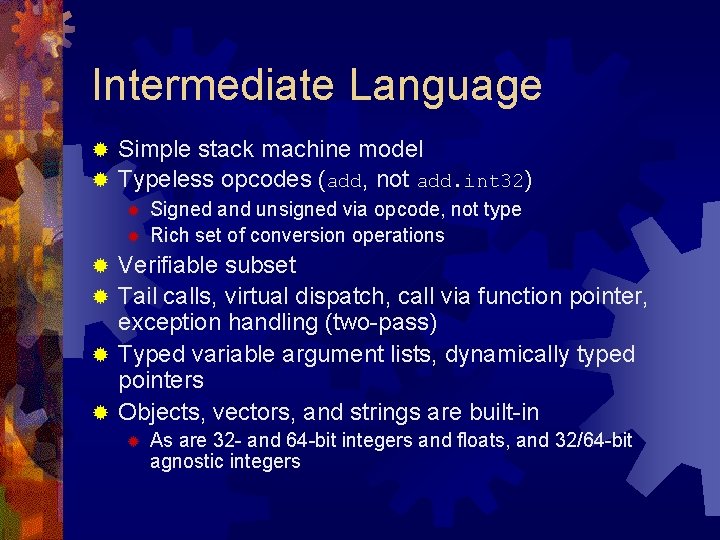
Intermediate Language Simple stack machine model ® Typeless opcodes (add, not add. int 32) ® ® ® Signed and unsigned via opcode, not type Rich set of conversion operations Verifiable subset ® Tail calls, virtual dispatch, call via function pointer, exception handling (two-pass) ® Typed variable argument lists, dynamically typed pointers ® Objects, vectors, and strings are built-in ® ® As are 32 - and 64 -bit integers and floats, and 32/64 -bit agnostic integers
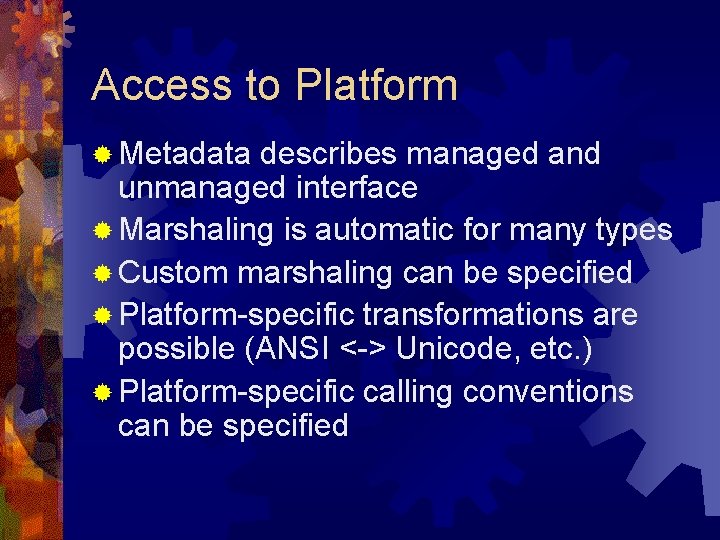
Access to Platform ® Metadata describes managed and unmanaged interface ® Marshaling is automatic for many types ® Custom marshaling can be specified ® Platform-specific transformations are possible (ANSI <-> Unicode, etc. ) ® Platform-specific calling conventions can be specified
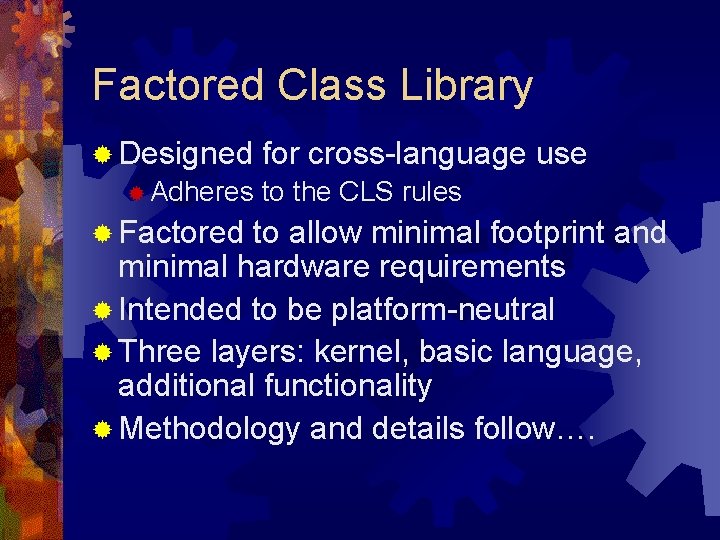
Factored Class Library ® Designed ® Adheres ® Factored for cross-language use to the CLS rules to allow minimal footprint and minimal hardware requirements ® Intended to be platform-neutral ® Three layers: kernel, basic language, additional functionality ® Methodology and details follow….
Outline ® What is the CLI? ® Factoring the Base Class Libraries ® Categories ® Packages by Category ® Questions and Answers
Goals ® Factored Class Library ® Size constraints (RAM, ROM, Flash) ® Computational constraints (FPU, 64 bit support) ® Feature requirements ® Factored Execution Environment ® Minimal base is always present ® File format independent of factorization ® Library factorization is the driver ® Standardization allows … ® … vendors to specify what’s available ® … developers to specify requirements
Methodology ® Define Kernel ® Fixes file format ® Minimal functionality and hardware ® Hand-picked classes and methods ® Define Basic Language ® Minimal hardware support required ® Most common language features ® ® Features required for C# with minimal hardware support Depends on classes defined in Kernel ® Package each advanced function separately ® Implemented a la cart by runtime vendors ® Required a la cart by developers
Defining a Package ® Choose the classes ® A class can only be in one package ® Minimize and specify dependencies on packages ® Base class in package or one it depends on ® Basic Language depends on the Kernel package ® All other packages depend on both Kernel and Basic Language ® Compute the missing methods Check it makes sense, new dependencies ® Interfaces may be in another package ® ® Methods will exist, just can’t cast to interface
Languages and Packages ® C# ® Requires Kernel, Basic Language, and Extended Numerics ® ECMAScript ® Requires ® ISO above plus Reflection C++ ® Requires Kernel, Basic Language, Extended Numerics, and Non. CLS
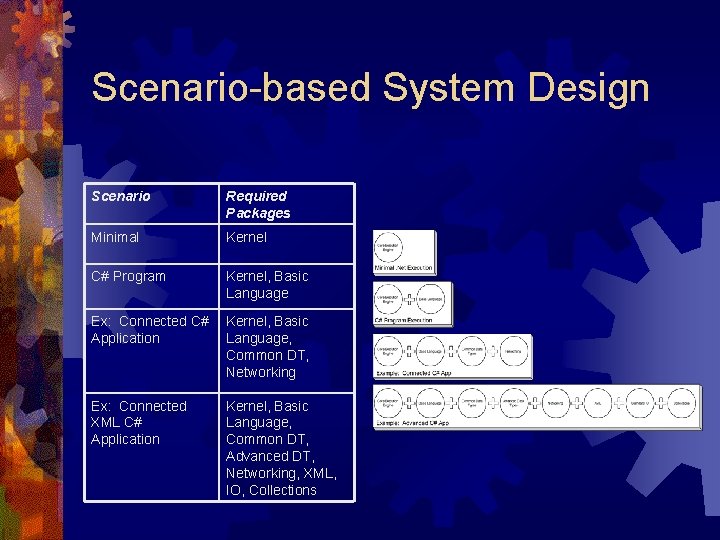
Scenario-based System Design Scenario Required Packages Minimal Kernel C# Program Kernel, Basic Language Ex: Connected C# Application Kernel, Basic Language, Common DT, Networking Ex: Connected XML C# Application Kernel, Basic Language, Common DT, Advanced DT, Networking, XML, IO, Collections
Outline ® What is the CLI? ® Factoring the Base Class Libraries ® Categories ® Packages by Category ® Questions and Answers
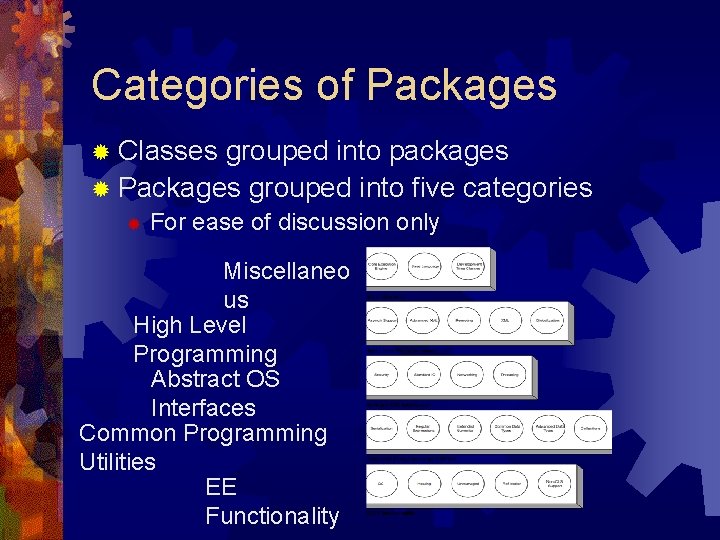
Categories of Packages ® Classes grouped into packages ® Packages grouped into five categories ® For ease of discussion only Miscellaneo us High Level Programming Abstract OS Interfaces Common Programming Utilities EE Functionality
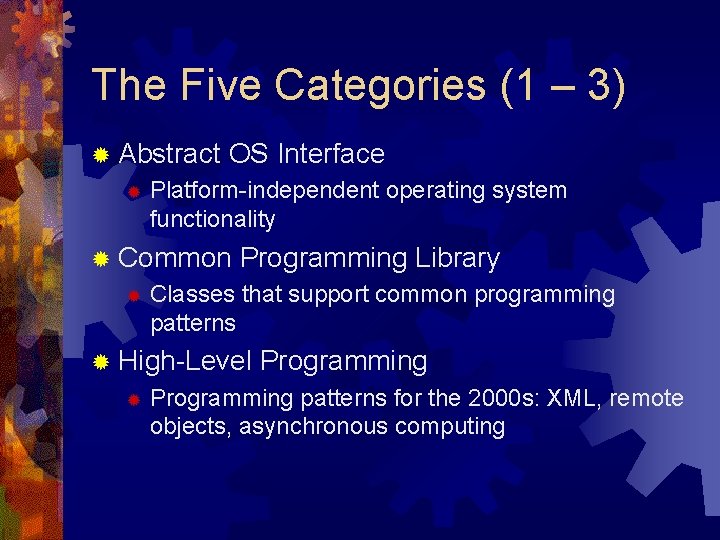
The Five Categories (1 – 3) ® Abstract ® OS Interface Platform-independent operating system functionality ® Common ® Programming Library Classes that support common programming patterns ® High-Level ® Programming patterns for the 2000 s: XML, remote objects, asynchronous computing
The Five Categories (4 – 5) ® EE Functionality ® Revealing underlying operations to programming languages ® Miscellaneous ® Kernel, Basic Language, and support for developers
Outline ® What is the CLI? ® Factoring the Base Class Libraries ® Categories ® Packages by Category ® Questions and Answers
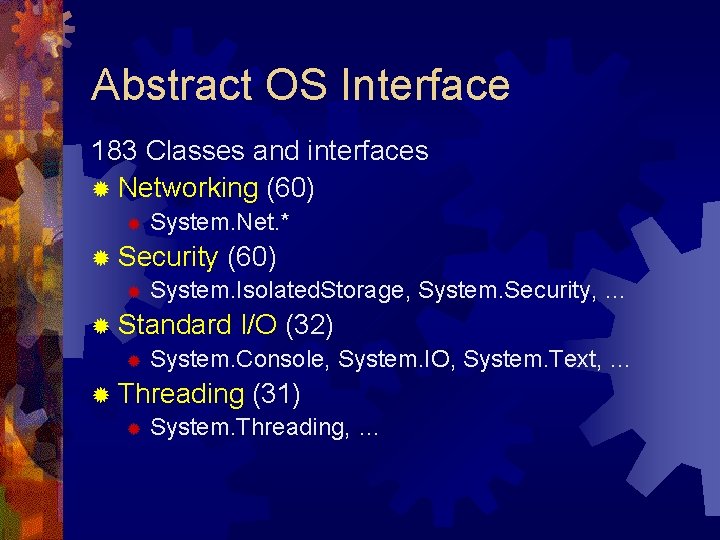
Abstract OS Interface 183 Classes and interfaces ® Networking (60) ® System. Net. * ® Security (60) ® System. Isolated. Storage, System. Security, … ® Standard I/O (32) ® System. Console, System. IO, System. Text, … ® Threading (31) ® System. Threading, …
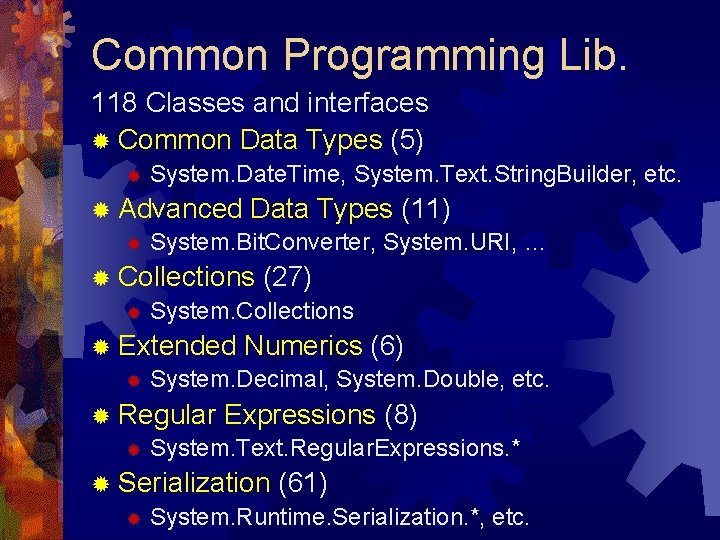
Common Programming Lib. 118 Classes and interfaces ® Common Data Types (5) ® System. Date. Time, System. Text. String. Builder, etc. ® Advanced Data Types (11) ® System. Bit. Converter, System. URI, … ® Collections (27) ® System. Collections ® Extended Numerics (6) ® System. Decimal, System. Double, etc. ® Regular Expressions (8) ® System. Text. Regular. Expressions. * ® Serialization (61) ® System. Runtime. Serialization. *, etc.
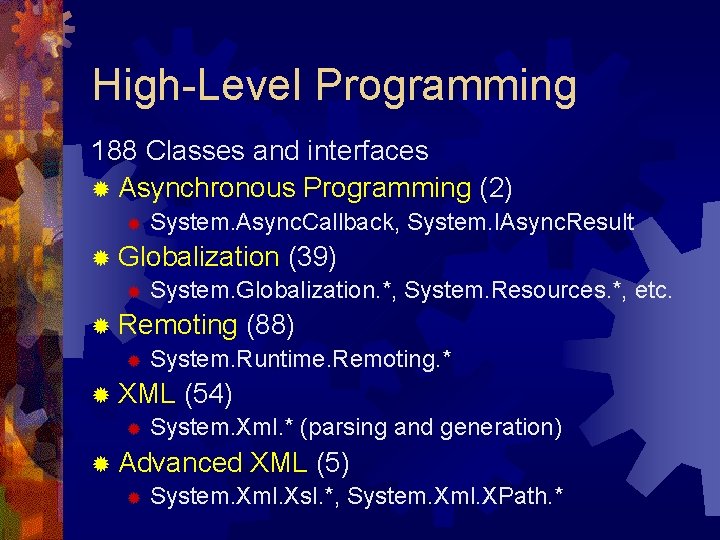
High-Level Programming 188 Classes and interfaces ® Asynchronous Programming (2) ® System. Async. Callback, System. IAsync. Result ® Globalization (39) ® System. Globalization. *, System. Resources. *, etc. ® Remoting (88) ® System. Runtime. Remoting. * ® XML (54) ® System. Xml. * (parsing and generation) ® Advanced XML (5) ® System. Xml. Xsl. *, System. Xml. XPath. *
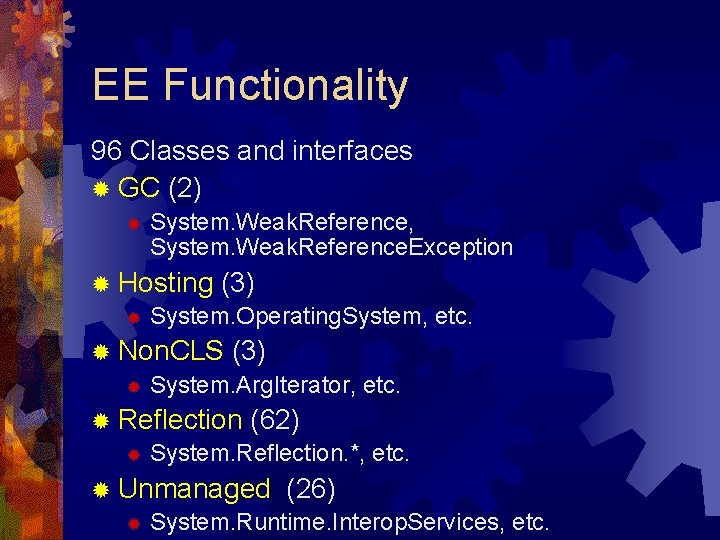
EE Functionality 96 Classes and interfaces ® GC (2) ® System. Weak. Reference, System. Weak. Reference. Exception ® Hosting (3) ® System. Operating. System, etc. ® Non. CLS (3) ® System. Arg. Iterator, etc. ® Reflection (62) ® System. Reflection. *, etc. ® Unmanaged (26) ® System. Runtime. Interop. Services, etc.
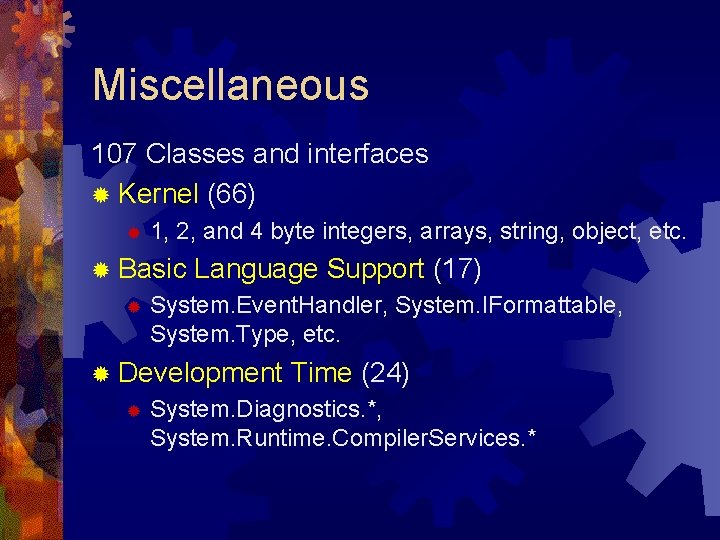
Miscellaneous 107 Classes and interfaces ® Kernel (66) ® 1, 2, and 4 byte integers, arrays, string, object, etc. ® Basic ® Language Support (17) System. Event. Handler, System. IFormattable, System. Type, etc. ® Development ® Time (24) System. Diagnostics. *, System. Runtime. Compiler. Services. *
Outline ® What is the CLI? ® Factoring the Base Class Libraries ® Categories ® Packages by Category ® Questions and Answers
- Slides: 26