
Common Lab Sources 1 Radioactive Sources 2 Radionuclides
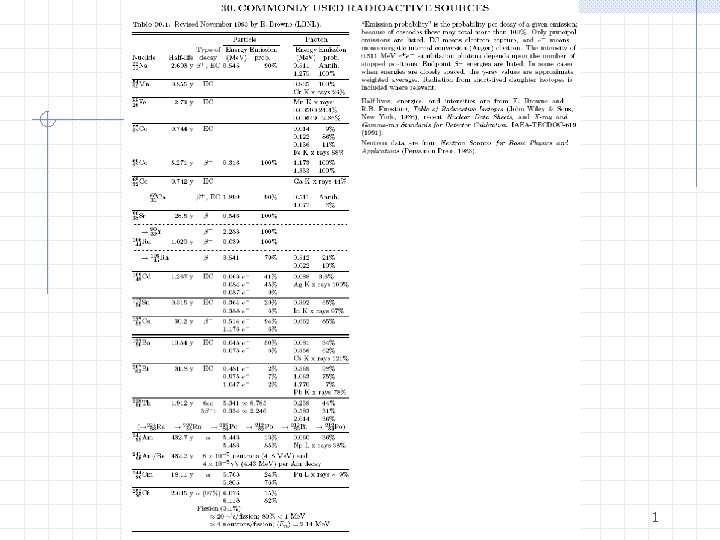
Common Lab Sources 1
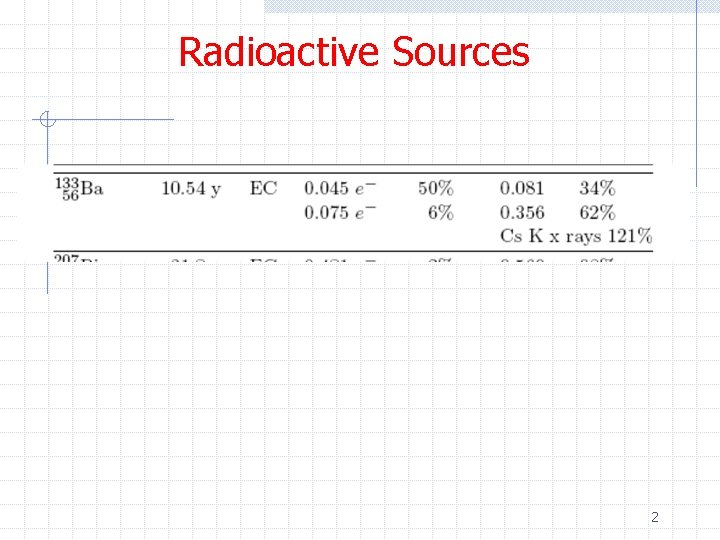
Radioactive Sources 2
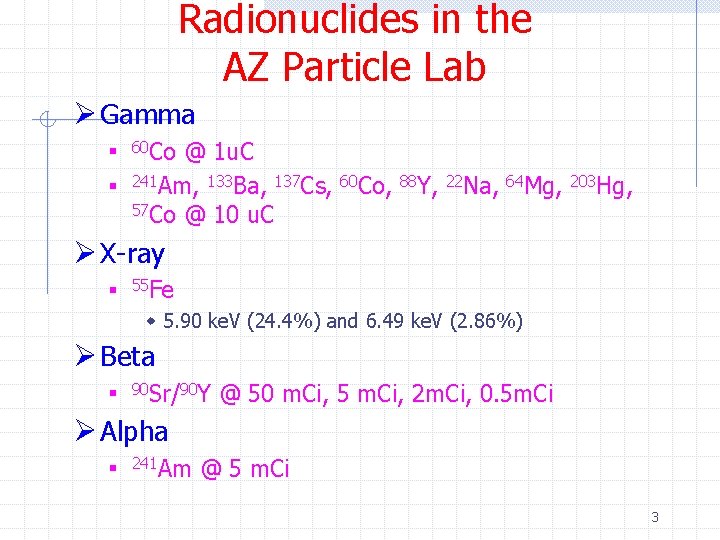
Radionuclides in the AZ Particle Lab Ø Gamma n n 60 Co @ 1 u. C 241 Am, 133 Ba, 137 Cs, 57 Co @ 10 u. C 60 Co, 88 Y, 22 Na, 64 Mg, 203 Hg, Ø X-ray n 55 Fe w 5. 90 ke. V (24. 4%) and 6. 49 ke. V (2. 86%) Ø Beta n 90 Sr/90 Y @ 50 m. Ci, 5 m. Ci, 2 m. Ci, 0. 5 m. Ci Ø Alpha n 241 Am @ 5 m. Ci 3
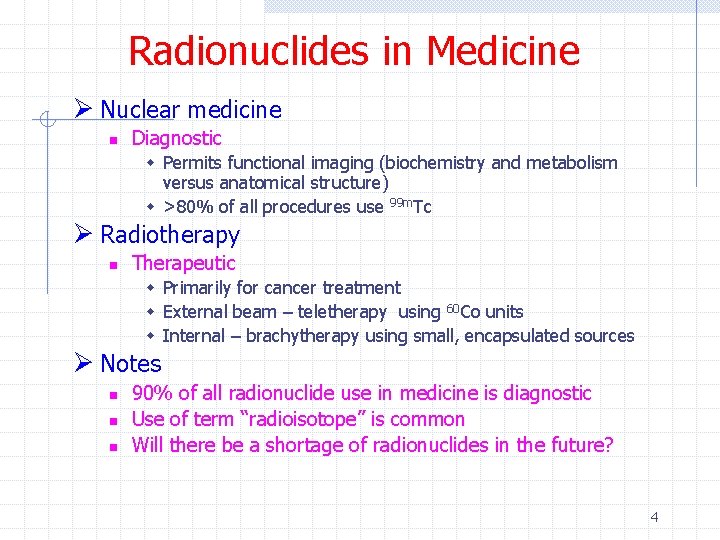
Radionuclides in Medicine Ø Nuclear medicine n Diagnostic w Permits functional imaging (biochemistry and metabolism versus anatomical structure) w >80% of all procedures use 99 m. Tc Ø Radiotherapy n Therapeutic w Primarily for cancer treatment w External beam – teletherapy using 60 Co units w Internal – brachytherapy using small, encapsulated sources Ø Notes n n n 90% of all radionuclide use in medicine is diagnostic Use of term “radioisotope” is common Will there be a shortage of radionuclides in the future? 4
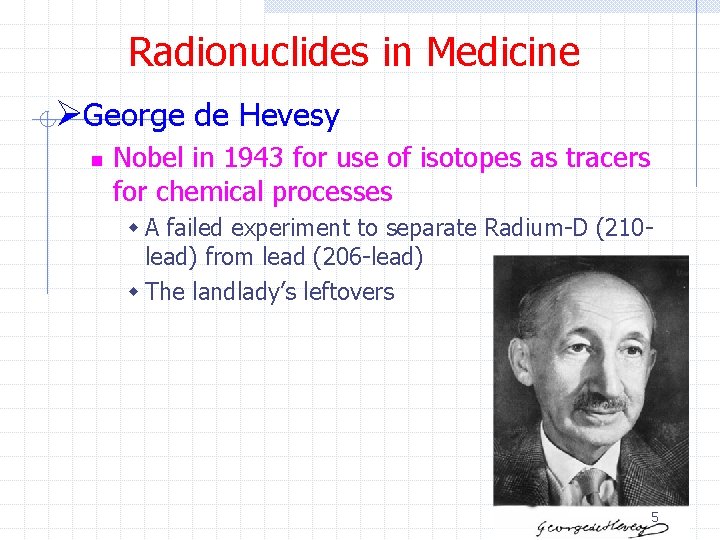
Radionuclides in Medicine ØGeorge de Hevesy n Nobel in 1943 for use of isotopes as tracers for chemical processes w A failed experiment to separate Radium-D (210 lead) from lead (206 -lead) w The landlady’s leftovers 5
Radionuclides for Diagnosis ØWhat are the characteristics of an ideal radionuclide for diagnosis? n Half-life? w Effective half-life 1/teff = 1/tradioactivity + 1/tbiological n n Type and energy of radiation? Production and expense? Purity? Target area to non-target ratio? 6
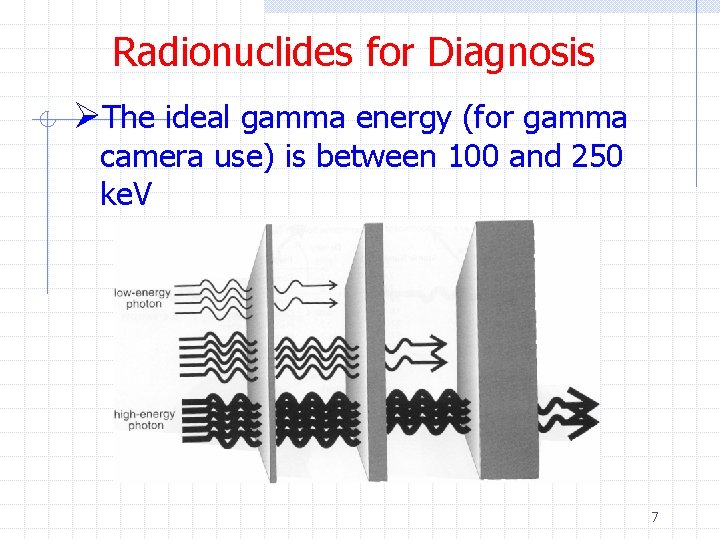
Radionuclides for Diagnosis ØThe ideal gamma energy (for gamma camera use) is between 100 and 250 ke. V 7
Nuclear Medicine Ø 99 m. Tc is used in ~ 80% of diagnostic procedures n 99 m. Tc pertechnetate (Tc. O 4 -) is mixed with an appropriate pharmaceutical (biological construct) for use for w w w w Cardiac imaging and function Skeletal and bone marrow imaging Pulmonary perfusion Liver and spleen function Cerebral perfusion Mammography Venous thrombosis Tumor location 8
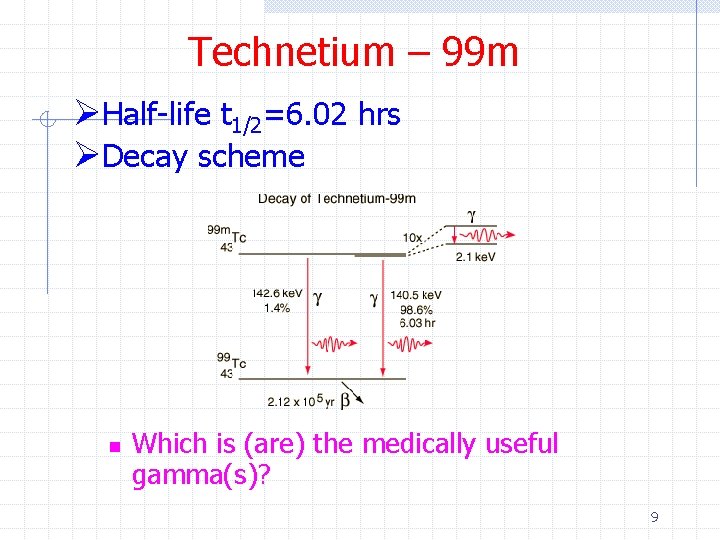
Technetium – 99 m ØHalf-life t 1/2=6. 02 hrs ØDecay scheme n Which is (are) the medically useful gamma(s)? 9
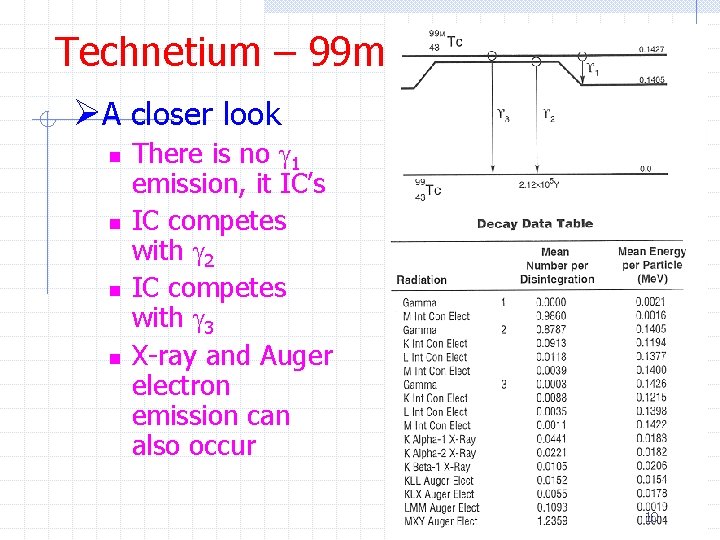
Technetium – 99 m ØA closer look n n There is no g 1 emission, it IC’s IC competes with g 2 IC competes with g 3 X-ray and Auger electron emission can also occur 10
Radionuclides for Therapy Ø Brachytherapy n n Brachys = short Brachytherapy uses encapsulated radioactive sources to deliver a high dose to tissues near the source w Provides localized delivery of dose w But the tumor must be well localized and small n n Proposed by Pierre Curie and, independently, Alexander Graham Bell shortly after the discovery of radioactivity Inverse square law determines most of the dosimetric effect 11
Brachytherapy ØUsed to treat a variety of cancers n n Prostate Gynecological Eye Skin ØOnly ~10% of radiotherapy patients are treated via brachytherapy 12
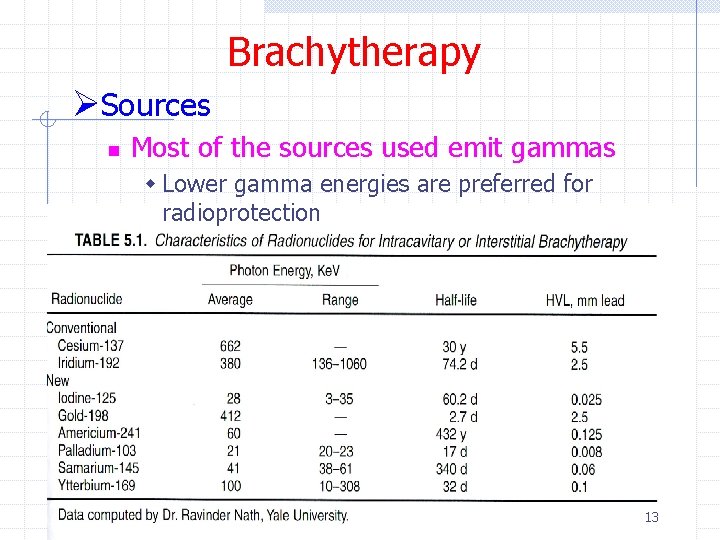
Brachytherapy ØSources n Most of the sources used emit gammas w Lower gamma energies are preferred for radioprotection 13
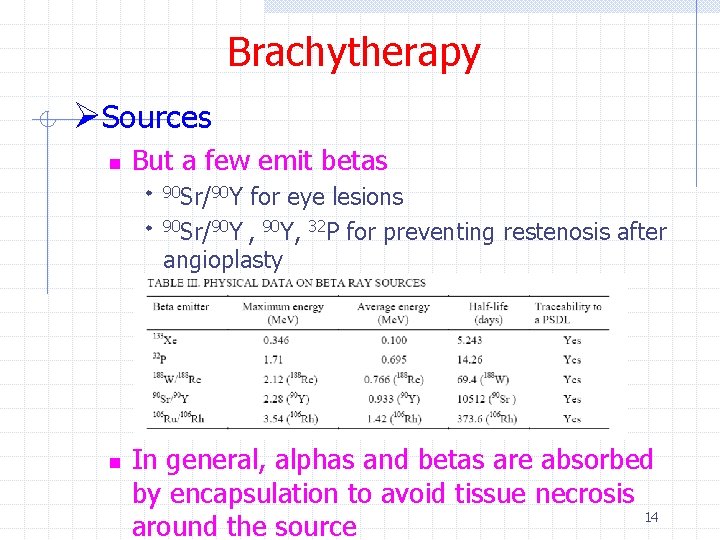
Brachytherapy ØSources n But a few emit betas w 90 Sr/90 Y w n for eye lesions 90 Sr/90 Y , 90 Y, 32 P for preventing restenosis after angioplasty In general, alphas and betas are absorbed by encapsulation to avoid tissue necrosis 14 around the source
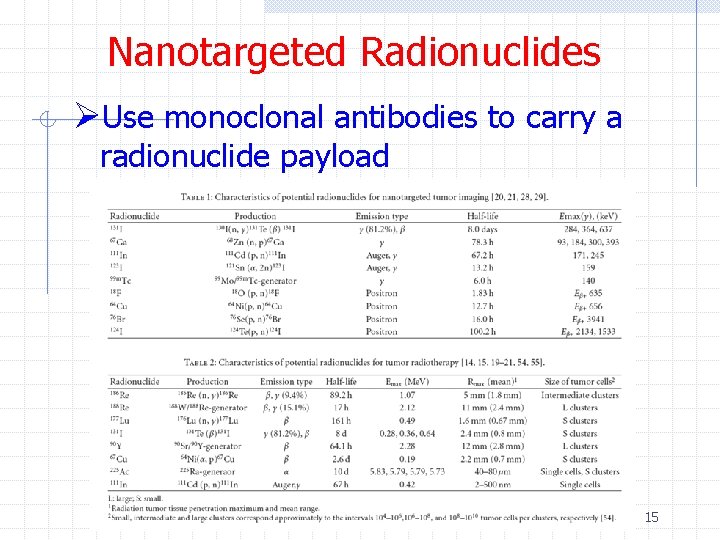
Nanotargeted Radionuclides ØUse monoclonal antibodies to carry a radionuclide payload 15
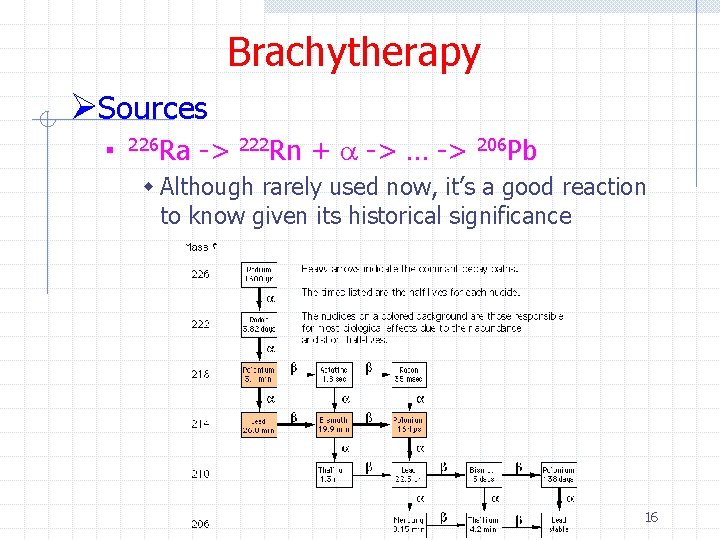
Brachytherapy ØSources n 226 Ra -> 222 Rn + a -> … -> 206 Pb w Although rarely used now, it’s a good reaction to know given its historical significance 16
Brachytherapy ØSources n 226 Ra -> 222 Rn + a -> … -> 206 Pb w Which equilibrium is achieved (t 1/2(226 Ra) = 1600 years)? w 222 Rn is a radioactive gas w About 50 gamma energies are possible ranging from 0. 184 to 2. 45 Me. V, though on average there are 2. 2 gammas emitted for each decay w The average energy (filtered by 0. 5 mm of Pt) is 0. 83 Me. V w The exposure rate constant (assuming 0. 5 mm of Pt) is G = 8. 25 R-cm 2/hr-m. Ci 17
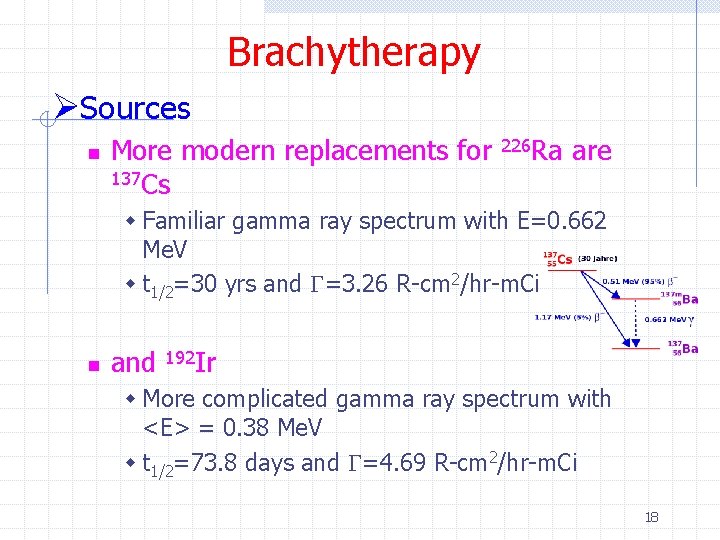
Brachytherapy ØSources n More modern replacements for 137 Cs 226 Ra are w Familiar gamma ray spectrum with E=0. 662 Me. V w t 1/2=30 yrs and G=3. 26 R-cm 2/hr-m. Ci n and 192 Ir w More complicated gamma ray spectrum with <E> = 0. 38 Me. V w t 1/2=73. 8 days and G=4. 69 R-cm 2/hr-m. Ci 18
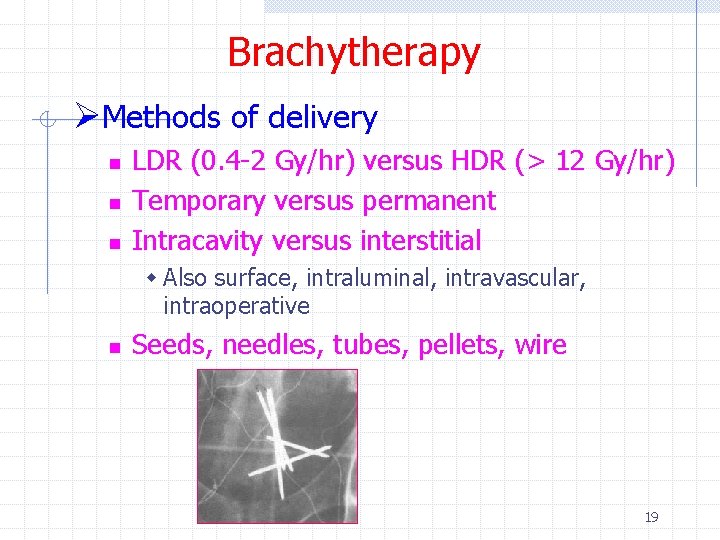
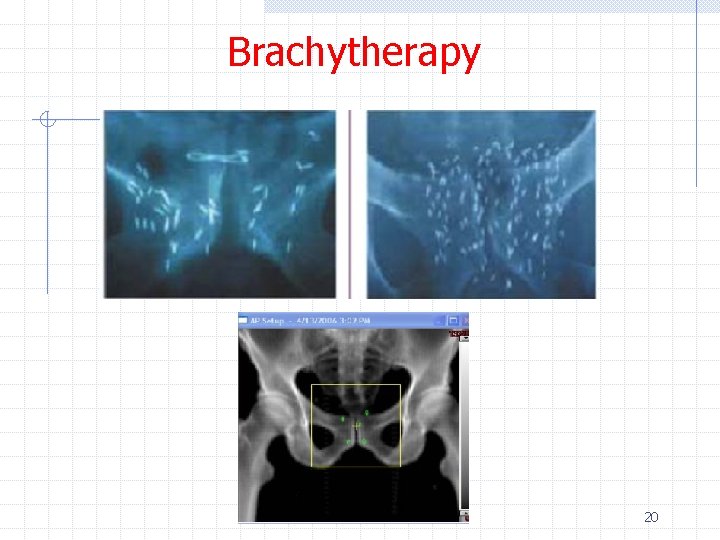
Brachytherapy ØMethods of delivery n n n LDR (0. 4 -2 Gy/hr) versus HDR (> 12 Gy/hr) Temporary versus permanent Intracavity versus interstitial w Also surface, intraluminal, intravascular, intraoperative n Seeds, needles, tubes, pellets, wire 19
Brachytherapy 20
Radionuclide Production ØHow are radionuclides made? n Primary sources w Nuclear reactors n n n 235 U fission produced Neutron activated Both produce neutron rich radionuclides w Cyclotrons n n n Uses charged particle beams (p, d, t, a) Produces proton rich radionuclides Secondary source w Radionuclide generators 21
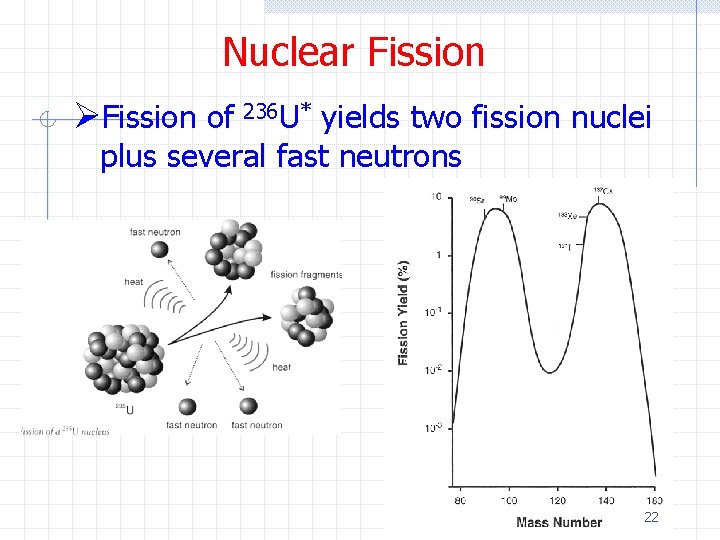
Nuclear Fission ØFission of 236 U* yields two fission nuclei plus several fast neutrons 22
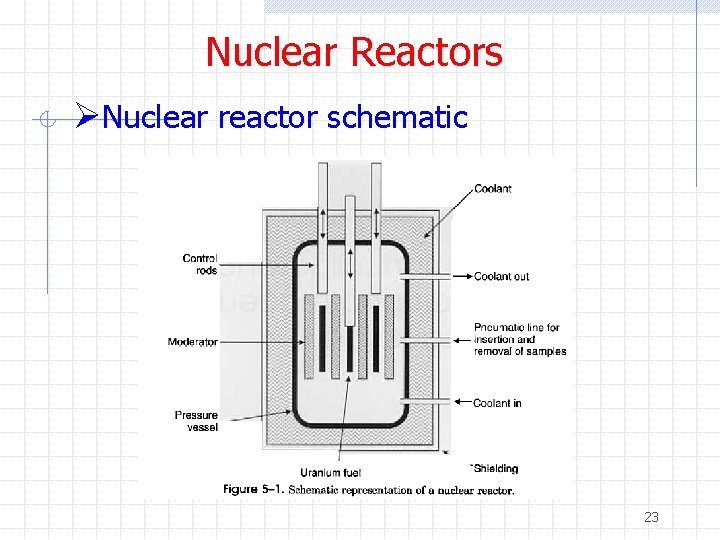
Nuclear Reactors ØNuclear reactor schematic 23
Fission Production Ø Nuclei such as 99 Mo, 131 I, and 133 Xe are produced in the fission products using an enriched 235 U target (HEU – 90%) Ø Complex chemical processing (digestion or dissolution) and purification separates the 99 Mo from chemically similar elements and radiocontaminents n The result is a high specific activity (Bq/kg), carrier free nuclide w This means there is no stable isotope of the element of interest w Some negatives are the potential proliferation of HEU targets and radioactive waste 24
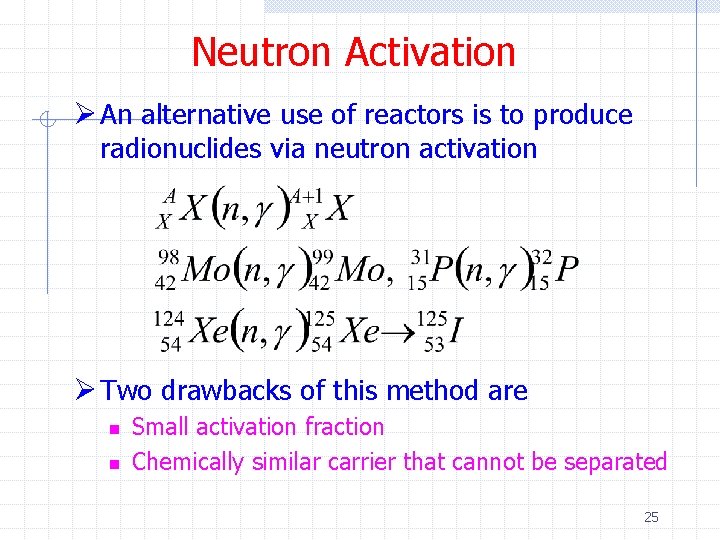
Neutron Activation Ø An alternative use of reactors is to produce radionuclides via neutron activation Ø Two drawbacks of this method are n n Small activation fraction Chemically similar carrier that cannot be separated 25
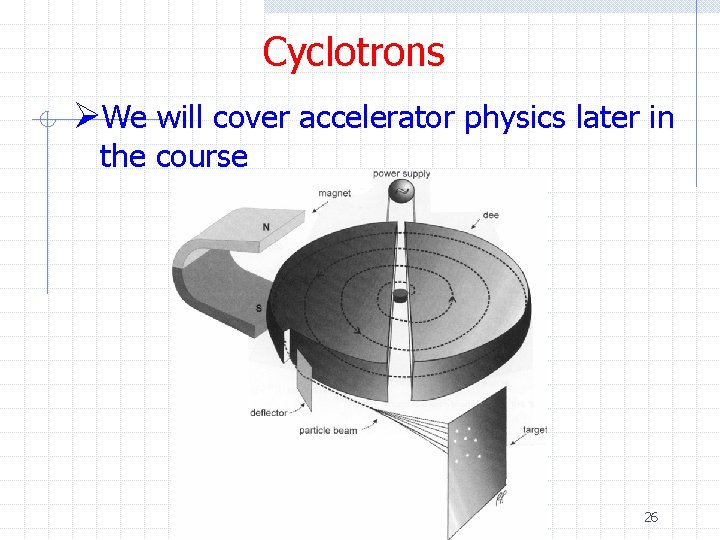
Cyclotrons ØWe will cover accelerator physics later in the course 26
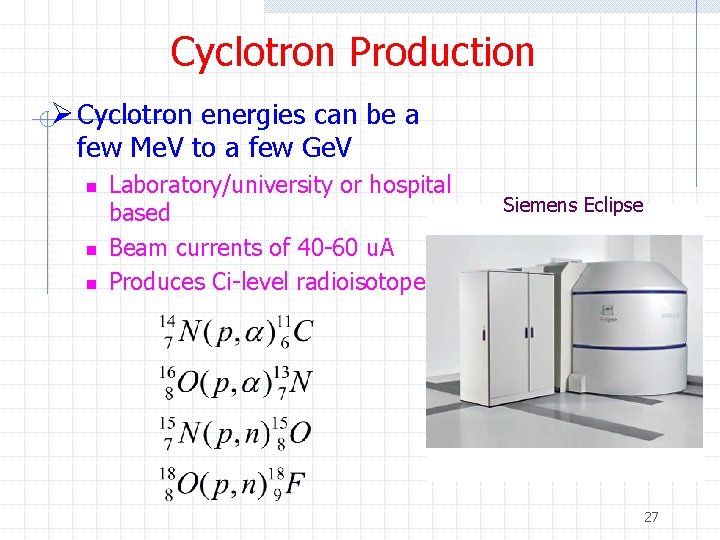
Cyclotron Production Ø Cyclotron energies can be a few Me. V to a few Ge. V n n n Laboratory/university or hospital based Beam currents of 40 -60 u. A Produces Ci-level radioisotopes Siemens Eclipse 27
Cyclotron Production ØThe reactions shown on the previous page n Are proton rich -> decay by e+ emission or EC w 18 F is the most common radionuclide in PET oncology n Are important elements of all biological processes hence make excellent tracers w 18 F is used to label FDG (18 F-fluorodeoxyglucose) w Useful because malignant tumors show a high uptake of FDG because of their high glucose consumption compared with normal cells n Have short lifetimes (O(minutes)) w Except t 1/2 for 18 F = 110 minutes 28
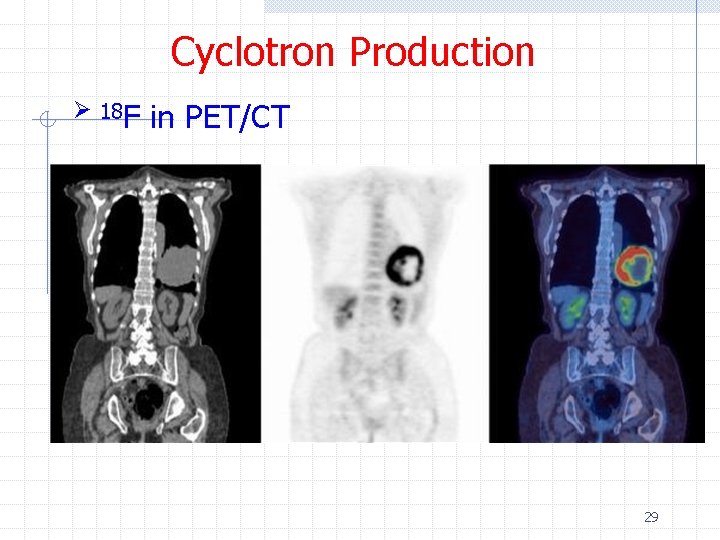
Cyclotron Production Ø 18 F in PET/CT 29
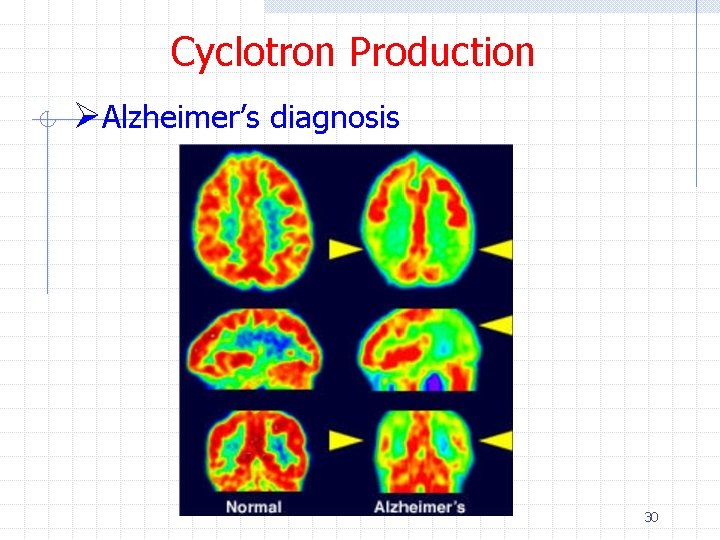
Cyclotron Production ØAlzheimer’s diagnosis 30
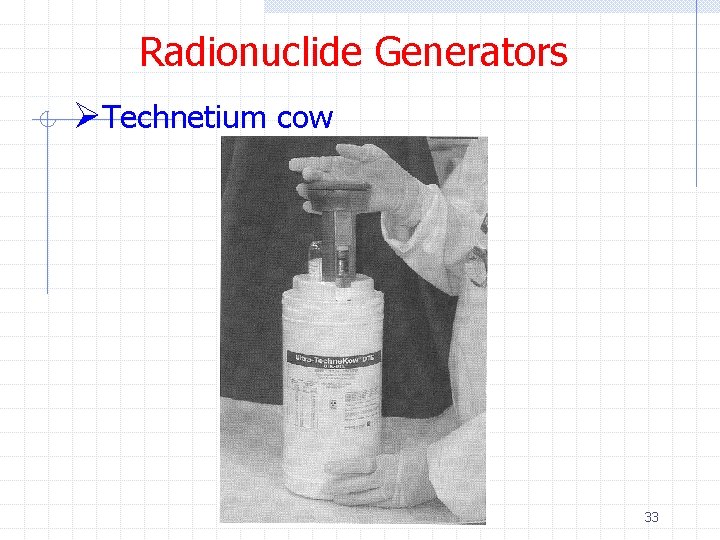
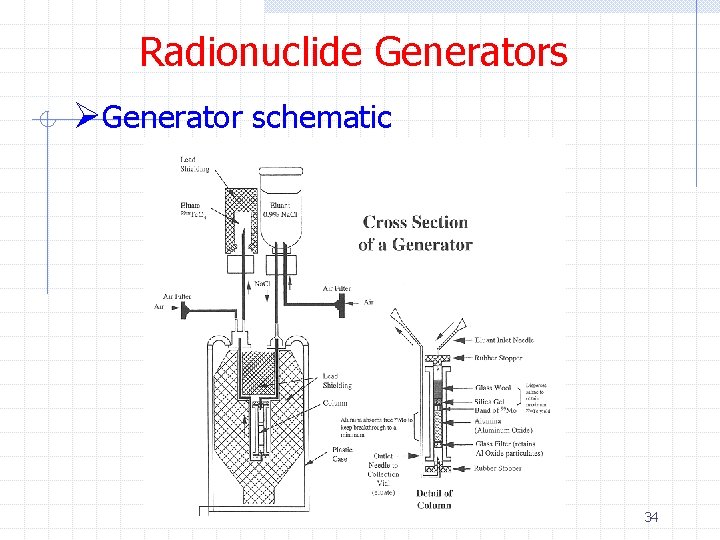
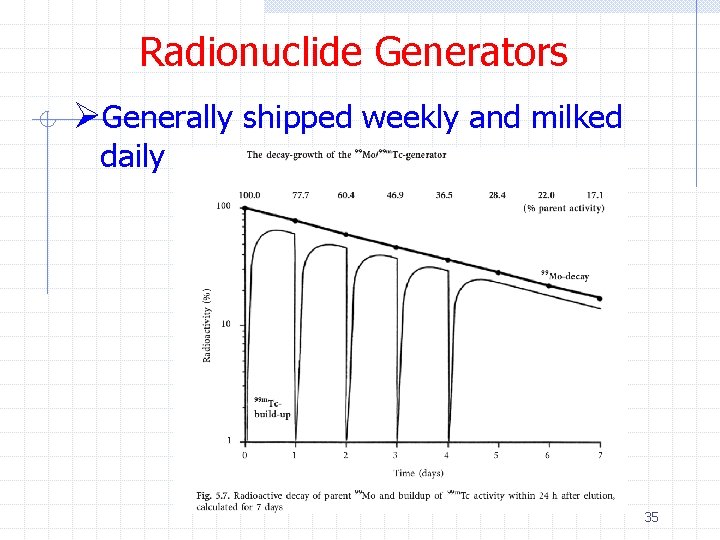
Radionuclide Generators Ø Generates a radionuclide by exploiting transient equilibrium n Most important application are moly generators w 99 Mo n n n (67 hours) decaying to 99 m. Tc (6 hours) Sodium pertechnetate (Na. Tc. O 4) results which can then be combined with an appropriate pharmaceutical Developed at BNL, a particle and nuclear physics lab Other generators also exist (69 Ge to 68 Ga, 82 Sr to 82 Rb, …) 31
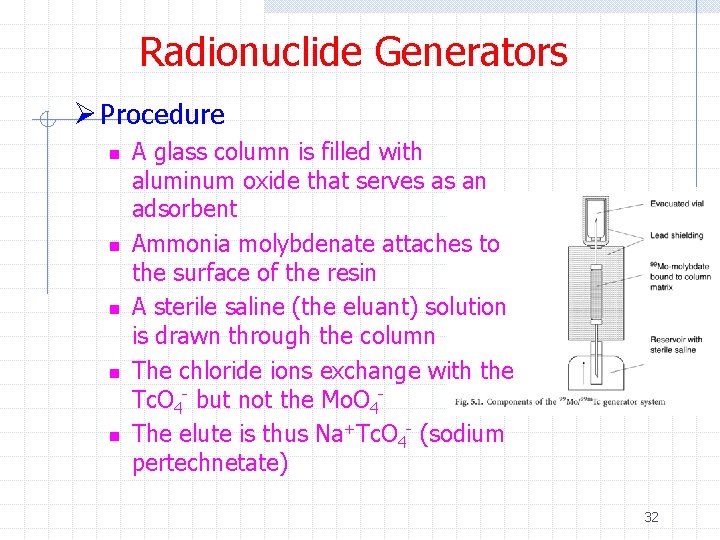
Radionuclide Generators Ø Procedure n n n A glass column is filled with aluminum oxide that serves as an adsorbent Ammonia molybdenate attaches to the surface of the resin A sterile saline (the eluant) solution is drawn through the column The chloride ions exchange with the Tc. O 4 - but not the Mo. O 4 The elute is thus Na+Tc. O 4 - (sodium pertechnetate) 32
Radionuclide Generators ØTechnetium cow 33
Radionuclide Generators ØGenerator schematic 34
Radionuclide Generators ØGenerally shipped weekly and milked daily 35
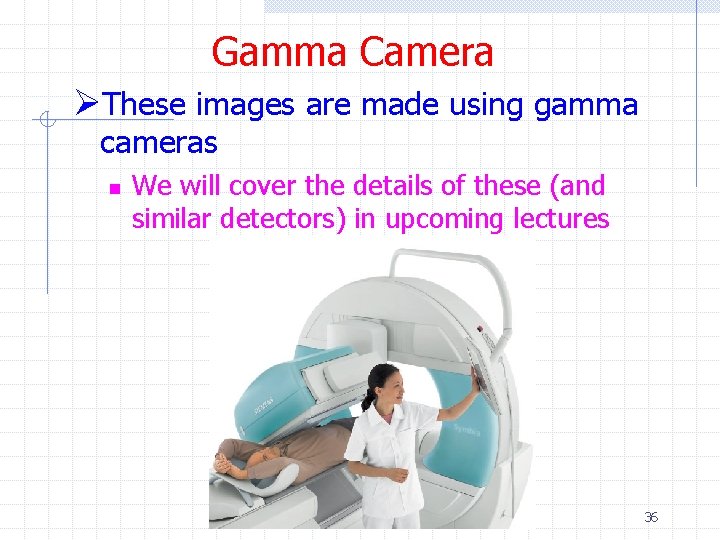
Gamma Camera ØThese images are made using gamma cameras n We will cover the details of these (and similar detectors) in upcoming lectures 36
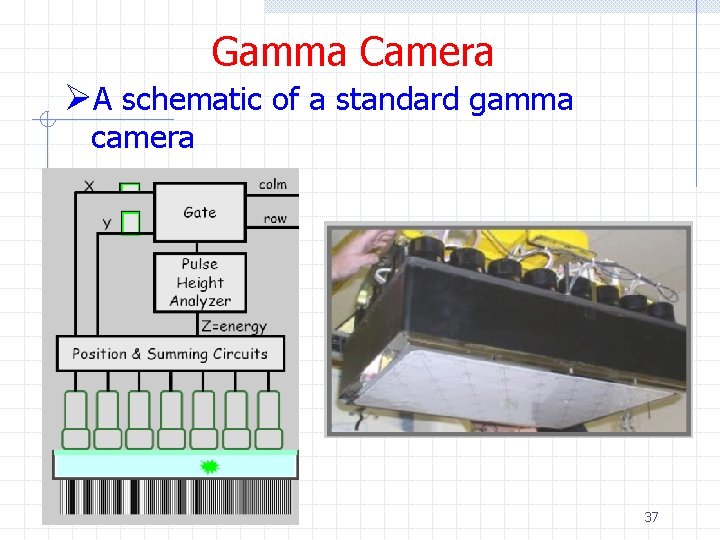
Gamma Camera ØA schematic of a standard gamma camera 37
- Slides: 37