
COMMON KEY TERMS IN PSYCHIATRIC NURSING Terms Anxiety
- Slides: 18
COMMON KEY TERMS IN PSYCHIATRIC NURSING
Terms • Anxiety: A state of feeling uncertainty experienced in response to an object or situation. - E. g. Exams - First meeting with a stranger • Stress: A state of extreme difficulty, pressure or strain with negative effects on physical and emotional health and well-being. - Deadline to meet - Social pressure
Terms… • Suicide: The act of killing oneself (self-distracting behavior) - Cruel act without thinking • Withdrawal: A state of habitual quiet and seeming un concerned with other people. - A focus on one’s own thoughts. • Depression: A mood state characterized by a feeling of sadness, dejection (self-dislike), despair, discouragement, or hopelessness
Terms. . • Personality disorder: A non-psychotic illness characterized by maladaptive behavior that the person uses to fulfill his or her needs and bring satisfaction to him or herself • Fugue state: A temporary state of disorientation and memory loss; it can occur with epilepsy, severe depression, and alcoholism • Flooding: A technique in behavior therapy in which the individual is exposed directly to a maximumintensity anxiety-producing situation or stimulus
Terms… • Hysteria (conversion disorder): The loss or impairment of some motor or sensory function for which there is no organic cause. Formerly known as hysteria or hysterical neurosis • Mental retardation: A disorder characterized by sub average intellectual functioning associated with or resulting in, the inability or impairment of the ability to think abstractly
Terms… • Dementia: An irreversible deterioration of brain function, affecting memory and thinking and reason - Judgment, orientation, memory, affect or emotional stability, cognition, and attention are all affected • Alcohol dependent: A person who cannot break the habit of drinking too much alcoholic drinks
Terms… • Paranoid personality disorder (PPD): Defined by mistrust and suspicion so intense that it interferes with thought patterns, behavior, and daily functioning. • Schizophrenia: Is a chronic, severe mental disorder that affects the way a person thinks, acts, expresses emotions, perceives reality, and relates to others. • Manic-depression: A mood disorder involving both mania and depressive episode.
Terms… • Illusion: A false interpretation or perception of a real environmental stimulus that may involve any of the senses. • Hallucinations: Sensory perceptions that occur in the absence of an actual external stimulus. - They may be auditory, visual, olfactory, gustatory or tactile. • Delusion: Persistent false belief rigidly held and not accepted by other members of the person’s culture
Terms… • Euthymia - A normal, tranquil mental state or mood. Often used to describe a stable mental state or mood in those affected with bipolar disorder • Euphoria- Experience (or affect) of pleasure or excitement and intense feelings of well-being and happiness • Anhedonia - Inability to enjoy activities • Alexithymia - Inability to describe one’s emotion
Terms… • Depersonalization: A feeling of being unreal or detached from oneself • Psychosis: Involves a serious distortion of the person’s thought processes characterized by a loss of touch with reality • Neurosis: An emotional state, anxiety, depression, distress or obsession where the person has some insight into their problems
Terms… • Narcissistic: A personality type that is self admiring and self important; preoccupied with own powers and abilities; seeking attention from others • Nihilistic disorder: A false belief that is firmly maintained in spite of incontrovertible and obvious proof to the contrary • Derealization: A feeling of being detached from reality and one’s surroundings
Terms… • Desensitization: A process which reduces responsiveness to a certain stimulus by being repeatedly exposed to it. • Displacement: A defense mechanism where the feelings are transferred unconsciously from its original source to a less threatening recipient • Amnesia: Loss of memory; this can be caused by head injury or can occur briefly, for no apparent reason, in middle to late life
Terms… • Verbigeration – meaningless repetition of words and phrases (disturbances in thinking and speech without a stimulus) • Word salad – incoherent mixture of words and phrases with no logical sequence • Perseveration – persistence of a response to a previous question. • Echolalia – pathological repetition of words of others • Aphasia – An impairment of language, affecting the production or comprehension of speech and the ability to read or write (Stroke)
Terms… • Flight of ideas - shifting of one topic from one subject to another in a somewhat related way. • Looseness of association-incoherent , illogical flow of thoughts (unrelated way) • Clang association – sound of word gives direction to the flow of thought. • Magical thinking – primitive thought process thoughts alone can change events. • Autistic thinking – regressive thought processsubjective interpretations not validated with objective reality
Disturbances of affect (emotion) • Inappropriate – disharmony between the stimuli and the emotional reaction. • Blunted affect – severe reduction in emotional reaction. • Flat affect – absence or near absence of emotional reaction. • Apathy – dulled emotional tone. • Agnosia – lack of sensory stimuli integration examples of affect are sadness, fear, joy, and anger.
Disturbances in motor activity • Echopraxia – Imitation of posture of others • Waxy flexibility – maintaining position for a long period of time • Ataxia – Loss of balance • Akathesia – Extreme restlessness • Dystonia- Uncoordinated spastic movements of the body • Tardive dyskenisia – Involuntary twitching or muscle movements • Apraxia – Involuntary un-purposeful movements
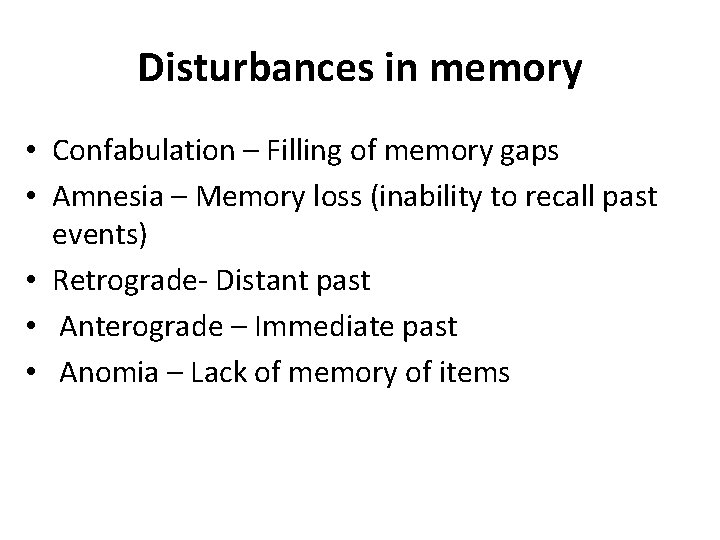
Disturbances in memory • Confabulation – Filling of memory gaps • Amnesia – Memory loss (inability to recall past events) • Retrograde- Distant past • Anterograde – Immediate past • Anomia – Lack of memory of items
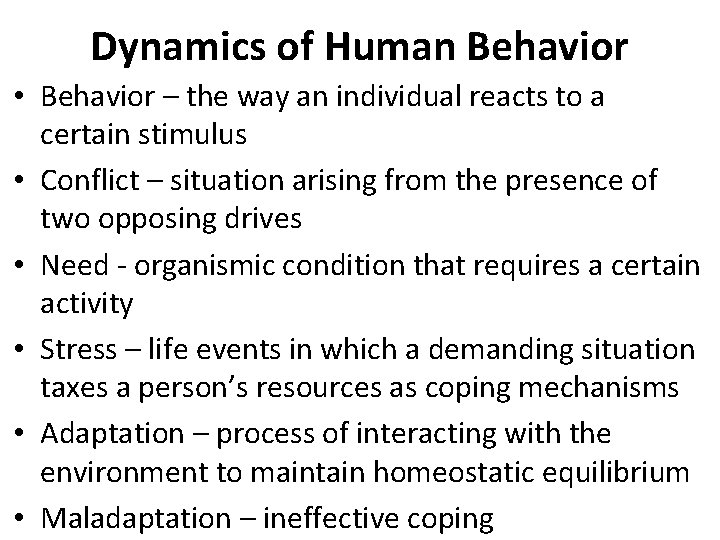
Dynamics of Human Behavior • Behavior – the way an individual reacts to a certain stimulus • Conflict – situation arising from the presence of two opposing drives • Need - organismic condition that requires a certain activity • Stress – life events in which a demanding situation taxes a person’s resources as coping mechanisms • Adaptation – process of interacting with the environment to maintain homeostatic equilibrium • Maladaptation – ineffective coping