
Common Elements of Culture Comparing cultures between different
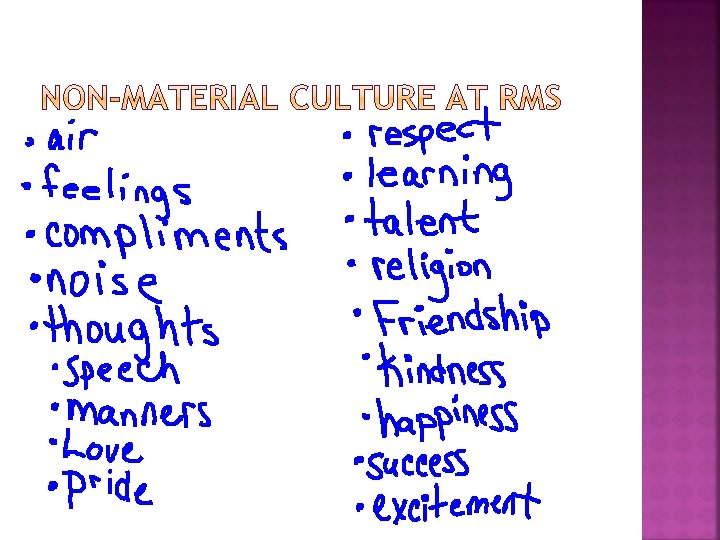

Common Elements of Culture
Comparing cultures between different groups of people is easier if you know the elements that are common to all cultures. There are seven elements, or an important part, of culture. These include: (1) beliefs and values, (2) economy, (3) government, (4) technology, (5) history, (6) expressions of culture and (7) environment.
(1) Beliefs and Values- Every culture has some beliefs and values that people share. People express their religious beliefs in many ways. Other beliefs might be about the relationship between people, how children are raised and educated or about the need to protect human rights and freedoms.
(2) Economy- Just as there are different forms of government, there also different economies. An economy is the way people use their resources to satisfy their needs and wants. Some countries have an economy based on farming in rural areas.
In other countries, the economy is based more on industries and businesses in large urban cities. Some people live in very wealthy countries, while others live in countries that are poor.
(3) Government- People around the world have different systems for governing themselves. In Canada, people elect their government leaders. Other countries have a different form of democracy. Some countries are ruled by a royal family, a dictator or the military.
(4) Technology- Technology refers to any tool, or equipment invented by humans. The tools a culture uses can affect people’s lives in a very big way. Imagine how the world changed once electricity was first introduced

(5) History- Our history is part of what makes us Canadians. Events of the past shape our culture and how we live today. It gives us a sense of our identity. Relations among the French, English, Aboriginals and people from many different nations helped to build this country.
(6) Expressions of Culture- Stories, music, paintings, dance, language, sports and fashion are all expressions of culture.
(7) Environment- The environment has an important influence on how we live, but it is not an element of culture because it is not something people have created. Climate, vegetation, and landform features influence the types of shelters, clothes, and food people eat.
We use the acronym BEG THE to remember the common elements of culture: B - Beliefs and Values E – Economy G – Government T – Technology H – History E – Expressions of Culture
- Slides: 12