
Common degree level systems in Hungarian Computer Science


- Slides: 40
Common degree level systems in Hungarian Computer Science Education Dr. Emőd Kovács Ph. D Institute of Mathematics and Informatics Eszterházy Károly College, Eger, Hungary
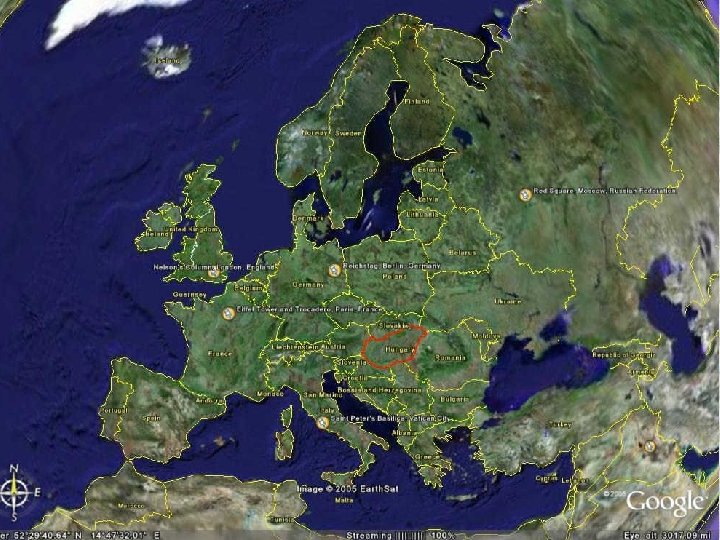
Europe, Hungary
Europe, Hungary
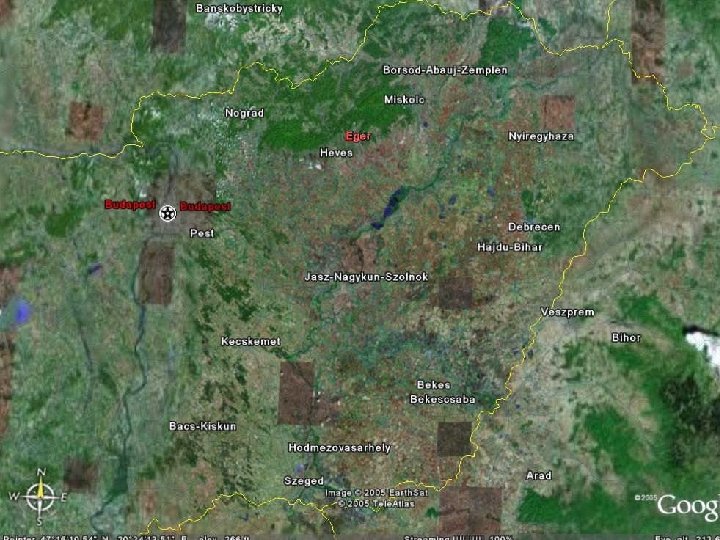
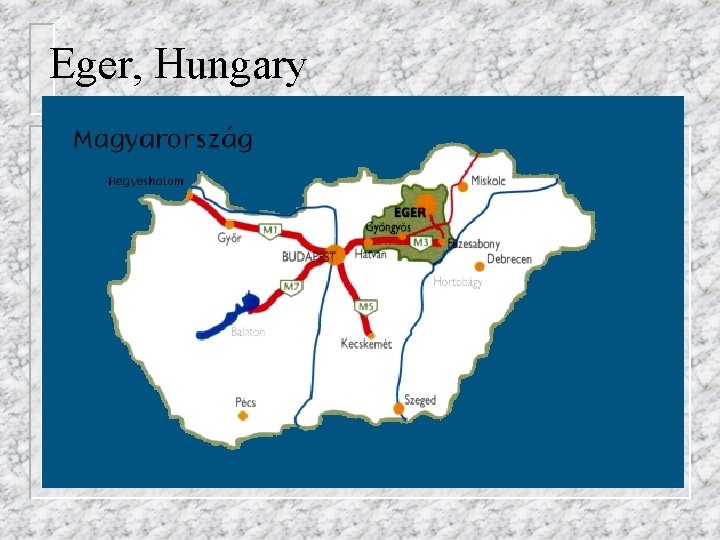
Eger, Hungary
Eszterházy Károly College n http: //www. ektf. hu
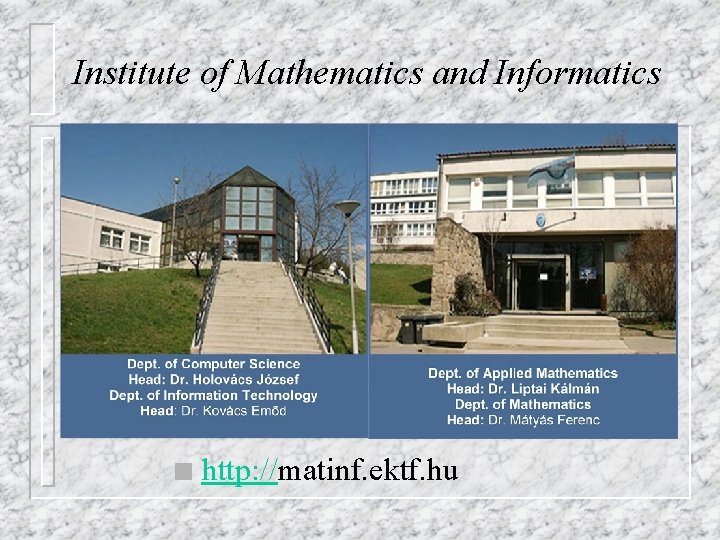
Institute of Mathematics and Informatics n http: //matinf. ektf. hu
The aims of this lecture I. Survey of Bologna Process II. Computing Curricula 2005 The Guide to Undergraduate Degree Programs in Computing III. Informatics BSc programs in Hungary and Eszterházy Károly College
I. Bologna Process in EU History: n All has started with Lisbon convention in 1997. – – – n The Lisbon convention is one of the most important thing in modern Europe. The full text at http: //conventions. coe. int Declared by Council of Europe and UNESCO 1998. Paris , ministers of education of EU's leading countries (France, Germany, Italy and United Kingdom) has signed a Sorbonne Joint Declaration – – They underlined the goals of Lisbon Convention and highlighted the necessity of homogenous European Higher Education Area. Their opinion was the opaque higher education and the many problems of the comparison of diplomas are the main difficulty of labour mobilizations
Next step : Bologna in 1999 About Higher Education: n 29 ministers of education signed the Bologna Declaration n the adoption of a system of easily readable and comparable degrees; n the adoption of a system essentially based on two main cycles in higher education, undergraduate and graduate; n the establishment of a system of credits promoting intellectual and physical mobility; n the promotion of free movement of teachers and students; n The declaration is engaged with the Anglo-Saxon type linear education system, undergraduate (BSc. or BA. ) and graduate(MSc. or MA. ) trainings.
Second stage in Prague, 2001. The location holds a symbolic meaning, as it was referred to the enlargement of EU. The Ministers emphasized the following points: n Lifelong learning, n Higher education institutions and students: Ministers stressed that the involvement of universities and other higher education institutions and of students as competent, active and constructive partners. n Promoting the attractiveness of the European Higher Education Area
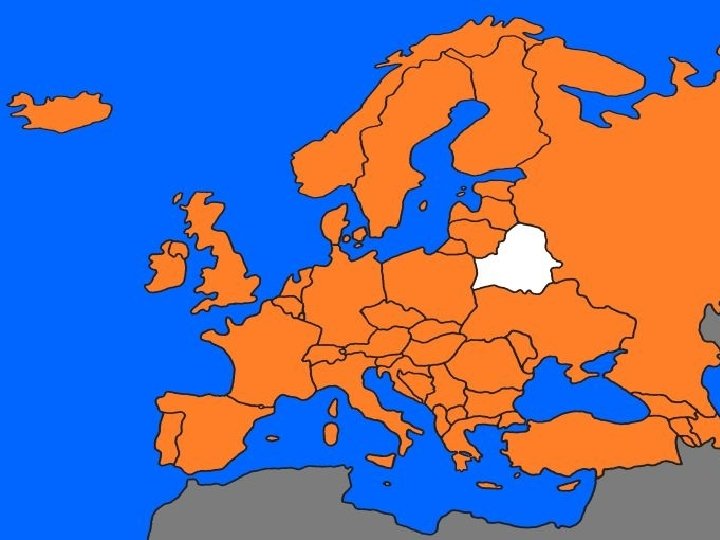
Next stages in Bologna Process n n Berlin in 2003. Ministers reviewed the progress achieved since the Prague meeting in 2001 and set directions and concrete priorities for the next 20 months, before they meet again in May 2005 in Bergen/Norway One of the new element is the compulsory “diploma supplement: ” They set the objective that every student graduating as from 2005 should receive the Diploma Supplement automatically and free of charge. It should be issued in a widely spoken European language. ” Lacking the space, we do not deal with the Bergen Declaration, Nowadays more than 45 countries joined the Bologna Process in EU. The next Ministerial Summit will be in London in May 2007.
II. Computing Curricula 2005 Major organizations: n Association for Information Systems, AIS n Computer Society of the Institute for Electrical and Electronic Engineers, IEEE-CS n Association for Machinery, ACM n Association for Information Technology Professionals, AITP
CC 2001 Project n Joint Task Force on Computing Curricula 2001 (CC 2001) established in late 1998 n Created by IEEE-CS, ACM and AIS n Target: to undertake a major review of curriculum guidelines for undergraduate programs in computing.
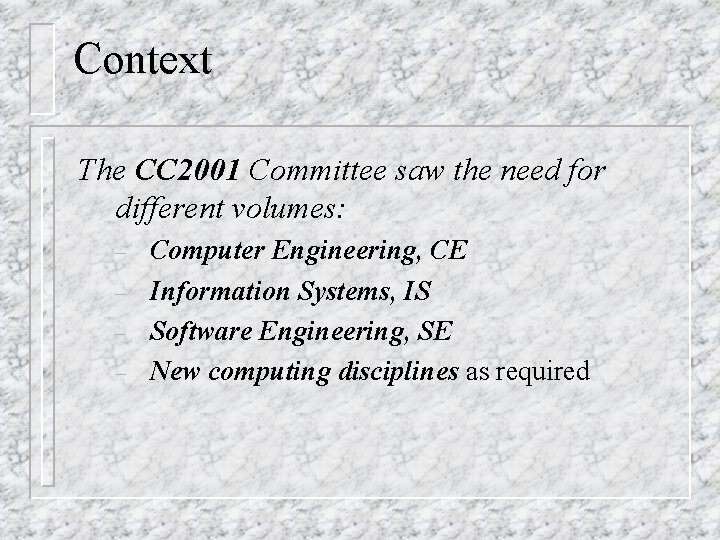
Context The CC 2001 Committee saw the need for different volumes: – – Computer Engineering, CE Information Systems, IS Software Engineering, SE New computing disciplines as required
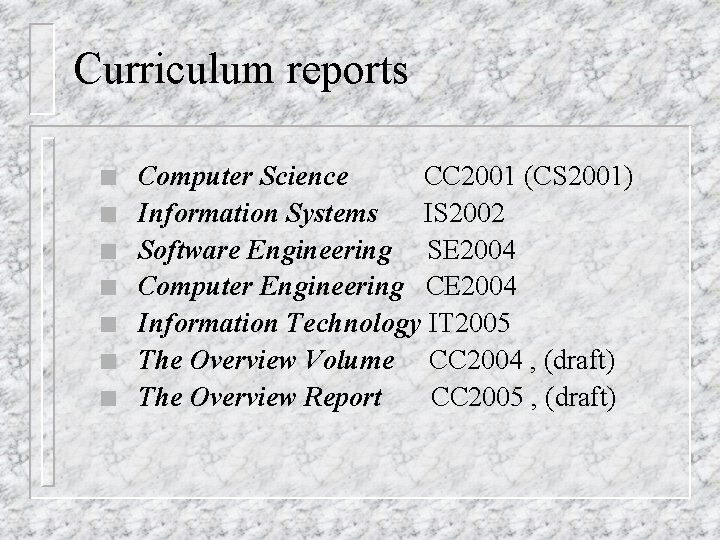
Curriculum reports n n n n Computer Science CC 2001 (CS 2001) Information Systems IS 2002 Software Engineering SE 2004 Computer Engineering CE 2004 Information Technology IT 2005 The Overview Volume CC 2004 , (draft) The Overview Report CC 2005 , (draft)
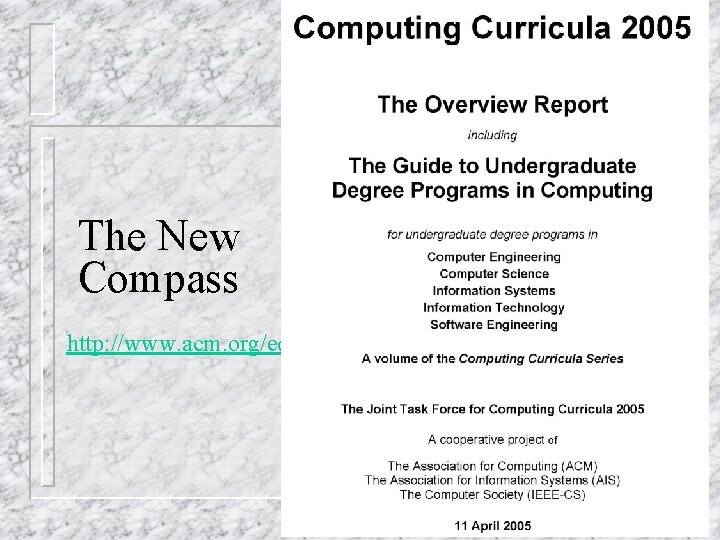
The New Compass http: //www. acm. org/education/curricula. html
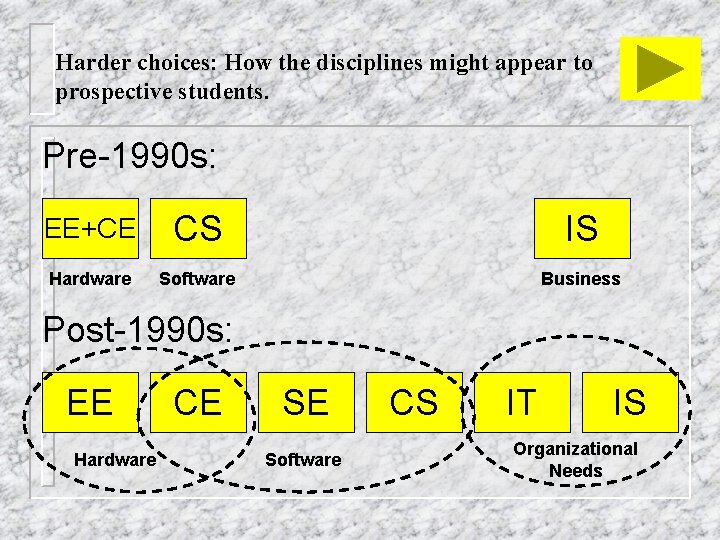
Harder choices: How the disciplines might appear to prospective students. Pre-1990 s: EE+CE CS IS Hardware Software Business Post-1990 s: EE Hardware CE SE Software CS IT IS Organizational Needs
CE, Computer Engineering Computer engineering is concerned with the design and construction of computers, and computer based systems. It involves the study of hardware, software, communications, and the interaction between them. Its curriculum focuses on theories, principles, and practices of traditional electrical engineering and mathematics, and applies them to the problems of designing computers and computer-related devices. Computer engineering students typically study the design of digital hardware systems, including computers, communications systems, and devices that contain computers. They also study software development with a focus on the software used within and between digital devices (not the software programs directly used by computer users). The emphasis of the curriculum is on hardware more than software, and it has a very strong engineering flavor. Currently, a dominant area within computing engineering is development of devices that have software embedded in hardware. Devices such as cell phones, digital recorders, alarm systems, radar systems, and laser surgical tools all rely on the integration of hardware and embedded software, and they are all the result of computer engineering.
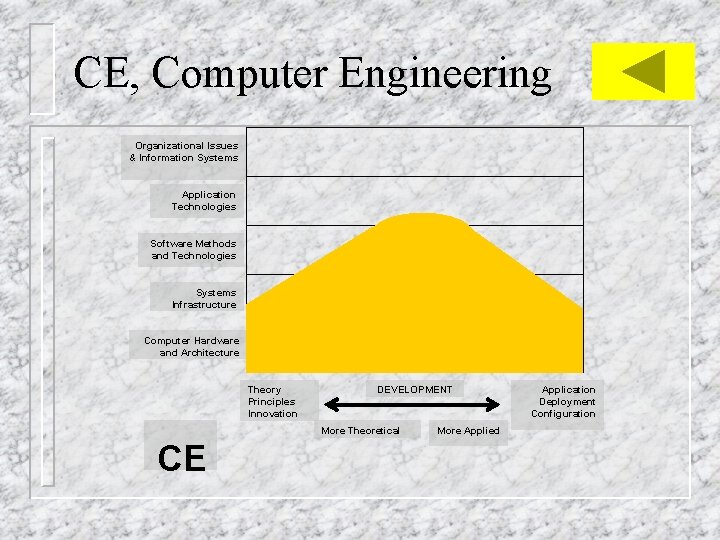
CE, Computer Engineering Organizational Issues & Information Systems Application Technologies Software Methods and Technologies Systems Infrastructure Computer Hardware and Architecture Theory Principles Innovation DEVELOPMENT More Theoretical CE More Applied Application Deployment Configuration
CS, Computer Science Computer science spans a wide range, from theoretical foundations to cuttingedge developments in robotics, computer vision, intelligent systems, and bioinformatics. The work of computer scientists falls into three areas: • Developing effective ways to solve computing problems. Computer scientists develop the best possible ways to store data in databases, send data over networks, and display complex images. Study of theory allows them to determine what performance is possible, and study of algorithms lets them develop new problem-solving approaches for better performance. • Devising new ways to use computers. Progress in CS areas of networks database, and human-computer interface produced the world-wide-web which changed the world. They are now working to make robots be practical aides, databases create new knowledge, and computers do new things. • Designing and implementing software. They are assigned key programming jobs and help keep other programmers aware of new approaches. Computer science spans the range from theory to programming and is the least -specialized of the computing disciplines. Other disciplines can produce graduates better prepared for specific jobs, while computer science offers a foundation that permits graduates to adapt to new technologies and ideas.
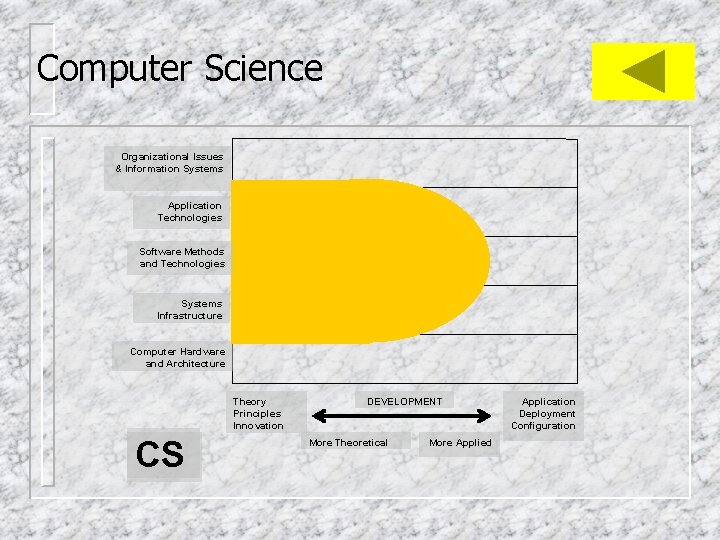
Computer Science Organizational Issues & Information Systems Application Technologies Software Methods and Technologies Systems Infrastructure Computer Hardware and Architecture Theory Principles Innovation CS DEVELOPMENT More Theoretical More Applied Application Deployment Configuration
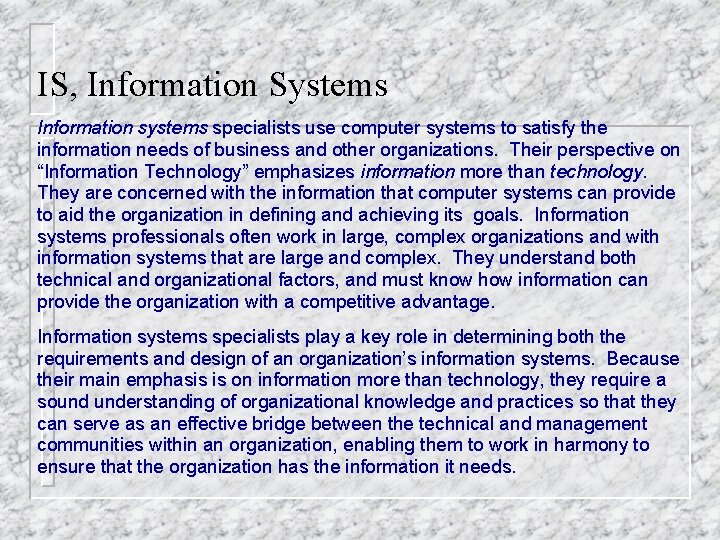
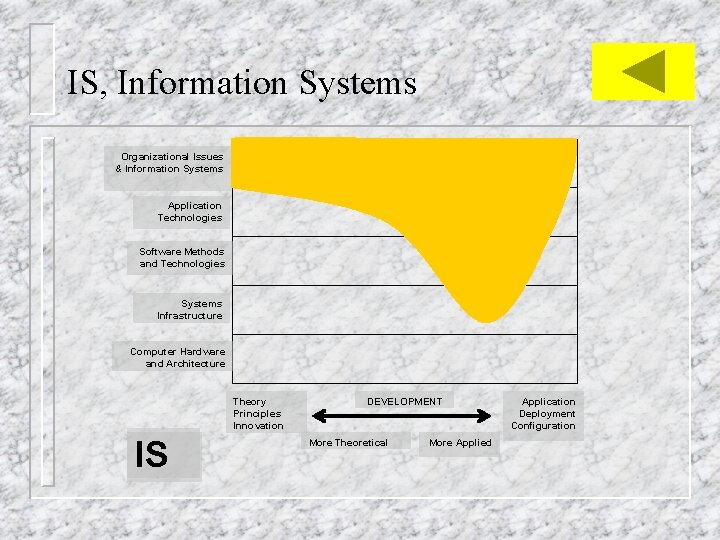
IS, Information Systems Information systems specialists use computer systems to satisfy the information needs of business and other organizations. Their perspective on “Information Technology” emphasizes information more than technology. They are concerned with the information that computer systems can provide to aid the organization in defining and achieving its goals. Information systems professionals often work in large, complex organizations and with information systems that are large and complex. They understand both technical and organizational factors, and must know how information can provide the organization with a competitive advantage. Information systems specialists play a key role in determining both the requirements and design of an organization’s information systems. Because their main emphasis is on information more than technology, they require a sound understanding of organizational knowledge and practices so that they can serve as an effective bridge between the technical and management communities within an organization, enabling them to work in harmony to ensure that the organization has the information it needs.
IS, Information Systems Organizational Issues & Information Systems Application Technologies Software Methods and Technologies Systems Infrastructure Computer Hardware and Architecture Theory Principles Innovation IS DEVELOPMENT More Theoretical More Applied Application Deployment Configuration
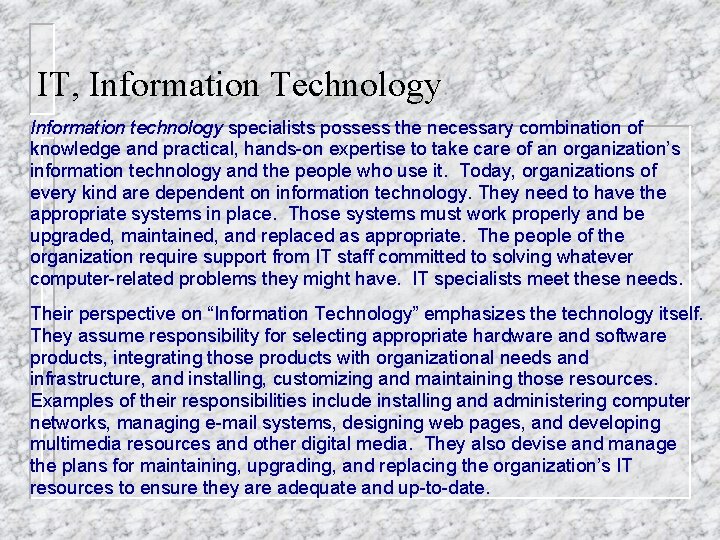
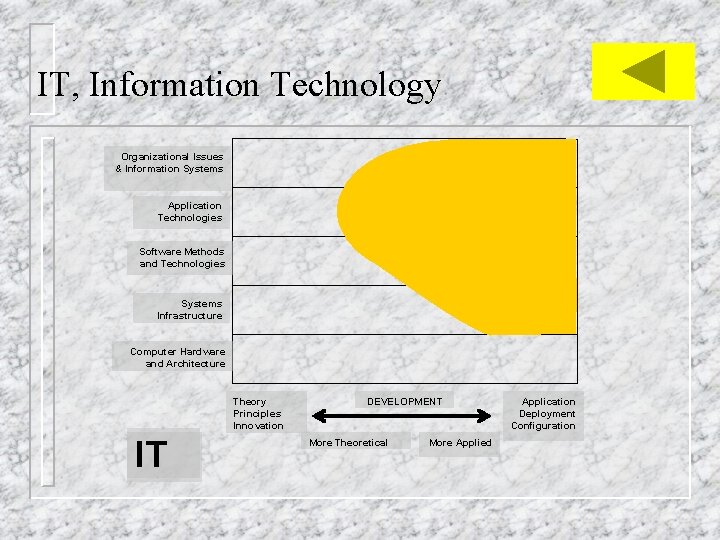
IT, Information Technology Information technology specialists possess the necessary combination of knowledge and practical, hands-on expertise to take care of an organization’s information technology and the people who use it. Today, organizations of every kind are dependent on information technology. They need to have the appropriate systems in place. Those systems must work properly and be upgraded, maintained, and replaced as appropriate. The people of the organization require support from IT staff committed to solving whatever computer-related problems they might have. IT specialists meet these needs. Their perspective on “Information Technology” emphasizes the technology itself. They assume responsibility for selecting appropriate hardware and software products, integrating those products with organizational needs and infrastructure, and installing, customizing and maintaining those resources. Examples of their responsibilities include installing and administering computer networks, managing e-mail systems, designing web pages, and developing multimedia resources and other digital media. They also devise and manage the plans for maintaining, upgrading, and replacing the organization’s IT resources to ensure they are adequate and up-to-date.
IT, Information Technology Organizational Issues & Information Systems Application Technologies Software Methods and Technologies Systems Infrastructure Computer Hardware and Architecture Theory Principles Innovation IT DEVELOPMENT More Theoretical More Applied Application Deployment Configuration
SE, Software Engineering Software engineering is the discipline of developing and maintaining software systems that behave reliably, can be developed with predicable costs, and are affordable to develop and maintain. It evolved in response to the increased importance of software in safety-critical situations and to the impact of large and expensive software systems in a wide range of situations. Traditionally, computer scientists produced software. As the size, complexity, and critical importance of software grew, it became apparent that proper software development practices require more than just the underlying principles of computer science. They also require the kind of rigor that engineering provides to ensure that software is reliable and trustworthy. Software engineering is different from other engineering disciplines. It integrates the science of computer science with sound engineering principles and practices. Software engineers generally study more applied math and less theory than computer science students. They take a more rigorous and pragmatic view of software reliability and maintenance, and focus on techniques for developing and maintaining software that is correct from its inception in order to avoid costly and potentially dangerous situations later.
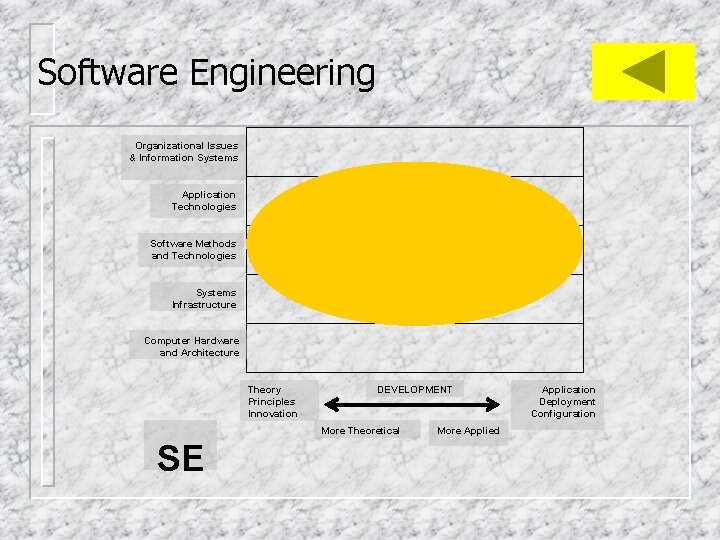
Software Engineering Organizational Issues & Information Systems Application Technologies Software Methods and Technologies Systems Infrastructure Computer Hardware and Architecture Theory Principles Innovation DEVELOPMENT More Theoretical SE More Applied Application Deployment Configuration
III. Changes in Hungary and in EKC n n The academic reform of Hungarian higher education is inseparable from the Bologna Process. The old, undivided version contained almost 500 types of diploma. In a new linear Anglo-Saxon system contains only around 100 BSc. degrees. From September 2006 the students can only begin their studies in the new system. The informatics play a main role in the new system therefore informatics is one of the eleven main training areas.
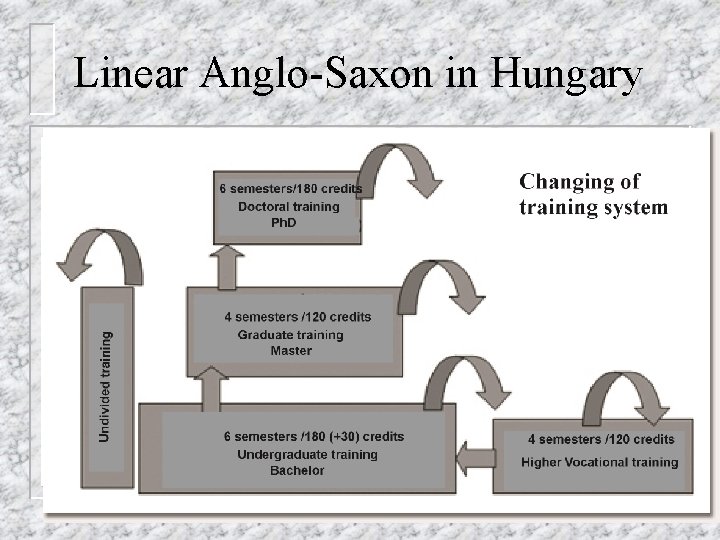
Linear Anglo-Saxon in Hungary
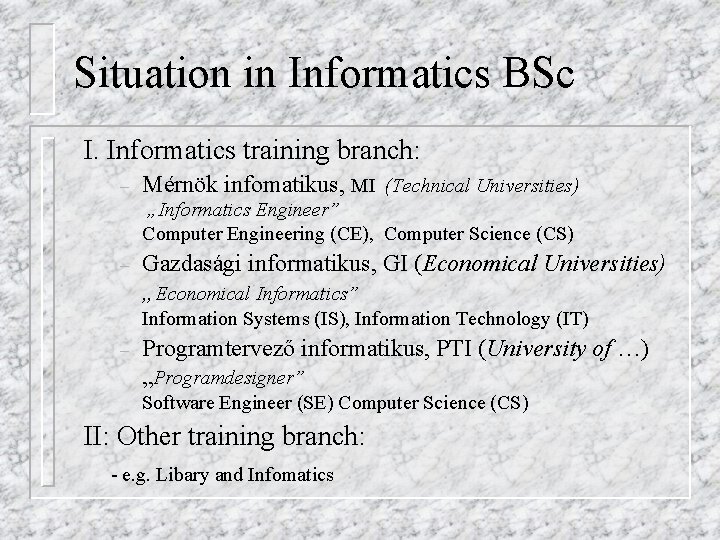
Situation in Informatics BSc I. Informatics training branch: – Mérnök infomatikus, MI (Technical Universities) „Informatics Engineer” Computer Engineering (CE), Computer Science (CS) – Gazdasági informatikus, GI (Economical Universities) „Economical Informatics” Information Systems (IS), Information Technology (IT) – Programtervező informatikus, PTI (University of …) „Programdesigner” Software Engineer (SE) Computer Science (CS) II: Other training branch: - e. g. Libary and Infomatics
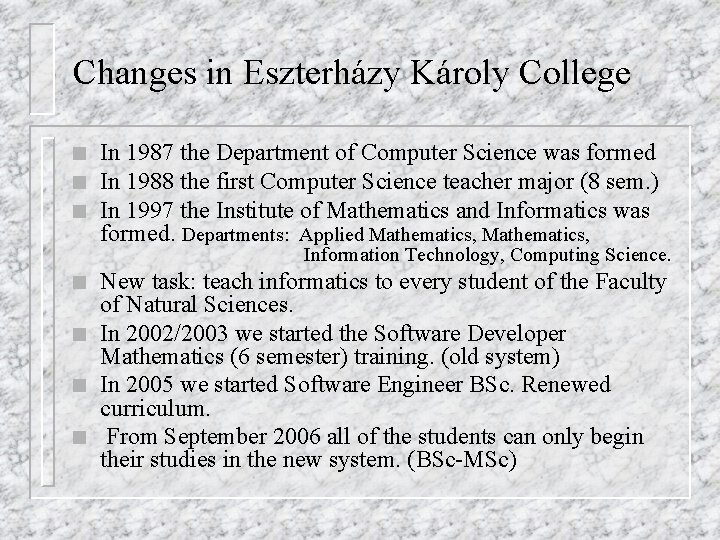
Changes in Eszterházy Károly College n n n In 1987 the Department of Computer Science was formed In 1988 the first Computer Science teacher major (8 sem. ) In 1997 the Institute of Mathematics and Informatics was formed. Departments: Applied Mathematics, Information Technology, Computing Science. n n New task: teach informatics to every student of the Faculty of Natural Sciences. In 2002/2003 we started the Software Developer Mathematics (6 semester) training. (old system) In 2005 we started Software Engineer BSc. Renewed curriculum. From September 2006 all of the students can only begin their studies in the new system. (BSc-MSc)
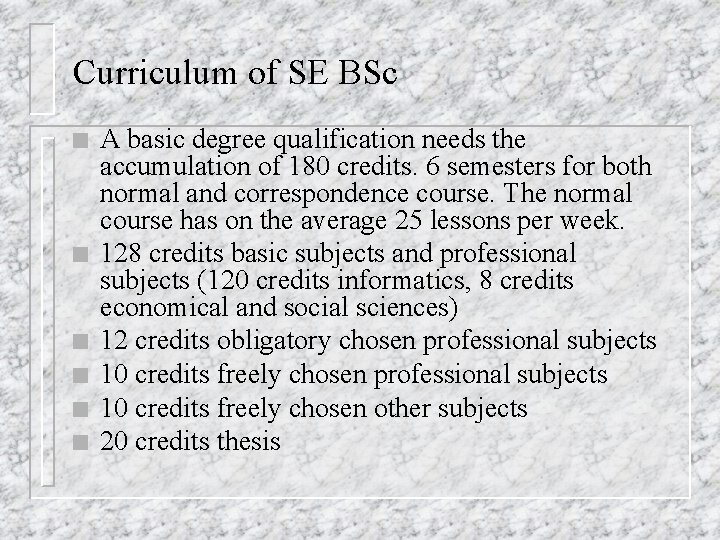
Curriculum of SE BSc n n n A basic degree qualification needs the accumulation of 180 credits. 6 semesters for both normal and correspondence course. The normal course has on the average 25 lessons per week. 128 credits basic subjects and professional subjects (120 credits informatics, 8 credits economical and social sciences) 12 credits obligatory chosen professional subjects 10 credits freely chosen other subjects 20 credits thesis
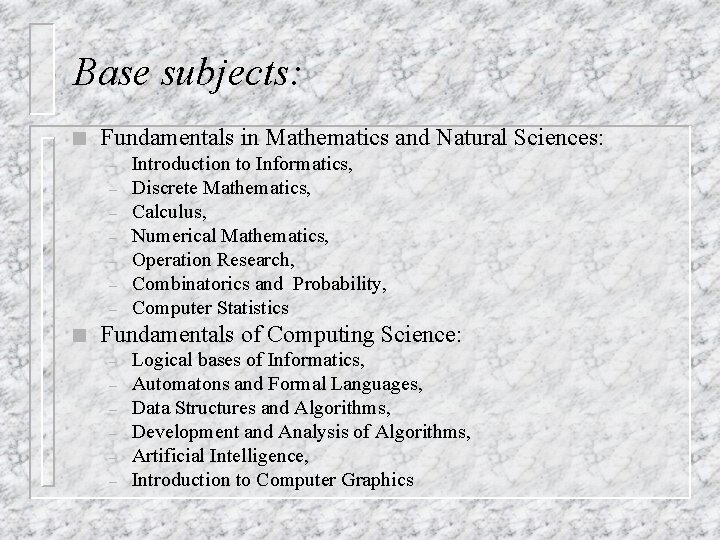
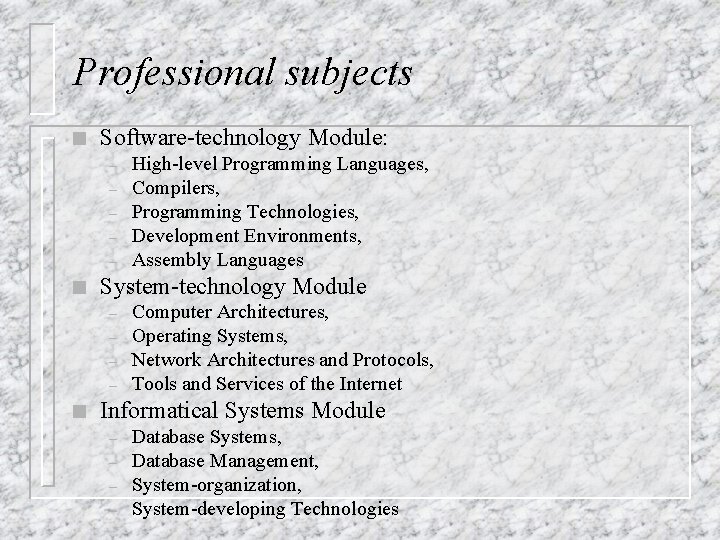
Base subjects: n Fundamentals in Mathematics and Natural Sciences: – – – – n Introduction to Informatics, Discrete Mathematics, Calculus, Numerical Mathematics, Operation Research, Combinatorics and Probability, Computer Statistics Fundamentals of Computing Science: – – – Logical bases of Informatics, Automatons and Formal Languages, Data Structures and Algorithms, Development and Analysis of Algorithms, Artificial Intelligence, Introduction to Computer Graphics
Professional subjects n Software-technology Module: – – – n System-technology Module – – n High-level Programming Languages, Compilers, Programming Technologies, Development Environments, Assembly Languages Computer Architectures, Operating Systems, Network Architectures and Protocols, Tools and Services of the Internet Informatical Systems Module – – Database Systems, Database Management, System-organization, System-developing Technologies
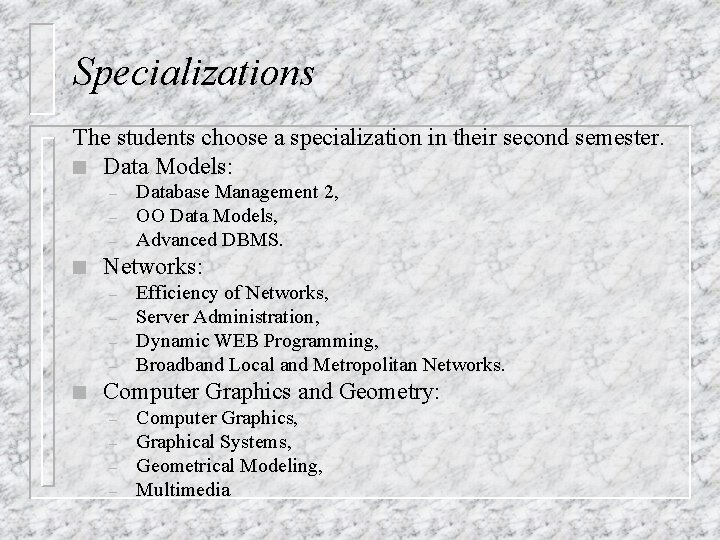
Specializations The students choose a specialization in their second semester. n Data Models: – – – n Networks: – – n Database Management 2, OO Data Models, Advanced DBMS. Efficiency of Networks, Server Administration, Dynamic WEB Programming, Broadband Local and Metropolitan Networks. Computer Graphics and Geometry: – – Computer Graphics, Graphical Systems, Geometrical Modeling, Multimedia
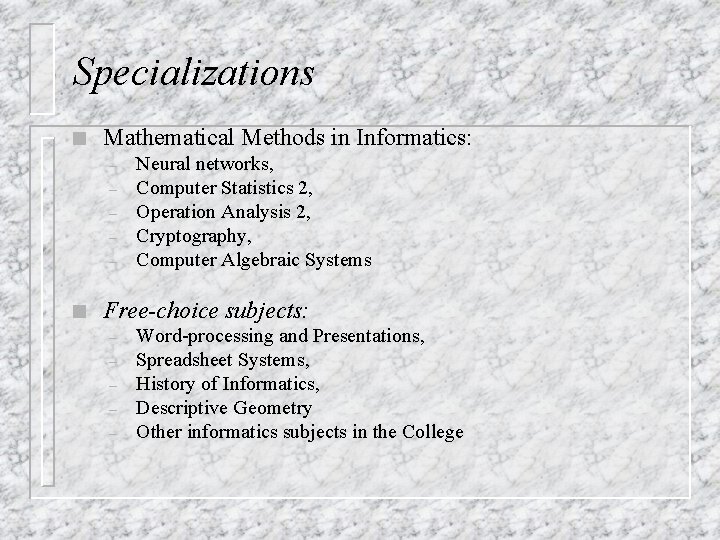
Specializations n Mathematical Methods in Informatics: – – – n Neural networks, Computer Statistics 2, Operation Analysis 2, Cryptography, Computer Algebraic Systems Free-choice subjects: – – – Word-processing and Presentations, Spreadsheet Systems, History of Informatics, Descriptive Geometry Other informatics subjects in the College
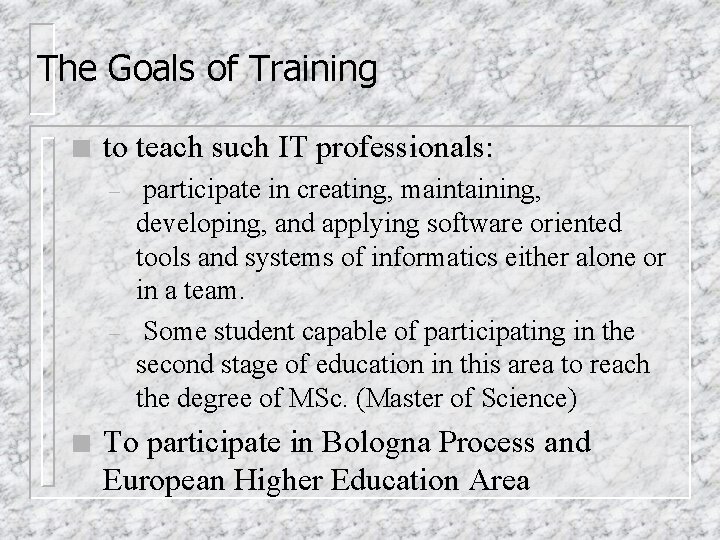
The Goals of Training n to teach such IT professionals: – – n participate in creating, maintaining, developing, and applying software oriented tools and systems of informatics either alone or in a team. Some student capable of participating in the second stage of education in this area to reach the degree of MSc. (Master of Science) To participate in Bologna Process and European Higher Education Area
Concluding remarks n n n The Bologna declaration seeks a common European answer to common European problems. Computing Curricula 2005 seeks a common Undergradute program in Computing We are very proud of our college and colleagues. It was a long way from the old fashioned teaching system to the new BSc. degree. We think that Eszterházy Károly College understood the challenges of the 21 st century.
Thank you for your attention n Emőd Kovács, emod@ektf. hu