
Common Curriculum Visioning Committee CCVC Presentation of Report
- Slides: 46
Common Curriculum Visioning Committee (CCVC) Presentation of Report CSB/SJU JOINT FACULTY SENATE SEPTEMBER 8, 2015
2014 -15 CCVC members § Terence Check (Chair) § Don Fischer § David Arnott § Jean Lavigne § Bret Benesh § Barb May § Jean Didier § Anne Sinko § Emily Esch § Isabel Tompkins (CSB student) § Ben Faber § Alex Wald (SJU student)
“When general education is organized as an a la carte menu of disconnected survey courses…it falls short of its intended horizonexpanding purposes. Instead of developing big-picture understanding of the wider world through a purposeful immersion in the liberal arts and sciences, students too often find that their broad or general learning is fragmented, incoherent, and frustrating. Advising practices show all too clearly the troubled state of general education: both advisors and other students frequently urge learners to ‘get their gen eds out of the way. ’ This is hardly an invitation to powerful learning. ” -- Carol Geary Schneider, Foreword to General Education Maps and Markers: Designing Meaningful Pathways to Student Achievement, 2015
CCVC Charge by the JFS: The JFS authorizes the Common Curriculum Visioning Committee (CCVC) to continue its work in providing direction and strategy for potentially implementing changes to the Common Curriculum. This shall be done by:
Part I: Collect data 1. Review the literature and national trends 2. Participate in the Association of American Colleges & Universities (AAC&U) 2015 Institute on General Education and Assessment in June 2015. 3. Identify the issues to be addressed at CSB/SJU ◦ ◦ Discussions with Departments and Stakeholders Student forums and surveys
Part II: Develop a Plan 1. Develop a set of guiding principles to move forward with in GE reform 2. Ideas for a working vision to initiate GE reform 3. Develop a proposed process and timeline for consideration 4. Work with JFA leadership for inclusion of GE themes at the 2015 Fall Faculty Workshop 5. Write and present a report (reviewed at AAC&U Institute)
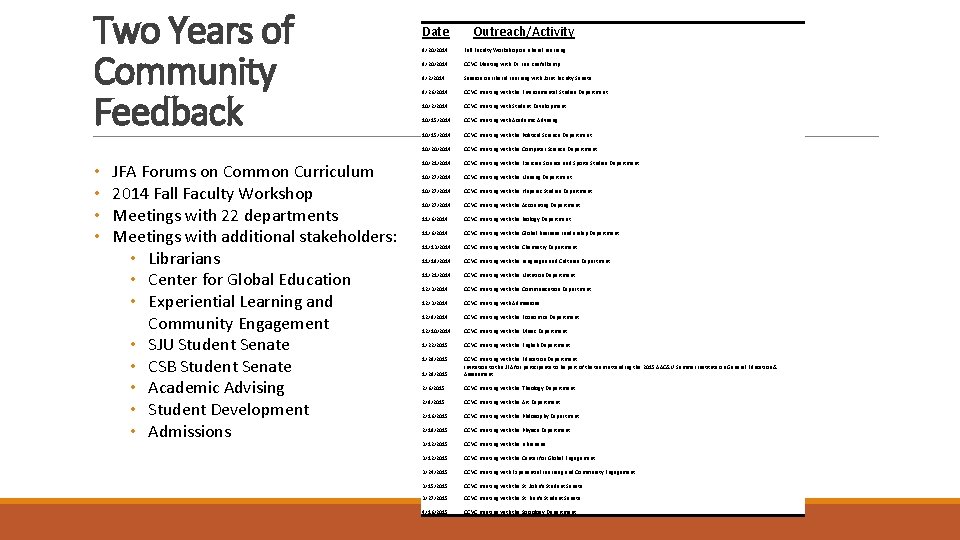
Two Years of Community Feedback • • JFA Forums on Common Curriculum 2014 Fall Faculty Workshop Meetings with 22 departments Meetings with additional stakeholders: • Librarians • Center for Global Education • Experiential Learning and Community Engagement • SJU Student Senate • CSB Student Senate • Academic Advising • Student Development • Admissions Date Outreach/Activity 8/20/2014 Fall Faculty Workshop on Liberal Learning 8/20/2014 CCVC Meeting with Dr. Lee Knefelkamp 9/2/2014 Session on Liberal Learning with Joint Faculty Senate 9/26/2014 CCVC meeting with the Environmental Studies Department 10/2/2014 CCVC meeting with Student Development 10/15/2014 CCVC meeting with Academic Advising 10/15/2014 CCVC meeting with the Political Science Department 10/20/2014 CCVC meeting with the Computer Science Department 10/21/2014 CCVC meeting with the Exercise Science and Sports Studies Department 10/27/2014 CCVC meeting with the Nursing Department 10/27/2014 CCVC meeting with the Hispanic Studies Department 10/27/2014 CCVC meeting with the Accounting Department 11/6/2014 CCVC meeting with the Biology Department 11/6/2014 CCVC meeting with the Global Business Leadership Department 11/13/2014 CCVC meeting with the Chemistry Department 11/19/2014 CCVC meeting with the Languages and Cultures Department 11/21/2014 CCVC meeting with the Nutrition Department 12/3/2014 CCVC meeting with the Communication Department 12/3/2014 CCVC meeting with Admissions 12/8/2014 CCVC meeting with the Economics Department 12/10/2014 CCVC meeting with the Music Department 1/22/2015 CCVC meeting with the English Department 1/28/2015 1/29/2015 CCVC meeting with the Education Department Invitation to the JFA for participants to be part of the team attending the 2015 AAC&U Summer Institute on General Education & Assessment 2/6/2015 CCVC meeting with the Theology Department 2/9/2015 CCVC meeting with the Art Department 2/16/2015 CCVC meeting with the Philosophy Department 2/19/2015 CCVC meeting with the Physics Department 3/12/2015 CCVC meeting with the Librarians 3/12/2015 CCVC meeting with the Center for Global Engagement 3/24/2015 CCVC meeting with Experiential Learning and Community Engagement 3/15/2015 CCVC meeting with the St. John's Student Senate 3/27/2015 CCVC meeting with the St. Ben's Student Senate 4/16/2015 CCVC meeting with the Sociology Department
Review of Literature and Consultation with Experts • Exhaustive review of national scholarship on general education reform • Consultation with prominent national experts on general education reform: ØLee Knefelkamp, former Academic Dean, Macalester College ØSusan Mc. Williams, Assistant Provost for Undergraduate Programs and Core Curriculum, USM ØPaul Gaston, Trustees Professor, Kent State University, Author of General Education Transformed (2015) and General Education & Liberal Learning (2010) ØDebra Humphreys, Vice President for Policy & Public Engagement, AAC&U ØTerrel Rhodes, VP for Quality, Curriculum & Assessment, AAC&U ØYves Labissiere, Interim Director for University Studies, Portland State University
Areas for Improvement • Lack of ownership • Common Curriculum is not “common. ” • Lacks overall vision • Distribution requirements encourage “checking boxes” • Curriculum is not Intentional, sequential, or Integrative • Lacks compelling narrative– not seen as distinctive nor essential • Lacks Integration with the major • Lacks cooperation across departments • Does not consider issues of equity • Assessment inconsistent
Opportunities and Imperatives for Change • Presidential Leadership for Liberal Arts Education • Strategic Directions 2020 • HLC Reaccreditation • Academic Affairs Restructuring • SJU Learning Commons • The Social and Political Context • The Expectations of Employers • Change from the Grassroots: CSB/SJU Faculty Want Reforms
Process Principles THE “HOW” OF GENERAL EDUCATION REFORM
Process Principle #1: Focus on Student Learning “When leaders adopt a stewardship posture, rather than acting as proponents of their own programs, departments, or units, they transcend narrow views of the institution, and the needs of the whole campus relevant to the reform process become salient. ” -- Susan Gano-Phillips et. al. “Rethinking the Roles of Leadership in General Education Reform, ” 2011
Process Principle #2: Form a Task Force “That curricular review should be conducted by the standing curriculum committee may seem reasonable. However, forming a special task force might be a better route to take. While a standing committee has its regular, timeconsuming business to accomplish, a task force can devote all its energy to the single purpose of reviewing or revising the curriculum. ” -- Paul L. Gaston and Jerry G. Gaff, Revising General Education—And Avoiding the Potholes, 2009
Process Principle #3: Support Proposals with Research Participants often “begin their deliberations by having members share their best ideas for improving general education. This approach can pool a great deal of ignorance and half-truths, and it frequently results in premature polarization of the group. By contrast, other task forces have embarked on a scholarly exploration of the topic and have consciously cultivated a spirit of inquiry so that each person learns to expand, refine, and alter his or her initial ideas. These task forces read the literature…” -- Paul L. Gaston and Jerry G. Gaff, Revising General Education—And Avoiding the Potholes, 2009
Process Principle #4: Establish Process before Discussing Content “So often when it comes to curriculum, faculty immediately want to discuss additions and changes to courses and programs…one must keep the discussion focused on student learning outcomes for the program, because it is at this level that meaningful curricular change can occur, be assessed, and have its value demonstrated. This also focuses the discussion on areas of broad agreement (the institutional values that are captured by student learning outcomes) and keeps faculty from arguing about personal, disciplinary, or departmental turf. ” -- Blase S. Scarnati, “The Politics and Process of General Education Reform: Key Political Principles, ” 2010
Process Principle #5: Establish a Timeline “Clearly articulating stages in the reform process and identifying specific deadlines for different stages helps reinforce a sense of progress and closure. ” -- Kathleen Rountree, Lisa Tolbert, and Stephen C. Zerwas, “Culture as Process: Using Cultural Factors to Promote General Education Reform, ” 2010
Process Principle #6: Devote Resources to the Work “Too many task forces try to effect massive curricular change without adequate support. . . Unless adequate support is given, a task force or committee cannot be expected to provide creative and effective leadership for curricular change. Allocating budget resources to this initiative is a major way in which academic administrators can demonstrate institutional support for educational improvement. ” -- Paul L. Gaston and Jerry G. Gaff, Revising General Education—And Avoiding the Potholes, 2009
Process Principle #7: Encourage Open, Inclusive, Transparent Communication “The need to maintain open, transparent communication about the reform process and content is critical for creating broad faculty support. ” -- Kathleen Rountree, Lisa Tolbert, and Stephen C. Zerwas, “Culture as Process: Using Cultural Factors to Promote General Education Reform, ” 2010
Process Principle #8: Engage a Variety of Audiences “An essential component of this collaborative leadership involves the development of trust and common purpose in revitalizing the GE curriculum, and it is through engagement of a wide variety of campus constituents that such trust and a sense of institutional stewardship are achieved. ” -- Susan Gano-Phillips, et. al. , The Journal of General Education, 2011
Process Principle #9: Discuss Vision and Learning Outcomes Prior to Curricular Design “Too often committees launch right into discussions of courses or curricular structure, omitting the essential steps of articulating and reaching for consensus on the learning goals and outcomes. ” -- Andrea Leskes and Ross Miller, General Education: A Self-Study Guide for Review & Assessment, 2005
Design Principles THE “WHAT” OF GENERAL EDUCATION REFORM
Vision and Design Principle #1: Make High-Impact Practices Purposeful and Integrative “Let’s be honest about how it appears to 19 -year-olds. They see such an ‘array’ [of general education courses] as merely a bunch of random, disconnected courses outside their major. The courses they finish don’t cohere into a ‘core’ or a ‘common experience. ’ They’re just a bunch of heterogeneous hoops to pass through. ” -- Mark Bauerlin , quoted in Paul L. Gaston, General Education Transformed, 2015
Vision and Design Principle #2: Consider Alternatives to Distribution Model “Over the past decade, undergraduate renewal has relied on curricular patterns that have not worked well. Outmoded distribution requirements, for example, where students select courses from broad academic fields have failed to accomplish what is intended. These courses amount to electives, not general education. For too many undergraduates, their educations do not fit into a coherent whole, and the distribution of courses is more frequently the result of campus political considerations than of educational ones. ” -- The Irvine Group, cited in The Journal of General Education, 1994
Vision and Design Principle #3: Follow Learning Outcomes Endorsed by JFS “Rather than focusing on content, we decided to focus on student outcomes, posing the question that would guide our work over the course of seven years: ‘What do we want our students to become? ’ This broad question permitted faculty to engage in conversations about general education and the purpose of a liberal arts education without raising concerns about departmental courses or hires. ” -- Roseanne M. Mirabella and Mary M. Balkun, “Developing a Four-Year Core Curriculum: Advice for Avoiding the Pitfalls and Building Consensus for Change, ” 2011
Vision and Design Principle #4: Focus on “Connections” “For most students, general education is a ‘collecting the dots’ experience, when it should be a ‘connecting the dots’ experience. ” -- Lee Knefelkamp, 2014 CSB/SJU Fall Faculty Workshop
“Connections” Make General Education Coherent by Scaffolding Courses “The research on cognitive development, deep learning, and mastery supports the value of intentional approaches to learning that are iterative, recurring, incremental, and progressively more challenging as students move through their educational careers. There are benefits to approaches that provide students with multiple opportunities to apply their learning to new, unscripted problems, and that are scaffolded in ways that allow students to develop their skills and abilities in intentional ways. ” -- Terrel L. Rhodes, General Education and Liberal Learning, 2010
“Connections” Integrate General Education with the Majors “Orienting students to general education outcomes and continuing to connect students to these outcomes in their major programs of study contribute to students’ ownership of this core learning, as well as to their deepened understanding of the relevance of general education” -- Peggy Maki, General Education & Liberal Learning: Principles of Effective Practice, 2010
“Connections” Establish “Interdisciplinary Concentrations” “The research supports an interdisciplinary, thematic approach, more tightly structured clusters of courses, and an interdisciplinary core, use of mentored clusters, extension throughout the four years, linkage of the program to articulated goals. ” -- Charles R. White, The Journal of General Education, 1994
“Connections” Demonstrate Integrative Learning Through “Signature Work” Characteristics of Signature Work projects: • Requires student agency and independence: students choose the topic, form the project, and complete much of the work independently. • Occurs over the course of a semester or a longer period of time. • Addresses “big problems”—real-world issues that matter to the student and to society. • Reflection component in the work. • Expectation of significant writing. • Students work closely with a faculty mentor. • Interdisciplinary. • Cumulative and integrative learning across specialized and general studies. • Many forms: major research project, internship, creative project, etc. • Students use e-portfolios to present and explain the work.
“Connections” Improve Connections with Activities Outside Classroom “Students have much to gain from the integration of co-curricular activities into the curriculum. In out-of-class experiences, students tend to take greater responsibility for their own learning; they learn from one another as well as their instructors. ” -- Myra Wilhite and Liz Banset, “Learning Outside the Box: Making Connections Between Co-Curricular Activities and the Curriculum, ” 1998 -99
Vision and Design Principle #5 Consider Equity in Curricular Design “We cannot address equity in higher education separately from core educational design. Rather we must make equity a key framework for any reform—one that is explicitly and deliberately wedded to the goals for educational excellence and student achievement. ” -- Keith Witham, et. al. , America’s Unmet Promise: The Imperative for Equity in Higher Education, 2015
Vision and Design Principle #6: Establish an Assessment Plan “While the new Common Curriculum has learning outcomes, based on interviews and a review of the outcomes, the team believes that many of them are too broad to be measured effectively. The team recommends that the institution develop a process for assessing the Common Curriculum in a way that more clearly measures student learning and then use that information to improve student learning. ” -- Comprehensive Evaluation Visit to St. John’s University, October 13 -15, 2008, for the Higher Learning Commission
Vision and Design Principle #7: Re-Brand General Education at CSB/SJU Vision and Design Principle #8: Ensure Students Can Graduate in Four Years
Making it Happen A PROPOSED TIMELINE AND PLAN
2015 -2016 Year Two Fall Semester 2015 Current Committee: • Present preview of report at the Fall Faculty Workshop • Make report and supporting documents publicly available • Present final report to the Joint Faculty Senate • Secure a new charge from the Joint Faculty Senate • Joint Faculty Senate Endorsement of process principles, vision & design principles and the timeline
2015 -2016 Year Two Fall Semester 2015 New Committee • Expand membership of CCVC to 20 -30 members • Develop steering committee and subcommittees • Public discussion of the report and principles for general education at CSB/SJU, as well as a working, provisional vision statement for general education. • Begin public discussion of learning outcomes (forums, reading clubs, town hall meetings, etc. ) to evaluate, modify, and adjust the Essential Learning Outcomes.
2015 -2016 Year Two Spring Semester 2016 • Continue public discussion of learning outcomes (reading groups, workshops, sessions) • Endorsement by the Joint Faculty Senate of a set of Essential Learning Outcomes • CCVC and interested faculty attend the AAC&U conference on “General Education & Assessment: From My Work to Our Work” (February 18 -20, 2016) • Following the endorsement of Essential Learning Outcomes, present a Call for Curriculum Model Teams and Targeted Suggestions.
2016 -2017 Year Three Fall Semester 2016: • All targeted suggestions are posted on website and made available to teams. • CCVC hosts workshops on curriculum model development. • Initial presentation of draft models. (It is expected that the working teams will present their models in November/December of 2016 to the campus community. CCVC will conduct surveys and discussions to collect feedback by the faculty and additional stakeholders. ) • APBC will conduct cost analysis of the models. • The Registrar’s Office will review feasibility of programming and scheduling any new requirements or changes to existing requirements. • CCVC will guide model development and work with model developers to ensure that the models being designed are supporting the guiding principles and learning outcomes.
2016 -2017 Year Three Spring Semester 2017: • Model revision (As a result of feedback and sharing of ideas, revision of the models will be likely. It is also predicted that some models may even merge due to similarities) • Model presentation and faculty vote (It is anticipated that the final models will be presented and voted on by the end of the spring semester 2017) • CSB/SJU sends a team to the AAC&U Summer Institute on General Education & Assessment to focus on implementation strategies
2017 -2019: Year Four and Five: Curricular Development • By this point, hire a Director or Dean of General Education. • Create a general education implementation steering team responsible for planning, directing and monitoring implementation of the revised general education curriculum. All academic units whose function relate to the delivery of general education will be included. • Continued conversations between curriculum designers, general education implementation steering team, and the Common Curriculum Committee to ensure community understanding of the new general education program. • Development of the requisite courses, focusing at first on those needed for incoming students in fall 2019. • Faculty development to assist with course revision, the creation of new courses, and the clustering of existing courses. • Training programs and workshops to facilitate pedagogy and course development during the transition. • Develop approval process so Common Curriculum Committee is not inundated with work. • Assessment plans are integrated into the planning process. • APBC will assist in determining transition costs. • Work with appropriate offices, such as Communications & Marketing, on public relations related to the new curriculum.
Characteristics of Success LESSONS FROM OTHER PROGRAMS
Characteristic #1: Provide time for collaboration on teaching and learning “If student learning is to be at the heart of an institution’s mission, we have learned, recognition of that work and allocation of resources in support of it must be of the highest priority. ” Tim Riordan and Stephen Sharkley, “Hand in Hand: The Role of Culture, Faculty, Identity, and Mission in Sustaining General Education Reform, ” 2010
Characteristic #2: Make a commitment to the support of teaching through financial resources, technology, and other means. “Ongoing efforts to provide training and professional development for instructors will be required. ” Stephen C. Zerwas and J. Worth Pickering, “Utilizing Change Theory to Promote General Education Reform: Practical Applications, ” 2010
Characteristic #3: Provide leadership and a home for the general education program and evaluate the learning outcomes through ongoing assessment. General education directors are “instrumental in keeping the institution’s general education program vital. Institutions without a director at the helm often experienced slow but steady retrenchment of their programs. ” Gordon Arnold and Janet T. Civian, “The Ecology of General Education Reform, ” 1997
Characteristic #4: Ensure continued quality with a curriculum that serves as a common foundation and language. “Too many students experience general education not as a conspicuously useful and meaningful component of a coherent baccalaureate education, but as a curricular impediment that they must ‘get out of the way’ prior to study in a major…The single most direct and effective approach to improving the educational experience for all students is the redesign of general education as a platform for integrative, digitally rich, proficiency-based, and question-centered learning grounded in the humanities, arts, sciences, and social sciences. ” Paul Gaston, Transforming General Education, 2015
Moving Forward “Criticizing a faculty for not agreeing on a single ‘ideal’ model of general education is akin to condemning the United States Congress for not enacting a universally agreeable tax code. There are simply too many issues to resolve, many of which are matters on which thoughtful educators have disagreed for generations. ” -- Derek Bok, Higher Education in America, 2013 “In curriculum reform, perhaps especially in reform of general education, there will always be unanswered questions and perceived obstacles that lead us to hesitate before moving forward. At some point, however, the only way to determine the quality of a reform is to try it and learn from our practice. ” -- Tim Riordan and Stephen Sharkley, “Hand in Hand: The Role of Culture, Faculty, Identity, and Mission in Sustaining General Education Reform, ” 2010