
Common Core State Standards Taking Floridas Education System
- Slides: 18
Common Core State Standards Taking Florida’s Education System to the Next Level Katie Stephens Director of Common Core Communications Katie. stephens@fldoe. org
What are the Common Core State Standards? Why do they matter?
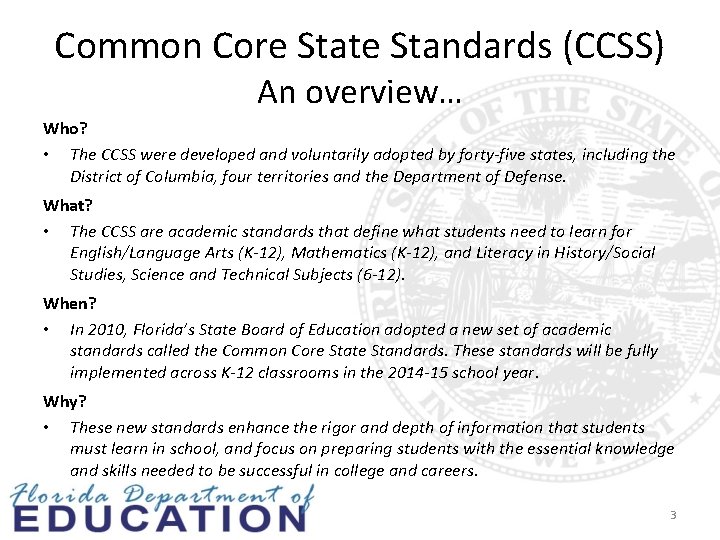
Common Core State Standards (CCSS) An overview… Who? • The CCSS were developed and voluntarily adopted by forty-five states, including the District of Columbia, four territories and the Department of Defense. What? • The CCSS are academic standards that define what students need to learn for English/Language Arts (K-12), Mathematics (K-12), and Literacy in History/Social Studies, Science and Technical Subjects (6 -12). When? • In 2010, Florida’s State Board of Education adopted a new set of academic standards called the Common Core State Standards. These standards will be fully implemented across K-12 classrooms in the 2014 -15 school year. Why? • These new standards enhance the rigor and depth of information that students must learn in school, and focus on preparing students with the essential knowledge and skills needed to be successful in college and careers. 3
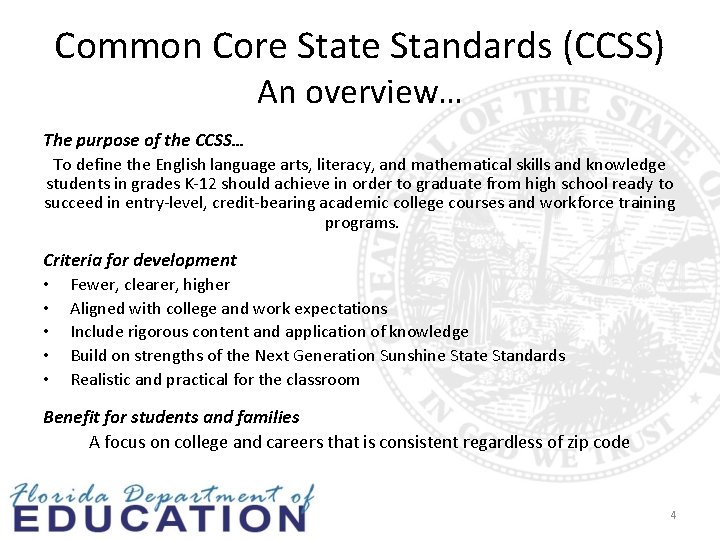
Common Core State Standards (CCSS) An overview… The purpose of the CCSS… To define the English language arts, literacy, and mathematical skills and knowledge students in grades K-12 should achieve in order to graduate from high school ready to succeed in entry-level, credit-bearing academic college courses and workforce training programs. Criteria for development • Fewer, clearer, higher • Aligned with college and work expectations • Include rigorous content and application of knowledge • Build on strengths of the Next Generation Sunshine State Standards • Realistic and practical for the classroom Benefit for students and families A focus on college and careers that is consistent regardless of zip code 4
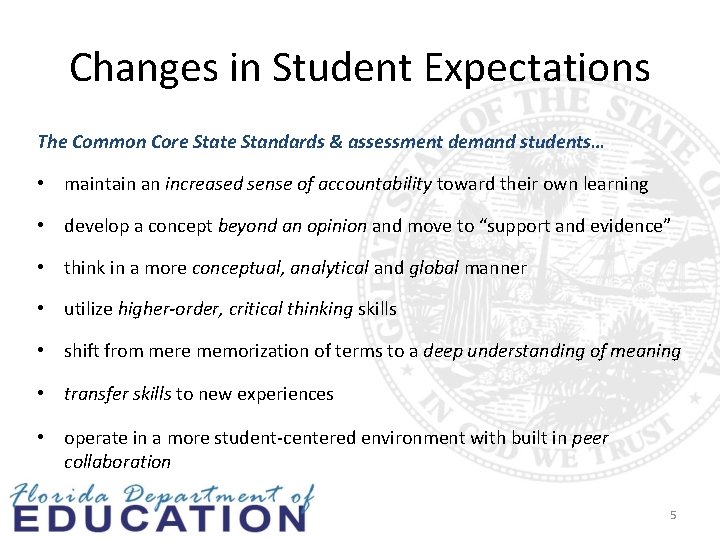
Changes in Student Expectations The Common Core State Standards & assessment demand students… • maintain an increased sense of accountability toward their own learning • develop a concept beyond an opinion and move to “support and evidence” • think in a more conceptual, analytical and global manner • utilize higher-order, critical thinking skills • shift from mere memorization of terms to a deep understanding of meaning • transfer skills to new experiences • operate in a more student-centered environment with built in peer collaboration 5
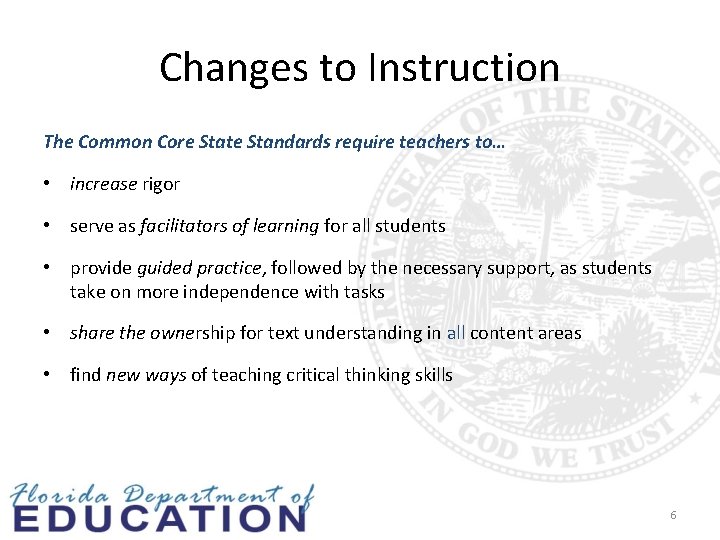
Changes to Instruction The Common Core State Standards require teachers to… • increase rigor • serve as facilitators of learning for all students • provide guided practice, followed by the necessary support, as students take on more independence with tasks • share the ownership for text understanding in all content areas • find new ways of teaching critical thinking skills 6
The Common Core State Standards represent an informed consensus on how best to prepare this country’s young people for college and careers. The standards describe “the what” that students need to learn; however, they do not spell out “the how” for teachers. 7
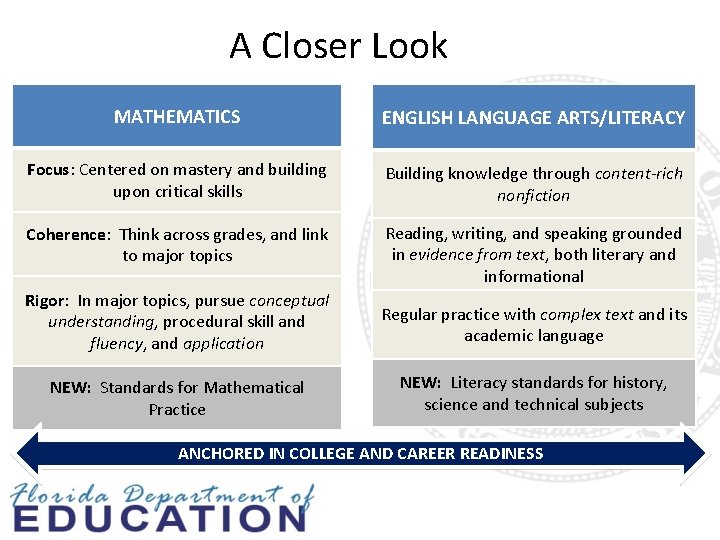
A Closer Look MATHEMATICS ENGLISH LANGUAGE ARTS/LITERACY Focus: Centered on mastery and building upon critical skills Building knowledge through content-rich nonfiction Coherence: Think across grades, and link to major topics Reading, writing, and speaking grounded in evidence from text, both literary and informational Rigor: In major topics, pursue conceptual understanding, procedural skill and fluency, and application Regular practice with complex text and its academic language NEW: Standards for Mathematical Practice NEW: Literacy standards for history, science and technical subjects ANCHORED IN COLLEGE AND CAREER READINESS
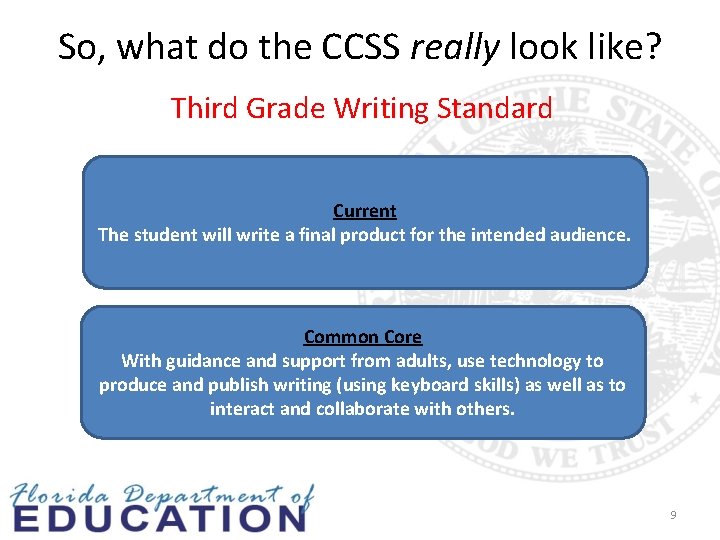
So, what do the CCSS really look like? Third Grade Writing Standard Current The student will write a final product for the intended audience. Common Core With guidance and support from adults, use technology to produce and publish writing (using keyboard skills) as well as to interact and collaborate with others. 9
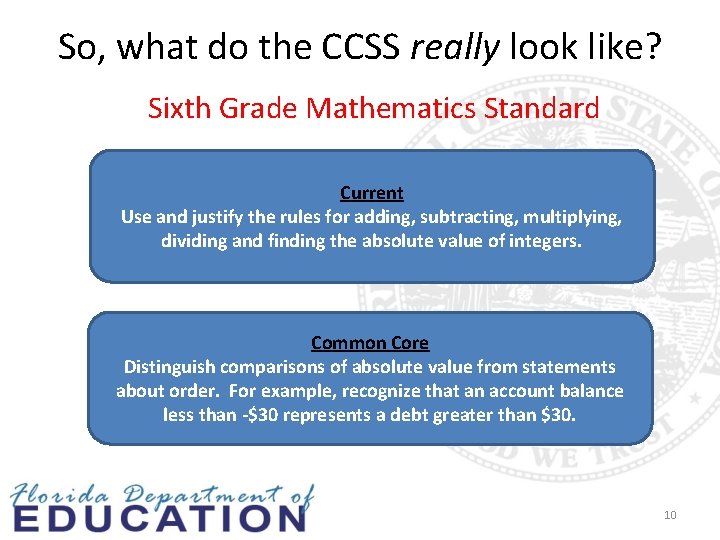
So, what do the CCSS really look like? Sixth Grade Mathematics Standard Current Use and justify the rules for adding, subtracting, multiplying, dividing and finding the absolute value of integers. Common Core Distinguish comparisons of absolute value from statements about order. For example, recognize that an account balance less than -$30 represents a debt greater than $30. 10
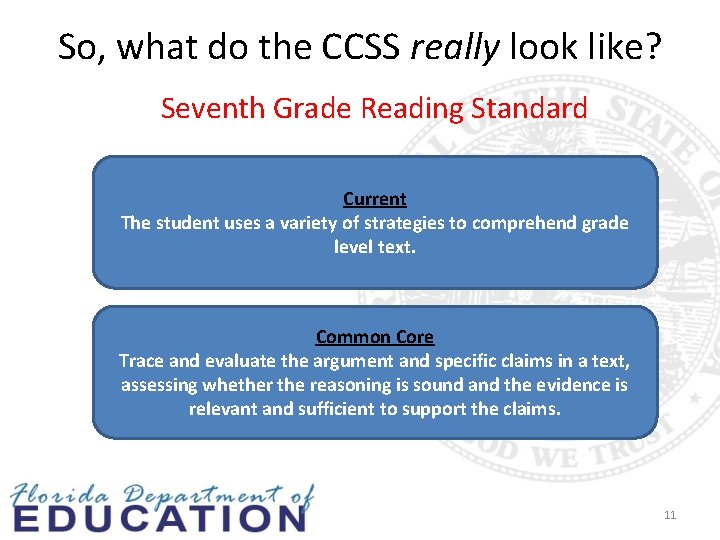
So, what do the CCSS really look like? Seventh Grade Reading Standard Current The student uses a variety of strategies to comprehend grade level text. Common Core Trace and evaluate the argument and specific claims in a text, assessing whether the reasoning is sound and the evidence is relevant and sufficient to support the claims. 11
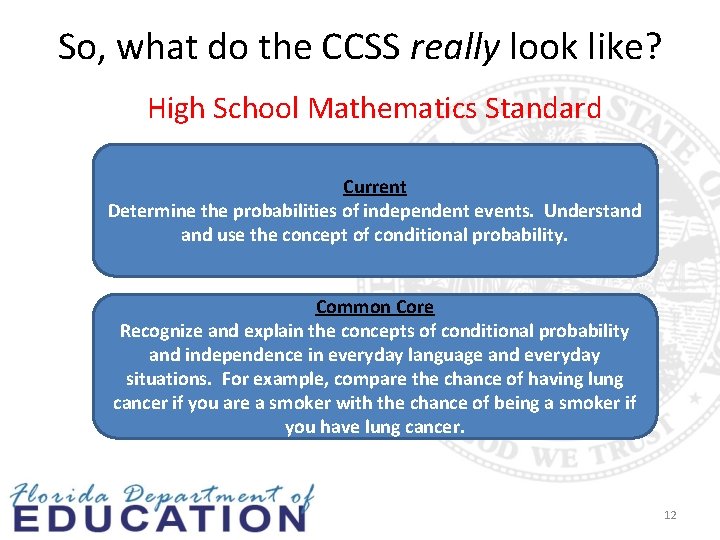
So, what do the CCSS really look like? High School Mathematics Standard Current Determine the probabilities of independent events. Understand use the concept of conditional probability. Common Core Recognize and explain the concepts of conditional probability and independence in everyday language and everyday situations. For example, compare the chance of having lung cancer if you are a smoker with the chance of being a smoker if you have lung cancer. 12
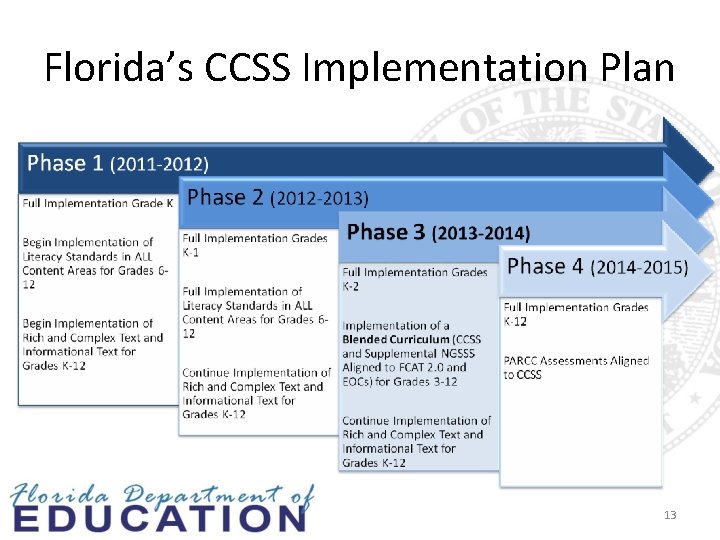
Florida’s CCSS Implementation Plan 13
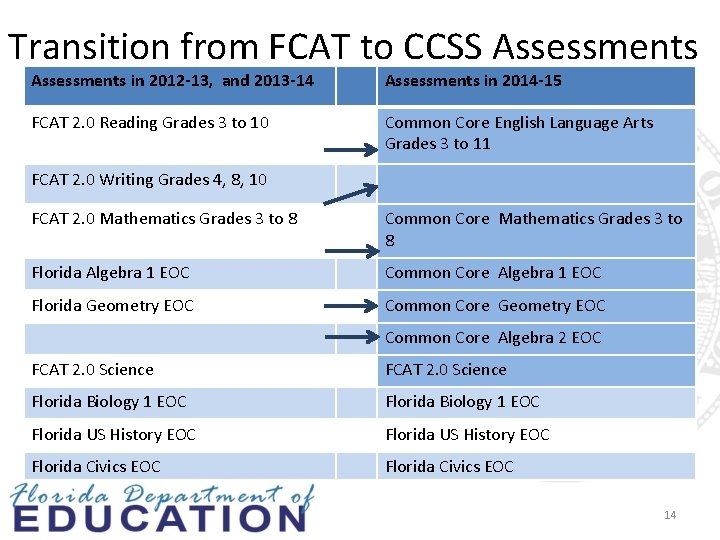
Transition from FCAT to CCSS Assessments in 2012 -13, and 2013 -14 Assessments in 2014 -15 FCAT 2. 0 Reading Grades 3 to 10 Common Core English Language Arts Grades 3 to 11 FCAT 2. 0 Writing Grades 4, 8, 10 FCAT 2. 0 Mathematics Grades 3 to 8 Common Core Mathematics Grades 3 to 8 Florida Algebra 1 EOC Common Core Algebra 1 EOC Florida Geometry EOC Common Core Algebra 2 EOC FCAT 2. 0 Science Florida Biology 1 EOC Florida US History EOC Florida Civics EOC 14
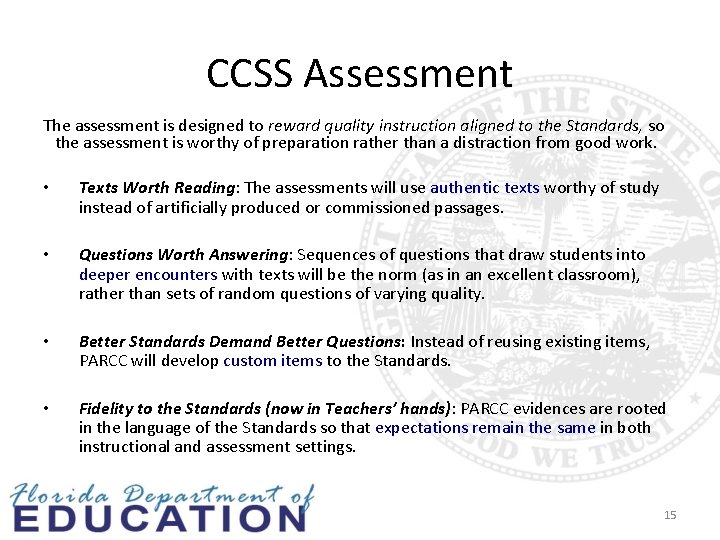
CCSS Assessment The assessment is designed to reward quality instruction aligned to the Standards, so the assessment is worthy of preparation rather than a distraction from good work. • Texts Worth Reading: The assessments will use authentic texts worthy of study instead of artificially produced or commissioned passages. • Questions Worth Answering: Sequences of questions that draw students into deeper encounters with texts will be the norm (as in an excellent classroom), rather than sets of random questions of varying quality. • Better Standards Demand Better Questions: Instead of reusing existing items, PARCC will develop custom items to the Standards. • Fidelity to the Standards (now in Teachers’ hands): PARCC evidences are rooted in the language of the Standards so that expectations remain the same in both instructional and assessment settings. 15
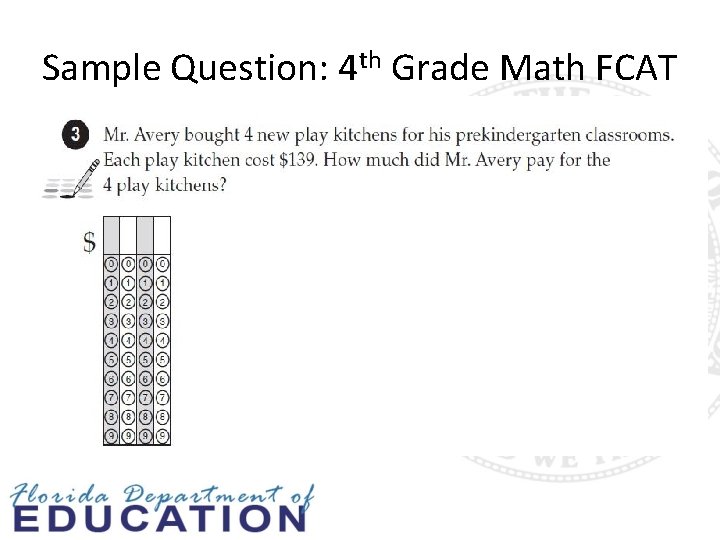
Sample Question: 4 th Grade Math FCAT
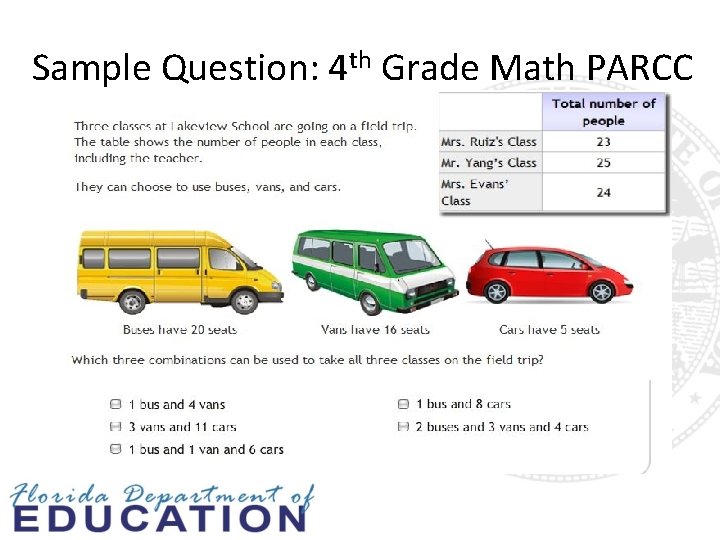
Sample Question: 4 th Grade Math PARCC
Common Core Resources To view the standards and resources: • www. floridastandards. org • www. corestandards. org • www. teachingchannel. org COMING SOON • • • New Common Core-focused website Awareness campaign Professional development for educators, administrators DOE-hosted informational web-events Other resources 18