
Common Core DiscussionsWriting Terms Hints Sentence Starters Examples
- Slides: 21
Common Core Discussions/Writing Terms, Hints, Sentence Starters, Examples
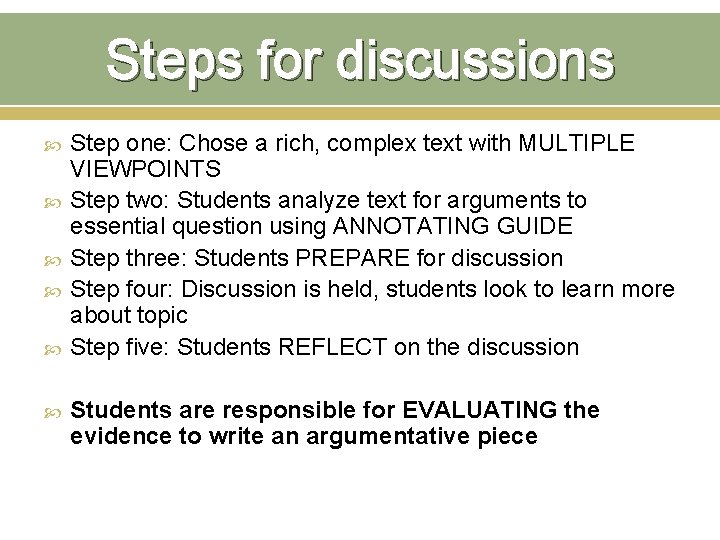
Steps for discussions Step one: Chose a rich, complex text with MULTIPLE VIEWPOINTS Step two: Students analyze text for arguments to essential question using ANNOTATING GUIDE Step three: Students PREPARE for discussion Step four: Discussion is held, students look to learn more about topic Step five: Students REFLECT on the discussion Students are responsible for EVALUATING the evidence to write an argumentative piece
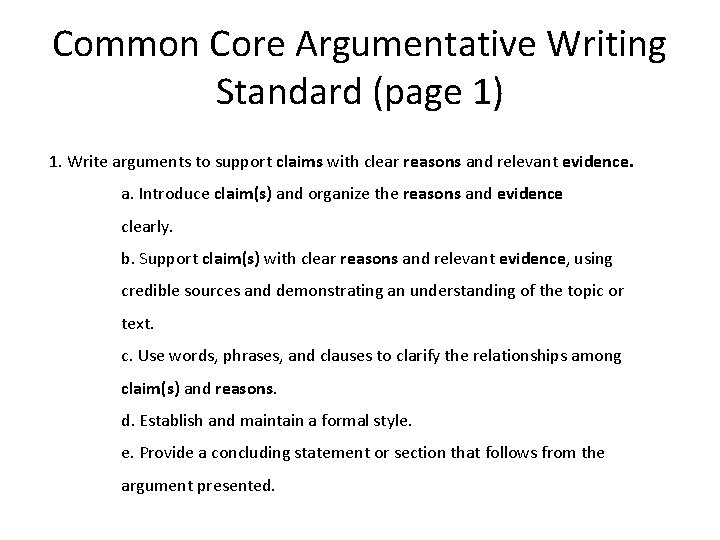
Common Core Argumentative Writing Standard (page 1) 1. Write arguments to support claims with clear reasons and relevant evidence. a. Introduce claim(s) and organize the reasons and evidence clearly. b. Support claim(s) with clear reasons and relevant evidence, using credible sources and demonstrating an understanding of the topic or text. c. Use words, phrases, and clauses to clarify the relationships among claim(s) and reasons. d. Establish and maintain a formal style. e. Provide a concluding statement or section that follows from the argument presented.
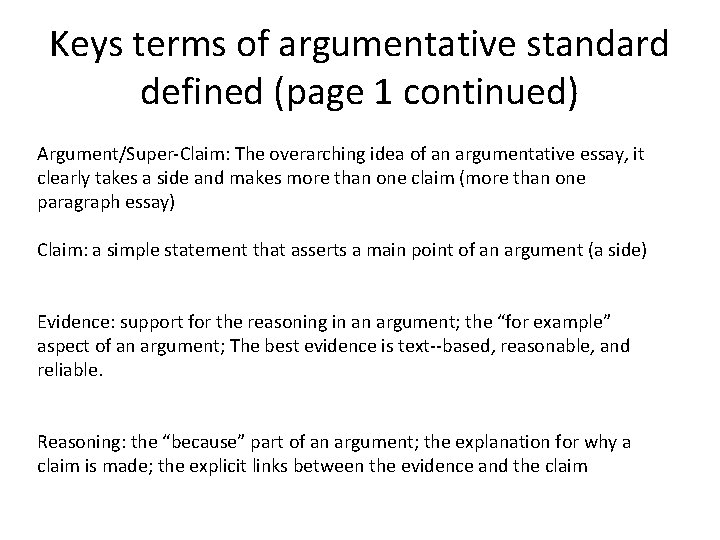
Keys terms of argumentative standard defined (page 1 continued) Argument/Super Claim: The overarching idea of an argumentative essay, it clearly takes a side and makes more than one claim (more than one paragraph essay) Claim: a simple statement that asserts a main point of an argument (a side) Evidence: support for the reasoning in an argument; the “for example” aspect of an argument; The best evidence is text based, reasonable, and reliable. Reasoning: the “because” part of an argument; the explanation for why a claim is made; the explicit links between the evidence and the claim
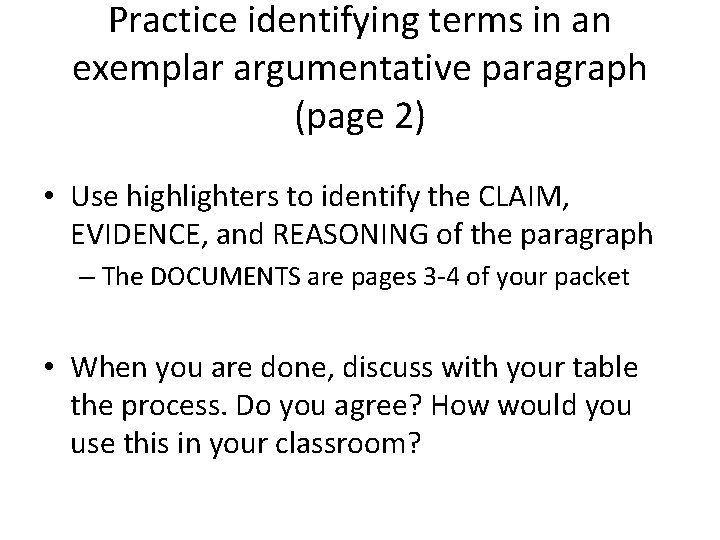
Practice identifying terms in an exemplar argumentative paragraph (page 2) • Use highlighters to identify the CLAIM, EVIDENCE, and REASONING of the paragraph – The DOCUMENTS are pages 3 4 of your packet • When you are done, discuss with your table the process. Do you agree? How would you use this in your classroom?
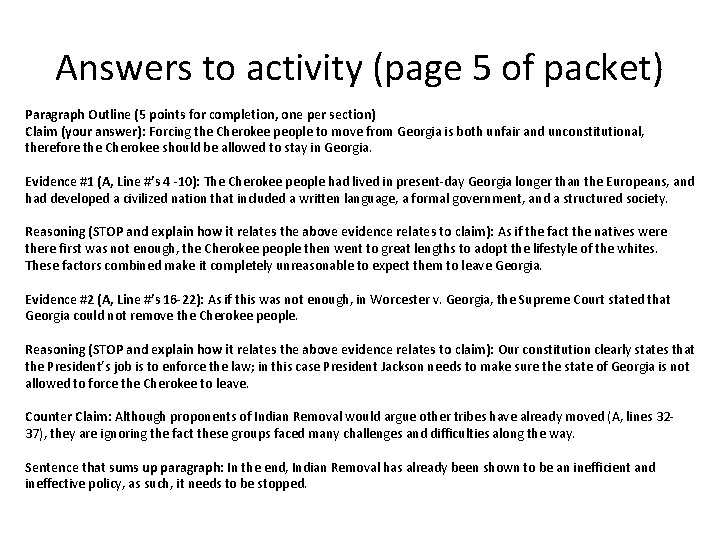
Answers to activity (page 5 of packet) Paragraph Outline (5 points for completion, one per section) Claim (your answer): Forcing the Cherokee people to move from Georgia is both unfair and unconstitutional, therefore the Cherokee should be allowed to stay in Georgia. Evidence #1 (A, Line #’s 4 -10): The Cherokee people had lived in present day Georgia longer than the Europeans, and had developed a civilized nation that included a written language, a formal government, and a structured society. Reasoning (STOP and explain how it relates the above evidence relates to claim): As if the fact the natives were there first was not enough, the Cherokee people then went to great lengths to adopt the lifestyle of the whites. These factors combined make it completely unreasonable to expect them to leave Georgia. Evidence #2 (A, Line #’s 16 -22): As if this was not enough, in Worcester v. Georgia, the Supreme Court stated that Georgia could not remove the Cherokee people. Reasoning (STOP and explain how it relates the above evidence relates to claim): Our constitution clearly states that the President’s job is to enforce the law; in this case President Jackson needs to make sure the state of Georgia is not allowed to force the Cherokee to leave. Counter Claim: Although proponents of Indian Removal would argue other tribes have already moved (A, lines 32 37), they are ignoring the fact these groups faced many challenges and difficulties along the way. Sentence that sums up paragraph: In the end, Indian Removal has already been shown to be an inefficient and ineffective policy, as such, it needs to be stopped.
Possible scaffolds for students • Pages 6 7 have possible writing scaffolds to use with students
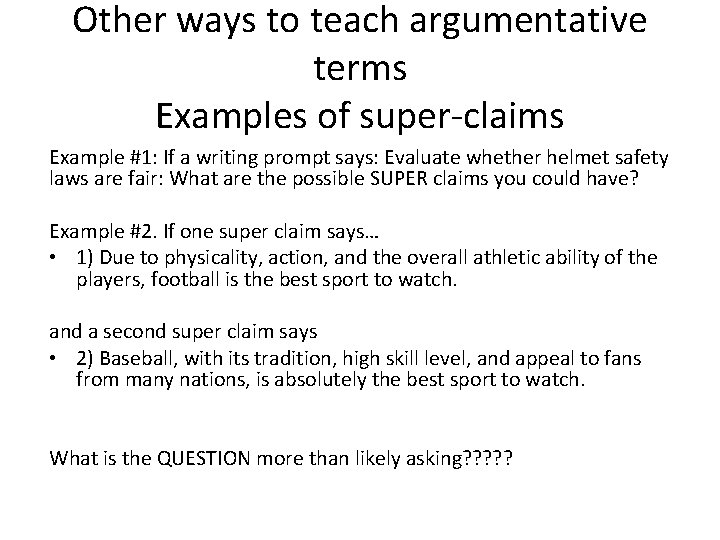
Other ways to teach argumentative terms Examples of super claims Example #1: If a writing prompt says: Evaluate whether helmet safety laws are fair: What are the possible SUPER claims you could have? Example #2. If one super claim says… • 1) Due to physicality, action, and the overall athletic ability of the players, football is the best sport to watch. and a second super claim says • 2) Baseball, with its tradition, high skill level, and appeal to fans from many nations, is absolutely the best sport to watch. What is the QUESTION more than likely asking? ? ?
Ways to teach continued… • 1) Due to physicality, action, and the overall athletic ability of the players, football is the best sport to watch. • 2) Baseball, with its tradition, high skill level, and appeal to fans from many nations, is absolutely the best sport to watch. • Choose one of the above… what are the body paragraphs going to be about based on the claim?
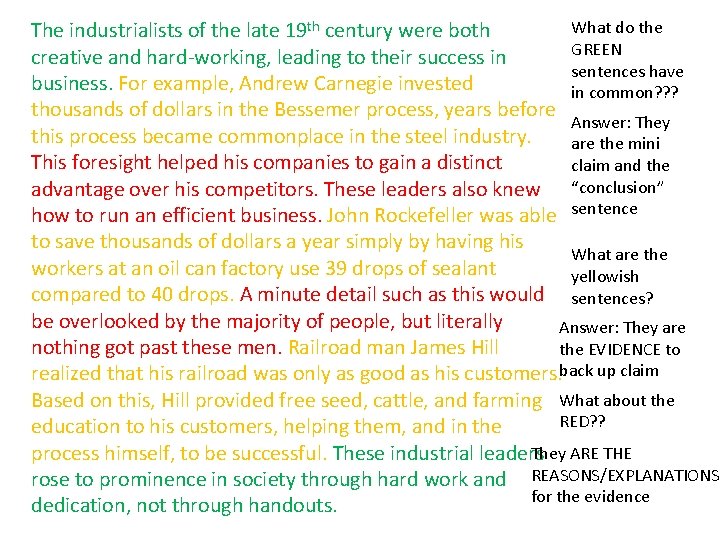
What do the The industrialists of the late 19 th century were both GREEN creative and hard working, leading to their success in sentences have business. For example, Andrew Carnegie invested in common? ? ? thousands of dollars in the Bessemer process, years before Answer: They this process became commonplace in the steel industry. are the mini This foresight helped his companies to gain a distinct claim and the advantage over his competitors. These leaders also knew “conclusion” how to run an efficient business. John Rockefeller was able sentence to save thousands of dollars a year simply by having his What are the workers at an oil can factory use 39 drops of sealant yellowish compared to 40 drops. A minute detail such as this would sentences? be overlooked by the majority of people, but literally Answer: They are nothing got past these men. Railroad man James Hill the EVIDENCE to realized that his railroad was only as good as his customers. back up claim Based on this, Hill provided free seed, cattle, and farming What about the RED? ? education to his customers, helping them, and in the They ARE THE process himself, to be successful. These industrial leaders rose to prominence in society through hard work and REASONS/EXPLANATIONS for the evidence dedication, not through handouts.
Reasoning sentence starters • Make sure to add evidence, but then EXPLAIN your evidence (which is called your REASONING) • EXPLAIN WHAT MORAL MEANS!!!! • Possible sentence starters This shows… This demonstrates… This proves… This helps to explain
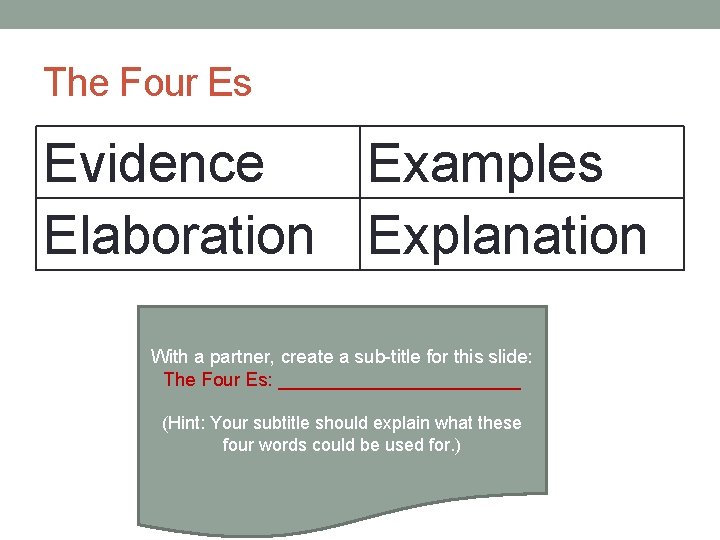
The Four Es Evidence Examples Elaboration Explanation With a partner, create a sub-title for this slide: The Four Es: ____________ (Hint: Your subtitle should explain what these four words could be used for. )
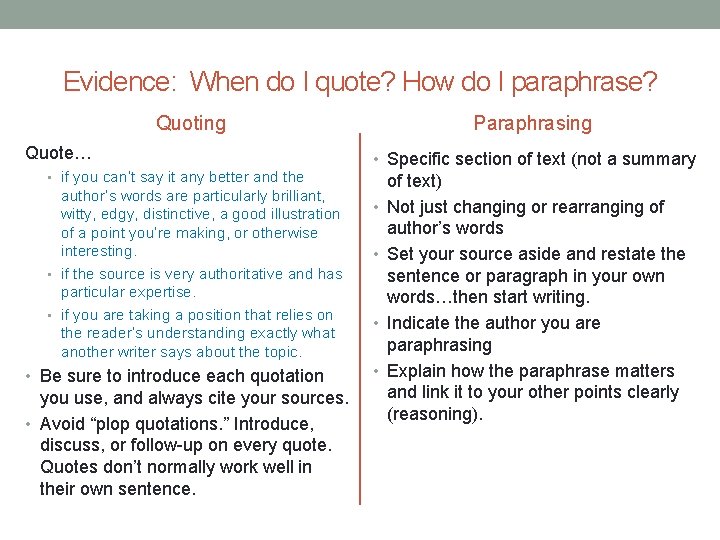
Evidence: When do I quote? How do I paraphrase? Quoting Quote… • if you can’t say it any better and the author’s words are particularly brilliant, witty, edgy, distinctive, a good illustration of a point you’re making, or otherwise interesting. • if the source is very authoritative and has particular expertise. • if you are taking a position that relies on the reader’s understanding exactly what another writer says about the topic. • Be sure to introduce each quotation you use, and always cite your sources. • Avoid “plop quotations. ” Introduce, discuss, or follow-up on every quote. Quotes don’t normally work well in their own sentence. Paraphrasing • Specific section of text (not a summary • • of text) Not just changing or rearranging of author’s words Set your source aside and restate the sentence or paragraph in your own words…then start writing. Indicate the author you are paraphrasing Explain how the paraphrase matters and link it to your other points clearly (reasoning).
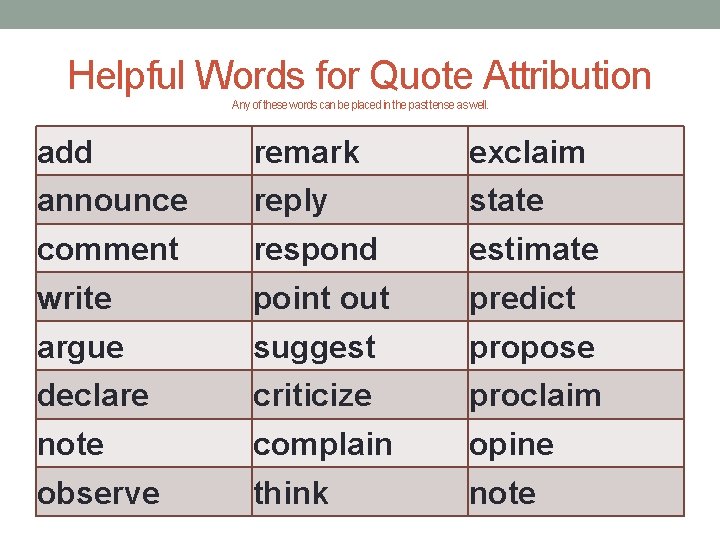
Helpful Words for Quote Attribution Any of these words can be placed in the past tense as well. add remark exclaim announce reply state comment respond estimate write point out predict argue suggest propose declare criticize proclaim note complain opine observe think note
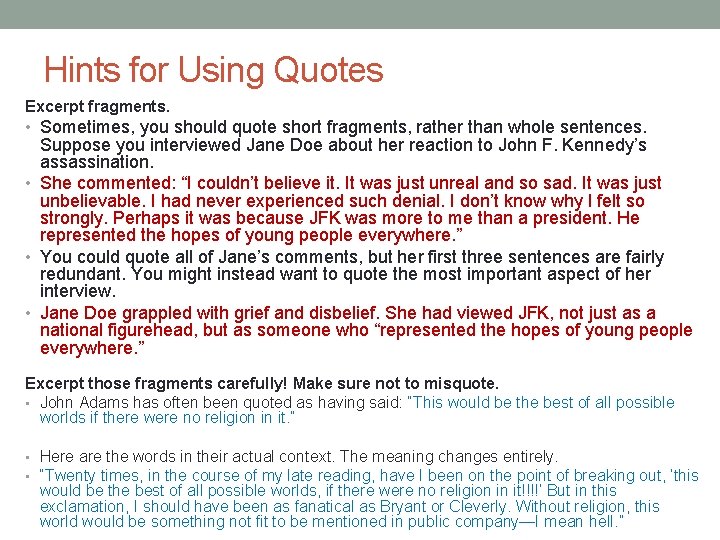
Hints for Using Quotes Excerpt fragments. • Sometimes, you should quote short fragments, rather than whole sentences. Suppose you interviewed Jane Doe about her reaction to John F. Kennedy’s assassination. • She commented: “I couldn’t believe it. It was just unreal and so sad. It was just unbelievable. I had never experienced such denial. I don’t know why I felt so strongly. Perhaps it was because JFK was more to me than a president. He represented the hopes of young people everywhere. ” • You could quote all of Jane’s comments, but her first three sentences are fairly redundant. You might instead want to quote the most important aspect of her interview. • Jane Doe grappled with grief and disbelief. She had viewed JFK, not just as a national figurehead, but as someone who “represented the hopes of young people everywhere. ” Excerpt those fragments carefully! Make sure not to misquote. • John Adams has often been quoted as having said: “This would be the best of all possible worlds if there were no religion in it. ” • Here are the words in their actual context. The meaning changes entirely. • “Twenty times, in the course of my late reading, have I been on the point of breaking out, ‘this would be the best of all possible worlds, if there were no religion in it!!!!’ But in this exclamation, I should have been as fanatical as Bryant or Cleverly. Without religion, this world would be something not fit to be mentioned in public company—I mean hell. ”
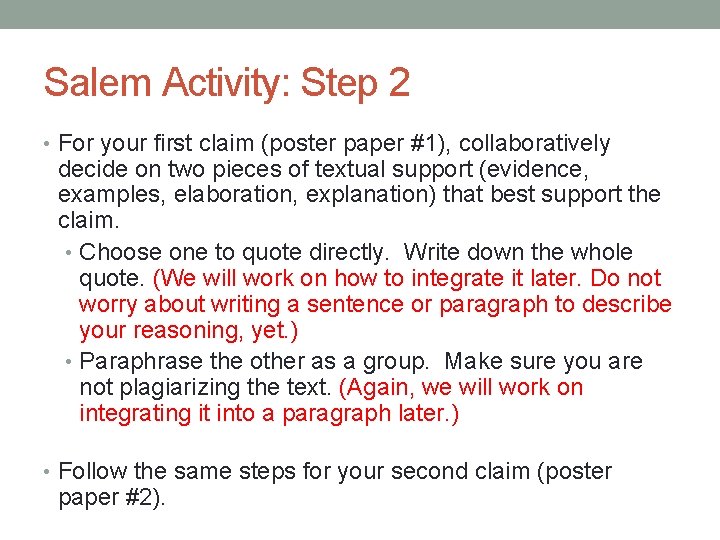
Salem Activity: Step 2 • For your first claim (poster paper #1), collaboratively decide on two pieces of textual support (evidence, examples, elaboration, explanation) that best support the claim. • Choose one to quote directly. Write down the whole quote. (We will work on how to integrate it later. Do not worry about writing a sentence or paragraph to describe your reasoning, yet. ) • Paraphrase the other as a group. Make sure you are not plagiarizing the text. (Again, we will work on integrating it into a paragraph later. ) • Follow the same steps for your second claim (poster paper #2).
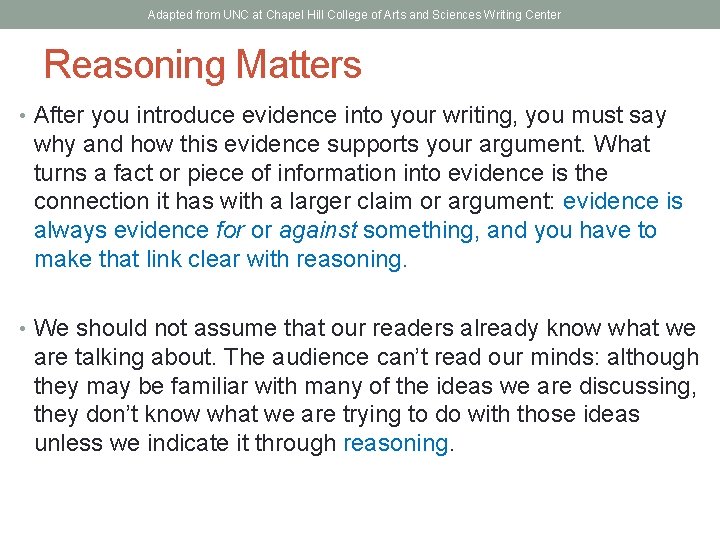
Adapted from UNC at Chapel Hill College of Arts and Sciences Writing Center Reasoning Matters • After you introduce evidence into your writing, you must say why and how this evidence supports your argument. What turns a fact or piece of information into evidence is the connection it has with a larger claim or argument: evidence is always evidence for or against something, and you have to make that link clear with reasoning. • We should not assume that our readers already know what we are talking about. The audience can’t read our minds: although they may be familiar with many of the ideas we are discussing, they don’t know what we are trying to do with those ideas unless we indicate it through reasoning.
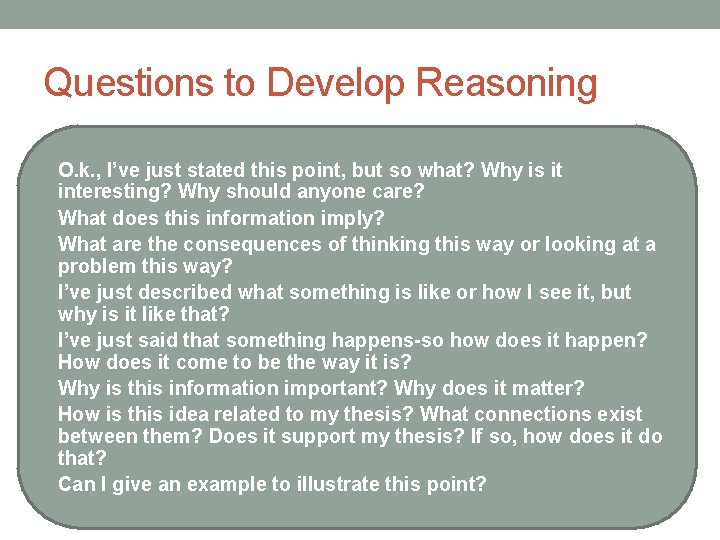
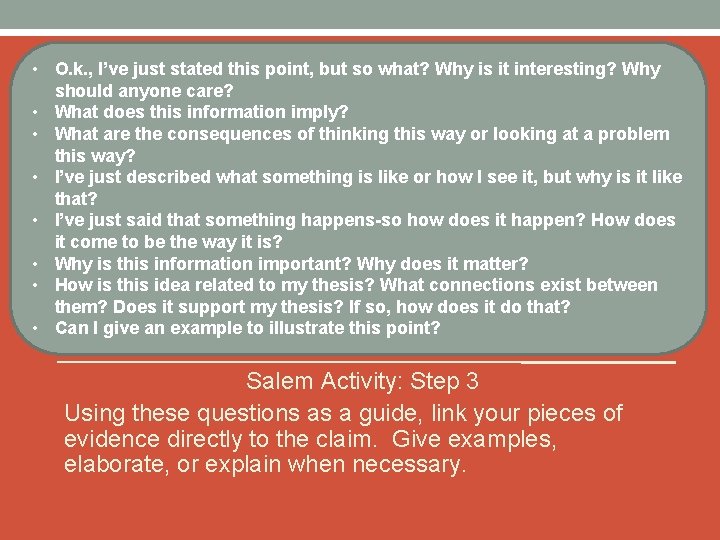
Questions to Develop Reasoning • O. k. , I’ve just stated this point, but so what? Why is it • • interesting? Why should anyone care? What does this information imply? What are the consequences of thinking this way or looking at a problem this way? I’ve just described what something is like or how I see it, but why is it like that? I’ve just said that something happens-so how does it happen? How does it come to be the way it is? Why is this information important? Why does it matter? How is this idea related to my thesis? What connections exist between them? Does it support my thesis? If so, how does it do that? Can I give an example to illustrate this point?
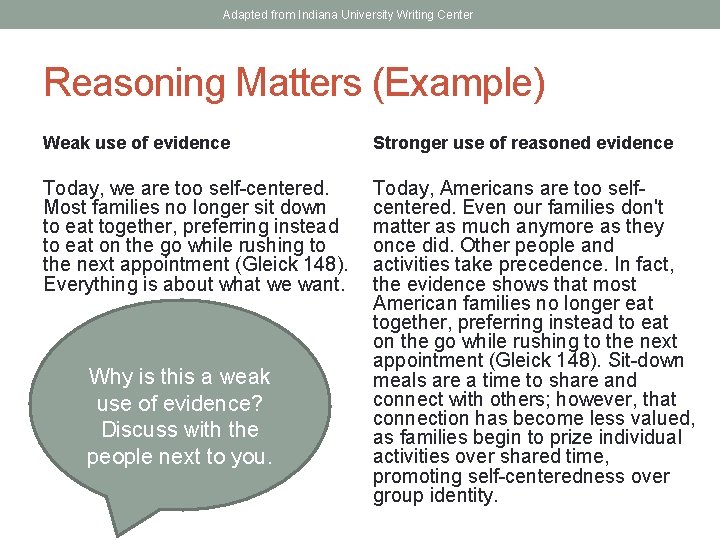
Adapted from Indiana University Writing Center Reasoning Matters (Example) Weak use of evidence Stronger use of reasoned evidence Today, we are too self-centered. Most families no longer sit down to eat together, preferring instead to eat on the go while rushing to the next appointment (Gleick 148). Everything is about what we want. Today, Americans are too selfcentered. Even our families don't matter as much anymore as they once did. Other people and activities take precedence. In fact, the evidence shows that most American families no longer eat together, preferring instead to eat on the go while rushing to the next appointment (Gleick 148). Sit-down meals are a time to share and connect with others; however, that connection has become less valued, as families begin to prize individual activities over shared time, promoting self-centeredness over group identity. Why is this a weak use of evidence? Discuss with the people next to you.
• O. k. , I’ve just stated this point, but so what? Why is it interesting? Why should anyone care? • What does this information imply? • What are the consequences of thinking this way or looking at a problem this way? • I’ve just described what something is like or how I see it, but why is it like that? • I’ve just said that something happens-so how does it happen? How does it come to be the way it is? • Why is this information important? Why does it matter? • How is this idea related to my thesis? What connections exist between them? Does it support my thesis? If so, how does it do that? • Can I give an example to illustrate this point? Salem Activity: Step 3 Using these questions as a guide, link your pieces of evidence directly to the claim. Give examples, elaborate, or explain when necessary.