
Common Confidentiality Provisions Ramsey Abarca Assistant Attorney General
Common Confidentiality Provisions Ramsey Abarca Assistant Attorney General Open Records Division
Mandatory Exceptions What is a Mandatory Exception? A statute which explicitly makes information confidential Cannot be waived Not discretionary – it either applies or does not apply Remember – unless you have a previous determination or a statute explicitly permitting redaction, you must seek a decision from the OAG or request permission from the requestor before withholding information.

Section 552. 101 of the Government Code Incorporates laws outside the Public Information Act (“PIA”) • Statutory law • Case law • Constitutional law Must be raised in conjunction with other law, including common-law privacy • “The submitted medical records are excepted from disclosure under section 552. 101 in conjunction with the Medical Practice Act. ” • “The marked information is excepted from disclosure under section 552. 101 in conjunction with common-law privacy. ”
Section 552. 101 + Statutes (Slide 1 of 6) Section 552. 101 + Statutes Medical Practice Act (“MPA”), subtitle B of Title 3 of the Occupations Code (Section 159. 002) • Medical health records and communications between a patient and a physician, e. g. , doctor’s notes, medical charts • Does not apply to health records and communications between a patient and a nurse who is not supervised by a physician Section 611. 002 of the Health & Safety Code • Mental health records and communications between a patient and a mental health professional Section 773. 091 of the Health & Safety Code • EMS records
Section 552. 101 + Statutes (Slide 2 of 6) Section 552. 101 + Statutes Americans with Disabilities Act of 1990 (“ADA”) • Certain medical records pertaining to an employee’s disability Section 1703. 306 of the Occupations Code • Results of a polygraph examination § Governmental body may release report and results to the examinee.
Section 552. 101 + Statutes (Slide 3 of 6) Open Records Decision No. 684 (2009) Previous determination for any governmental body to withhold information without the delay of requesting an attorney general decision Intended to encourage the prompt release of information and increase efficiency Particularly applicable to personnel records but applies in other circumstances as well
Section 552. 101 + Statutes (Slide 4 of 6) Open Records Decision No. 684 (2009) Direct deposit authorization under section 552. 101 + common -law privacy Form I-9 and attachments under section 552. 101 + 8 USC 1324 a W-2 and W-4 forms under section 552. 101 + 26 USC 6103(a)
Section 552. 101 + Statutes (Slide 5 of 6) Open Records Decision No. 684 (2009) Certified agenda and tape of a closed meeting under section 552. 101 + section 551. 104 of the Government Code Fingerprints under section 552. 101 + section 560. 003 of the Government Code • Individual has right of access to own fingerprint information. L-2 and L-3 declarations under section 552. 101 + section 1701. 306 of the Occupations Code Form DD-214 or other military discharge record that a governmental body receives on or after September 1, 2003 under section 552. 140
Section 552. 101 + Statutes (Slide 6 of 6) Section 552. 101 encompasses all statutes outside of the Act. Learn what confidentiality statutes apply to your governmental body or its information. Explain how confidentiality statutes apply to your governmental body. Identify confidentiality statutes never addressed in an open records ruling.
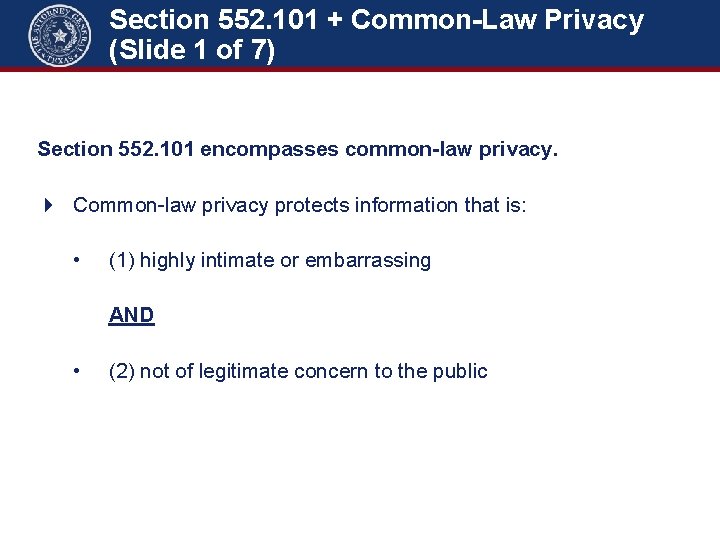
Section 552. 101 + Common-Law Privacy (Slide 1 of 7) Section 552. 101 + Common-Law Privacy – Slide 1 of 5 Section 552. 101 encompasses common-law privacy. Common-law privacy protects information that is: • (1) highly intimate or embarrassing AND • (2) not of legitimate concern to the public
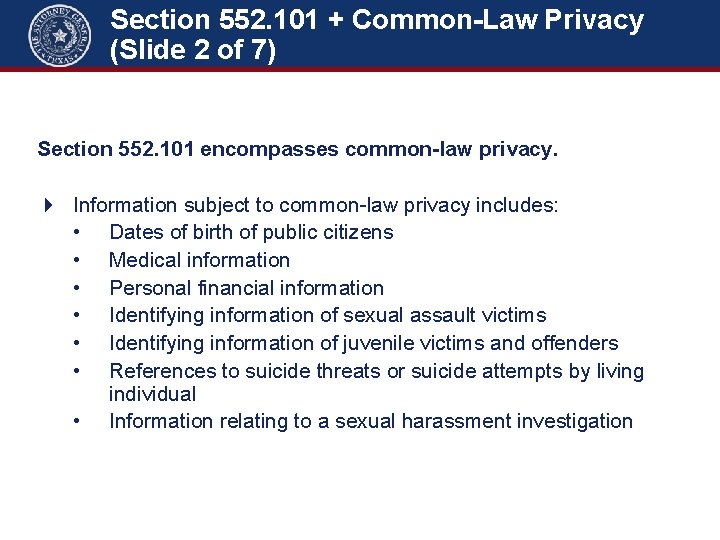
Section 552. 101 + Common-Law Privacy (Slide 2 of 7) Section 552. 101 + Common-Law Privacy – Slide 1 of 5 Section 552. 101 encompasses common-law privacy. Information subject to common-law privacy includes: • Dates of birth of public citizens • Medical information • Personal financial information • Identifying information of sexual assault victims • Identifying information of juvenile victims and offenders • References to suicide threats or suicide attempts by living individual • Information relating to a sexual harassment investigation
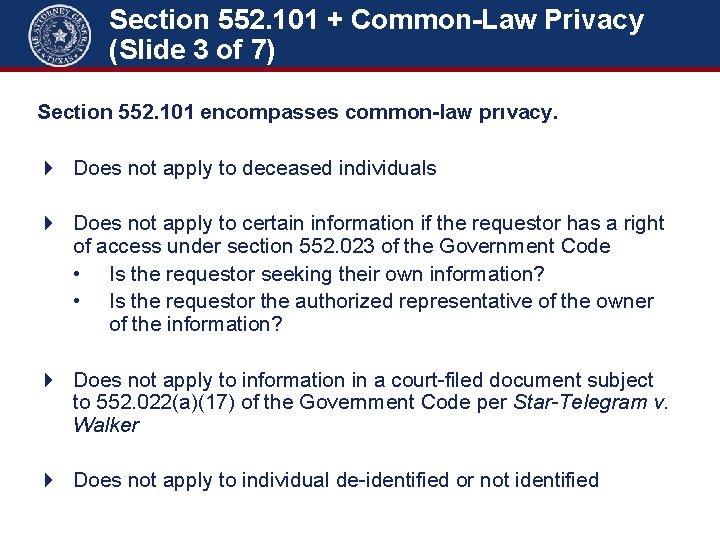
Section 552. 101 + Common-Law Privacy (Slide 3 of 7) Section 552. 101 + Common-Law Privacy – Slide 1 of 5 Section 552. 101 encompasses common-law privacy. Does not apply to deceased individuals Does not apply to certain information if the requestor has a right of access under section 552. 023 of the Government Code • Is the requestor seeking their own information? • Is the requestor the authorized representative of the owner of the information? Does not apply to information in a court-filed document subject to 552. 022(a)(17) of the Government Code per Star-Telegram v. Walker Does not apply to individual de-identified or not identified
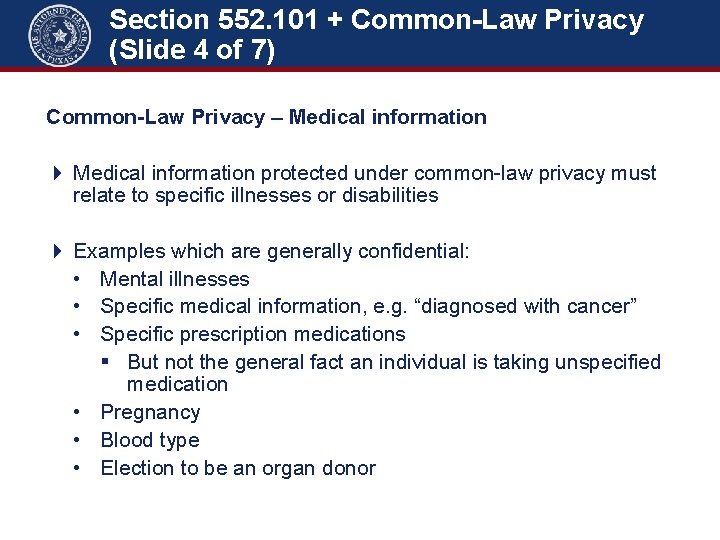
Section 552. 101 + Common-Law Privacy (Slide 4 of 7) Section 552. 101 + Common-Law Privacy – Slide 3 of 5 Common-Law Privacy – Medical information protected under common-law privacy must relate to specific illnesses or disabilities Examples which are generally confidential: • Mental illnesses • Specific medical information, e. g. “diagnosed with cancer” • Specific prescription medications § But not the general fact an individual is taking unspecified medication • Pregnancy • Blood type • Election to be an organ donor
Section 552. 101 + Common-Law Privacy (Slide 5 of 7) Common-Law Privacy – Financial information Legitimate public interest in the essential facts about a financial transaction with a governmental body • Gross salary information of employee of a governmental body • Information relating to an employee’s participation in a group insurance funded in part or full by a governmental body But private financial choices are confidential.
Section 552. 101 + Common-Law Privacy (Slide 6 of 7) Section 552. 101 + Common-Law Privacy – Slide 5 of 5 Common-Law Privacy – Financial information Personal financial information protected under common-law privacy must be information not relating to a financial transaction between an individual and a governmental body. • Examples which are generally confidential: § Salary of employee of a non-governmental body § Net salary of employee of governmental body § Private assets or debts § Optional insurance coverage § Direct deposit authorization § Lien information § Designation of beneficiaries of retirement benefits
Section 552. 101 + Common-Law Privacy (Slide 7 of 7) Common-Law Privacy Application of common-law privacy is fact specific. Governmental body must seek an attorney general decision when common-law privacy is at issue, except for • Direct deposit authorization under the previous determination in Open Records Decision No. 684 (2009), or • Governmental body received a previous determination to withhold dates of birth
Section 552. 102(a) Section 552. 101 + Common-Law Privacy – Slide 5 of 5 Section 552. 102(a) protects the date of birth of an employee of a governmental body in a record maintained by his or her employer in an employment context
Section 552. 117 (Slide 1 of 5) Section 552. 101 + Common-Law Privacy – Slide 5 of 5 Section 552. 117(a)(1) protects the following information for a current or former employee or official of a governmental body so long as an election is made under 552. 024: • Home address, • Home telephone number, • Emergency contact information, • Social security number, and • Family member information. 552. 024(c) authorizes a governmental body to withhold information subject to 552. 117(a)(1) without requesting a decision
Section 552. 117 (Slide 2 of 5) Section 552. 101 + Common-Law Privacy – Slide 5 of 5 Section 552. 117(a)(1) protects the following information for a current or former employee or official of a governmental body so long as an election is made under 552. 024: • Home address (but not post office box), • Home telephone number (and personal cellular and pager number), • Emergency contact information, • Social security number, and • Family member information (but not ex-spouses, boyfriends, or girlfriends). 552. 024(c) authorizes a governmental body to withhold information subject to 552. 117(a)(1) without requesting a decision
Section 552. 117 (Slide 3 of 5) Section 552. 101 + Common-Law Privacy – Slide 5 of 5 Section 552. 117(a)(2) protects the following information for a peace officer or security officer regardless of whether the officer complies with 552. 024 or 552. 1175: • Home address • Home telephone number • Emergency contact information • Social security number • Family member information Open Records Decision No. 670 (2001) authorizes a governmental body to withhold information subject to 552. 117(a)(2) without requesting a decision
Section 552. 117 (Slide 4 of 5) Section 552. 117(a)(2) protects the following information for a peace officer or security officer regardless of whether the officer complies with 552. 024 or 552. 1175: • Home address (but not post office box), • Home telephone number (and personal cellular and pager number), • Emergency contact information, • Social security number, and • Family member information (but not ex-spouses, boyfriends, or girlfriends) Open Records Decision No. 670 (2001) authorizes a governmental body to withhold information subject to 552. 117(a)(2) without requesting a decision
Section 552. 117 (Slide 5 of 5) Section 552. 117(a)(3)-(17) The same personal information is confidential for several other categories of individuals, including: • Current or former employee of the Texas Department of Criminal Justice • Current or former employee of the Texas Juvenile Justice Department • Current or former member of the Army, Navy, Air Force, Coast Guard, Marine Corps, or Texas military forces • Current or former district attorney, criminal district attorney, or county or municipal attorney whose jurisdiction includes any criminal law or child protective services • Current or former federal judge or state judge or their spouse • A firefighter, volunteer firefighter or emergency medical services personnel • And several other categories that may apply to your governmental body
Section 552. 1175 (Slide 1 of 3) Section 552. 101 + Common-Law Privacy – Slide 5 of 5 Section 552. 1175(b) protects the following information of categories of individuals who choose to restrict public access to the information and notify a governmental body of this election: • Home address • Home telephone number • Emergency contact information • Date of birth • Social security number • Family member information 552. 1175(f) authorizes a governmental body to withhold information subject to 552. 1175 without requesting a decision
Section 552. 1175 (Slide 2 of 3) Section 552. 101 + Common-Law Privacy – Slide 5 of 5 Section 552. 1175(b) protects the following information of categories of individuals who choose to restrict public access to the information and notify a governmental body of this election: • Home address (but not post office box) • Home telephone number (or personal cellular or pager number) • Emergency contact information • Date of birth (unlike 552. 117) • Social security number • Family member information (but not ex-spouses, boyfriends, or girlfriends) 552. 1175(f) authorizes a governmental body to withhold information subject to 552. 1175 without requesting a decision
Section 552. 1175 (Slide 3 of 3) Section 552. 1175 The same personal information is confidential for several categories of individuals, including: • Peace officers or special investigators, defined by article 2. 12 of the Code of Criminal Procedure • County jailers • Current or former district attorney, criminal district attorney, or county or municipal attorney whose jurisdiction includes any criminal law or child protective services • Current or former member of the Army, Navy, Air Force, Coast Guard, Marine Corps, or Texas military forces • Federal judge or state judge • A firefighter, volunteer firefighter or emergency medical services personnel • And several other categories that may apply to your governmental body
Sections 552. 117 & 552. 1175 (Slide 1 of 3) Section 552. 101 + Common-Law Privacy – Slide 5 of 5 Section 552. 117 applies current and former employees of your governmental body whose information is held by you in an employment capacity. Under 552. 117 an employee must elect confidentiality before you receive a request or confidentiality is automatic, e. g. , peace officer. Section 552. 1175 applies to various categories of individuals whose information you hold in a non-employment capacity. Under 552. 1175 an individual may elect confidentiality after you receive a request for information.
Sections 552. 117 & 552. 1175 (Slide 2 of 3) Sections 552. 117 & 552. 1175 – Slide 2 of 3 Section 552. 117(a)(1) Right of access under 552. 023 May redact pursuant to 552. 024 Section 552. 117(a)(2) Right of access under 552. 023 May redact pursuant to Open Records Decision No. 670 (2001) Section 552. 1175 Right of access under 552. 023 May redact pursuant to 552. 1175(f)
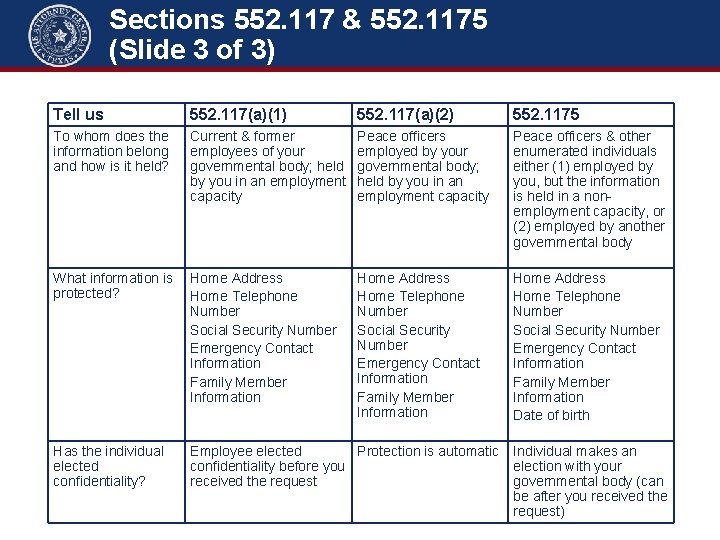
Sections 552. 117 & 552. 1175 (Slide 3 of 3) Tell us 552. 117(a)(1) 552. 117(a)(2) 552. 1175 To whom does the information belong and how is it held? Current & former employees of your governmental body; held by you in an employment capacity Peace officers employed by your governmental body; held by you in an employment capacity Peace officers & other enumerated individuals either (1) employed by you, but the information is held in a nonemployment capacity, or (2) employed by another governmental body What information is protected? Home Address Home Telephone Number Social Security Number Emergency Contact Information Family Member Information Date of birth Has the individual elected confidentiality? Employee elected Protection is automatic confidentiality before you received the request Individual makes an election with your governmental body (can be after you received the request)
Section 552. 130 Section 552. 101 + Common-Law Privacy – Slide 5 of 5 Section 552. 130 protects motor vehicle operator’s or driver’s license, permit, title, or registration issued by Texas or another state or country or a personal identification document issued by Texas or another state or country or a local agency authorized to issue an identification document. For example, 552. 130 applies to: • Driver’s license • Vehicle Identification Number (VIN) • License plate number 552. 130(c) authorizes a governmental body to withhold information subject to 552. 130 without requesting a decision.
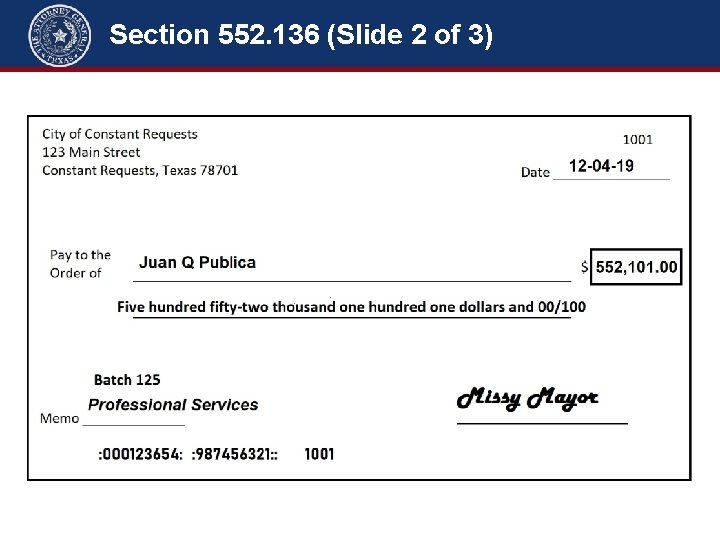
Section 552. 136 (Slide 1 of 3) Section 552. 136 protects a credit card, debit card, charge card, or access device number that is collected, assembled, or maintained by or for a governmental body. “Access device” means an identifier that may be used to obtain money, goods, services, or another thing of value, or initiate a transfer of funds. For example, 552. 136 applies to: • Bank account number • Routing numbers • Insurance policy numbers 552. 136(c) authorizes a governmental body to withhold information subject to 552. 136 without requesting a decision.
Section 552. 136 (Slide 2 of 3) Section 552. 101 + Common-Law Privacy – Slide 5 of 5

Section 552. 136 (Slide 3 of 3) Section 552. 101 + Common-Law Privacy – Slide 5 of 5
Section 552. 137 (Slide 1 of 2) Section 552. 101 + Common-Law Privacy – Slide 5 of 5 Section 552. 137 generally protects a private e-mail address unless the owner affirmatively consents to its release. However, 552. 137 does not apply to an e-mail address with a government contractor, a vendor seeking a government contract, contained in a bid, in a letterhead, or provided in relation to an application for an administrative license. Open Records Decision No. 684 (2007) authorizes a governmental body to withhold information subject to 552. 137 without requesting a decision.
Section 552. 137 (Slide 2 of 2) Section 552. 101 + Common-Law Privacy – Slide 5 of 5 Section 552. 137 does not prevent a governmental body from disclosing an e-mail address for any reason to another governmental body or federal agency. Pursuant to Austin Bulldog v. Leffingwell, the personal e-mail addresses of government officials who use their private e-mail addresses to conduct official government business are not protected by 552. 137.
Section 552. 139 (Slide 1 of 2) Section 552. 101 + Common-Law Privacy – Slide 5 of 5 Section 552. 139 protects information that relates to computer network security, to confidential network security information, or the design, operation, or defense of a computer network. Section 2059. 055 of the Government Code states network security information is confidential if it is related to passwords, personal identification numbers, access codes, encryption, other components of the security system of a governmental entity, or used to prevent, detect, or investigate criminal activity.
Section 552. 139 (Slide 2 of 2) Section 552. 139 specifically makes confidential: • A computer network vulnerability report • Any other assessment of vulnerability to unauthorized access or harm • A photocopy or other copy of an identification badge issued to an official or employee of a governmental body • Information directly arising from a governmental body’s routine efforts to prevent, detect, investigation, or mitigate a computer security incident
Section 552. 147 Section 552. 101 + Common-Law Privacy – Slide 5 of 5 Section 552. 147 Authorizes a governmental body to redact the social security number of a living person without the necessity of requesting an attorney general decision. School district employee social security numbers are confidential pursuant to section 552. 147(a-1). Applies to any part of a social security number, including the last four digits. Does not apply to an entire social security card.
Mandatory Exceptions (Slide 1 of 9) Sections 552. 102(a), 552. 130, 552. 136, 552. 137, and 552. 147 Please remember Inform us if a right of access applies. Section 552. 023 gives a person, or their authorized representative, a right of access to their personal information. Deceased individual’s information is generally not protected under these exceptions.
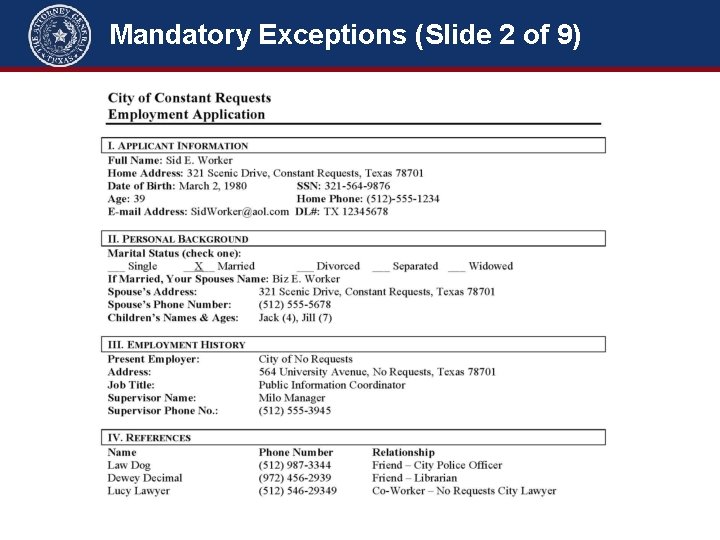
Mandatory Exceptions (Slide 2 of 9) Sections 552. 102(a), 552. 130, 552. 136, 552. 137, and 552. 147
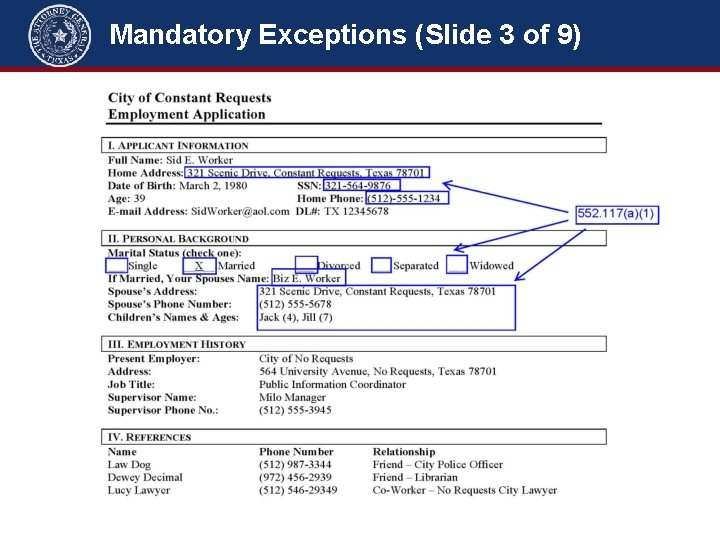
Mandatory Exceptions (Slide 3 of 9) Sections 552. 102(a), 552. 130, 552. 136, 552. 137, and 552. 147

Mandatory Exceptions (Slide 4 of 9) Sections 552. 102(a), 552. 130, 552. 136, 552. 137, and 552. 147
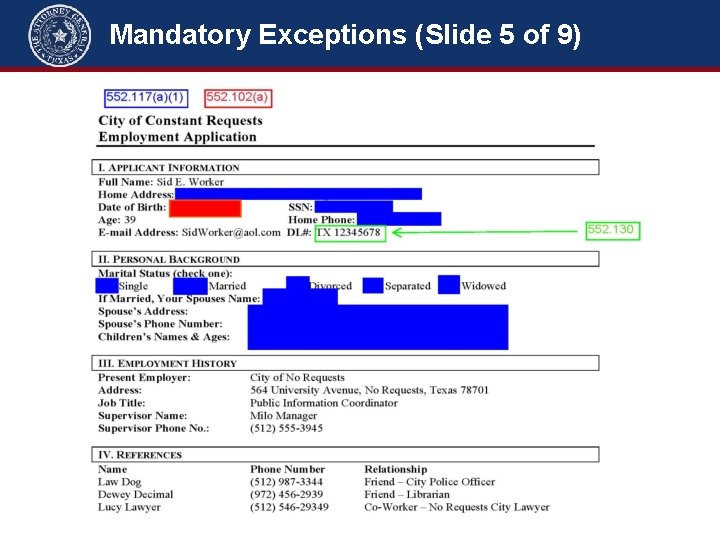
Mandatory Exceptions (Slide 5 of 9) Sections 552. 102(a), 552. 130, 552. 136, 552. 137, and 552. 147
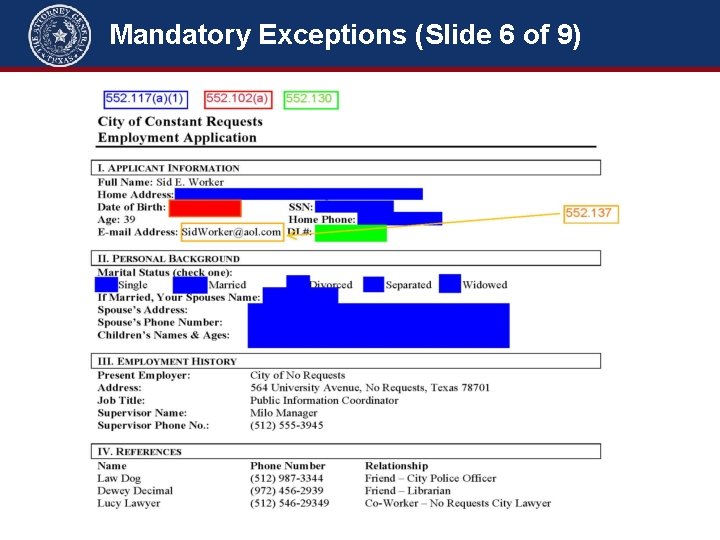
Mandatory Exceptions (Slide 6 of 9) Sections 552. 102(a), 552. 130, 552. 136, 552. 137, and 552. 147
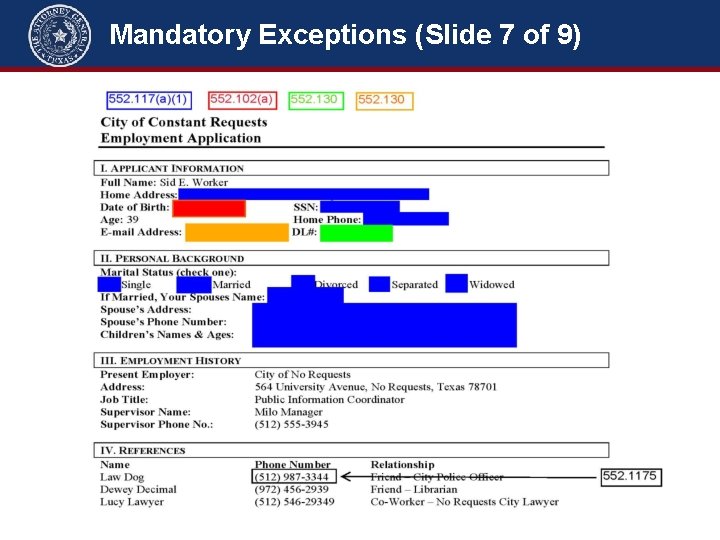
Mandatory Exceptions (Slide 7 of 9) Sections 552. 102(a), 552. 130, 552. 136, 552. 137, and 552. 147
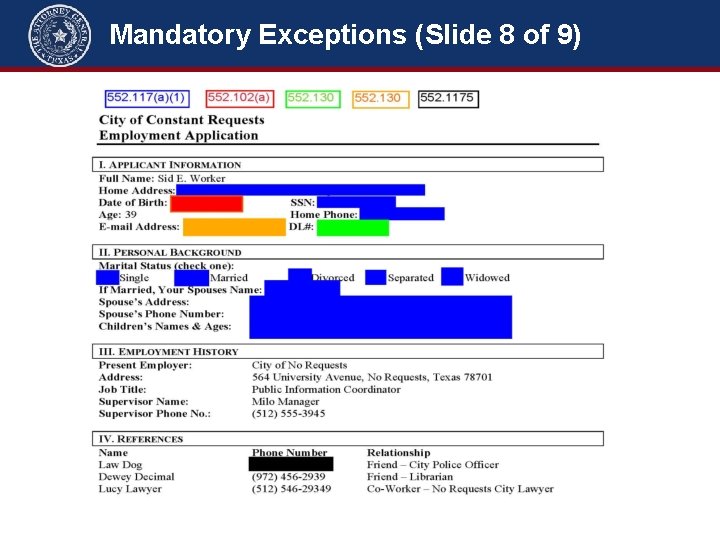
Mandatory Exceptions (Slide 8 of 9) Sections 552. 102(a), 552. 130, 552. 136, 552. 137, and 552. 147
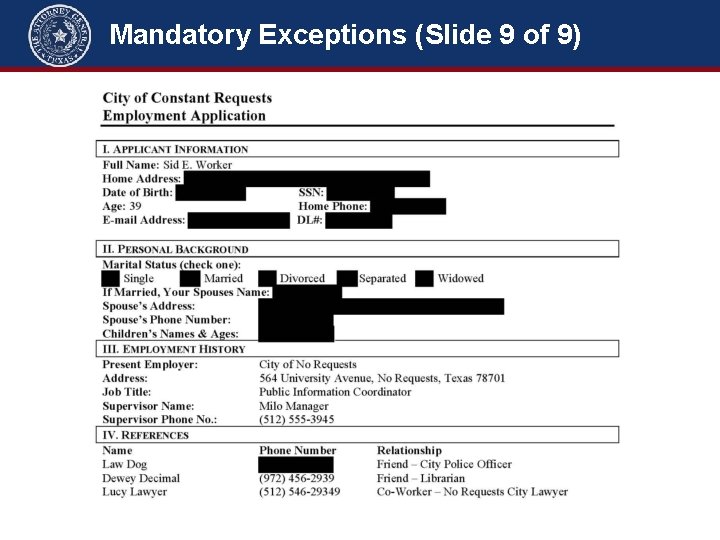
Mandatory Exceptions (Slide 9 of 9) Sections 552. 102(a), 552. 130, 552. 136, 552. 137, and 552. 147
School District Information (Slide 1 of 3) School District Information Section 552. 102(b) of the Government Code College transcripts of professional public school employee, except for the teacher’s: • Name • Courses, and • Degree obtained 552. 102(b) applies only to personnel files of school districts. 552. 102(b) does not apply to college transcripts held by other governmental bodies. If not clear, let us know if the individual is a professional public school employee, e. g. , teacher.
School District Information (Slide 2 of 3) School District Information Section 552. 135 of the Government Code Protects the identity of a current or former student or district employee who reports a possible civil, criminal, or regulatory violation to the district or the proper regulatory enforcement authority Protects the identity of informers but not witnesses
School District Information (Slide 3 of 3) School District Information Section 21. 355 of the Education Code Evaluations of “teacher” or “administrator” are confidential. Tell us if the person at issue held the appropriate teaching or administrator’s certificate at the time of the evaluation. Only applies to an evaluation of person working in a teaching or administrative capacity. Does not apply to an evaluation of a teacher or administrator in a coaching capacity. Section 21. 048 of the Education Code Teacher certification test results are confidential.
Sexual Harassment Investigation (Slide 1 of 5) 552. 101 + Common-Law Privacy: Sexual Harassment Investigation – Slide 1 of 3 Sexual Harassment Investigations
Sexual Harassment Investigation (Slide 2 of 5) 552. 101 + Common-Law Privacy: Sexual Harassment Investigation – Slide 2 of 3 Sexual Harassment Investigation Must be in employment context. In Morales v. Ellen the court of appeals addressed the applicability of the common law privacy doctrine to files of an investigation of allegations of sexual harassment. Protected information is handled two different ways, depending on whether or not there is an adequate summary of the investigation.
Sexual Harassment Investigation (Slide 3 of 5) 552. 101 + Common-Law Privacy: Sexual Harassment Investigation – Slide 3 of 3 Sexual Harassment Investigation Adequate Summary of Investigation • Release only the summary and the statement of the person under investigation. § BUT redact the victim’s and witnesses’ identifying information under 552. 101 + common-law privacy. • Remaining investigation information is withheld under 552. 101 + common-law privacy. No Adequate Summary of Investigation • Release all information regarding the investigation in most cases. § BUT redact the victim’s and witnesses’ identifying information under 552. 101 + common-law privacy.
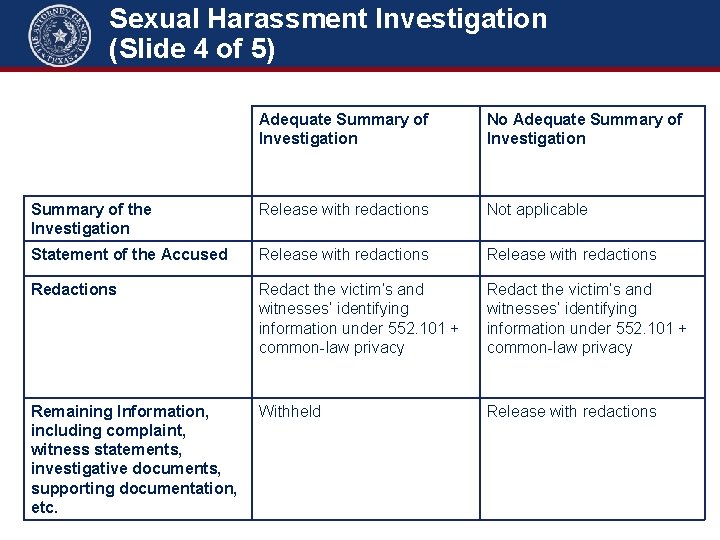
Sexual Harassment Investigation (Slide 4 of 5) 552. 101 + Common-Law Privacy: Sexual Harassment Investigation – Slide 3 of 3 Adequate Summary of Investigation No Adequate Summary of Investigation Summary of the Investigation Release with redactions Not applicable Statement of the Accused Release with redactions Redactions Redact the victim’s and witnesses’ identifying information under 552. 101 + common-law privacy Remaining Information, including complaint, witness statements, investigative documents, supporting documentation, etc. Withheld Release with redactions
Sexual Harassment Investigation (Slide 5 of 5) 552. 101 + Common-Law Privacy: Sexual Harassment Investigation – Slide 3 of 3 Sexual Harassment Investigation Request for a ruling required • Governmental body must request a ruling regardless of whethere is an adequate summary or not. • Inform our office of relevant information to determine whether what information is protected by common-law privacy. • If the requestor is the complainant or a witness, they would have a right of access to their own information.
Section 552. 101 + Statutes Involving Criminal History Record Information (“CHRI”) • CHRI is information about a person’s arrests, detentions, indictments, informations, and other formal criminal charges • CHRI about a person is collected and maintained by the Texas Department of Public Safety (“DPS”) and certain persons are allowed access Section 411. 097 of the Government Code • CHRI that relates to a school district applicant or employee Section 411. 0845 of the Government Code • CHRI obtained from the DPS electronic clearinghouse and subscription service
Section 552. 101 + Statutes Involving Children or Juveniles (Slide 1 of 2) Section 552. 101 + Statutes Involving Children or Juveniles – Slide 1 of 2 Section 261. 201 of the Family Code • Child victims (under 18 years of age) • “Abuse” or “neglect” • 261. 201(k) right of access Section 58. 008 of the Family Code • Juvenile suspects or offenders (ages 10 -16) • “Delinquent conduct” or “conduct indicating a need for supervision” • Conduct before, on, or after September 1, 1997 • 58. 008(d) right of access
Section 552. 101 + Statutes Involving Children or Juveniles (Slide 2 of 2) Section 552. 101 + Statutes Involving Children or Juveniles – Slide 1 of 2 Section 261. 201 of the Family Code Section 58. 008 of the Family Code • Our office needs to know the ages of certain individuals for these statutes. • Do not redact dates of birth from the information you submit to the Office of the Attorney General.
Questions? OAG’s Open Government Hotline (877) OPEN-TEX (512) 478 -6736 OAG Website www. texasattorneygeneral. gov/open-government
- Slides: 58