
Common Cause Modeling Huntsville Society of Reliability Engineers
Common Cause Modeling Huntsville Society of Reliability Engineers RAM VIII Training Summit November 3 -4, 2015 Frank Hark Bastion Technologies, Inc. Paul Britton, NASA Robert Ring, Bastion Technologies, Inc. Steven Novack, Bastion Technologies, Inc. 1
Agenda Ø Objective Ø Key Definitions Ø Calculating Common Cause Ø Examples Ø Defense against Common Cause Ø Impact of varied CCF and abortability Ø Response Surface for various CCF Beta Ø Takeaways 2
Objective Ø Common Cause Failures (CCFs) are known and documented phenomenon that limit the benefit of system redundancy as a design approach to achieve high reliability Ø Because Launch vehicle data is sparse, generic data from the nuclear industry is used to estimate CCF for launch vehicles Ø This presentation addresses the impact of CCF risk on system reliability and safety 3
Key Definitions Ø A common cause failure (CCF) is a failure where: Ø Two or more items fail within the mission time from a common failure mechanism. Ø Beta Factor is defined as the fraction of the component failures that result in a common cause failure 4
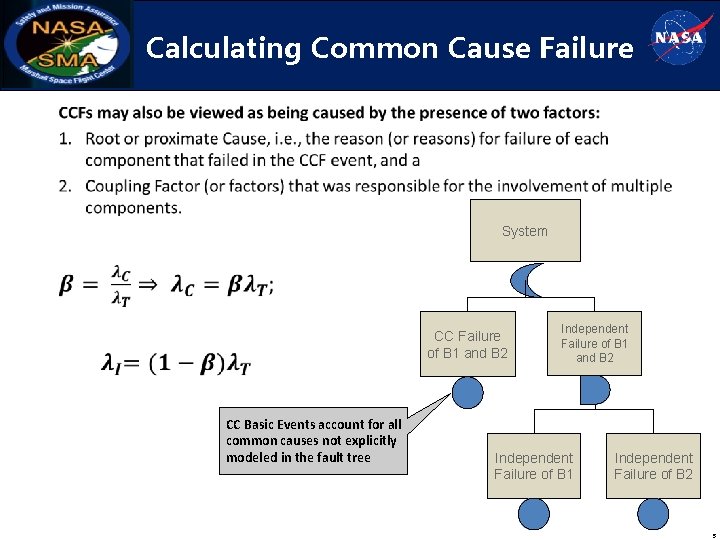
Calculating Common Cause Failure System CC Failure of B 1 and B 2 CC Basic Events account for all common causes not explicitly modeled in the fault tree Independent Failure of B 1 and B 2 Independent Failure of B 1 Independent Failure of B 2 5
Examples (taken from the NASA PRA Guide) The following are examples of actual CCF events: Ø Hydrazine leaks leading to two APU explosions on Space Shuttle mission STS-9 Ø Multiple engine failures on aircraft (Fokker F 27 – 1997, 1988; Boeing 747, 1992) Ø Three hydraulic system failures following Engine # 2 failure on a DC-10, 1989 Ø Failure of all three redundant auxiliary feed-water pumps at Three Mile Island NPP Ø Failure of two Space Shuttle Main Engine (SSME) controllers on two separate engines when a wire short occurred Ø Failure of two O-rings, causing hot gas blow-by in a solid rocket booster of Space Shuttle flight 51 L Ø Failure of two redundant circuit boards due to electro-static shock by a technician during replacement of an adjacent unit Ø A worker accidentally tripping two redundant pumps by placing a ladder near pump motors to paint the ceiling at a nuclear power plant Ø A maintenance contractor unfamiliar with component configuration putting lubricant in the motor winding of several redundant valves, making them inoperable Ø Undersized motors purchased from a new vendor causing failure of four redundant cooling fans Ø Check valves installed backwards, blocking flow in two redundant lines Ø CCFs may also be viewed as being caused by the presence of two factors: 6
Reducing it Checklist for reducing common cause categorized into 8 groups 1. Degree of physical separation/segregation 2. Diversity/redundancy (e. g. , different technology, design, different maintenance personnel) 3. Complexity/maturity of design/experience 4. Use of assessments/analysis and feedback data 5. Procedures/ human interface (e. g. , maintenance/testing) 6. Competence/ training/ safety culture 7. Environmental control (e. g. , temperature, humidity, personnel access) 8. Environmental testing 7

Impact of Varied CCF and Abortability Ø CCF estimate becomes important when trading between a 1 out of 2 system and 1 component fails Ø Abort immediately or continue mission Ø STS used fail opt/fail safe redundancy Ø Cost/weight concerns limit some systems to one level of redundancy Ø What is the benefit of adding an additional level of redundancy 8
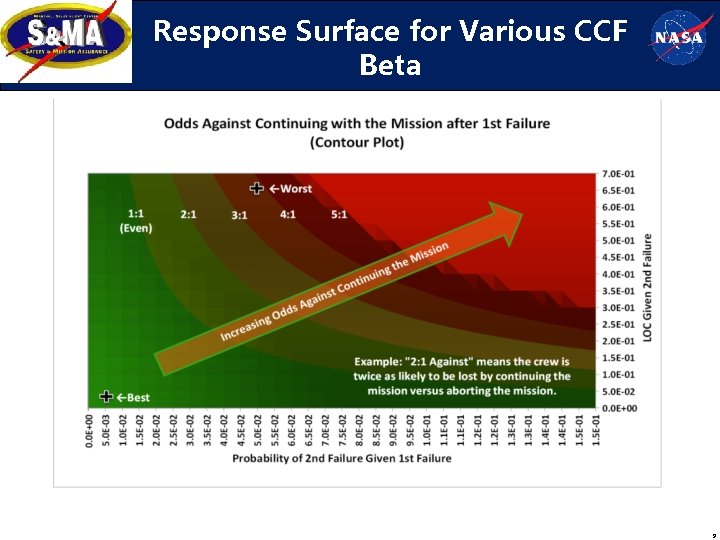
Response Surface for Various CCF Beta 9
Takeaways Ø Common cause failure is a known impact to redundant system Ø Common modeling assumptions may underestimate the real risks Ø When data is unavailable, it is important to judge the impact of system reliability, safety, and common cause factors over a range of values 10

References 1. A. Mosleh et al. , “Procedures for Treating Common Cause Failures in Safety and Reliability Studies, ” U. S. Nuclear Regulatory Commission and Electric Power Research Institute, NUREG/CR-4780, and EPRI NP 5613. 2. Zitrou A, Bedford T. 2003 Foundations of the UPM common cause model. In: Bedford T Gelder PH. Van, eds. Safety and reliability. Balkema, ESREL 2003; 1769 -1775 3. A. Mosleh, D. M. Rasmuson, F. M. Marshall, “Guidelines on Modeling Common-Cause Failures in Probabilistic Risk Assessment, ” Office for Analysis and Evaluation of Operational Data, NUREG/CR-5485 11
- Slides: 11