
Common Base Amplifier with 7 d B gain
Common Base Amplifier with 7 - d. B gain at 176 GHz in In. P mesa DHBT Technology V. Paidi, Z. Griffith, Y. Wei, M. Dahlstrom, N. Parthasarathy, M. Seo, M. Urteaga, M. J. W. Rodwell , Department of Electrical and Computer Engineering, University of California, Santa Barbara, CA 93106 L. Samoska, A. Fung, Jet Propulsion Labs, Pasadena, CA 91109 Slide 1
Outline • Motivation. • Why Common-base? • Effect of layout parasitics on circuit stability and MSG. • In. P mesa DHBT process. • Circuit simulations. • Device Results • G-band Power amplifier results. • W-band Power amplifier results. Slide 2
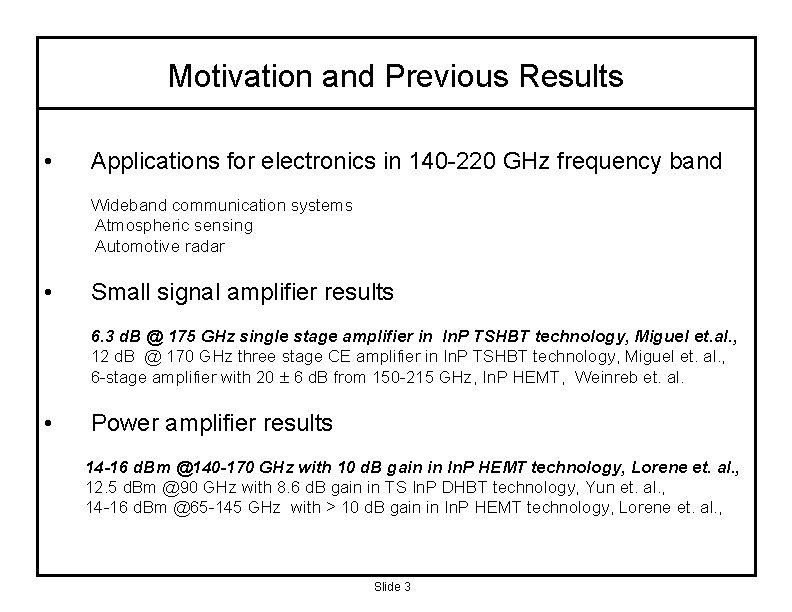
Motivation and Previous Results • Applications for electronics in 140 -220 GHz frequency band Wideband communication systems Atmospheric sensing Automotive radar • Small signal amplifier results 6. 3 d. B @ 175 GHz single stage amplifier in In. P TSHBT technology, Miguel et. al. , 12 d. B @ 170 GHz three stage CE amplifier in In. P TSHBT technology, Miguel et. al. , 6 -stage amplifier with 20 6 d. B from 150 -215 GHz, In. P HEMT, Weinreb et. al. • Power amplifier results 14 -16 d. Bm @140 -170 GHz with 10 d. B gain in In. P HEMT technology, Lorene et. al. , 12. 5 d. Bm @90 GHz with 8. 6 d. B gain in TS In. P DHBT technology, Yun et. al. , 14 -16 d. Bm @65 -145 GHz with > 10 d. B gain in In. P HEMT technology, Lorene et. al. , Slide 3
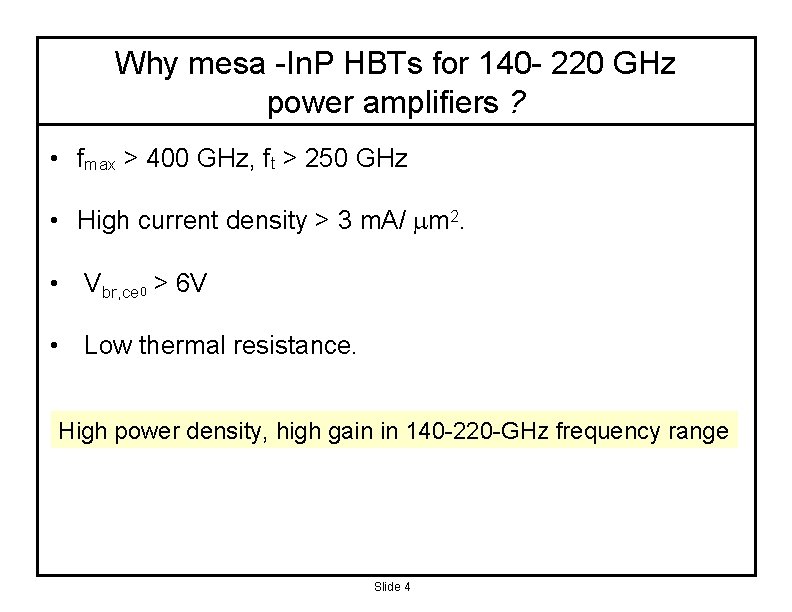
Why mesa -In. P HBTs for 140 - 220 GHz power amplifiers ? • fmax > 400 GHz, ft > 250 GHz • High current density > 3 m. A/ m 2. • Vbr, ce 0 > 6 V • Low thermal resistance. High power density, high gain in 140 -220 -GHz frequency range Slide 4
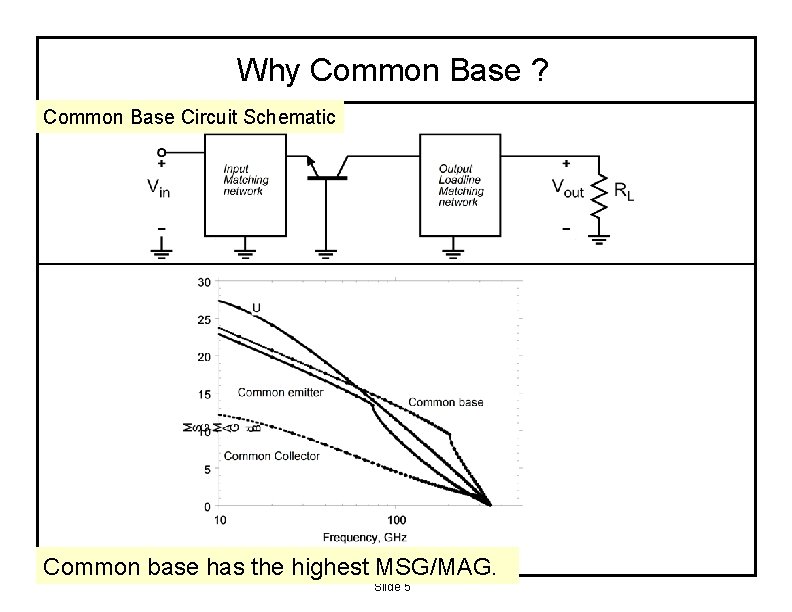
Why Common Base ? Common Base Circuit Schematic Common base has the highest MSG/MAG. Slide 5
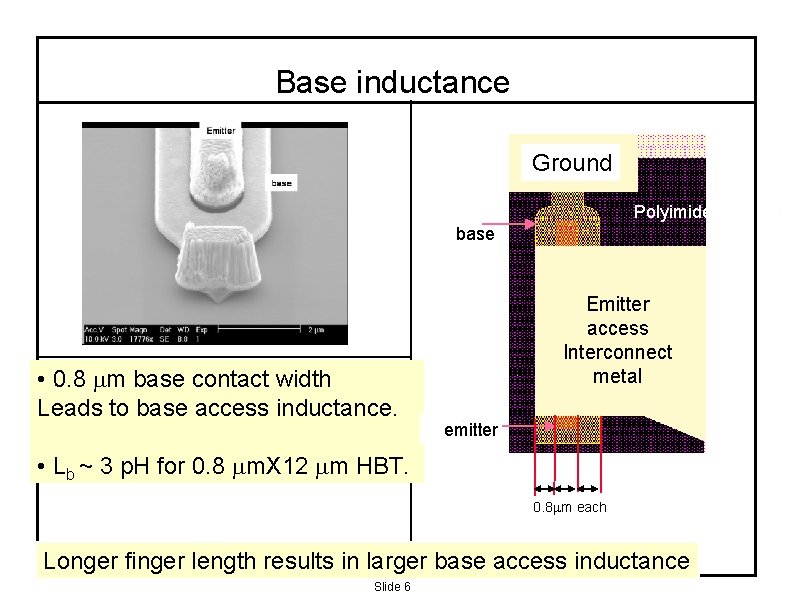
Base inductance Ground Polyimide base • 0. 8 m base contact width Leads to base access inductance. Emitter access Interconnect metal emitter • Lb ~ 3 p. H for 0. 8 m. X 12 m HBT. 0. 8 m each Longer finger length results in larger base access inductance Slide 6
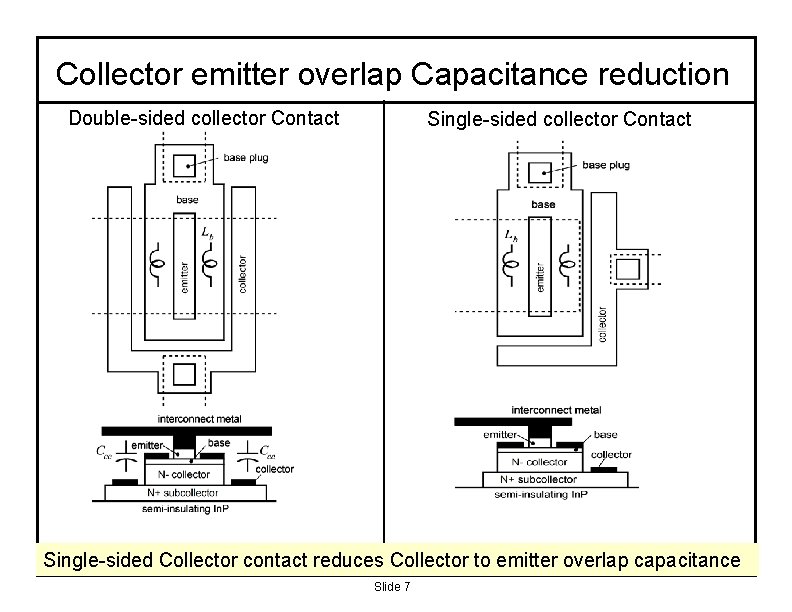
Collector emitter overlap Capacitance reduction Double-sided collector Contact Single-sided Collector contact reduces Collector to emitter overlap capacitance Slide 7
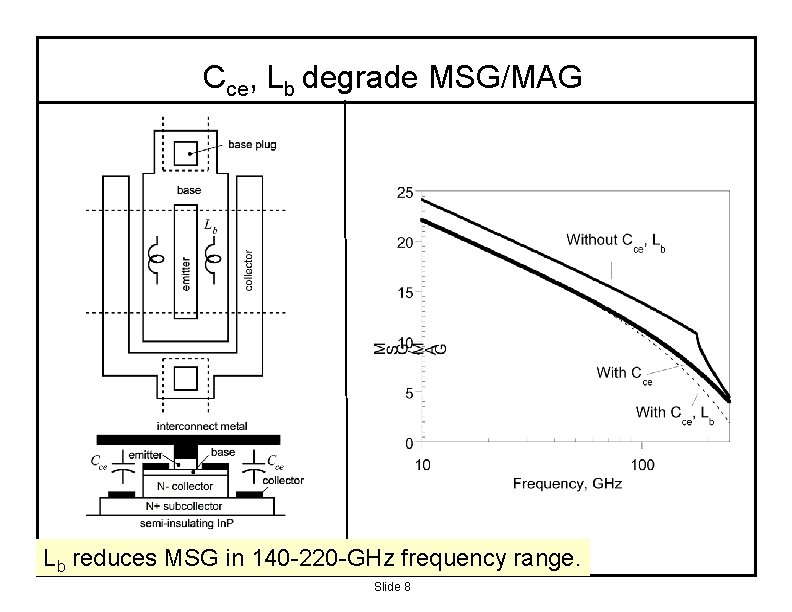
Cce, Lb degrade MSG/MAG Lb reduces MSG in 140 -220 -GHz frequency range. Slide 8
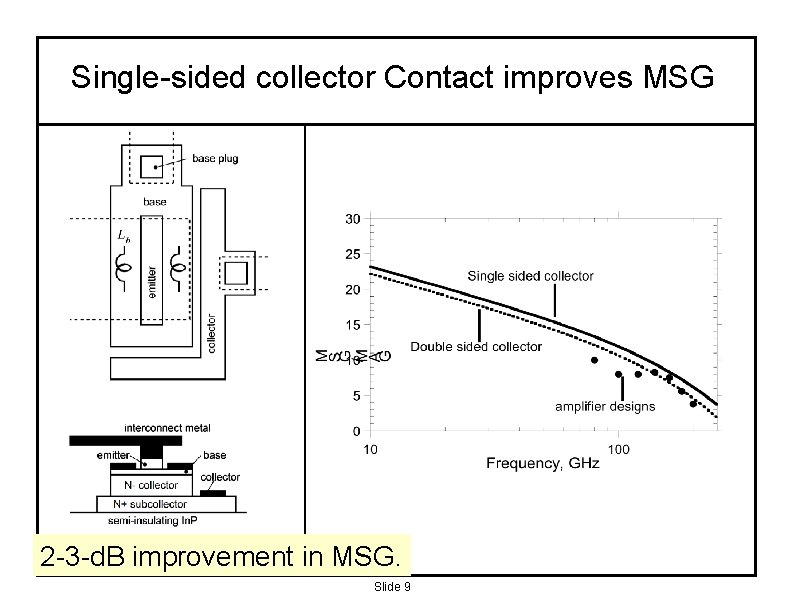
Single-sided collector Contact improves MSG 2 -3 -d. B improvement in MSG. Slide 9
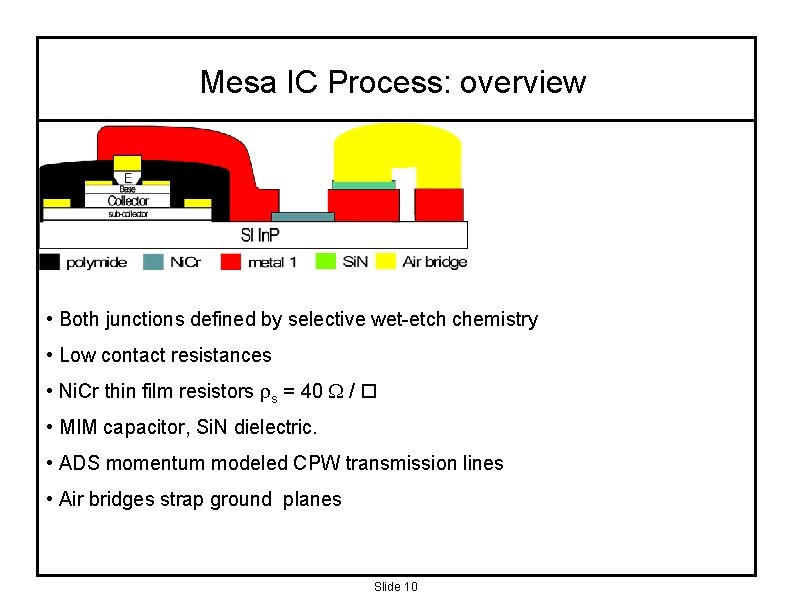
Mesa IC Process: overview • Both junctions defined by selective wet-etch chemistry • Low contact resistances • Ni. Cr thin film resistors s = 40 / • MIM capacitor, Si. N dielectric. • ADS momentum modeled CPW transmission lines • Air bridges strap ground planes Slide 10
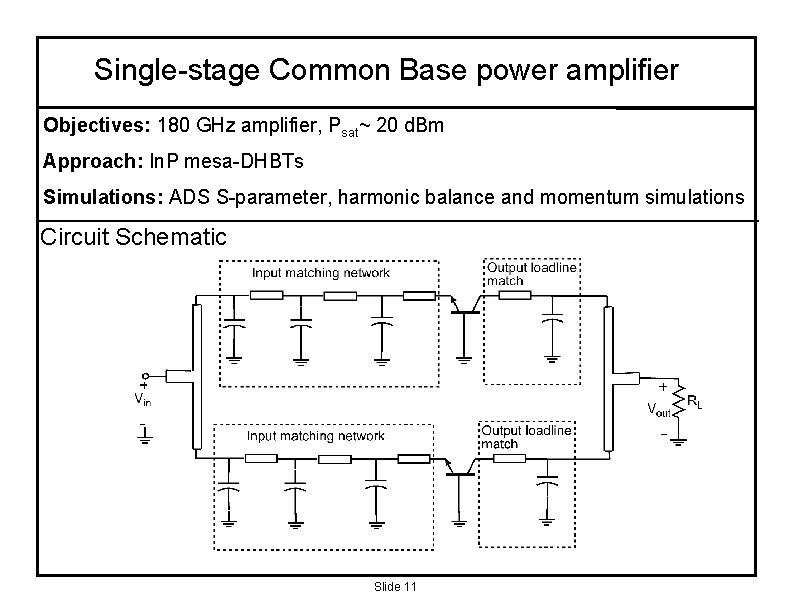
Single-stage Common Base power amplifier Objectives: 180 GHz amplifier, Psat~ 20 d. Bm Approach: In. P mesa-DHBTs Simulations: ADS S-parameter, harmonic balance and momentum simulations Circuit Schematic Slide 11
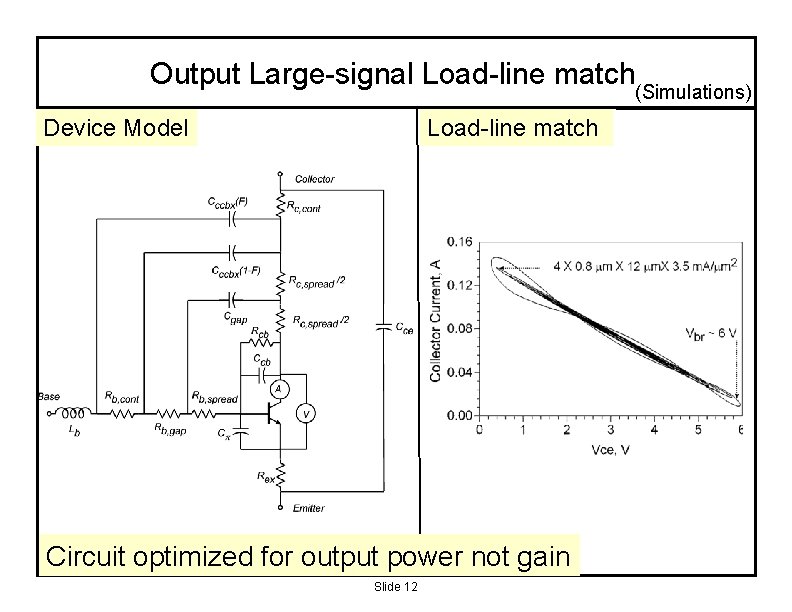
Output Large-signal Load-line match (Simulations) Device Model Load-line match Circuit optimized for output power not gain Slide 12
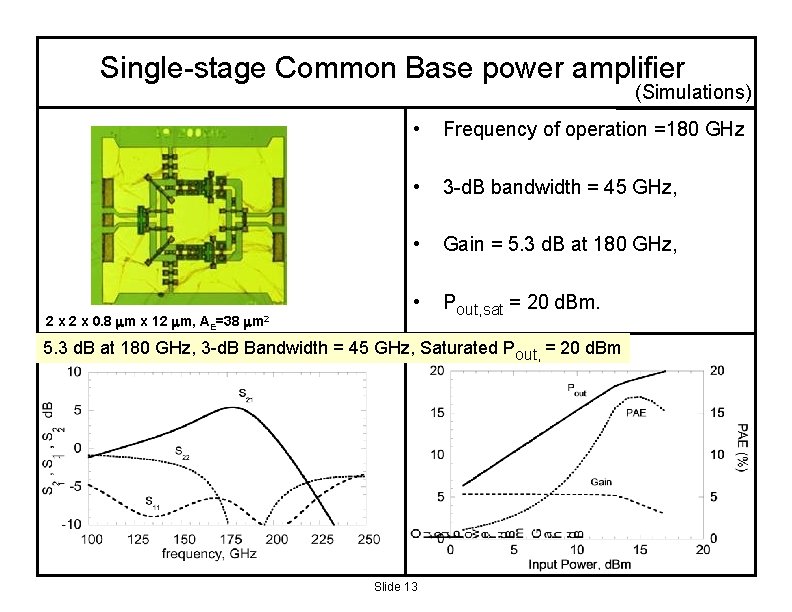
Single-stage Common Base power amplifier (Simulations) 2 x 0. 8 m x 12 m, AE=38 m 2 • Frequency of operation =180 GHz • 3 -d. B bandwidth = 45 GHz, • Gain = 5. 3 d. B at 180 GHz, • Pout, sat = 20 d. Bm. 5. 3 d. B at 180 GHz, 3 -d. B Bandwidth = 45 GHz, Saturated Pout, = 20 d. Bm Slide 13

Two-stage Common Base amplifier Objectives: 180 GHz amplifier, Psat~ 20 d. Bm Approach: In. P mesa-DHBTs Simulations: S-parameter and harmonic and momentum simulation in ADS Circuit Schematic Slide 14

Two-stage Common Base amplifier (Simulations) Frequency of operation =180 GHz 3 -d. B bandwidth = 45 GHz, Gain = 8. 7 d. B, 6 x 0. 8 m x 12 m, AE=58 m 2 Pout, sat = 19. 5 d. Bm. Power simulations at 180 GHz Slide 15
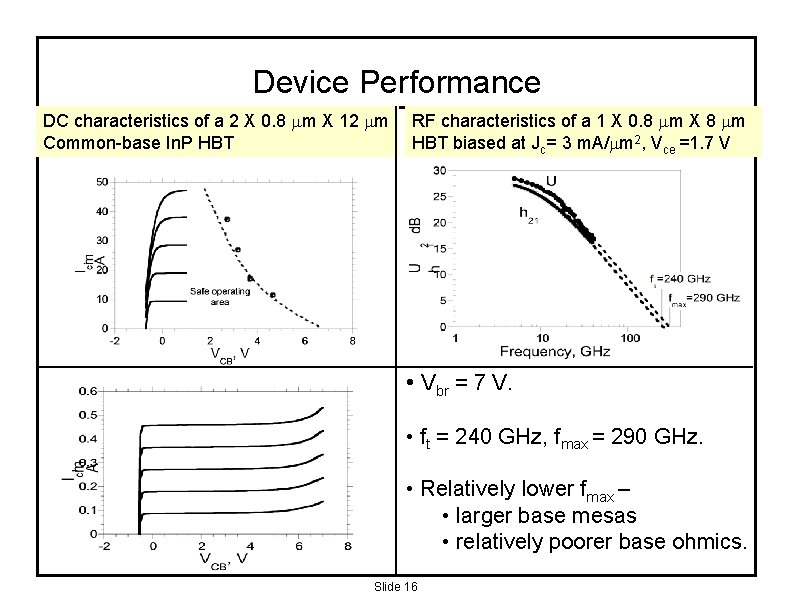
Device Performance DC characteristics of a 2 X 0. 8 m X 12 m Common-base In. P HBT RF characteristics of a 1 X 0. 8 m X 8 m HBT biased at Jc= 3 m. A/ m 2, Vce =1. 7 V • Vbr = 7 V. • ft = 240 GHz, fmax = 290 GHz. • Relatively lower fmax – • larger base mesas • relatively poorer base ohmics. Slide 16
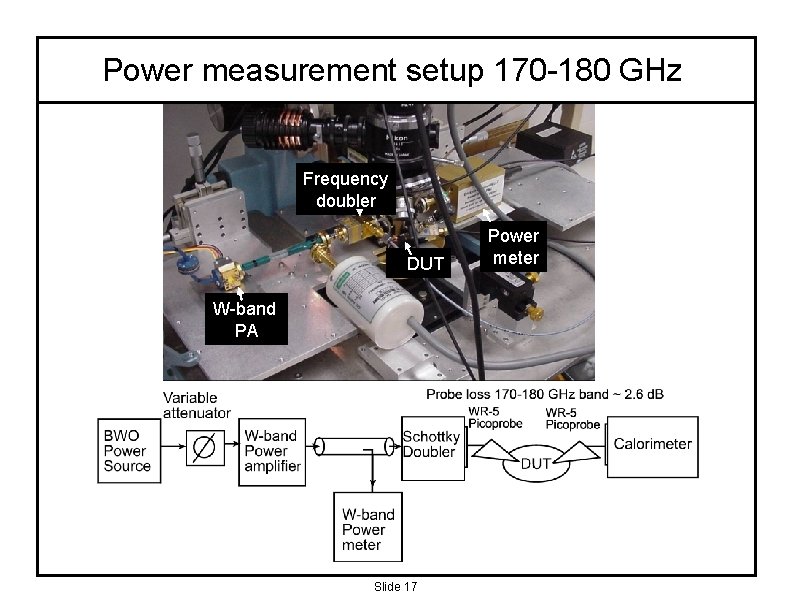
Power measurement setup 170 -180 GHz Frequency doubler DUT W-band PA Slide 17 Power meter
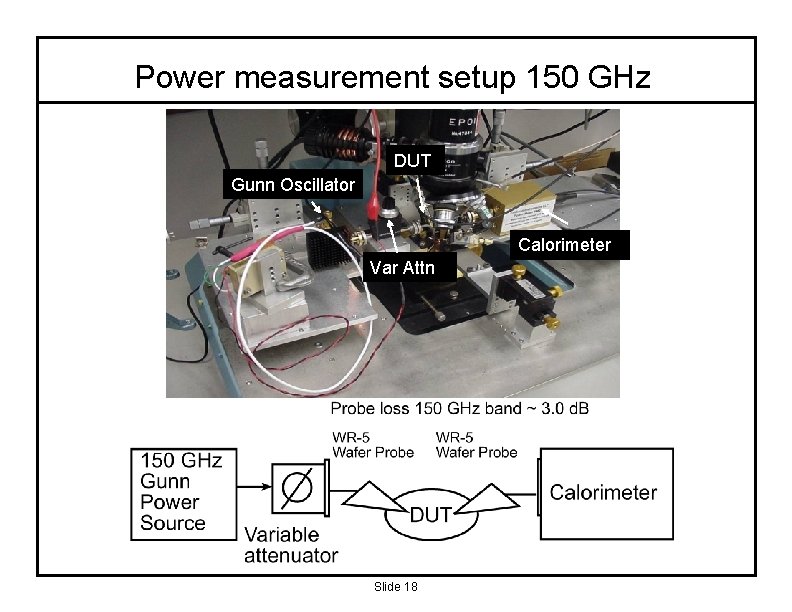
Power measurement setup 150 GHz DUT Gunn Oscillator Calorimeter Var Attn Slide 18
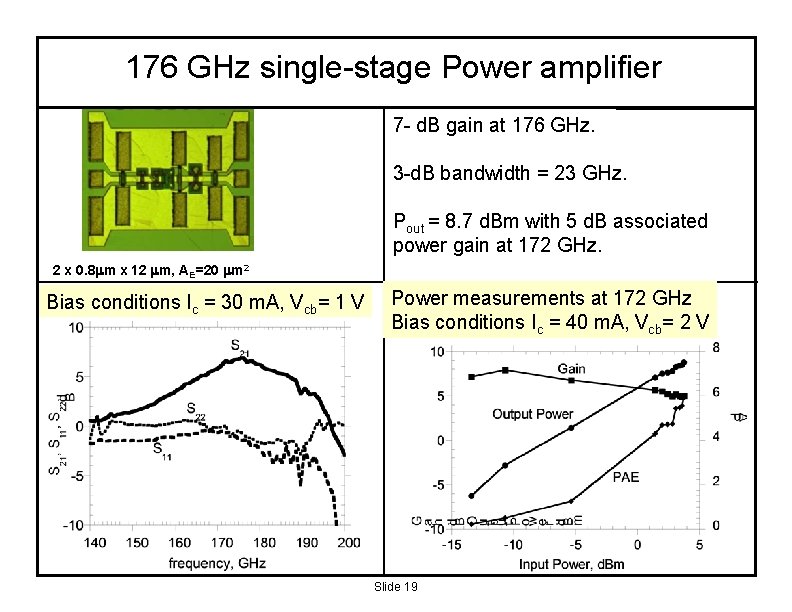
176 GHz single-stage Power amplifier 7 - d. B gain at 176 GHz. 3 -d. B bandwidth = 23 GHz. Pout = 8. 7 d. Bm with 5 d. B associated power gain at 172 GHz. 2 x 0. 8 m x 12 m, AE=20 m 2 Bias conditions Ic = 30 m. A, Vcb= 1 V Power measurements at 172 GHz Bias conditions Ic = 40 m. A, Vcb= 2 V Slide 19
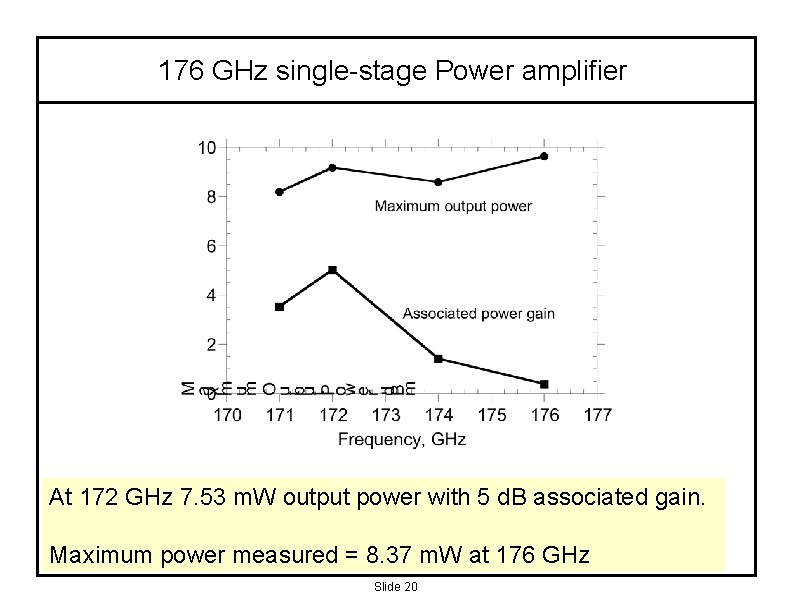
176 GHz single-stage Power amplifier At 172 GHz 7. 53 m. W output power with 5 d. B associated gain. Maximum power measured = 8. 37 m. W at 176 GHz Slide 20
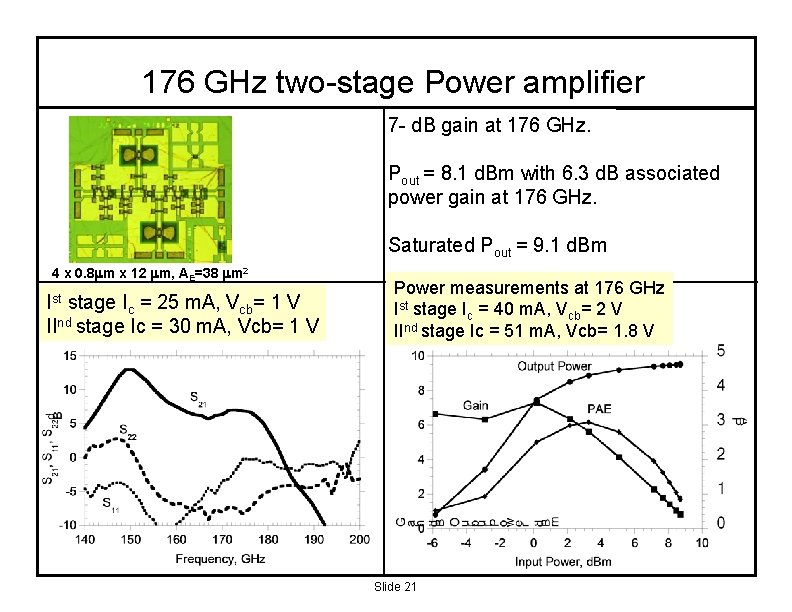
176 GHz two-stage Power amplifier 7 - d. B gain at 176 GHz. Pout = 8. 1 d. Bm with 6. 3 d. B associated power gain at 176 GHz. Saturated Pout = 9. 1 d. Bm 4 x 0. 8 m x 12 m, AE=38 m 2 Ist stage Ic = 25 m. A, Vcb= 1 V IInd stage Ic = 30 m. A, Vcb= 1 V Power measurements at 176 GHz Ist stage Ic = 40 m. A, Vcb= 2 V IInd stage Ic = 51 m. A, Vcb= 1. 8 V Slide 21
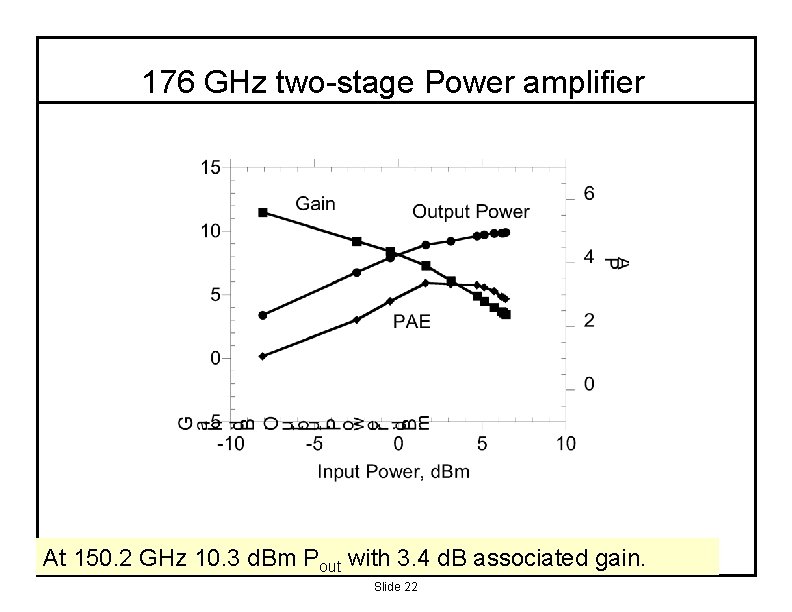
176 GHz two-stage Power amplifier At 150. 2 GHz 10. 3 d. Bm Pout with 3. 4 d. B associated gain. Slide 22
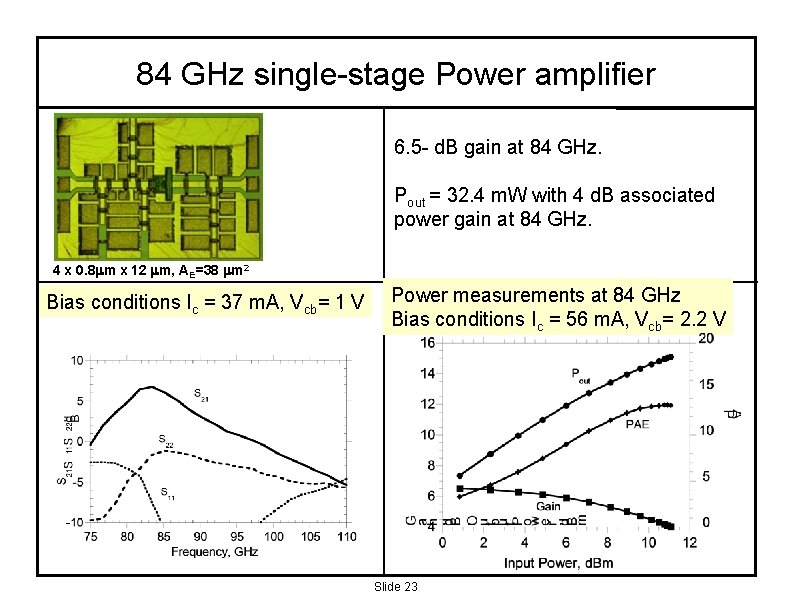
84 GHz single-stage Power amplifier 6. 5 - d. B gain at 84 GHz. Pout = 32. 4 m. W with 4 d. B associated power gain at 84 GHz. 4 x 0. 8 m x 12 m, AE=38 m 2 Bias conditions Ic = 37 m. A, Vcb= 1 V Power measurements at 84 GHz Bias conditions Ic = 56 m. A, Vcb= 2. 2 V Slide 23
Accomplishments Design and fabrication of W-band (75 -110 -GHz) G – band (140 -220 -GHz) power amplifiers in In. P mesa DHBT technology 7 -d. B at 176 GHz with a single-stage common-base amplifier. Obtained 8. 77 d. Bm output power with 5 -d. B associated power gain at 172 GHz. Obtained 32 m. W at 84 GHz. This work was supported by the ONR , JPL , DARPA (USA). Slide 24
- Slides: 24