
Common Assignments An Innovative Approach to Standardizing Assessment
- Slides: 23
Common Assignments: An Innovative Approach to Standardizing Assessment Measures Gyanesh Lama, Ph. D. Assessment Academy Council on Social Work Education nd 62 Annual Program Meeting Atlanta, Georgia November 6, 2016 Department of Social Work Education
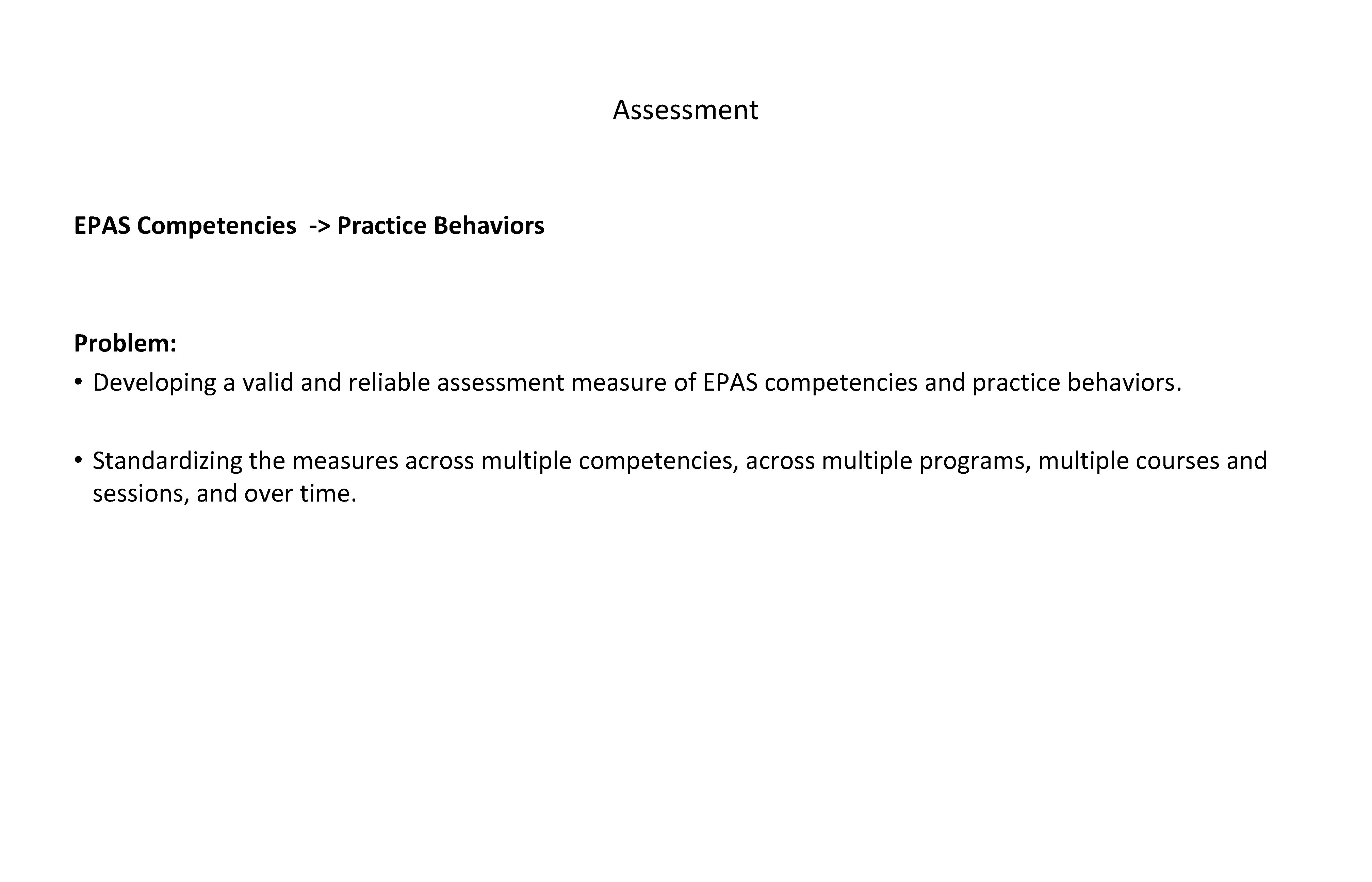
Assessment EPAS Competencies -> Practice Behaviors Problem: • Developing a valid and reliable assessment measure of EPAS competencies and practice behaviors. • Standardizing the measures across multiple competencies, across multiple programs, multiple courses and sessions, and over time.
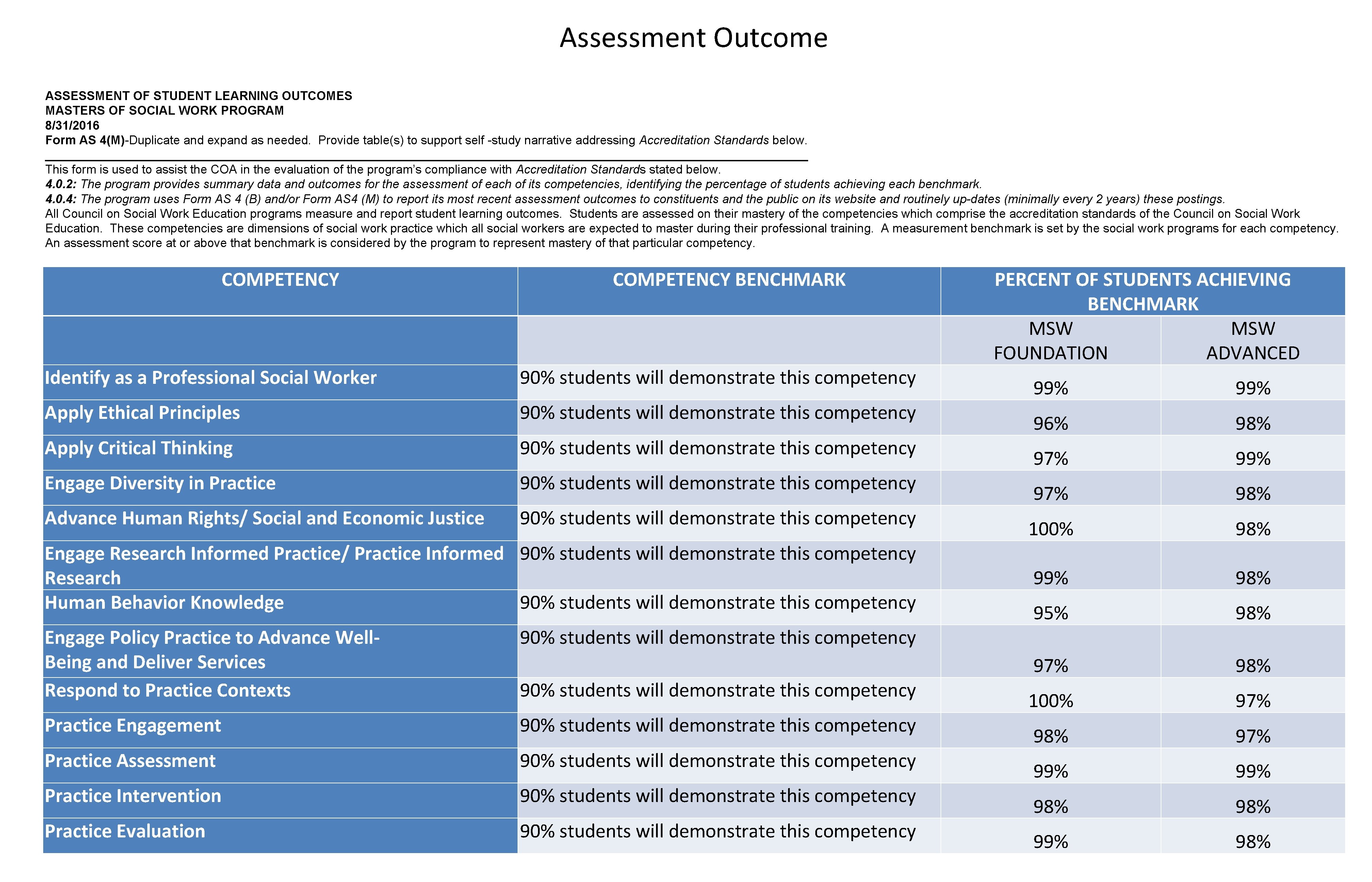
Assessment Outcome ASSESSMENT OF STUDENT LEARNING OUTCOMES MASTERS OF SOCIAL WORK PROGRAM 8/31/2016 Form AS 4(M)-Duplicate and expand as needed. Provide table(s) to support self -study narrative addressing Accreditation Standards below. ________________________________________________________ This form is used to assist the COA in the evaluation of the program’s compliance with Accreditation Standards stated below. 4. 0. 2: The program provides summary data and outcomes for the assessment of each of its competencies, identifying the percentage of students achieving each benchmark. 4. 0. 4: The program uses Form AS 4 (B) and/or Form AS 4 (M) to report its most recent assessment outcomes to constituents and the public on its website and routinely up-dates (minimally every 2 years) these postings. All Council on Social Work Education programs measure and report student learning outcomes. Students are assessed on their mastery of the competencies which comprise the accreditation standards of the Council on Social Work Education. These competencies are dimensions of social work practice which all social workers are expected to master during their professional training. A measurement benchmark is set by the social work programs for each competency. An assessment score at or above that benchmark is considered by the program to represent mastery of that particular competency. COMPETENCY BENCHMARK Identify as a Professional Social Worker 90% students will demonstrate this competency Apply Ethical Principles 90% students will demonstrate this competency Apply Critical Thinking 90% students will demonstrate this competency Engage Diversity in Practice 90% students will demonstrate this competency Advance Human Rights/ Social and Economic Justice 90% students will demonstrate this competency Engage Research Informed Practice/ Practice Informed 90% students will demonstrate this competency Research Human Behavior Knowledge 90% students will demonstrate this competency Engage Policy Practice to Advance Well. Being and Deliver Services Respond to Practice Contexts 90% students will demonstrate this competency Practice Engagement 90% students will demonstrate this competency Practice Assessment 90% students will demonstrate this competency Practice Intervention 90% students will demonstrate this competency Practice Evaluation 90% students will demonstrate this competency PERCENT OF STUDENTS ACHIEVING BENCHMARK MSW FOUNDATION ADVANCED 99% 96% 98% 97% 99% 97% 98% 100% 98% 99% 98% 95% 98% 97% 98% 100% 97% 98% 97% 99% 98%
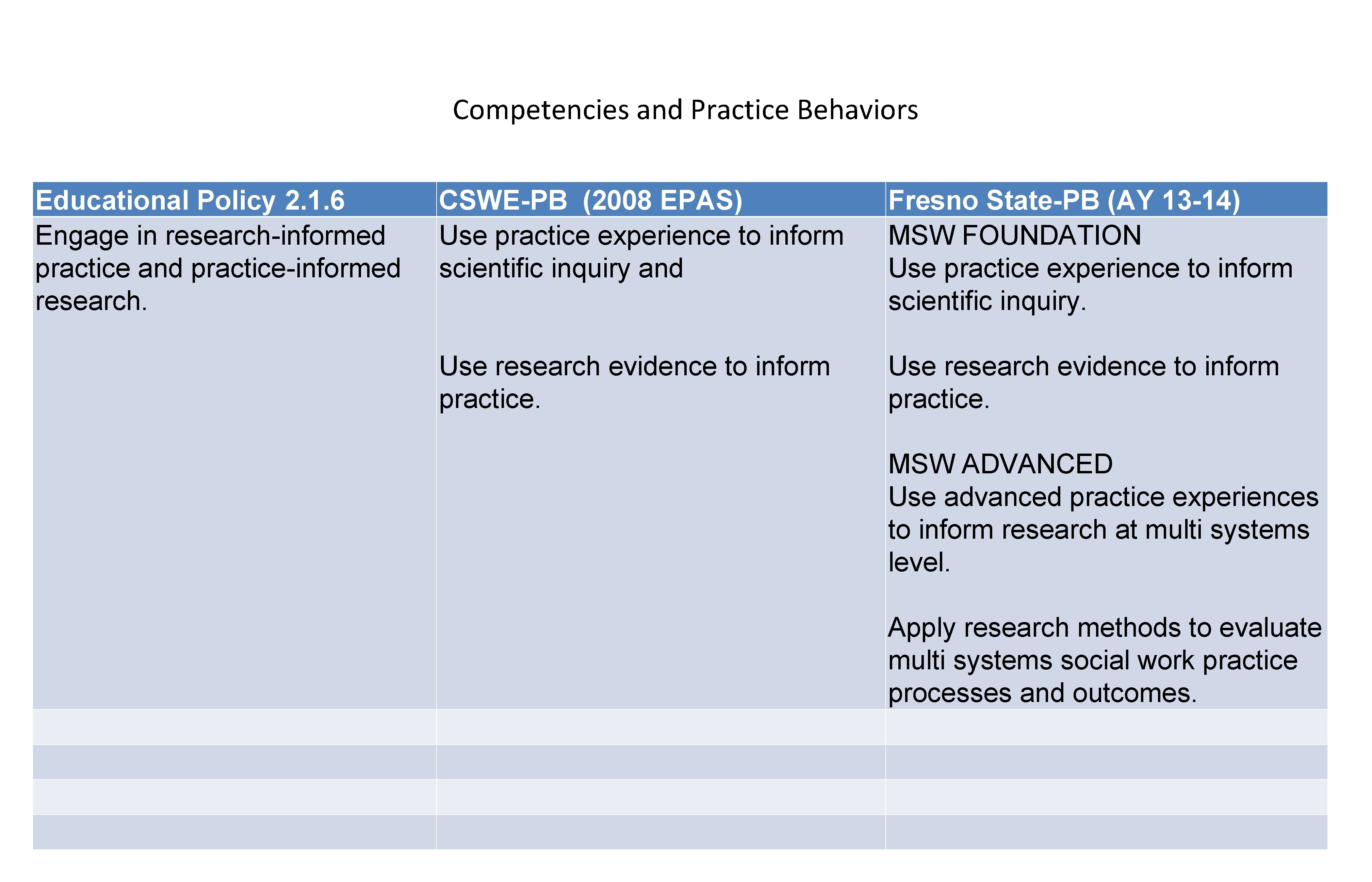
Competencies and Practice Behaviors Educational Policy 2. 1. 6 Engage in research-informed practice and practice-informed research. CSWE-PB (2008 EPAS) Use practice experience to inform scientific inquiry and Fresno State-PB (AY 13 -14) MSW FOUNDATION Use practice experience to inform scientific inquiry. Use research evidence to inform practice. MSW ADVANCED Use advanced practice experiences to inform research at multi systems level. Apply research methods to evaluate multi systems social work practice processes and outcomes.
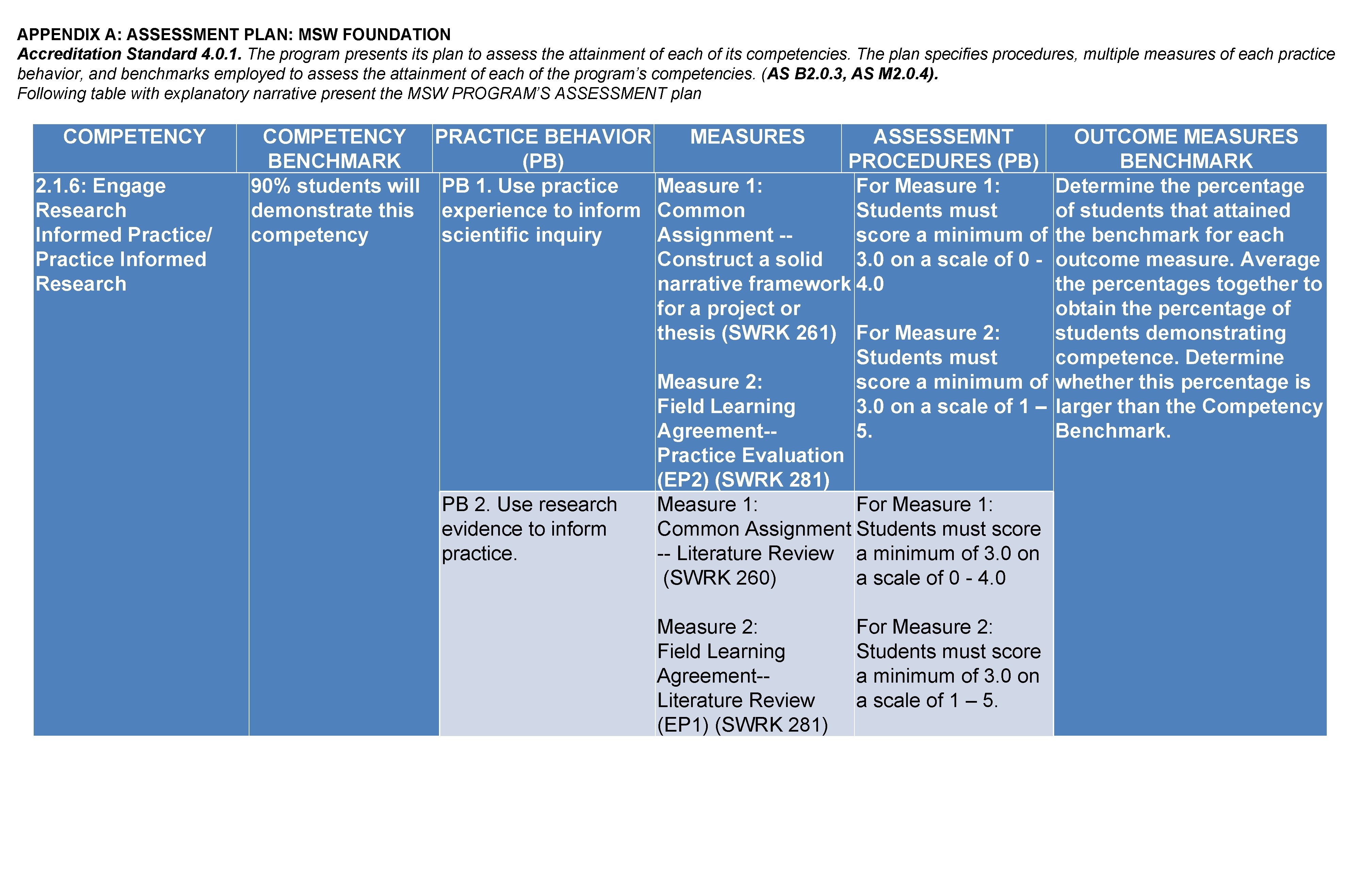
APPENDIX A: ASSESSMENT PLAN: MSW FOUNDATION Accreditation Standard 4. 0. 1. The program presents its plan to assess the attainment of each of its competencies. The plan specifies procedures, multiple measures of each practice behavior, and benchmarks employed to assess the attainment of each of the program’s competencies. (AS B 2. 0. 3, AS M 2. 0. 4). Following table with explanatory narrative present the MSW PROGRAM’S ASSESSMENT plan COMPETENCY 2. 1. 6: Engage Research Informed Practice/ Practice Informed Research COMPETENCY PRACTICE BEHAVIOR MEASURES ASSESSEMNT BENCHMARK (PB) PROCEDURES (PB) 90% students will PB 1. Use practice Measure 1: For Measure 1: demonstrate this experience to inform Common Students must competency scientific inquiry Assignment -score a minimum of Construct a solid 3. 0 on a scale of 0 narrative framework 4. 0 for a project or thesis (SWRK 261) For Measure 2: Students must Measure 2: score a minimum of Field Learning 3. 0 on a scale of 1 – Agreement-5. Practice Evaluation (EP 2) (SWRK 281) PB 2. Use research Measure 1: For Measure 1: evidence to inform Common Assignment Students must score practice. -- Literature Review a minimum of 3. 0 on (SWRK 260) a scale of 0 - 4. 0 Measure 2: Field Learning Agreement-Literature Review (EP 1) (SWRK 281) For Measure 2: Students must score a minimum of 3. 0 on a scale of 1 – 5. OUTCOME MEASURES BENCHMARK Determine the percentage of students that attained the benchmark for each outcome measure. Average the percentages together to obtain the percentage of students demonstrating competence. Determine whether this percentage is larger than the Competency Benchmark.
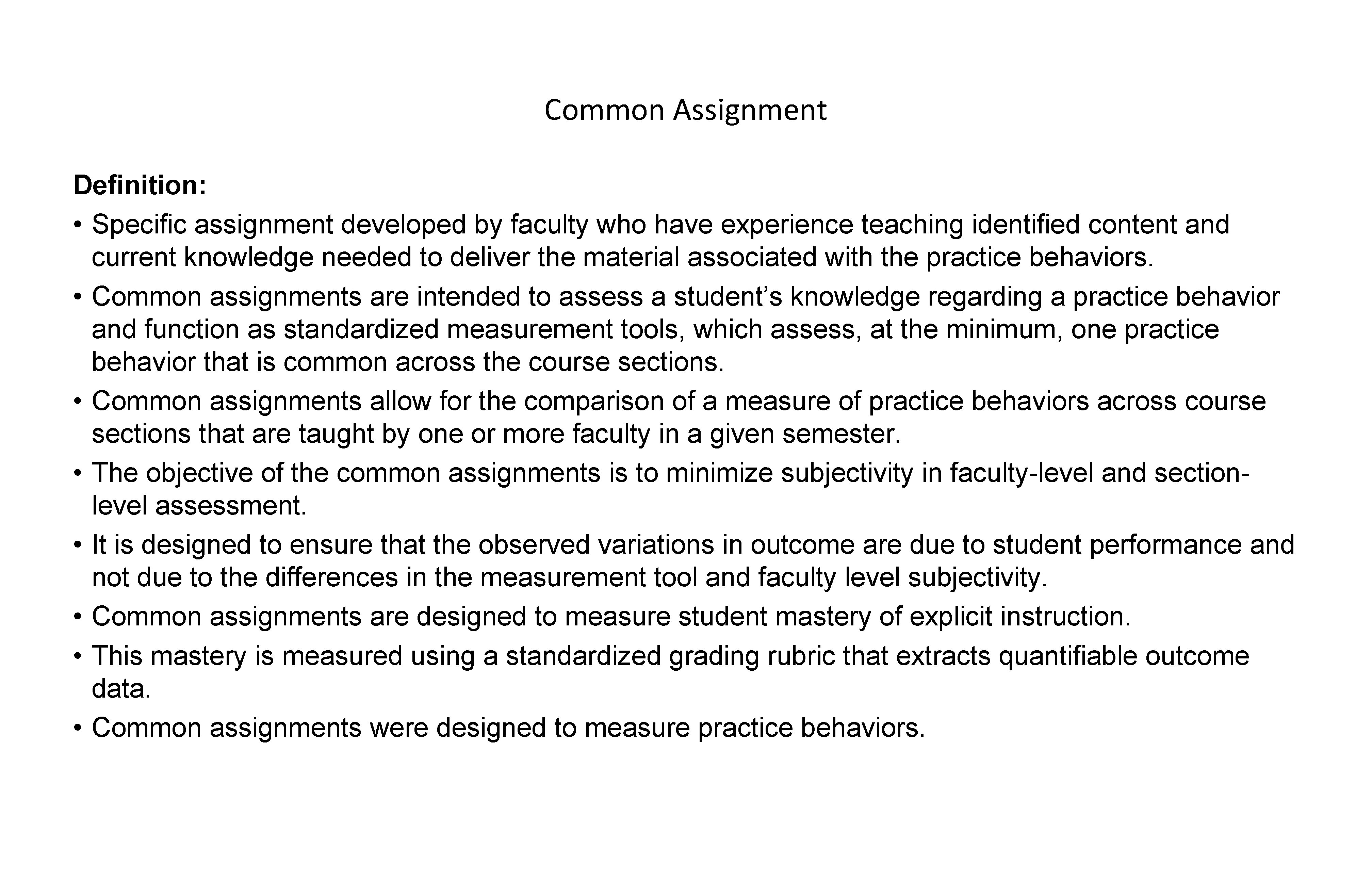
Common Assignment Definition: • Specific assignment developed by faculty who have experience teaching identified content and current knowledge needed to deliver the material associated with the practice behaviors. • Common assignments are intended to assess a student’s knowledge regarding a practice behavior and function as standardized measurement tools, which assess, at the minimum, one practice behavior that is common across the course sections. • Common assignments allow for the comparison of a measure of practice behaviors across course sections that are taught by one or more faculty in a given semester. • The objective of the common assignments is to minimize subjectivity in faculty-level and sectionlevel assessment. • It is designed to ensure that the observed variations in outcome are due to student performance and not due to the differences in the measurement tool and faculty level subjectivity. • Common assignments are designed to measure student mastery of explicit instruction. • This mastery is measured using a standardized grading rubric that extracts quantifiable outcome data. • Common assignments were designed to measure practice behaviors.
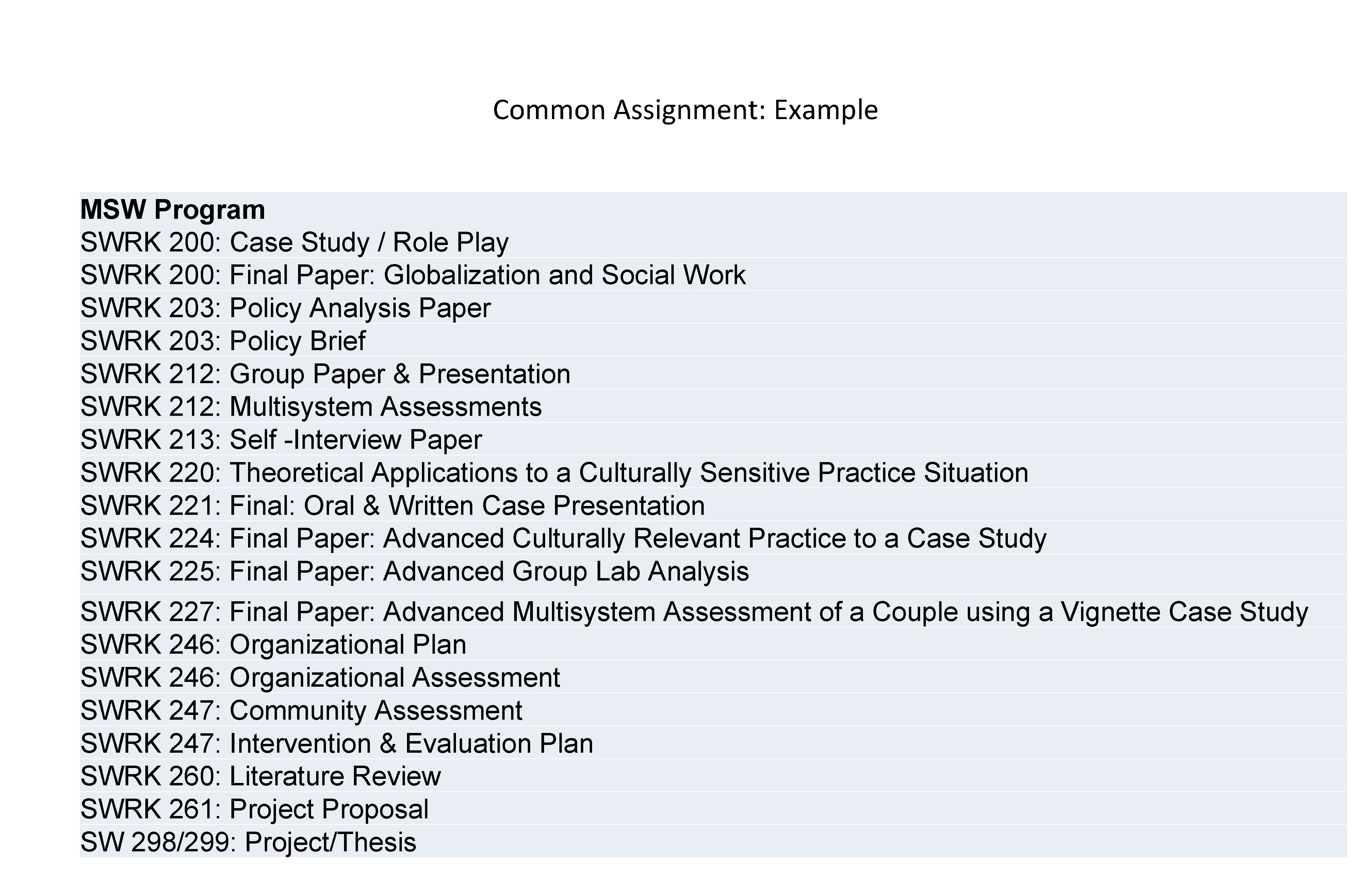
Common Assignment: Example MSW Program SWRK 200: Case Study / Role Play SWRK 200: Final Paper: Globalization and Social Work SWRK 203: Policy Analysis Paper SWRK 203: Policy Brief SWRK 212: Group Paper & Presentation SWRK 212: Multisystem Assessments SWRK 213: Self -Interview Paper SWRK 220: Theoretical Applications to a Culturally Sensitive Practice Situation SWRK 221: Final: Oral & Written Case Presentation SWRK 224: Final Paper: Advanced Culturally Relevant Practice to a Case Study SWRK 225: Final Paper: Advanced Group Lab Analysis SWRK 227: Final Paper: Advanced Multisystem Assessment of a Couple using a Vignette Case Study SWRK 246: Organizational Plan SWRK 246: Organizational Assessment SWRK 247: Community Assessment SWRK 247: Intervention & Evaluation Plan SWRK 260: Literature Review SWRK 261: Project Proposal SW 298/299: Project/Thesis
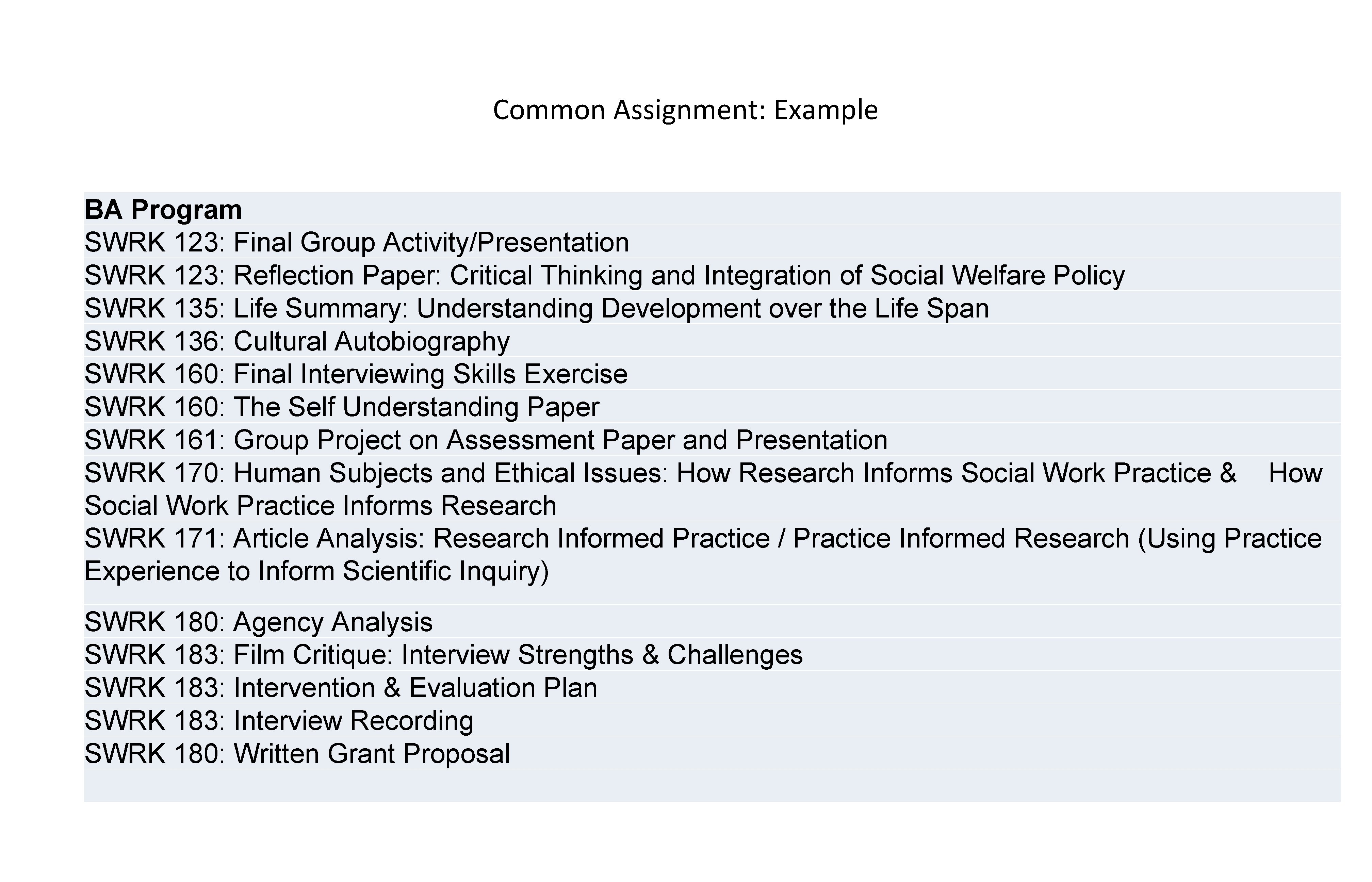
Common Assignment: Example BA Program SWRK 123: Final Group Activity/Presentation SWRK 123: Reflection Paper: Critical Thinking and Integration of Social Welfare Policy SWRK 135: Life Summary: Understanding Development over the Life Span SWRK 136: Cultural Autobiography SWRK 160: Final Interviewing Skills Exercise SWRK 160: The Self Understanding Paper SWRK 161: Group Project on Assessment Paper and Presentation SWRK 170: Human Subjects and Ethical Issues: How Research Informs Social Work Practice & How Social Work Practice Informs Research SWRK 171: Article Analysis: Research Informed Practice / Practice Informed Research (Using Practice Experience to Inform Scientific Inquiry) SWRK 180: Agency Analysis SWRK 183: Film Critique: Interview Strengths & Challenges SWRK 183: Intervention & Evaluation Plan SWRK 183: Interview Recording SWRK 180: Written Grant Proposal
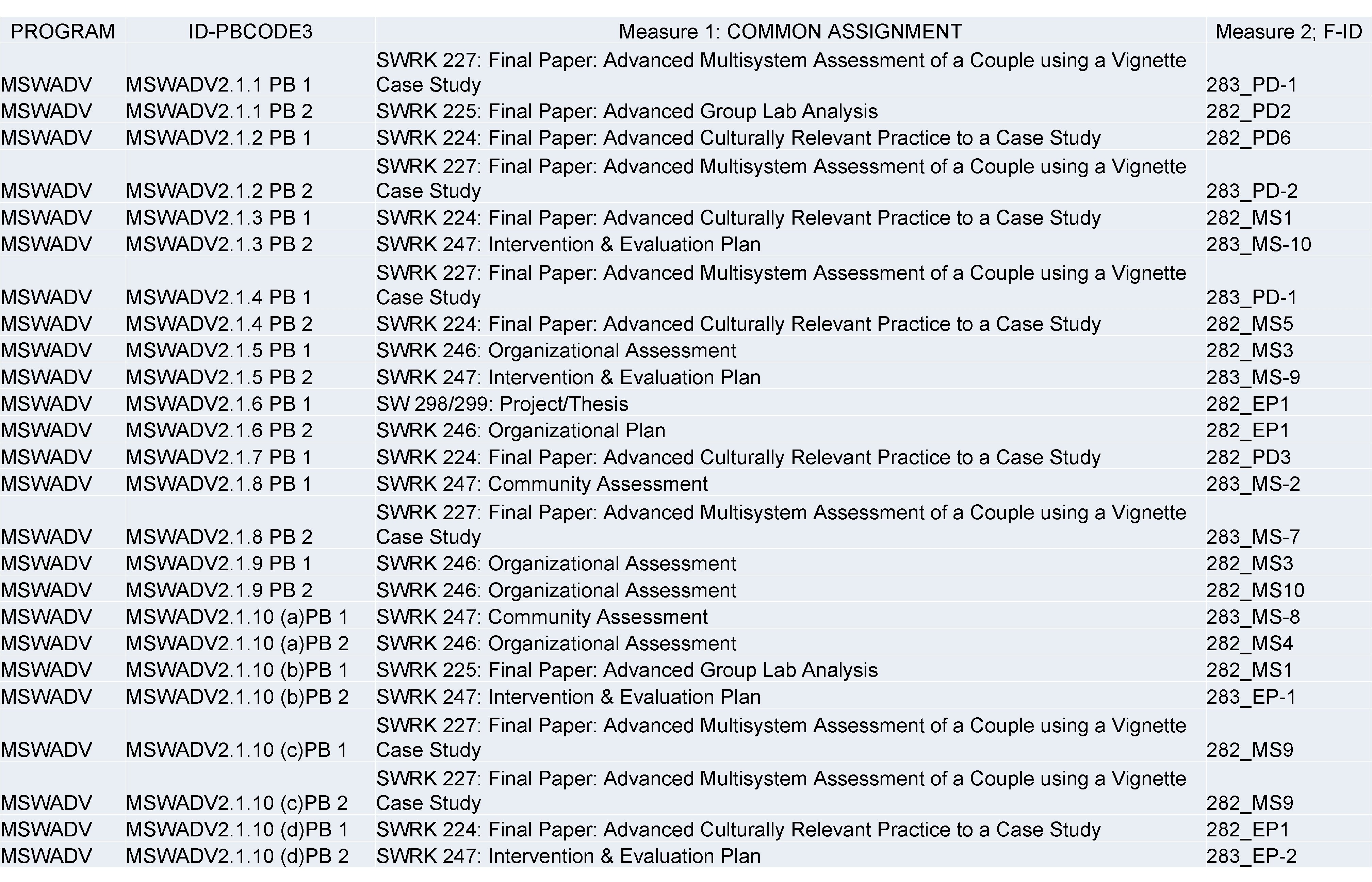
PROGRAM ID-PBCODE 3 MSWADV 2. 1. 1 PB 1 MSWADV 2. 1. 1 PB 2 MSWADV 2. 1. 2 PB 1 MSWADV 2. 1. 2 PB 2 MSWADV 2. 1. 3 PB 1 MSWADV 2. 1. 3 PB 2 MSWADV MSWADV MSWADV 2. 1. 4 PB 1 MSWADV 2. 1. 4 PB 2 MSWADV 2. 1. 5 PB 1 MSWADV 2. 1. 5 PB 2 MSWADV 2. 1. 6 PB 1 MSWADV 2. 1. 6 PB 2 MSWADV 2. 1. 7 PB 1 MSWADV 2. 1. 8 PB 1 MSWADV MSWADV 2. 1. 8 PB 2 MSWADV 2. 1. 9 PB 1 MSWADV 2. 1. 9 PB 2 MSWADV 2. 1. 10 (a)PB 1 MSWADV 2. 1. 10 (a)PB 2 MSWADV 2. 1. 10 (b)PB 1 MSWADV 2. 1. 10 (b)PB 2 MSWADV 2. 1. 10 (c)PB 1 MSWADV 2. 1. 10 (c)PB 2 MSWADV 2. 1. 10 (d)PB 1 MSWADV 2. 1. 10 (d)PB 2 Measure 1: COMMON ASSIGNMENT SWRK 227: Final Paper: Advanced Multisystem Assessment of a Couple using a Vignette Case Study SWRK 225: Final Paper: Advanced Group Lab Analysis SWRK 224: Final Paper: Advanced Culturally Relevant Practice to a Case Study SWRK 227: Final Paper: Advanced Multisystem Assessment of a Couple using a Vignette Case Study SWRK 224: Final Paper: Advanced Culturally Relevant Practice to a Case Study SWRK 247: Intervention & Evaluation Plan SWRK 227: Final Paper: Advanced Multisystem Assessment of a Couple using a Vignette Case Study SWRK 224: Final Paper: Advanced Culturally Relevant Practice to a Case Study SWRK 246: Organizational Assessment SWRK 247: Intervention & Evaluation Plan SW 298/299: Project/Thesis SWRK 246: Organizational Plan SWRK 224: Final Paper: Advanced Culturally Relevant Practice to a Case Study SWRK 247: Community Assessment SWRK 227: Final Paper: Advanced Multisystem Assessment of a Couple using a Vignette Case Study SWRK 246: Organizational Assessment SWRK 247: Community Assessment SWRK 246: Organizational Assessment SWRK 225: Final Paper: Advanced Group Lab Analysis SWRK 247: Intervention & Evaluation Plan SWRK 227: Final Paper: Advanced Multisystem Assessment of a Couple using a Vignette Case Study SWRK 224: Final Paper: Advanced Culturally Relevant Practice to a Case Study SWRK 247: Intervention & Evaluation Plan Measure 2; F-ID 283_PD-1 282_PD 2 282_PD 6 283_PD-2 282_MS 1 283_MS-10 283_PD-1 282_MS 5 282_MS 3 283_MS-9 282_EP 1 282_PD 3 283_MS-2 283_MS-7 282_MS 3 282_MS 10 283_MS-8 282_MS 4 282_MS 1 283_EP-1 282_MS 9 282_EP 1 283_EP-2
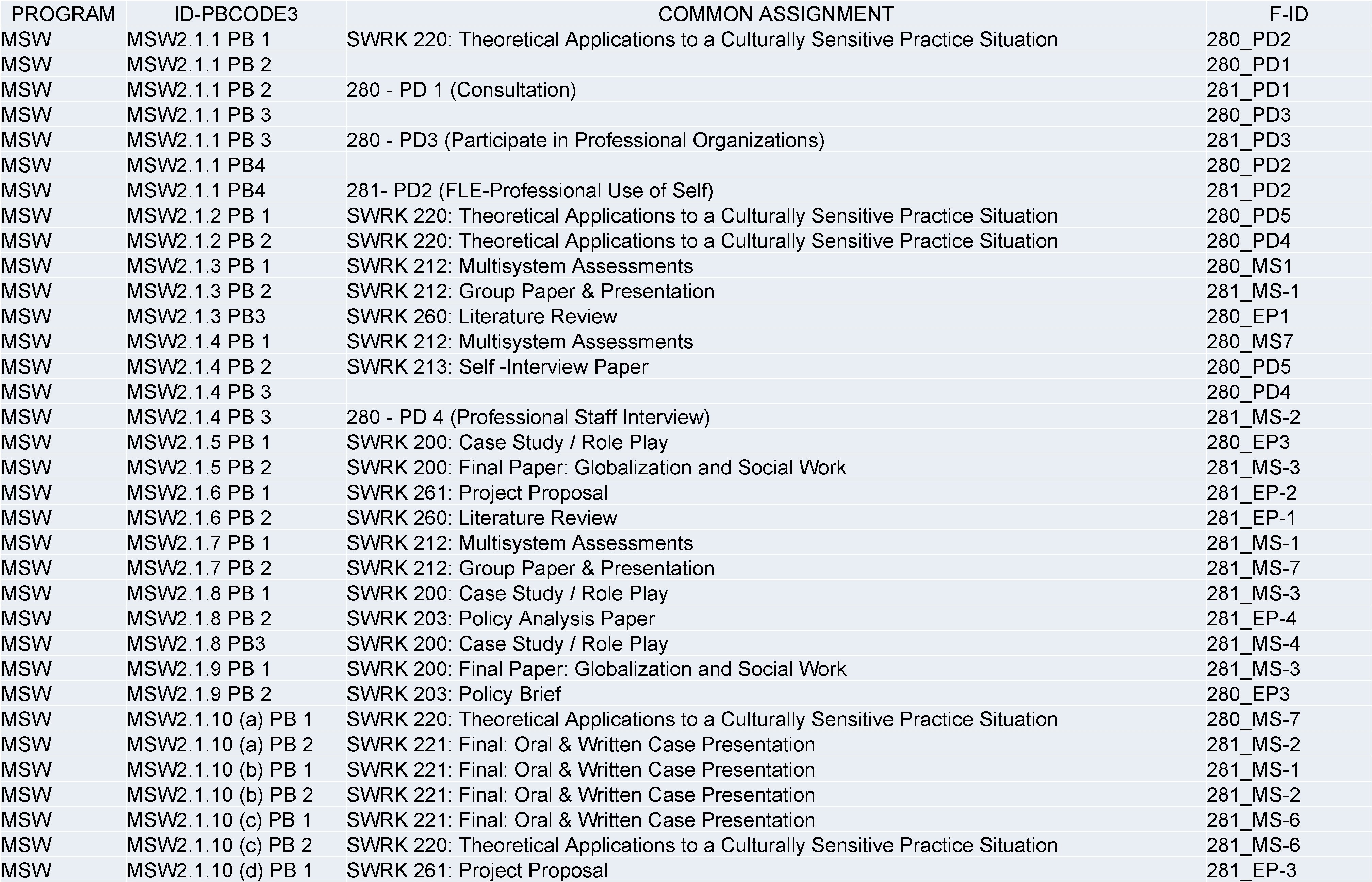
PROGRAM MSW MSW MSW MSW MSW MSW MSW MSW MSW ID-PBCODE 3 MSW 2. 1. 1 PB 1 MSW 2. 1. 1 PB 2 MSW 2. 1. 1 PB 3 MSW 2. 1. 1 PB 4 MSW 2. 1. 2 PB 1 MSW 2. 1. 2 PB 2 MSW 2. 1. 3 PB 1 MSW 2. 1. 3 PB 2 MSW 2. 1. 3 PB 3 MSW 2. 1. 4 PB 1 MSW 2. 1. 4 PB 2 MSW 2. 1. 4 PB 3 MSW 2. 1. 5 PB 1 MSW 2. 1. 5 PB 2 MSW 2. 1. 6 PB 1 MSW 2. 1. 6 PB 2 MSW 2. 1. 7 PB 1 MSW 2. 1. 7 PB 2 MSW 2. 1. 8 PB 1 MSW 2. 1. 8 PB 2 MSW 2. 1. 8 PB 3 MSW 2. 1. 9 PB 1 MSW 2. 1. 9 PB 2 MSW 2. 1. 10 (a) PB 1 MSW 2. 1. 10 (a) PB 2 MSW 2. 1. 10 (b) PB 1 MSW 2. 1. 10 (b) PB 2 MSW 2. 1. 10 (c) PB 1 MSW 2. 1. 10 (c) PB 2 MSW 2. 1. 10 (d) PB 1 COMMON ASSIGNMENT SWRK 220: Theoretical Applications to a Culturally Sensitive Practice Situation 280 - PD 1 (Consultation) 280 - PD 3 (Participate in Professional Organizations) 281 - PD 2 (FLE-Professional Use of Self) SWRK 220: Theoretical Applications to a Culturally Sensitive Practice Situation SWRK 212: Multisystem Assessments SWRK 212: Group Paper & Presentation SWRK 260: Literature Review SWRK 212: Multisystem Assessments SWRK 213: Self -Interview Paper 280 - PD 4 (Professional Staff Interview) SWRK 200: Case Study / Role Play SWRK 200: Final Paper: Globalization and Social Work SWRK 261: Project Proposal SWRK 260: Literature Review SWRK 212: Multisystem Assessments SWRK 212: Group Paper & Presentation SWRK 200: Case Study / Role Play SWRK 203: Policy Analysis Paper SWRK 200: Case Study / Role Play SWRK 200: Final Paper: Globalization and Social Work SWRK 203: Policy Brief SWRK 220: Theoretical Applications to a Culturally Sensitive Practice Situation SWRK 221: Final: Oral & Written Case Presentation SWRK 220: Theoretical Applications to a Culturally Sensitive Practice Situation SWRK 261: Project Proposal F-ID 280_PD 2 280_PD 1 281_PD 1 280_PD 3 281_PD 3 280_PD 2 281_PD 2 280_PD 5 280_PD 4 280_MS 1 281_MS-1 280_EP 1 280_MS 7 280_PD 5 280_PD 4 281_MS-2 280_EP 3 281_MS-3 281_EP-2 281_EP-1 281_MS-7 281_MS-3 281_EP-4 281_MS-3 280_EP 3 280_MS-7 281_MS-2 281_MS-1 281_MS-2 281_MS-6 281_EP-3
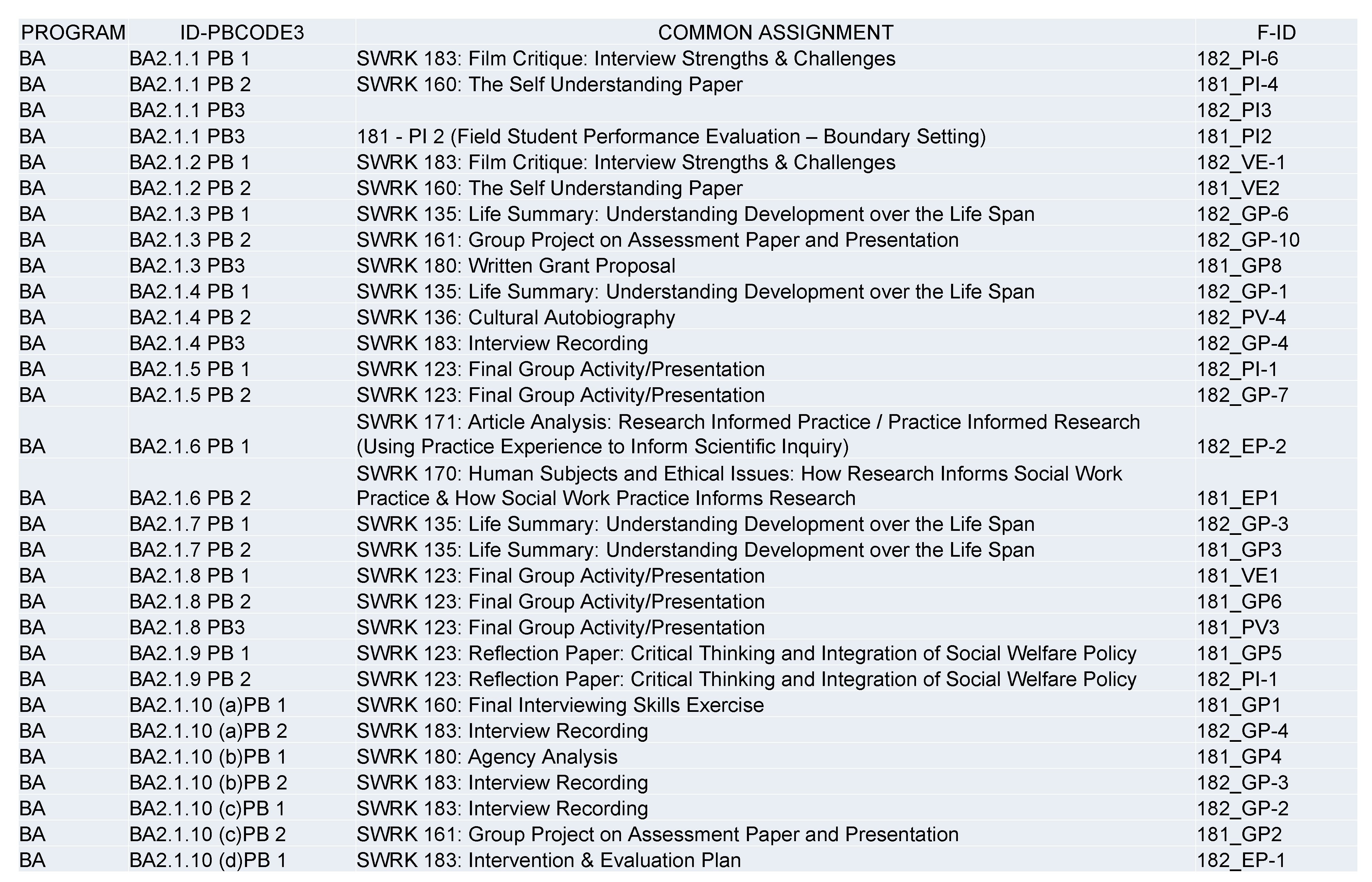
PROGRAM ID-PBCODE 3 BA BA 2. 1. 1 PB 1 BA BA 2. 1. 1 PB 2 BA BA 2. 1. 1 PB 3 BA BA 2. 1. 2 PB 1 BA BA 2. 1. 2 PB 2 BA BA 2. 1. 3 PB 1 BA BA 2. 1. 3 PB 2 BA BA 2. 1. 3 PB 3 BA BA 2. 1. 4 PB 1 BA BA 2. 1. 4 PB 2 BA BA 2. 1. 4 PB 3 BA BA 2. 1. 5 PB 1 BA BA 2. 1. 5 PB 2 BA BA 2. 1. 6 PB 1 BA BA BA BA 2. 1. 6 PB 2 BA 2. 1. 7 PB 1 BA 2. 1. 7 PB 2 BA 2. 1. 8 PB 1 BA 2. 1. 8 PB 2 BA 2. 1. 8 PB 3 BA 2. 1. 9 PB 1 BA 2. 1. 9 PB 2 BA 2. 1. 10 (a)PB 1 BA 2. 1. 10 (a)PB 2 BA 2. 1. 10 (b)PB 1 BA 2. 1. 10 (b)PB 2 BA 2. 1. 10 (c)PB 1 BA 2. 1. 10 (c)PB 2 BA 2. 1. 10 (d)PB 1 COMMON ASSIGNMENT SWRK 183: Film Critique: Interview Strengths & Challenges SWRK 160: The Self Understanding Paper 181 - PI 2 (Field Student Performance Evaluation – Boundary Setting) SWRK 183: Film Critique: Interview Strengths & Challenges SWRK 160: The Self Understanding Paper SWRK 135: Life Summary: Understanding Development over the Life Span SWRK 161: Group Project on Assessment Paper and Presentation SWRK 180: Written Grant Proposal SWRK 135: Life Summary: Understanding Development over the Life Span SWRK 136: Cultural Autobiography SWRK 183: Interview Recording SWRK 123: Final Group Activity/Presentation SWRK 171: Article Analysis: Research Informed Practice / Practice Informed Research (Using Practice Experience to Inform Scientific Inquiry) SWRK 170: Human Subjects and Ethical Issues: How Research Informs Social Work Practice & How Social Work Practice Informs Research SWRK 135: Life Summary: Understanding Development over the Life Span SWRK 123: Final Group Activity/Presentation SWRK 123: Reflection Paper: Critical Thinking and Integration of Social Welfare Policy SWRK 160: Final Interviewing Skills Exercise SWRK 183: Interview Recording SWRK 180: Agency Analysis SWRK 183: Interview Recording SWRK 161: Group Project on Assessment Paper and Presentation SWRK 183: Intervention & Evaluation Plan F-ID 182_PI-6 181_PI-4 182_PI 3 181_PI 2 182_VE-1 181_VE 2 182_GP-6 182_GP-10 181_GP 8 182_GP-1 182_PV-4 182_GP-4 182_PI-1 182_GP-7 182_EP-2 181_EP 1 182_GP-3 181_GP 3 181_VE 1 181_GP 6 181_PV 3 181_GP 5 182_PI-1 181_GP 1 182_GP-4 181_GP 4 182_GP-3 182_GP-2 181_GP 2 182_EP-1
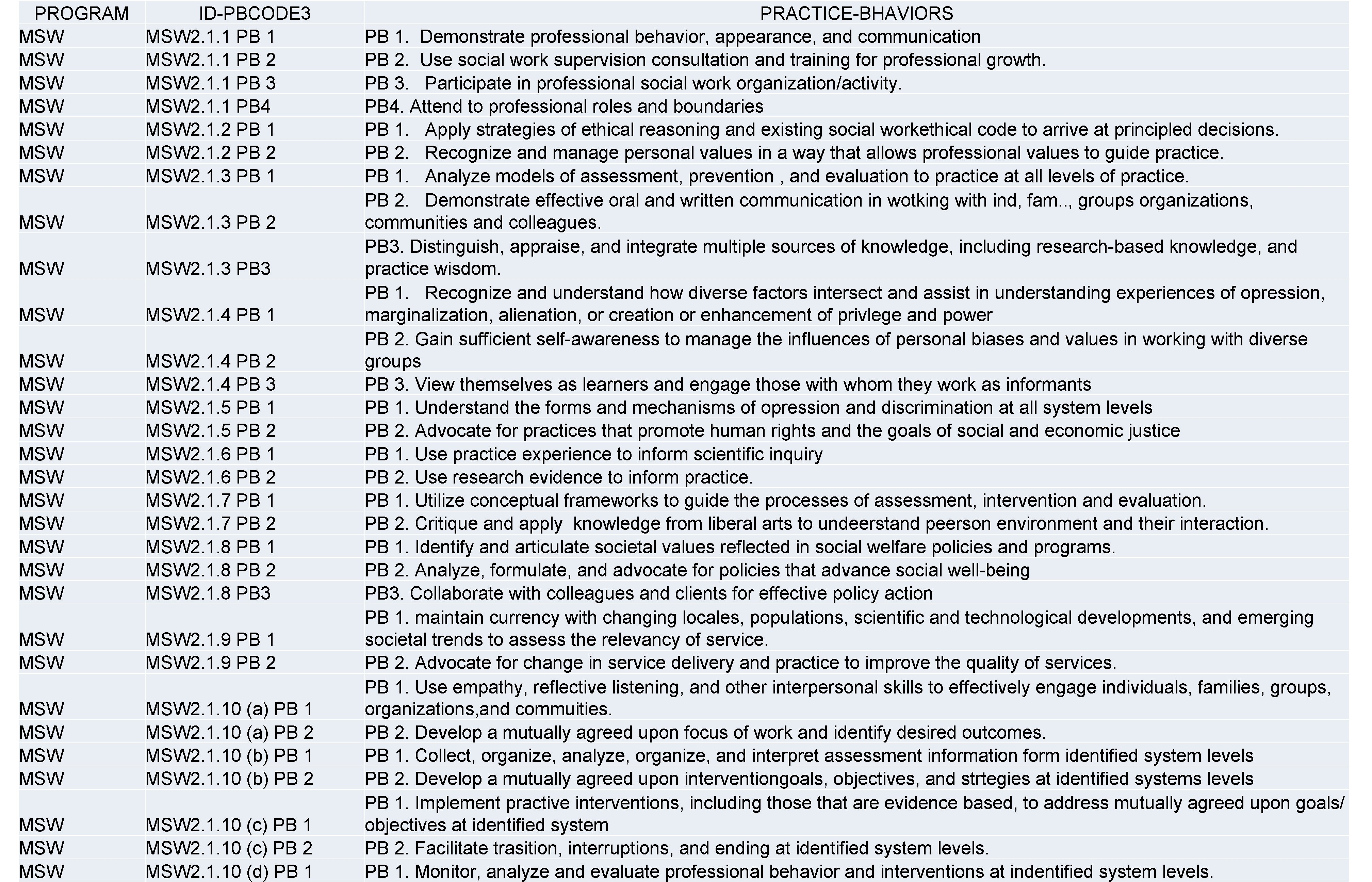
PROGRAM MSW MSW ID-PBCODE 3 MSW 2. 1. 1 PB 1 MSW 2. 1. 1 PB 2 MSW 2. 1. 1 PB 3 MSW 2. 1. 1 PB 4 MSW 2. 1. 2 PB 1 MSW 2. 1. 2 PB 2 MSW 2. 1. 3 PB 1 MSW 2. 1. 3 PB 2 MSW 2. 1. 3 PB 3 MSW 2. 1. 4 PB 1 MSW MSW MSW 2. 1. 4 PB 2 MSW 2. 1. 4 PB 3 MSW 2. 1. 5 PB 1 MSW 2. 1. 5 PB 2 MSW 2. 1. 6 PB 1 MSW 2. 1. 6 PB 2 MSW 2. 1. 7 PB 1 MSW 2. 1. 7 PB 2 MSW 2. 1. 8 PB 1 MSW 2. 1. 8 PB 2 MSW 2. 1. 8 PB 3 MSW MSW 2. 1. 9 PB 1 MSW 2. 1. 9 PB 2 MSW MSW MSW 2. 1. 10 (a) PB 1 MSW 2. 1. 10 (a) PB 2 MSW 2. 1. 10 (b) PB 1 MSW 2. 1. 10 (b) PB 2 MSW MSW 2. 1. 10 (c) PB 1 MSW 2. 1. 10 (c) PB 2 MSW 2. 1. 10 (d) PB 1 PRACTICE-BHAVIORS PB 1. Demonstrate professional behavior, appearance, and communication PB 2. Use social work supervision consultation and training for professional growth. PB 3. Participate in professional social work organization/activity. PB 4. Attend to professional roles and boundaries PB 1. Apply strategies of ethical reasoning and existing social workethical code to arrive at principled decisions. PB 2. Recognize and manage personal values in a way that allows professional values to guide practice. PB 1. Analyze models of assessment, prevention , and evaluation to practice at all levels of practice. PB 2. Demonstrate effective oral and written communication in wotking with ind, fam. . , groups organizations, communities and colleagues. PB 3. Distinguish, appraise, and integrate multiple sources of knowledge, including research-based knowledge, and practice wisdom. PB 1. Recognize and understand how diverse factors intersect and assist in understanding experiences of opression, marginalization, alienation, or creation or enhancement of privlege and power PB 2. Gain sufficient self-awareness to manage the influences of personal biases and values in working with diverse groups PB 3. View themselves as learners and engage those with whom they work as informants PB 1. Understand the forms and mechanisms of opression and discrimination at all system levels PB 2. Advocate for practices that promote human rights and the goals of social and economic justice PB 1. Use practice experience to inform scientific inquiry PB 2. Use research evidence to inform practice. PB 1. Utilize conceptual frameworks to guide the processes of assessment, intervention and evaluation. PB 2. Critique and apply knowledge from liberal arts to undeerstand peerson environment and their interaction. PB 1. Identify and articulate societal values reflected in social welfare policies and programs. PB 2. Analyze, formulate, and advocate for policies that advance social well-being PB 3. Collaborate with colleagues and clients for effective policy action PB 1. maintain currency with changing locales, populations, scientific and technological developments, and emerging societal trends to assess the relevancy of service. PB 2. Advocate for change in service delivery and practice to improve the quality of services. PB 1. Use empathy, reflective listening, and other interpersonal skills to effectively engage individuals, families, groups, organizations, and commuities. PB 2. Develop a mutually agreed upon focus of work and identify desired outcomes. PB 1. Collect, organize, analyze, organize, and interpret assessment information form identified system levels PB 2. Develop a mutually agreed upon interventiongoals, objectives, and strtegies at identified systems levels PB 1. Implement practive interventions, including those that are evidence based, to address mutually agreed upon goals/ objectives at identified system PB 2. Facilitate trasition, interruptions, and ending at identified system levels. PB 1. Monitor, analyze and evaluate professional behavior and interventions at indentified system levels.
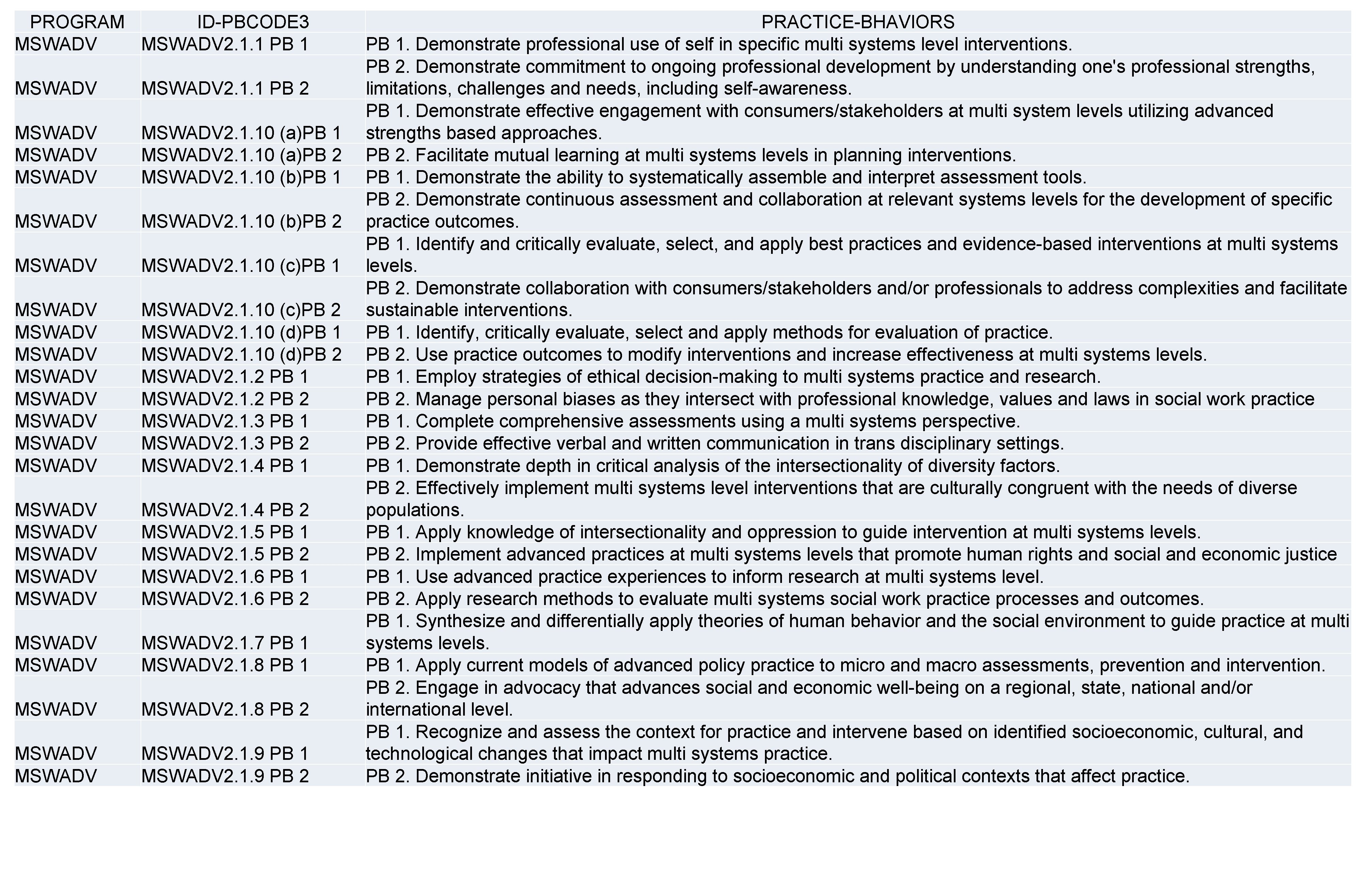
PROGRAM ID-PBCODE 3 MSWADV 2. 1. 1 PB 1 MSWADV 2. 1. 1 PB 2 MSWADV 2. 1. 10 (a)PB 1 MSWADV 2. 1. 10 (a)PB 2 MSWADV 2. 1. 10 (b)PB 1 MSWADV 2. 1. 10 (b)PB 2 MSWADV 2. 1. 10 (c)PB 1 MSWADV MSWADV MSWADV 2. 1. 10 (c)PB 2 MSWADV 2. 1. 10 (d)PB 1 MSWADV 2. 1. 10 (d)PB 2 MSWADV 2. 1. 2 PB 1 MSWADV 2. 1. 2 PB 2 MSWADV 2. 1. 3 PB 1 MSWADV 2. 1. 3 PB 2 MSWADV 2. 1. 4 PB 1 MSWADV MSWADV 2. 1. 4 PB 2 MSWADV 2. 1. 5 PB 1 MSWADV 2. 1. 5 PB 2 MSWADV 2. 1. 6 PB 1 MSWADV 2. 1. 6 PB 2 MSWADV 2. 1. 7 PB 1 MSWADV 2. 1. 8 PB 2 MSWADV 2. 1. 9 PB 1 MSWADV 2. 1. 9 PB 2 PRACTICE-BHAVIORS PB 1. Demonstrate professional use of self in specific multi systems level interventions. PB 2. Demonstrate commitment to ongoing professional development by understanding one's professional strengths, limitations, challenges and needs, including self-awareness. PB 1. Demonstrate effective engagement with consumers/stakeholders at multi system levels utilizing advanced strengths based approaches. PB 2. Facilitate mutual learning at multi systems levels in planning interventions. PB 1. Demonstrate the ability to systematically assemble and interpret assessment tools. PB 2. Demonstrate continuous assessment and collaboration at relevant systems levels for the development of specific practice outcomes. PB 1. Identify and critically evaluate, select, and apply best practices and evidence-based interventions at multi systems levels. PB 2. Demonstrate collaboration with consumers/stakeholders and/or professionals to address complexities and facilitate sustainable interventions. PB 1. Identify, critically evaluate, select and apply methods for evaluation of practice. PB 2. Use practice outcomes to modify interventions and increase effectiveness at multi systems levels. PB 1. Employ strategies of ethical decision-making to multi systems practice and research. PB 2. Manage personal biases as they intersect with professional knowledge, values and laws in social work practice PB 1. Complete comprehensive assessments using a multi systems perspective. PB 2. Provide effective verbal and written communication in trans disciplinary settings. PB 1. Demonstrate depth in critical analysis of the intersectionality of diversity factors. PB 2. Effectively implement multi systems level interventions that are culturally congruent with the needs of diverse populations. PB 1. Apply knowledge of intersectionality and oppression to guide intervention at multi systems levels. PB 2. Implement advanced practices at multi systems levels that promote human rights and social and economic justice PB 1. Use advanced practice experiences to inform research at multi systems level. PB 2. Apply research methods to evaluate multi systems social work practice processes and outcomes. PB 1. Synthesize and differentially apply theories of human behavior and the social environment to guide practice at multi systems levels. PB 1. Apply current models of advanced policy practice to micro and macro assessments, prevention and intervention. PB 2. Engage in advocacy that advances social and economic well-being on a regional, state, national and/or international level. PB 1. Recognize and assess the context for practice and intervene based on identified socioeconomic, cultural, and technological changes that impact multi systems practice. PB 2. Demonstrate initiative in responding to socioeconomic and political contexts that affect practice.
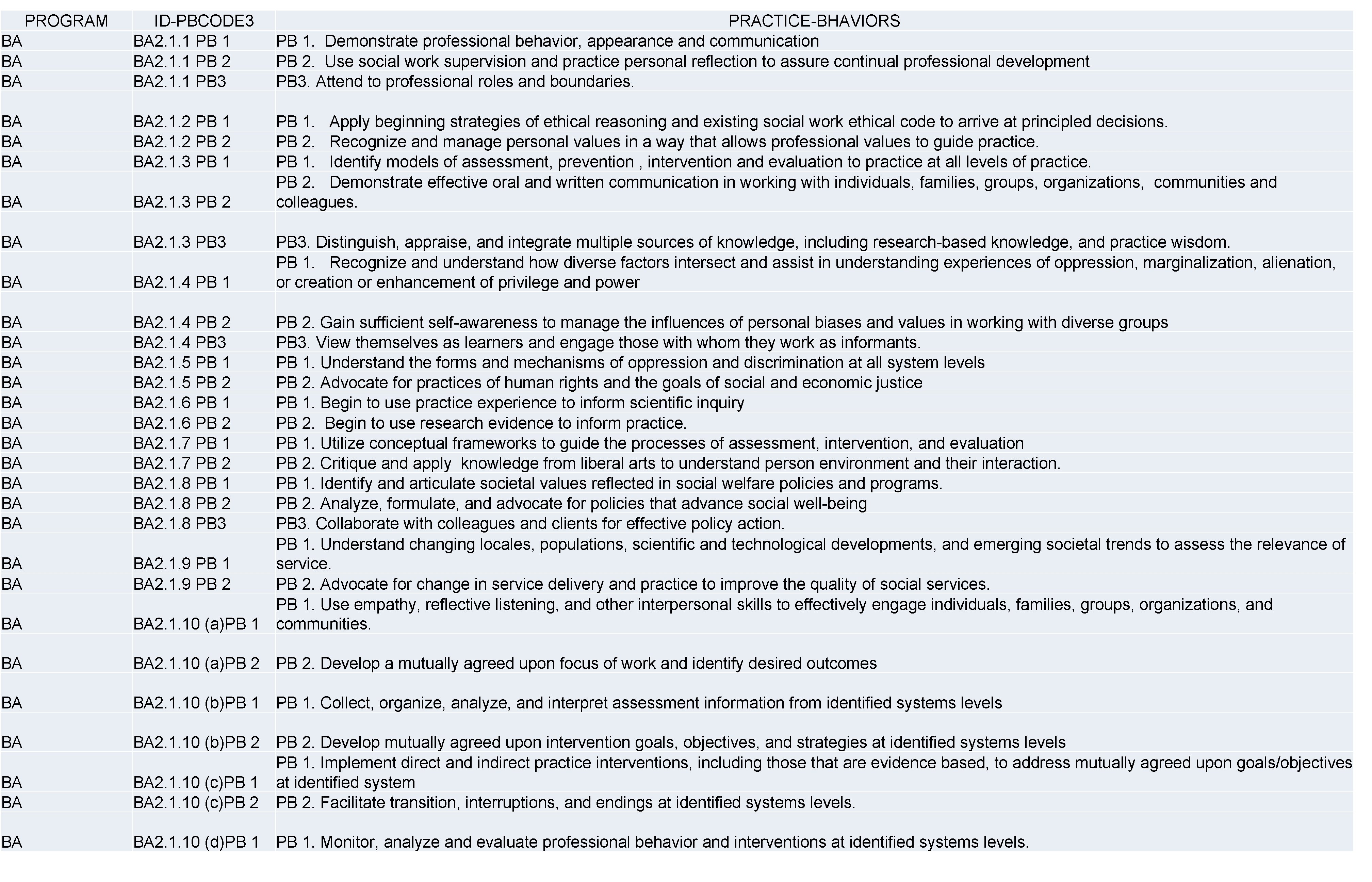
PROGRAM BA BA BA ID-PBCODE 3 BA 2. 1. 1 PB 1 BA 2. 1. 1 PB 2 BA 2. 1. 1 PB 3 PRACTICE-BHAVIORS PB 1. Demonstrate professional behavior, appearance and communication PB 2. Use social work supervision and practice personal reflection to assure continual professional development PB 3. Attend to professional roles and boundaries. BA BA 2. 1. 2 PB 1 BA 2. 1. 2 PB 2 BA 2. 1. 3 PB 1 BA BA 2. 1. 3 PB 2 PB 1. Apply beginning strategies of ethical reasoning and existing social work ethical code to arrive at principled decisions. PB 2. Recognize and manage personal values in a way that allows professional values to guide practice. PB 1. Identify models of assessment, prevention , intervention and evaluation to practice at all levels of practice. PB 2. Demonstrate effective oral and written communication in working with individuals, families, groups, organizations, communities and colleagues. BA BA 2. 1. 3 PB 3 BA BA 2. 1. 4 PB 1 BA BA BA 2. 1. 4 PB 2 BA 2. 1. 4 PB 3 BA 2. 1. 5 PB 1 BA 2. 1. 5 PB 2 BA 2. 1. 6 PB 1 BA 2. 1. 6 PB 2 BA 2. 1. 7 PB 1 BA 2. 1. 7 PB 2 BA 2. 1. 8 PB 1 BA 2. 1. 8 PB 2 BA 2. 1. 8 PB 3. Distinguish, appraise, and integrate multiple sources of knowledge, including research-based knowledge, and practice wisdom. PB 1. Recognize and understand how diverse factors intersect and assist in understanding experiences of oppression, marginalization, alienation, or creation or enhancement of privilege and power BA PB 2. Gain sufficient self-awareness to manage the influences of personal biases and values in working with diverse groups PB 3. View themselves as learners and engage those with whom they work as informants. PB 1. Understand the forms and mechanisms of oppression and discrimination at all system levels PB 2. Advocate for practices of human rights and the goals of social and economic justice PB 1. Begin to use practice experience to inform scientific inquiry PB 2. Begin to use research evidence to inform practice. PB 1. Utilize conceptual frameworks to guide the processes of assessment, intervention, and evaluation PB 2. Critique and apply knowledge from liberal arts to understand person environment and their interaction. PB 1. Identify and articulate societal values reflected in social welfare policies and programs. PB 2. Analyze, formulate, and advocate for policies that advance social well-being PB 3. Collaborate with colleagues and clients for effective policy action. PB 1. Understand changing locales, populations, scientific and technological developments, and emerging societal trends to assess the relevance of BA 2. 1. 9 PB 1 service. BA 2. 1. 9 PB 2. Advocate for change in service delivery and practice to improve the quality of social services. PB 1. Use empathy, reflective listening, and other interpersonal skills to effectively engage individuals, families, groups, organizations, and BA 2. 1. 10 (a)PB 1 communities. BA BA 2. 1. 10 (a)PB 2. Develop a mutually agreed upon focus of work and identify desired outcomes BA BA 2. 1. 10 (b)PB 1. Collect, organize, analyze, and interpret assessment information from identified systems levels BA BA 2. 1. 10 (b)PB 2. Develop mutually agreed upon intervention goals, objectives, and strategies at identified systems levels PB 1. Implement direct and indirect practice interventions, including those that are evidence based, to address mutually agreed upon goals/objectives BA 2. 1. 10 (c)PB 1 at identified system BA 2. 1. 10 (c)PB 2. Facilitate transition, interruptions, and endings at identified systems levels. BA BA 2. 1. 10 (d)PB 1. Monitor, analyze and evaluate professional behavior and interventions at identified systems levels. BA BA
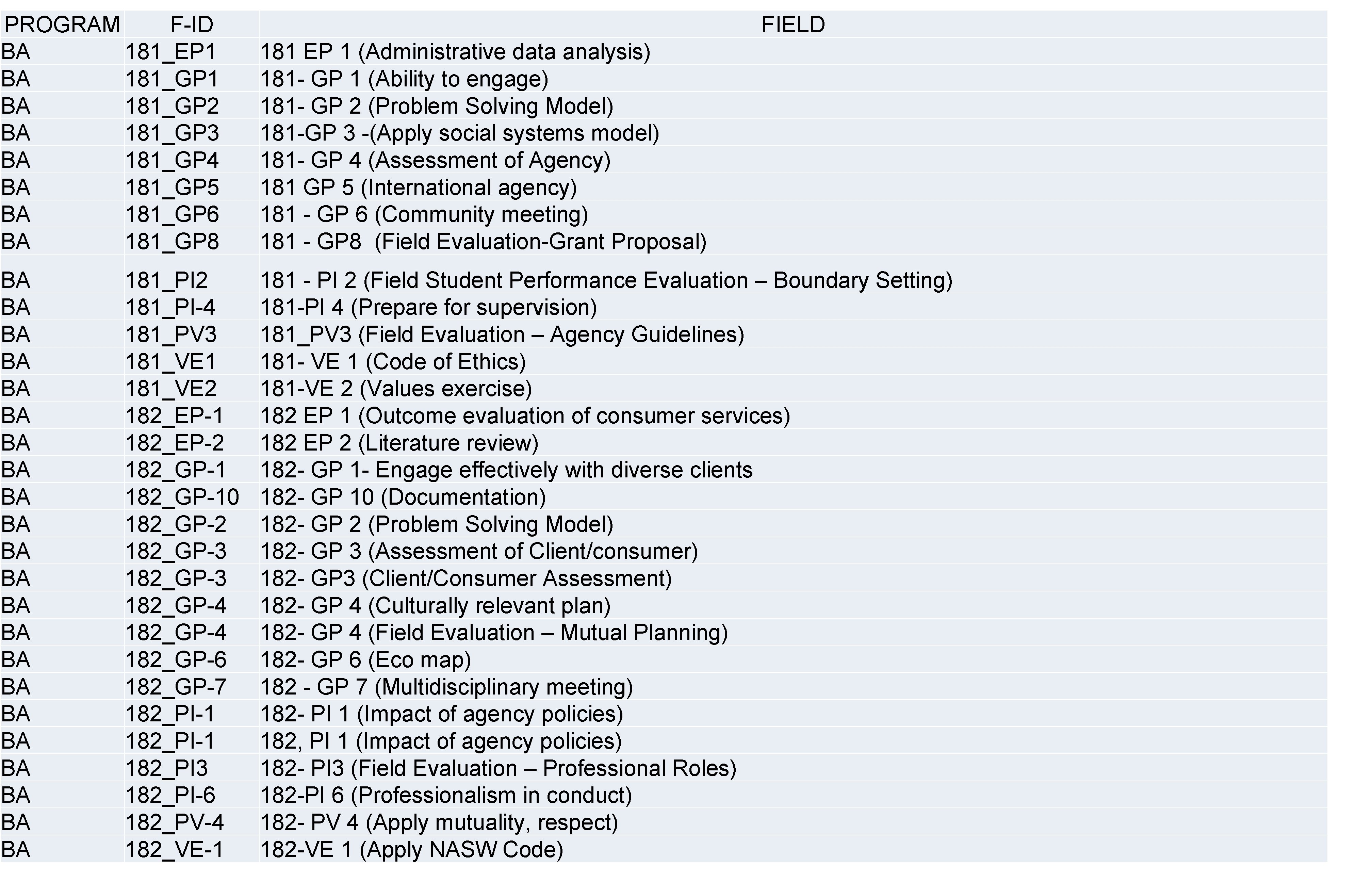
PROGRAM F-ID BA 181_EP 1 BA 181_GP 2 BA 181_GP 3 BA 181_GP 4 BA 181_GP 5 BA 181_GP 6 BA 181_GP 8 181 EP 1 (Administrative data analysis) 181 - GP 1 (Ability to engage) 181 - GP 2 (Problem Solving Model) 181 -GP 3 -(Apply social systems model) 181 - GP 4 (Assessment of Agency) 181 GP 5 (International agency) 181 - GP 6 (Community meeting) 181 - GP 8 (Field Evaluation-Grant Proposal) BA BA BA BA BA BA 181 - PI 2 (Field Student Performance Evaluation – Boundary Setting) 181 -PI 4 (Prepare for supervision) 181_PV 3 (Field Evaluation – Agency Guidelines) 181 - VE 1 (Code of Ethics) 181 -VE 2 (Values exercise) 182 EP 1 (Outcome evaluation of consumer services) 182 EP 2 (Literature review) 182 - GP 1 - Engage effectively with diverse clients 182 - GP 10 (Documentation) 182 - GP 2 (Problem Solving Model) 182 - GP 3 (Assessment of Client/consumer) 182 - GP 3 (Client/Consumer Assessment) 182 - GP 4 (Culturally relevant plan) 182 - GP 4 (Field Evaluation – Mutual Planning) 182 - GP 6 (Eco map) 182 - GP 7 (Multidisciplinary meeting) 182 - PI 1 (Impact of agency policies) 182, PI 1 (Impact of agency policies) 182 - PI 3 (Field Evaluation – Professional Roles) 182 -PI 6 (Professionalism in conduct) 182 - PV 4 (Apply mutuality, respect) 182 -VE 1 (Apply NASW Code) 181_PI 2 181_PI-4 181_PV 3 181_VE 1 181_VE 2 182_EP-1 182_EP-2 182_GP-10 182_GP-2 182_GP-3 182_GP-4 182_GP-6 182_GP-7 182_PI-1 182_PI 3 182_PI-6 182_PV-4 182_VE-1 FIELD
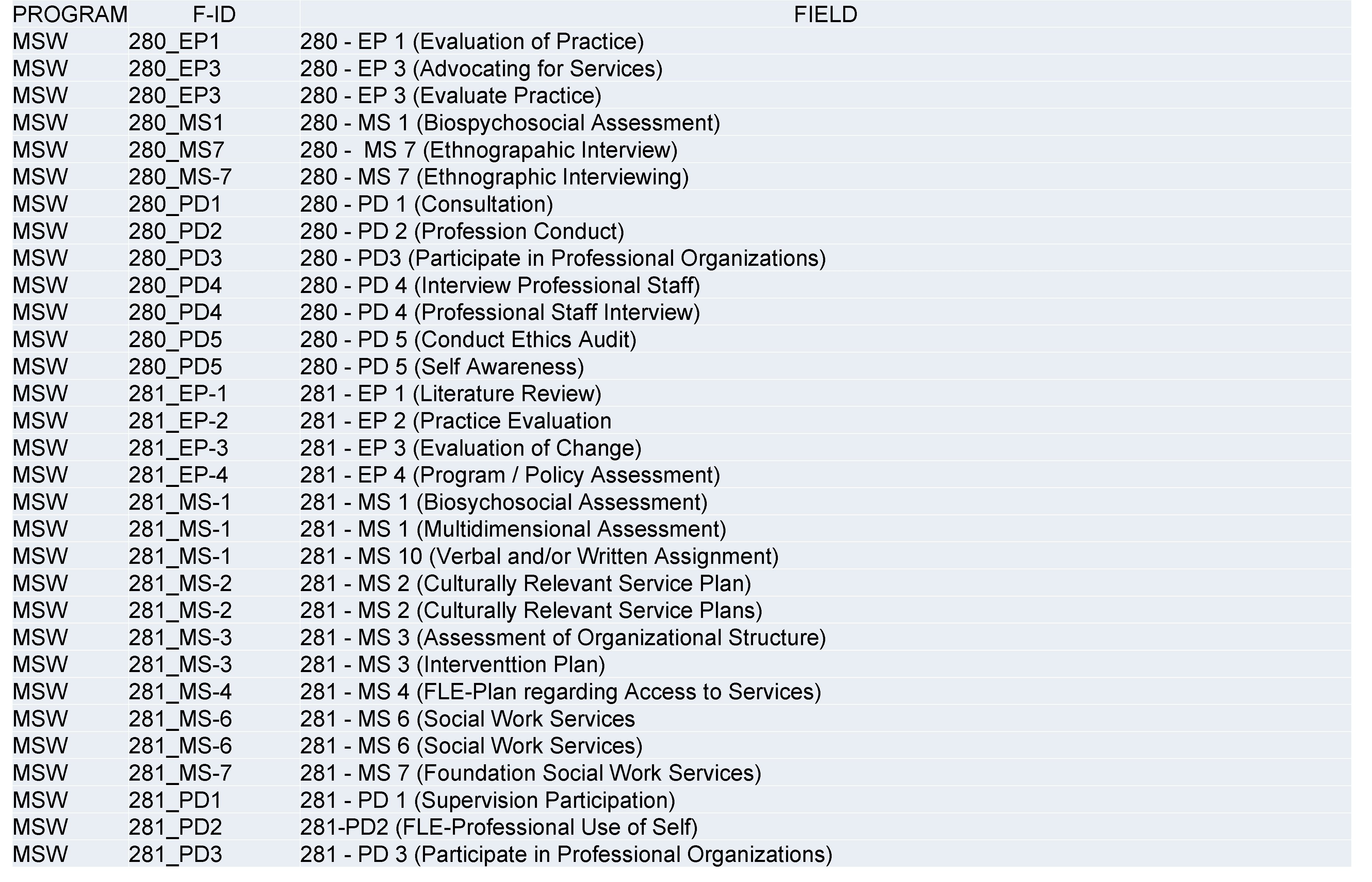
PROGRAM F-ID MSW 280_EP 1 MSW 280_EP 3 MSW 280_MS 1 MSW 280_MS 7 MSW 280_MS-7 MSW 280_PD 1 MSW 280_PD 2 MSW 280_PD 3 MSW 280_PD 4 MSW 280_PD 5 MSW 281_EP-1 MSW 281_EP-2 MSW 281_EP-3 MSW 281_EP-4 MSW 281_MS-1 MSW 281_MS-2 MSW 281_MS-3 MSW 281_MS-4 MSW 281_MS-6 MSW 281_MS-7 MSW 281_PD 1 MSW 281_PD 2 MSW 281_PD 3 FIELD 280 - EP 1 (Evaluation of Practice) 280 - EP 3 (Advocating for Services) 280 - EP 3 (Evaluate Practice) 280 - MS 1 (Biospychosocial Assessment) 280 - MS 7 (Ethnograpahic Interview) 280 - MS 7 (Ethnographic Interviewing) 280 - PD 1 (Consultation) 280 - PD 2 (Profession Conduct) 280 - PD 3 (Participate in Professional Organizations) 280 - PD 4 (Interview Professional Staff) 280 - PD 4 (Professional Staff Interview) 280 - PD 5 (Conduct Ethics Audit) 280 - PD 5 (Self Awareness) 281 - EP 1 (Literature Review) 281 - EP 2 (Practice Evaluation 281 - EP 3 (Evaluation of Change) 281 - EP 4 (Program / Policy Assessment) 281 - MS 1 (Biosychosocial Assessment) 281 - MS 1 (Multidimensional Assessment) 281 - MS 10 (Verbal and/or Written Assignment) 281 - MS 2 (Culturally Relevant Service Plans) 281 - MS 3 (Assessment of Organizational Structure) 281 - MS 3 (Interventtion Plan) 281 - MS 4 (FLE-Plan regarding Access to Services) 281 - MS 6 (Social Work Services) 281 - MS 7 (Foundation Social Work Services) 281 - PD 1 (Supervision Participation) 281 -PD 2 (FLE-Professional Use of Self) 281 - PD 3 (Participate in Professional Organizations)
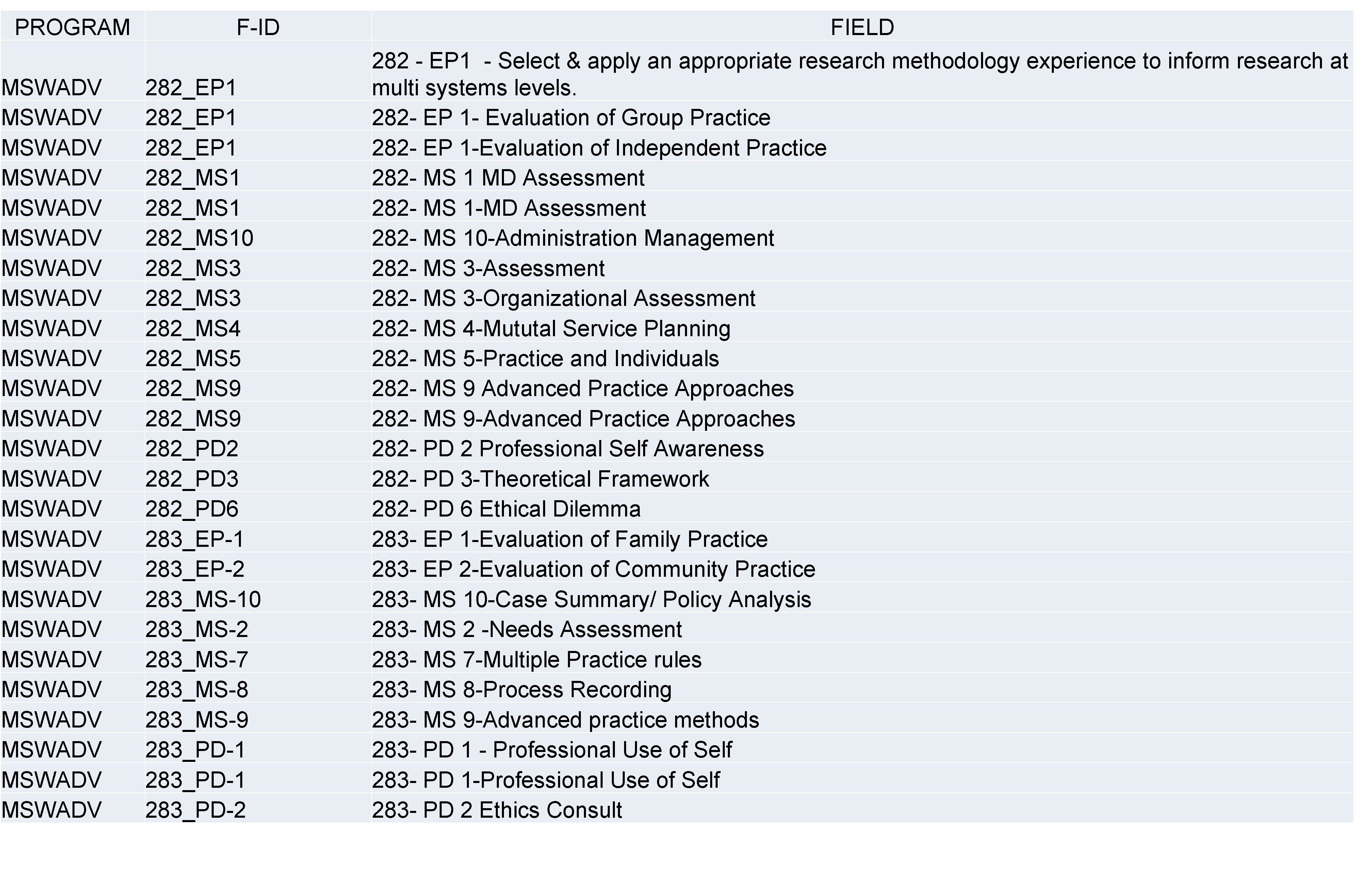
PROGRAM MSWADV MSWADV MSWADV MSWADV MSWADV MSWADV MSWADV F-ID 282_EP 1 282_MS 10 282_MS 3 282_MS 4 282_MS 5 282_MS 9 282_PD 2 282_PD 3 282_PD 6 283_EP-1 283_EP-2 283_MS-10 283_MS-2 283_MS-7 283_MS-8 283_MS-9 283_PD-1 283_PD-2 FIELD 282 - EP 1 - Select & apply an appropriate research methodology experience to inform research at multi systems levels. 282 - EP 1 - Evaluation of Group Practice 282 - EP 1 -Evaluation of Independent Practice 282 - MS 1 MD Assessment 282 - MS 1 -MD Assessment 282 - MS 10 -Administration Management 282 - MS 3 -Assessment 282 - MS 3 -Organizational Assessment 282 - MS 4 -Mututal Service Planning 282 - MS 5 -Practice and Individuals 282 - MS 9 Advanced Practice Approaches 282 - MS 9 -Advanced Practice Approaches 282 - PD 2 Professional Self Awareness 282 - PD 3 -Theoretical Framework 282 - PD 6 Ethical Dilemma 283 - EP 1 -Evaluation of Family Practice 283 - EP 2 -Evaluation of Community Practice 283 - MS 10 -Case Summary/ Policy Analysis 283 - MS 2 -Needs Assessment 283 - MS 7 -Multiple Practice rules 283 - MS 8 -Process Recording 283 - MS 9 -Advanced practice methods 283 - PD 1 - Professional Use of Self 283 - PD 1 -Professional Use of Self 283 - PD 2 Ethics Consult
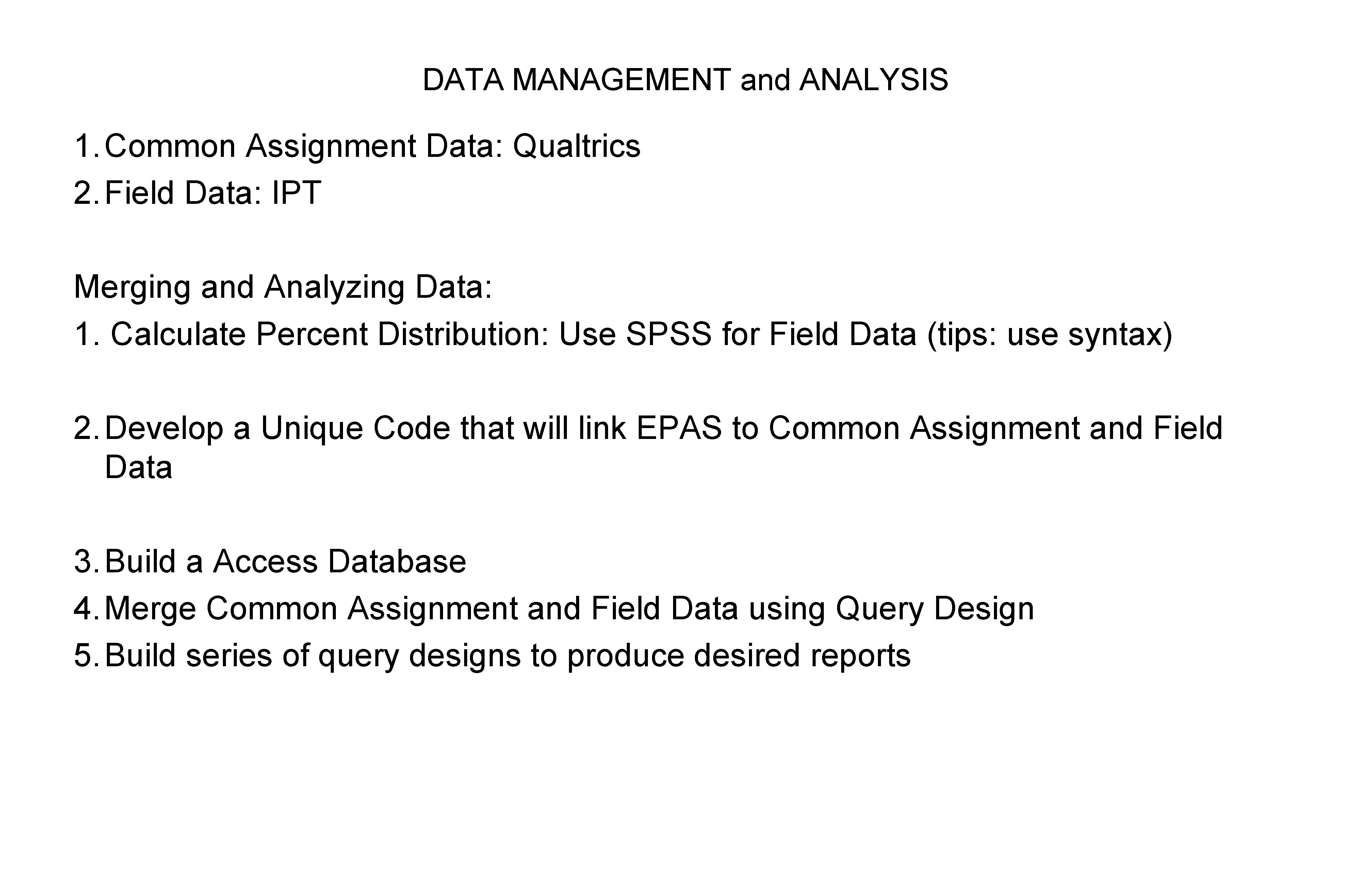
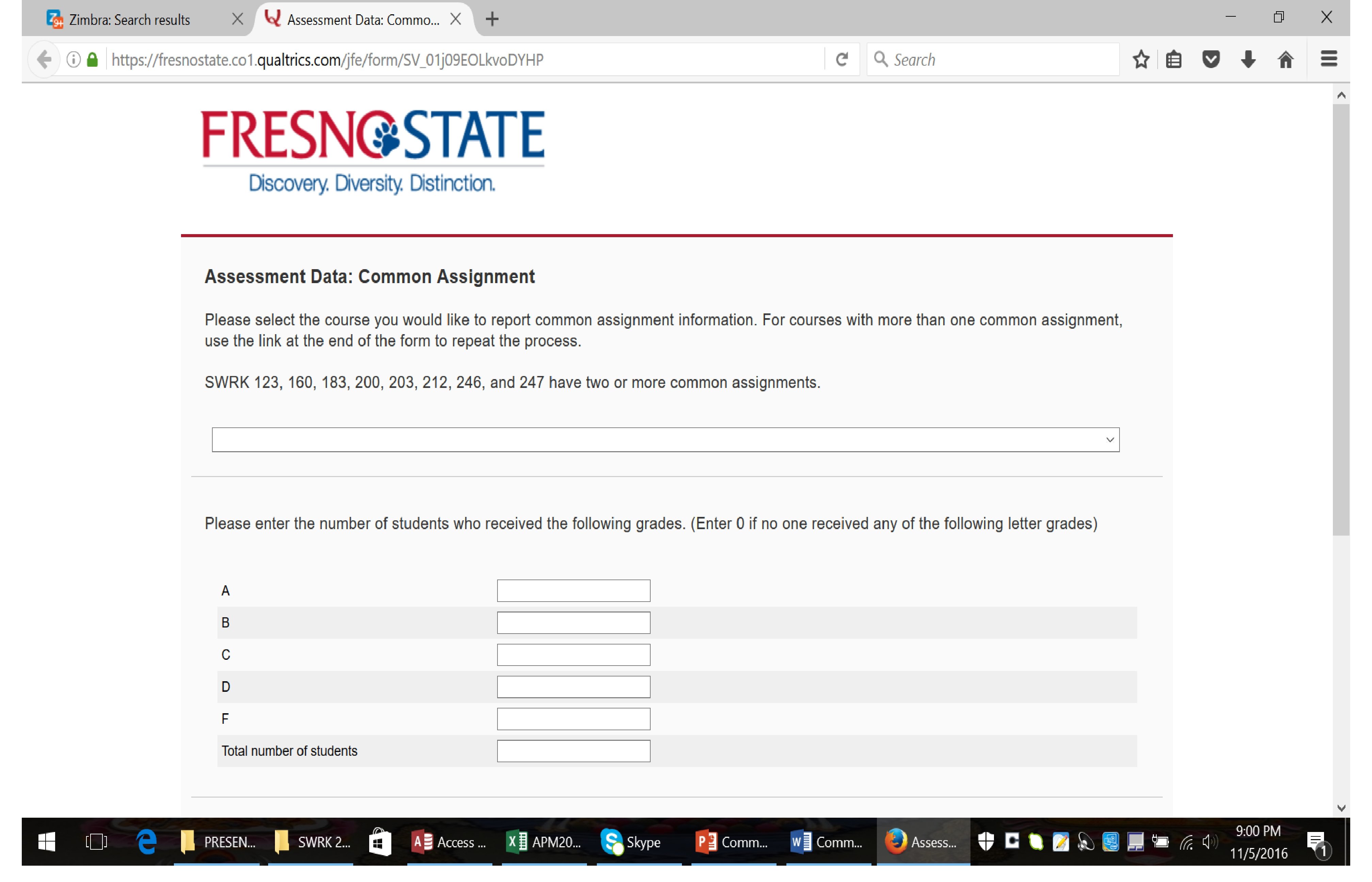
DATA MANAGEMENT and ANALYSIS 1. Common Assignment Data: Qualtrics 2. Field Data: IPT Merging and Analyzing Data: 1. Calculate Percent Distribution: Use SPSS for Field Data (tips: use syntax) 2. Develop a Unique Code that will link EPAS to Common Assignment and Field Data 3. Build a Access Database 4. Merge Common Assignment and Field Data using Query Design 5. Build series of query designs to produce desired reports
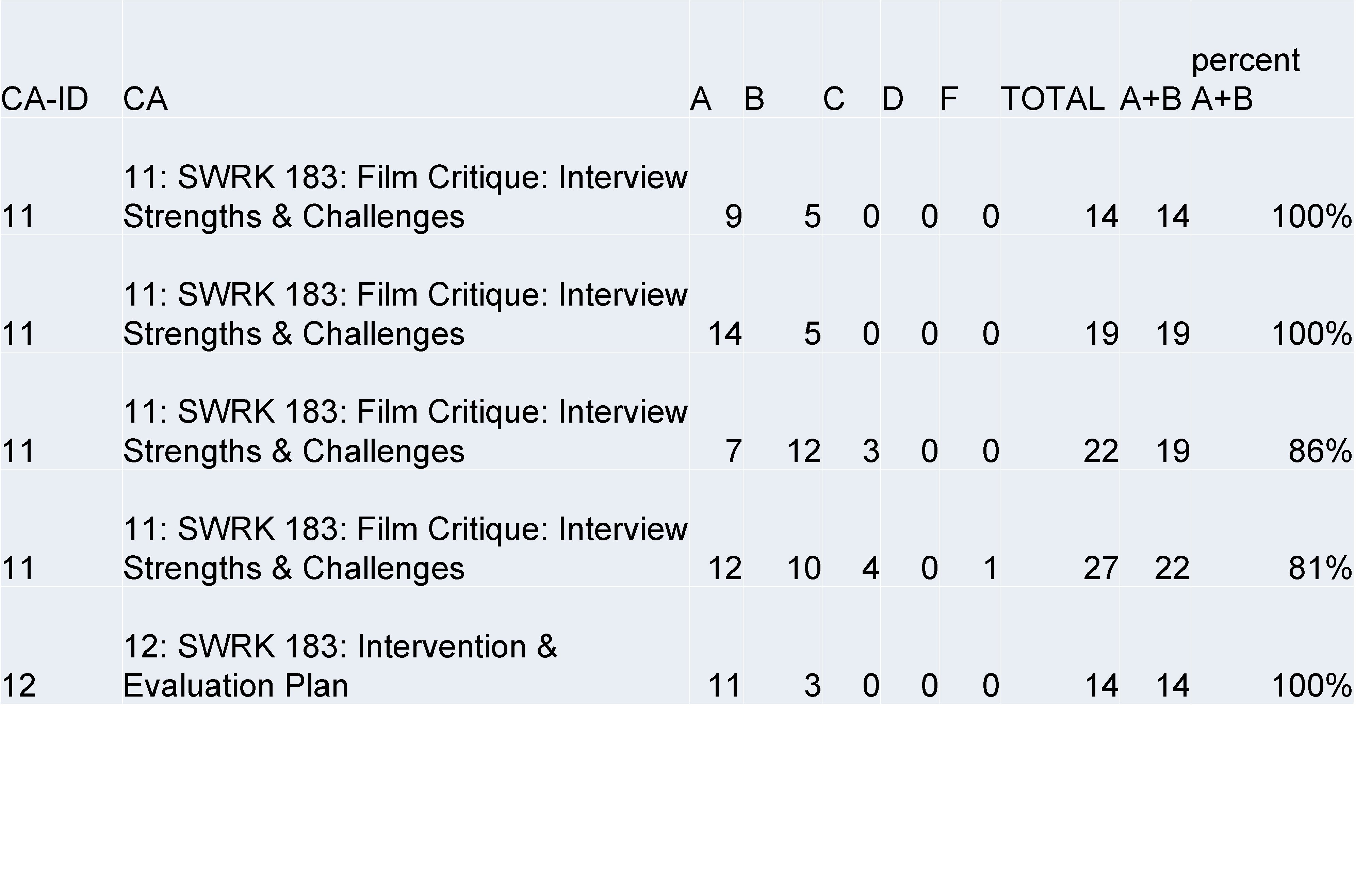
A B CA-ID CA 11 11: SWRK 183: Film Critique: Interview Strengths & Challenges 9 5 0 0 0 14 14 100% 11 11: SWRK 183: Film Critique: Interview Strengths & Challenges 14 5 0 0 0 19 19 100% 11 11: SWRK 183: Film Critique: Interview Strengths & Challenges 7 12 3 0 0 22 19 86% 11 11: SWRK 183: Film Critique: Interview Strengths & Challenges 12 10 4 0 1 27 22 81% 12 12: SWRK 183: Intervention & Evaluation Plan 3 0 0 0 14 14 100% 11 C D percent TOTAL A+B F
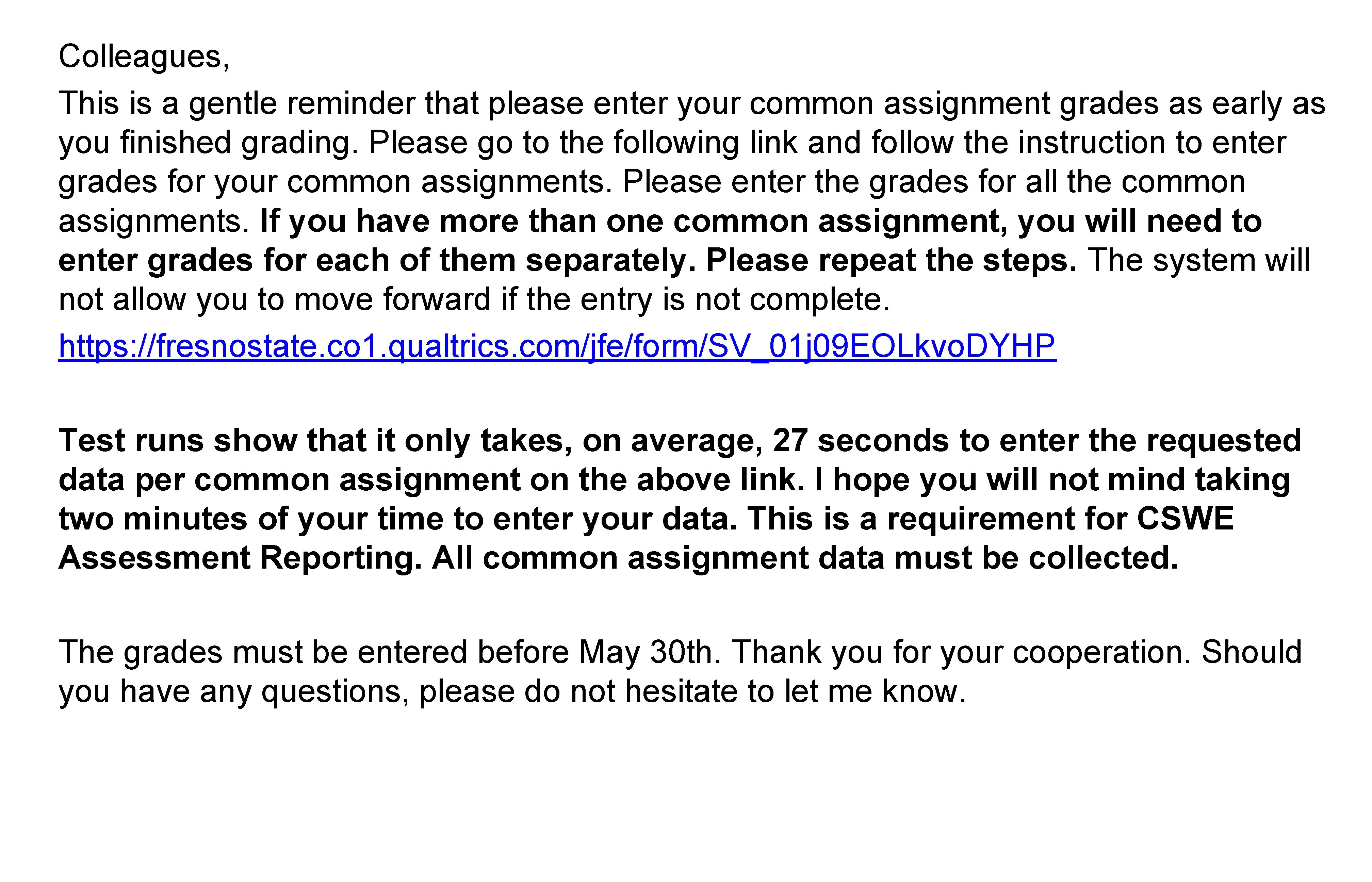
Colleagues, This is a gentle reminder that please enter your common assignment grades as early as you finished grading. Please go to the following link and follow the instruction to enter grades for your common assignments. Please enter the grades for all the common assignments. If you have more than one common assignment, you will need to enter grades for each of them separately. Please repeat the steps. The system will not allow you to move forward if the entry is not complete. https: //fresnostate. co 1. qualtrics. com/jfe/form/SV_01 j 09 EOLkvo. DYHP Test runs show that it only takes, on average, 27 seconds to enter the requested data per common assignment on the above link. I hope you will not mind taking two minutes of your time to enter your data. This is a requirement for CSWE Assessment Reporting. All common assignment data must be collected. The grades must be entered before May 30 th. Thank you for your cooperation. Should you have any questions, please do not hesitate to let me know.
STRENGTH 1. Fairly easy to implement 2. Instruments are standardized, considered valid and reliable 3. Common Assignments could be simulations 4. Quick turn-around 5. Data can be used for other assessments: GE, SOAP, Annual Report 6. Potential for automation
WEAKNESS 1. Fairly lengthy process to decide on the Common Assignments and Rubrics 2. Academic freedom: not all faculty are fan of standardized system 3. Good amount of database design and analyses skills needed 4. Some manual adjustments are needed, not complete automation