
Common Alerting Protocol CAP Early Warning Systems in











- Slides: 33
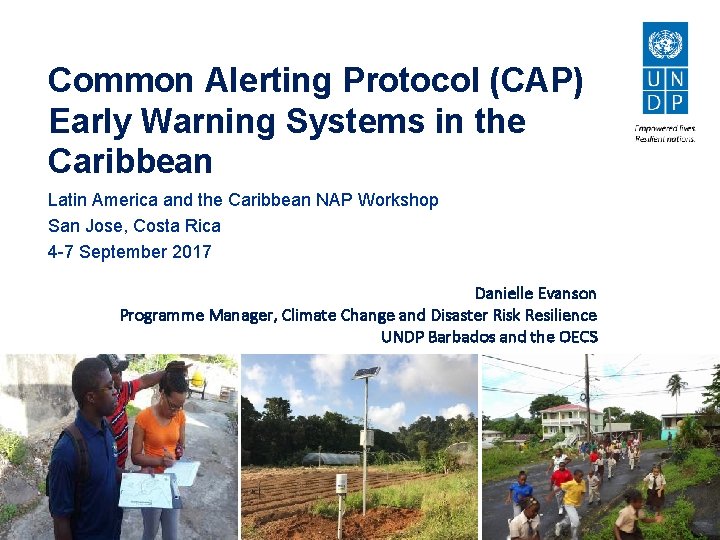
Common Alerting Protocol (CAP) Early Warning Systems in the Caribbean Latin America and the Caribbean NAP Workshop San Jose, Costa Rica 4 -7 September 2017 Danielle Evanson Programme Manager, Climate Change and Disaster Risk Resilience UNDP Barbados and the OECS
Outline • • • Effective early warning systems (EWS) The Common Alerting Protocol (CAP) CAP EWS implementation in the Caribbean Key partnerships and sustainability Experiences and lessons learnt Next steps in the region
Early warning systems • Why EWS? – Cost-effective risk mitigation – Short installation time, little environmental impact – Enables better preparation and response • Components for effective people-centred EWS: – Detection, monitoring and forecasting the hazards – Analyses of risks involved – Dissemination of timely warnings, which should carry the authority of government – Activation of emergency plans to prepare and respond • Good governance and appropriate institutional arrangements are critical
Early warning systems Ten principles for effective EWS implementation: 1. 2. 3. 4. 5. Strong political recognition of the benefits of EWS reflected in harmonised national to local disaster risk management policies, planning, legislation and budgeting. Effective EWS are built upon four components EWS stakeholders are identified and their roles and responsibilities and coordination mechanisms clearly defined and documented within national to local plans, legislation, directives, MOUs, etc. EWS capacities are supported by adequate resources (e. g. human, financial, equipment, etc. ) across national to local levels and the system is designed and for long-term sustainability. Hazard, exposure and vulnerability information are used to carry-out risk assessments at different levels, as critical input into emergency planning and development of warning messages.
Early warning systems 6. Warning messages are: (i) clear, consistent and include risk information; (ii) designed with consideration for linking threat levels to emergency preparedness and response actions (e. g. using colour, flags) and understood by authorities and the population; and (iii) issued from a single (or unified), recognised and “authoritative” source. 7. Warning dissemination mechanisms are able to reach the authorities, other EWS stake-holders and the population at risk in a timely and reliable fashion. 8. Emergency response plans are developed with consideration for hazard/risk levels, characteristics of the exposed communities. 9. Training on hazard/risk/emergency preparedness awareness integrated in various formal and informal educational programmes with regular drills to ensure operational readiness. 10. Effective feedback and improvement mechanisms are in place at all levels of EWS to provide systematic evaluation and ensure system improvement over time.
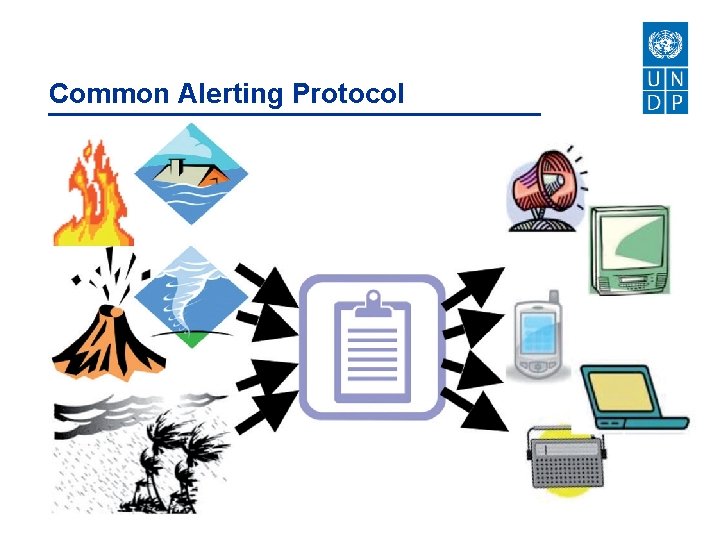
Common Alerting Protocol • An open, non-proprietary digital message format for all types of alerts and notifications • An international standard for sharing alert messages with affected populations, emergency response teams, etc - Endorsed by the WMO and ITU • Allows dissemination of the same message across multiple media (e. g. radio, tv, email, siren) at the same time from a single point • Can be used for all types of hazards and emergencies e. g. fire, tsunami, hurricane, earthquake, missing persons, oil spills • Consistency of messages across multiple media • Flexible geographic targeting; multilingual and multi-audience messaging
Common Alerting Protocol
Objectives of using CAP • Strengthening the linkages between forecasting and dissemination • All hazard approach • Simplifying the dissemination mechanism • Improving consistency and reliability of messages from authorised sources • Increasing public trust in messaging • Reaching the “last mile” of the population • Better response to warning messages and preparedness actions of the population • Minimising loss of life and livelihoods
CAP in the Caribbean • First implemented by Anguilla in 2007 • Experience sharing started in 2009 -2012 with the British and Dutch overseas territories • Expanded to the Eastern Caribbean since 2013 • Anguilla has continued to build its system and lend its growing technical expertise to other countries in the region
Antigua and Barbuda, St Kitts and Nevis Barbados, Saint Lucia Dominica, Grenada, St Vincent and the Grenadines Aruba, Montserrat, Sint Maarten Anguilla
Detection, monitoring, forecasting
Detection, monitoring, forecasting • Developed the DEWETRA platform with CIMH and CIMA Research Foundation in Italy – Enhanced capabilities for near real-time numerical weather predictions – Expansion of the meteorological observation and early warning networks • Hazard monitoring capacity enhanced in 4 countries: – 7 rain gauges – 7 water level stations – All connected to DEWETRA
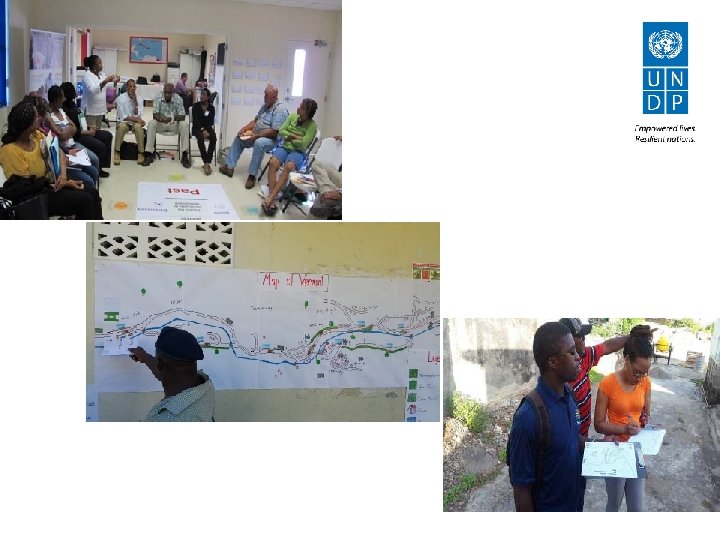
Risk analysis • Vulnerability and Capacity Assessments (VCAs) completed in 8 communities in 4 countries • Capacity building of community members and a training of trainers session
Dissemination of timely warnings
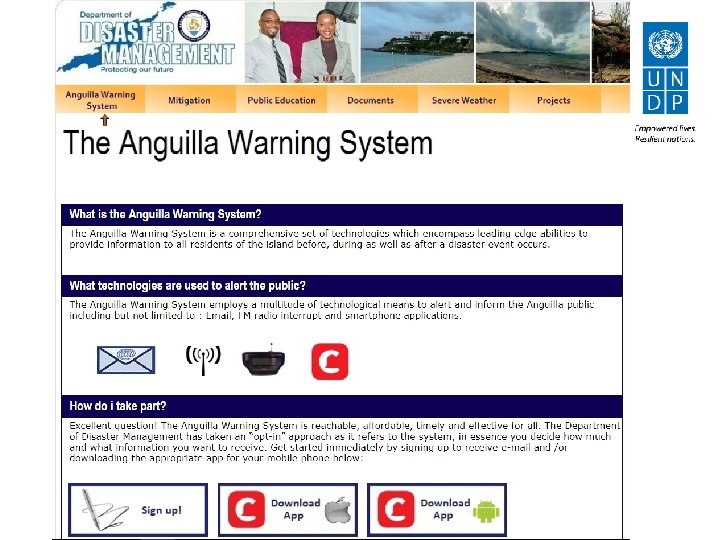
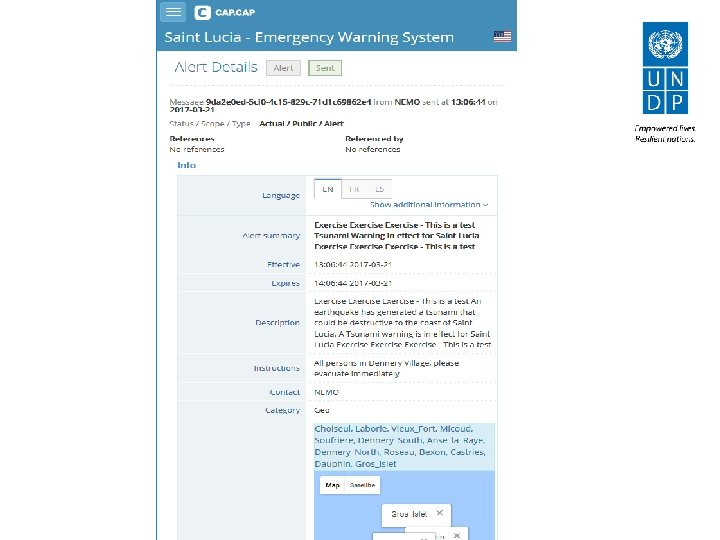
Dissemination of timely warnings • Installation of CAP servers in 9 countries • Dissemination capacity improved: – – – radio broadcast interrupt radio data system email notification cap app CAP-enabled an existing siren system • Alert message templates developed in 5 languages (Dutch, English, French, Spanish, Papiamentu) • Policy, protocols, SOPs and agreement documents developed using templates from Government of Anguilla • Training in use of systems
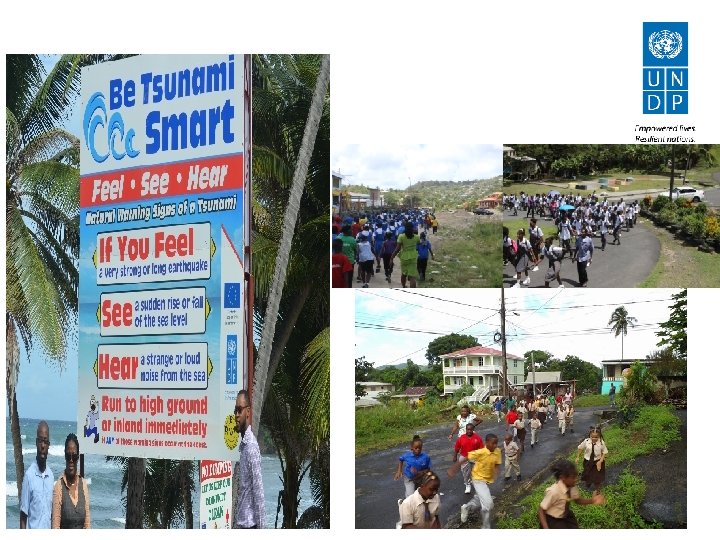
Activation of emergency plans • • • Dedicated public awareness and education (PAE) programme developed, including for hearing impaired Simulation exercises to evaluate responding agencies and communities ability to execute portions of its response and improve organisation coordination School emergency plans developed in Dominica
EWS Toolkit www. cdema. org
Main partnerships • Caribbean Disaster Emergency Management Agency (CDEMA) • United Nations International Strategy for Disaster Reduction (UNISDR) • Caribbean Institute for Meteorology and Hydrology (CIMH) • International Federation of the Red Cross and Red Crescent Societies (IFRC) • French Red Cross (FRC) • United Nations Educational, Scientific and Cultural Organisation, Intergovernmental Oceanographic Commission (UNESCO IOC)
Experiences and lessons learnt 1. Strong political recognition reflected in policies, planning, legislation and budgeting. 2. Dedicated human capacity to manage the systems trained in IT and with a disaster management perspective. EWS capacities must be supported by adequate resources (e. g. human, financial, equipment) at national and local levels. 3. PAE relating to the system is not to be underestimated and should be completed in parallel with installation of the system. Feedback and improvement system is needed.
Experiences and lessons learnt 4. Security and theft for monitoring equipment is a major concern for the islands. 5. VCA process is good at identifying community initiated mitigative actions. However if the main actions suggested are beyond the scope of the project then the community is left with a sense of disappointment in some cases. 6. Systems should work in parallel with already existing community alerting mechanisms/approaches.
Next steps • Working on a project with Government of Cuba, CDEMA, IFRC and Oxfam to strengthen the institutionalisation of CAP EWS and capturing the knowledge and experiences • Refining and expanding the EWS Toolkit, including Cuba’s extensive hydromet experience • Support Antigua and Barbuda and St Kitts and Nevis in adopting CAP
Next steps • CDEMA recently constituted a Regional EWS Consortium to serve as a strategic advisory body for advancement and strengthened coordination of EWS within the Caribbean • CIMH is working to expand its climate products and services, particularly to key vulnerable sectors – Prepares long range forecasts e. g. Cari. COF, SPI, sectoral climate bulletins – Recently designated a WMO Regional Climate Centre https: //rcc. cimh. edu. bb/ – Convenes Consortium for Early Warning Information Systems Across Climate Timescales (EWISACTS) to improve the effectiveness and efficiency of sustainable planning, adaptation and mitigation strategies across major weather and climate sensitive socioeconomic sectors – Signed cooperation agreements with regional agencies for agriculture, health, tourism, water, disaster management
Questions?