
Commodity Chains and Marketing Strategies Nike and the

- Slides: 16
Commodity Chains and Marketing Strategies: Nike and the Global Athletic Footwear Industry Miguel Korzeniewicz, Ch. 18, pp. 163 -172 (Excerpted from Korzeniewicz, “Commodity Chairs and Marketing Strategies…, ” in Gereffi & Korzeniewicz, eds. , Commodity Chains and Global Capitalism, 1994) 1
Global Commodity Chains (GCC) n GCC: the complex global network of economic links which ties together groups, organizations, and regions involved in the production and distribution of goods n GCC analysis is a development of the world- system or global-system perspective (which, themselves grow out of dependency theory) (Gereffi & Korzeniewicz, eds. , Commodity Chains and Global Capitalism, 1994) 2
GCC challenges idea that “development” in capitalism is contained within nation-states n Development in context of capitalism is a global process n GCC tracks the organizational, geographical, & cultural dimensions of world-wide chains for the manufacture & distribution of goods n e. g. , clothing, automobiles, food, & drugs (Gereffi & Korzeniewicz, eds. , Commodity Chains and Global Capitalism, 1994) 3
Focusing on the distribution segment of GCC n Inadequate attention has been paid to the design, distribution and marketing nodes within a GCC n Yet these are often the sources of innovation that allows firms to capture greater shares of wealth in a commodity chain 4
Athletic footwear market shows how GCCs are embedded in cultural trends n Marketing & consumption patterns in “core” shape production patterns in peripheral and semi-peripheral countries n The social organization of advertising, fashion, and consumption shapes the networks & nodes of GCCs 5
Trends in the US Athletic Shoe Market n Continued phenomenal rates of growth n Highly segmented by consumer age groups n Teenagers the most important consumers n Athletic shoes constructed and promoted among teens as important & visible symbol of social status and identity 6
Sports footwear market highly segmented by: n Consumer age group n Model/target sport n Price rather than appearance & functionality is the key factor differentiating athletic shoes as status symbols 7
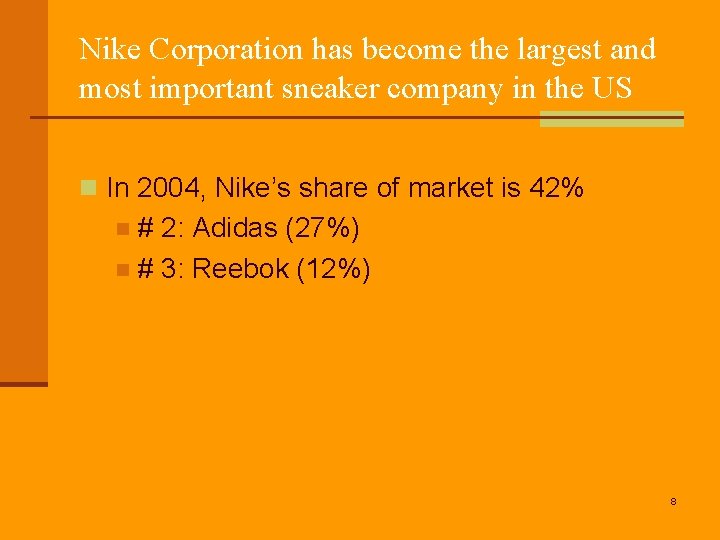
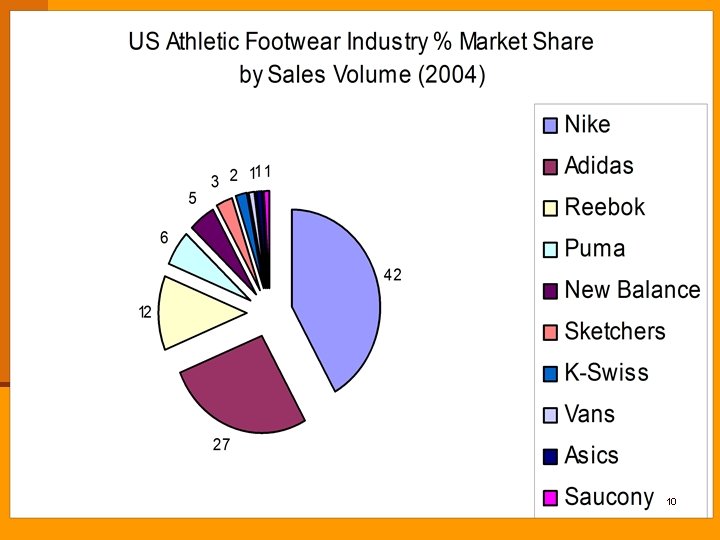
Nike Corporation has become the largest and most important sneaker company in the US n In 2004, Nike’s share of market is 42% # 2: Adidas (27%) n # 3: Reebok (12%) n 8
The key to Nike’s rise? n ability to capture a succession of nodes along GCC, increasing its expertise and control over critical areas: n design n distribution n marketing n advertising 9
10
The most fundamental industry innovation is the creation of a market n constructing a convincing world of symbols, ideas, and values harnessing the desires of individuals to the consumption of athletic shoes (165) 11
Pd. 1: Gaining control over import & distribution nodes of GCC (1962 -1975) n Nike sells tens of millions of sneakers in the US annually, yet all manufacturing operations are conducted overseas n Nike begins importing shoes from Japan n Nike concentrates its design, distribution, and marketing activities in the US 12
Nike is the archetype of a global sourcing strategy: subcontracting n Nike originated by importing shoes from Japan n It has subcontracted nearly all of its production overseas ever since n Nike’s VP for Asia-Pacific: “We don’t know the first thing about manufacturing. ” 13
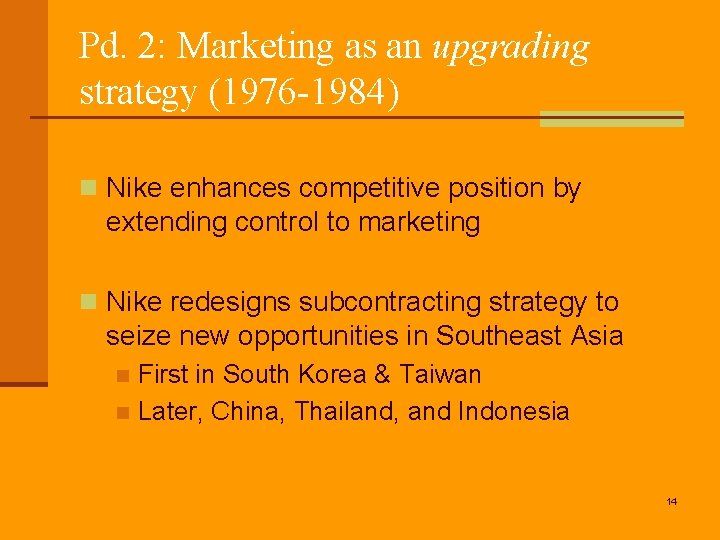
Pd. 2: Marketing as an upgrading strategy (1976 -1984) n Nike enhances competitive position by extending control to marketing n Nike redesigns subcontracting strategy to seize new opportunities in Southeast Asia First in South Korea & Taiwan n Later, China, Thailand, and Indonesia n 14
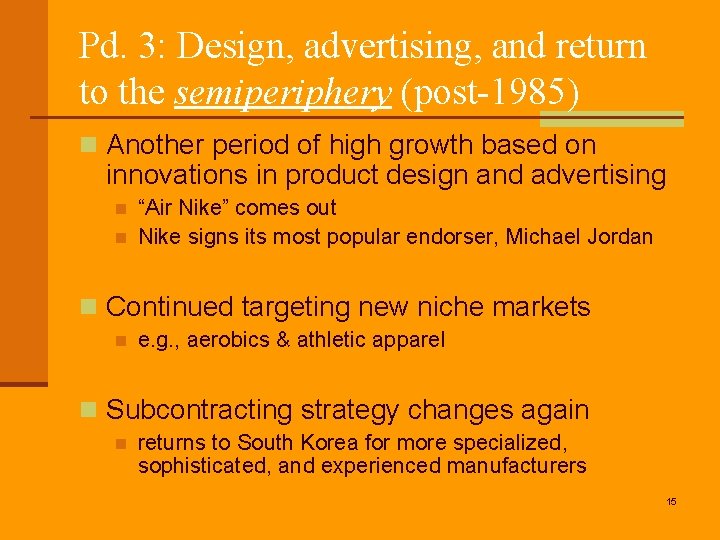
Pd. 3: Design, advertising, and return to the semiperiphery (post-1985) n Another period of high growth based on innovations in product design and advertising n n “Air Nike” comes out Nike signs its most popular endorser, Michael Jordan n Continued targeting new niche markets n e. g. , aerobics & athletic apparel n Subcontracting strategy changes again n returns to South Korea for more specialized, sophisticated, and experienced manufacturers 15
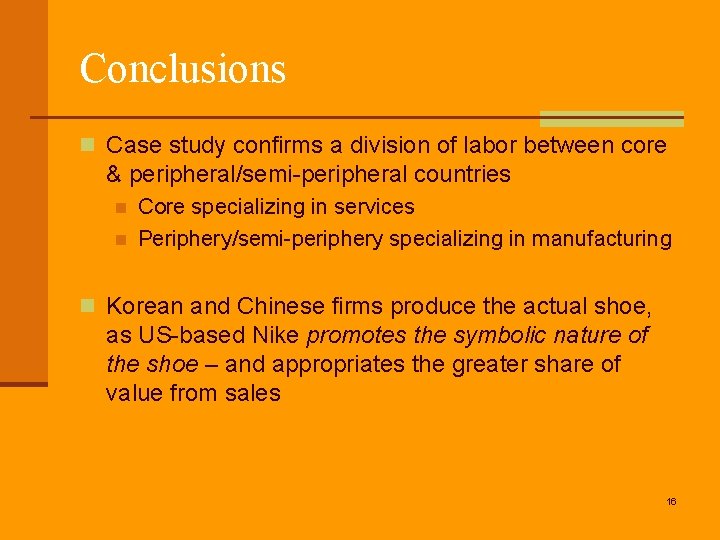
Conclusions n Case study confirms a division of labor between core & peripheral/semi-peripheral countries n n Core specializing in services Periphery/semi-periphery specializing in manufacturing n Korean and Chinese firms produce the actual shoe, as US-based Nike promotes the symbolic nature of the shoe – and appropriates the greater share of value from sales 16