
Committee on Earth Observation Satellites Extension of ARD
Committee on Earth Observation Satellites Extension of ARD concept to Atmosphere and Oceans? SIT-VC meeting Session 2: Item 1 Frascati, Italy Tuesday 12 September 2017
Objective and Background Objective of these charts: • To stimulate discussion of possibly generalizing CEOSs Analysis Ready Data efforts beyond Land, to Atmosphere and Oceans. Structure of this presentation: • Background on CARD 4 L • Some thoughts on the arguments for and against a CEOS effort to expand Analysis Ready Data work beyond CARD 4 L / LSI-VC CEOS LSI-VC-4, 6 -8 September 2017 2
Objective and Background: • FDA team have raised the possibility of expanding CEOS work on Analysis Ready Data for Land (CARD 4 L) to other domains, specifically, ocean and atmosphere. • LSI-VC are developing a framework for CEOS’ Analysis Ready Data for Land (CARD 4 L). • Analysis Ready Data are satellite data that have been processed to a minimum set of requirements and organised into a form that allows immediate analysis with a minimum of user effort and interoperability both through time and with other datasets. • CARD 4 L envisages land-based products that are measurements of geophysical variables, including (but not limited to) surface reflectance, land surface temperature, and radar backscatter intensity. This brings the land imaging domain to a measurement approach, akin to ocean variables such as SST. • CARD 4 L aims to provide a large number of non-specialist users with data that are ready for use, and which enable interoperability. • “Better than free” – CARD 4 L will be analysis ready and organised, and have the CEOS brand. CEOS LSI-VC-4, 6 -8 September 2017 3
Objective and Background CARD 4 L Progress and outlook: • Definition agreed at Plenary – 2016 • Framework set out – Early 2017 • Product Family Specifications – 2017 • Implement and promote the framework – 2017/2018 • Capture the benefit of CARD 4 L to users (under discussion) – 2018 CEOS LSI-VC-4, 6 -8 September 2017 4
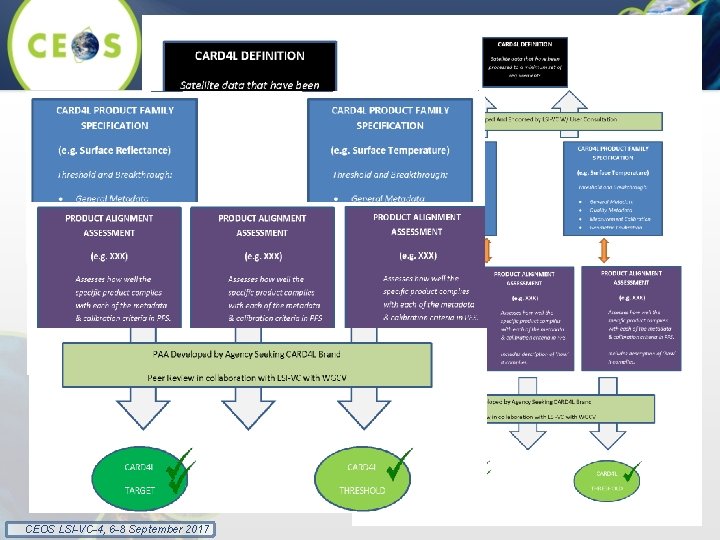
CARD 4 L Framework • Data that have been processed to a minimum set of requirements and organised into a form that allows immediate analysis with a minimum of user effort and interoperability both through time and with other datasets. • Product family specifications indicate threshold and target requirements CEOS LSI-VC-4, 6 -8 September 2017
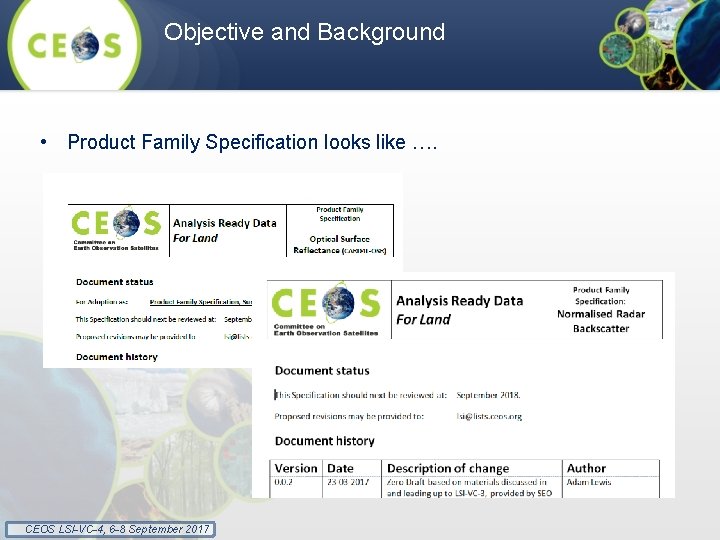
Objective and Background • Product Family Specification looks like …. CEOS LSI-VC-4, 6 -8 September 2017
A comprehensive strategy for Analysis Ready Data in CEOS – beyond CARD 4 L? ARD is a key element of future data architectures (FDA-AHT) o Analysis Ready Data: “Preparation and distribution of trusted, calibrated, well documented data from multiple sensors in an analysis ready form for land, inland water, coastal and ocean applications” Is there benefit in a comprehensive ARD strategy for CEOS as FDA suggest? • Do we want CARD 4 Ocean, CARD 4 Atmosphere? • Do we already have these elements? For example GHRSST. o Do these datasets meet the expectation of … immediate analysis … interoperability both through time and with other datasets. • Are there ‘gaps’ in ocean and atmosphere datasets that stop short of it being analysis ready? • Is there value in ‘joining forces’ across domains toward a consistent ‘analysis ready data’ message? These are open questions. Let’s not create more work for its own sake! CEOS LSI-VC-4, 6 -8 September 2017 7
Why do it? What are the arguments for extending ARD to other domains? Key arguments: o Much greater exploitation of EO data (also, exploitation of much more EO data), is essential to the success of EO programs. To deliver real benefits the data must be richly exploited in ways that cannot be foreseen. o Future data architectures are needed that make this greater exploitation possible. o Architectures must have direct access to data – at a machine-to-machine level. The data must be Analysis Ready o Analysis Ready Data are satellite data that have been processed to a minimum set of requirements and organised into a form that allows immediate analysis with a minimum of user effort and interoperability both through time and with other datasets. In addition, adding new ARD data types could o strengthen CEOSs ARD efforts as a whole, bringing greater effort and expertise to the work, o ensure that similar work in the ocean and atmosphere communities (if any) is aligned with the LSI-VC work, ensuring efficiency and effectiveness CEOS LSI-VC-4, 6 -8 September 2017 8
Why not do it? Some thoughts: There may not be a problem! • Ocean and atmosphere communities may already be producing products that are analysis ready, that is: o processed to a minimum set of requirements (geophysical variables with lineage and QA) and o organised … allows immediate analysis with a minimum of effort and o interoperability both through time and with other datasets. There may not be the same need as with land • The utilisation of these datasets may already be high o There may not be the same potential for increased use that there is with satellite data for land products • There may be few barriers to full exploitation of new data streams o Current systems may be able to cater for future data volumes and velocity Ability to complete the work • Significant effort would be required across CEOS o Widening the framework would require commitment from the ocean and atmosphere VCs o What is the optimal timing? Should we mature CARD 4 L more before looking at the wider situation? CEOS LSI-VC-4, 6 -8 September 2017 9
- Slides: 9